Somewhere in the settings of every major social platform is a link to a Terms of Service document that almost nobody reads. This is not an accident of UX design. The document is long, written in legal language, and structured so that the most consequential clauses appear deep inside sections with names like "Licenses" and "Intellectual Property." By the time most people encounter Instagram or Twitter or TikTok for the first time, they have already agreed to terms they have never seen.
The clause that matters most, the one that changes the nature of everything you post from that point forward, typically reads something like this: by posting content on the platform, you grant the company a non-exclusive, transferable, sublicensable, royalty-free, worldwide license to use, reproduce, modify, distribute, and display that content for any purpose.
That sentence, buried in paragraph fourteen of a document you scrolled past in 2012, is the actual ownership arrangement you entered into. Everything since has operated under its terms.
What "You Own Your Content" Actually Means
Platforms say this frequently. Meta says it. Twitter said it. YouTube says it. In a narrow legal sense, it is true: you retain the copyright to the photos you take and the words you write. The platform is not claiming to own your intellectual property in the way a record label might claim ownership of a song.
What the platform claims instead is something more practically significant: the right to use your content however it wants, in perpetuity, without paying you, without asking permission each time, and without telling you when or how it is being used. The copyright stays with you. The utility of that copyright, the ability to control how the content circulates and who profits from its circulation, transfers to the platform the moment you post.
This distinction matters because copyright without control is a largely symbolic right. A photographer who retains copyright to an image while granting Meta an irrevocable license to use it commercially has not protected their work in any meaningful way. They have kept the certificate of ownership while handing over the keys.
The Three Things You Cannot Do With Content You "Own"
- You cannot move it. Every major platform makes export technically possible and practically difficult. Facebook allows you to download your data, but what you receive is a zip file of JPEGs stripped of their original metadata, captions formatted in ways that do not transfer cleanly to other platforms, and a contact list that has no utility outside the platform's own ecosystem. The content is portable in the way that a photograph printed on paper is portable: you have the object, but the context that gave it meaning, the audience, the engagement, the discoverability, stays behind.
- You cannot take your audience with you. The followers you have accumulated on any centralized platform are not yours. They are the platform's users who have chosen to follow you within that platform's environment. If you move, they do not automatically come. You have to rebuild the relationship on new infrastructure, starting from zero, because the platform owns the connection between you and them, not you. This is the most significant practical constraint of platform-based audience building, and it is the one most creators do not fully confront until they are facing a ban or a platform collapse and realize the audience they built over years cannot be exported in any useful form.
- You cannot control how it is used after posting. The license you grant when you post is irrevocable for most platforms under their current terms. Content you delete from a platform is removed from public view, but it is not necessarily removed from the platform's servers or from the training datasets of AI systems that ingested it before deletion. Meta updated its Terms of Service in 2023 to clarify that user content could be used to train its AI models. Users who had been posting for a decade before that update had already provided years of training data under terms that did not explicitly contemplate this use. The retroactive application of new uses to old content is possible because the original license was broad enough to cover uses that did not yet exist.
What Happened When Platforms Decided to Train AI on Your Posts
The AI training question has moved from hypothetical to current in the past two years, and it has made the ownership gap more visible than the licensing language alone ever did.
When a platform trains a large language model or an image generation model on user content, it is extracting commercial value from that content at scale. The resulting model is a sellable product. The people whose posts, photos, captions, and interactions constitute the training data receive nothing from that transaction. The license they granted when they agreed to the Terms of Service was broad enough to cover this use, which is why the platforms do not need to ask permission or offer compensation.
Getty Images sued Stability AI for training on its licensed image library without authorization. The distinction between that case and what Meta or Twitter have done with user content is that Getty had explicit licensing agreements that prohibited this use, while social media users had agreed to terms that permitted it. The photographers on Instagram whose aesthetic choices trained a model that now competes with their work for clients have no equivalent legal standing, because they agreed to the license.
This is not a bug in the system. The license was designed to be broad enough to cover future uses the platform had not yet conceived.
What Real Ownership Looks Like
Real digital ownership has three components that platform-based publishing does not provide: control over the content itself, control over the identity attached to it, and control over the distribution relationship with an audience.
Email newsletters come closer than social platforms on the first and third points. The content lives on servers you choose, and the subscriber list is portable in a way that a social following is not. But the identity is still attached to an email address managed by a provider, and the content is still hostage to the platform's deliverability decisions and terms.
The architecture that comes closest to genuine ownership at the protocol level is Nostr. Your identity on Nostr is a cryptographic key pair you generate locally. Your content is signed with your private key before it reaches any relay. No company issued your identity, which means no company can revoke it. No single relay operator can erase your publishing history, because the content can exist across multiple relays simultaneously and is verifiably yours through the signature, not through any platform's database record.
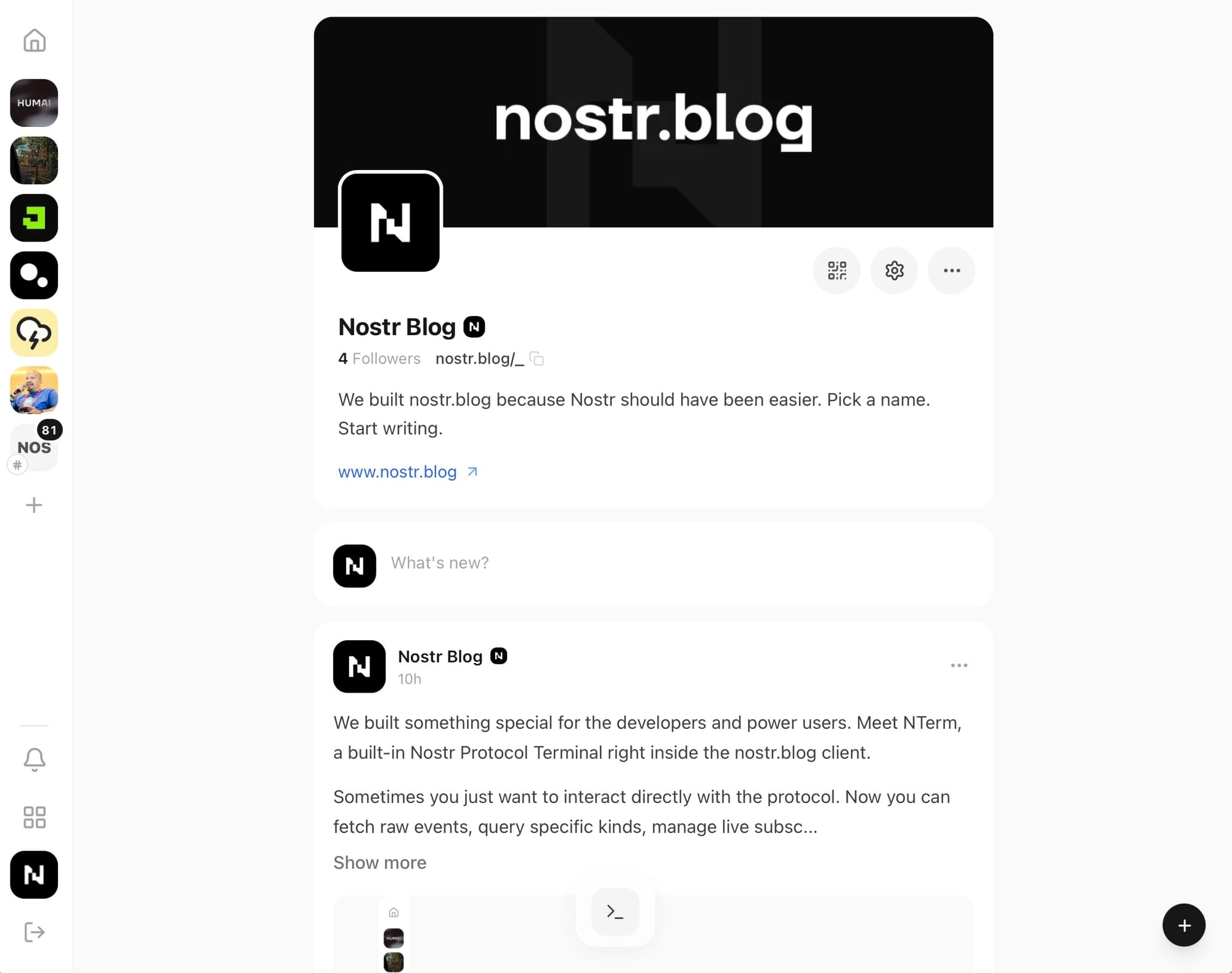
Nostr.blog is built on this foundation for writers specifically. When you publish there, the piece is signed with your key and distributed across relays rather than stored on a single company's server. The media library works like a local file system because the relationship to your content is structurally different from an upload to Instagram or Substack: you are not depositing content with a platform, you are publishing it to a protocol. The Lightning-based payment integration means readers can support specific pieces directly, without a platform taking a percentage or a subscription minimum obscuring the transaction. The ownership logic runs through the entire product rather than being a marketing claim layered on top of a conventional platform structure.
This does not mean Nostr has solved every problem. The audience is smaller. The tooling requires more setup than opening a social media account. But the ownership is not a Terms of Service promise that can be amended next year when the business model changes. It is structural.
The Practical Question
If you have been publishing on centralized platforms for any length of time, a significant body of your work is currently living under license terms you probably did not read carefully, on servers you do not control, attached to an identity that the platform can suspend or restrict. The question is not whether this is theoretically bad, it fairly clearly is, but what you want to do about it given that your audience is where it is and moving is costly.
The realistic answer for most people is not to delete everything and rebuild on a protocol. It is to start treating platform-based content as distribution with limited rights rather than as publishing with ownership. The content that matters most, the work you would want to control and monetize on your own terms over a ten-year horizon, probably should not live exclusively on a platform whose Terms of Service you cannot negotiate.
A newsletter you own the subscriber list for. Long-form writing on a protocol like Nostr where the content is cryptographically yours. These are not replacements for Instagram or Twitter as distribution channels. They are the part of the infrastructure that does not depend on someone else's license terms to remain yours.
The photo you posted in 2015 is gone in any meaningful ownership sense. The question is whether the work you are creating in 2026 will look the same in ten years.
FAQ
If I retain copyright, why doesn't that protect my content on social platforms? Copyright gives you the right to control reproduction and distribution of your work, but when you agree to a platform's Terms of Service, you license away those rights for the platform's purposes. Retaining copyright while granting an irrevocable, royalty-free license is roughly equivalent to owning a building while granting someone else permanent, free use of the entire interior.
Can platforms use my content to train AI without telling me? Under most current Terms of Service, yes. The license you grant when you post is typically broad enough to cover uses that did not exist when you agreed to it. Meta updated its terms in 2023 to make AI training use more explicit, but the underlying license structure had permitted it before the update.
What happens to my content if I delete my account? It is removed from public view, but what happens on the platform's servers varies by platform and is not always clearly disclosed. Content that was ingested into AI training datasets before deletion has already been used and cannot be retroactively removed from those datasets.
What is the difference between owning content on Nostr versus on Substack? Substack stores your content on its servers and manages your subscriber relationships. If Substack changes its terms or shuts down, your content and subscriber list are at risk of becoming inaccessible or unusable. On Nostr, your content is signed with a cryptographic key you hold and distributed across relays. The content is verifiably yours through the signature, not through any company's database. Nostr.blog builds a practical publishing environment on this foundation, but the ownership guarantee comes from the protocol rather than from the product's terms.
Is there any way to reclaim ownership of content already posted on social platforms? No practical mechanism exists. You can delete content from public view, but you cannot revoke the license you granted when you posted it, and you cannot remove content that was already copied, indexed, or used for AI training before deletion. The license granted in most platform Terms of Service is explicitly irrevocable.
Does any of this matter for someone who just uses social media casually? It matters less for casual use and more for anyone whose professional identity, business, or creative work is substantially invested in platform-based content. A decade of professional photography on Instagram, a journalism career built on Twitter, a brand built on Facebook, these represent significant work living under terms that give the creator less control than they likely assumed they had.
Related Articles
 Mark
Mark Mark
Mark