


There is a version of this conversation that ends in a Twitter thread about how Twitter is bad, posted by someone who has not logged off in three years. This is not that conversation. The critique of Meta, X, TikTok, and LinkedIn is not that the people running them are villains. The critique is structural: these platforms were built around incentives that are fundamentally misaligned with the people who use them, and that misalignment produces predictable, recurring failures that no amount of product iteration has fixed, because fixing them would require dismantling the business model.
The Algorithm Is Not a Feature, It Is the Product
When Meta talks about its recommendation algorithm, it describes a system designed to surface content you will find relevant and engaging. That framing is technically accurate and almost entirely misleading, in the same way that saying a casino is designed to give people entertainment is technically accurate.
The algorithm's actual optimization target is not your satisfaction but your time on platform, which is a proxy for ad impressions, which is the actual revenue line. These targets overlap sometimes and diverge often, and when they diverge, the algorithm sides with the platform. This is not a conspiracy so much as arithmetic: the system is optimized for what the business can sell, and attention is what the business sells.
Facebook's own internal research, made public during the 2021 congressional hearings, showed that the company understood this dynamic and chose not to act on it because the interventions that reduced toxicity also reduced engagement. The slide deck was titled "Civic Integrity" and it was shelved. X under its current ownership has been more candid about the tradeoffs, occasionally to the point of incoherence: the "For You" feed has been reorganized multiple times based on criteria that were never fully published, with changes communicated through Elon Musk's personal account rather than any product documentation. TikTok is the most honest of the group, in that it does not pretend to connect you with people you know. It is a pure session-length maximizer, and it is very good at that specific job.
Reach Is Rented, Not Owned

Every creator who has spent serious time building an audience on a centralized platform eventually confronts the same reality: the audience does not belong to them. It belongs to the platform, which agrees to show your content to some portion of your followers in exchange for your continued presence. Change the terms of that presence by posting less frequently or running into a content policy decision, and the reach drops, sometimes to near zero overnight. This is not a fringe edge case but the default condition of building on someone else's infrastructure.
Publishers and creators who spent years building Facebook followings discovered that organic reach on Facebook Pages collapsed from around 16 percent in 2012 to somewhere between 2 and 5 percent by the mid-2010s. The platform had allowed them to build real audiences and then adjusted the algorithm in ways that required paying to reach those same audiences through advertising. The audiences existed; the reach had always been rented.
Twitter's version of this was slower but comparable. For about a decade it functioned as the closest thing the internet had to a real-time public square for journalists and researchers, useful for breaking news and following primary sources. That utility attracted an influential audience whose presence made the platform more valuable to everyone else. Then the API pricing changed, the third-party clients were killed, and the verification system was restructured in ways that degraded the signal-to-noise ratio for sourcing. The journalists who had built their professional distribution on Twitter did not lose followers overnight, but the platform around those followers changed enough that rebuilding elsewhere started to feel like a reasonable calculation. A journalist with 200,000 Twitter followers in 2022 and 200,000 Twitter followers in 2025 has not held their position so much as watched the ground shift beneath it.
The Rules Change Without Notice, and You Have No Appeal
Account bans and content removals are where the structural problems become most visible, because the stakes are highest and the process is least transparent. Facebook processes somewhere in the range of 100 billion pieces of content daily across its platforms. Moderation at that scale is necessarily automated and built around pattern-matching rather than context. The error rate on any automated system running at that scale produces a very large absolute number of incorrect decisions, even if the percentage error rate is small.
For creators and journalists whose professional infrastructure runs through these platforms, a wrongful removal is a serious operational problem with limited recourse. Timelines are unpredictable, explanations for decisions are often minimal, and the asymmetry means the platform can take weeks to review an appeal while a creator's reach continues to suffer. There is no external body that adjudicates these disputes.
The data side of the relationship is equally one-sided. The relevant clause in Meta's current Terms grants the company "a non-exclusive, transferable, sub-licensable, royalty-free, and worldwide license" to use content users post for any purpose, including commercial AI training. Accepting these terms is the condition of using the service, and the terms are not negotiable. This is the network effect as a coercive mechanism: the platform's value comes from its users, and the platform uses that value to make the terms of participation difficult to refuse.
What a Different Architecture Looks Like
The honest alternative to a better centralized platform is a different architecture, and the most serious attempt at that currently is Nostr: an open protocol where your identity is a cryptographic key pair you generate and hold, your content is signed with that key, and no company can change the terms under which you publish because there is no company.
Moderation on Nostr is distributed across relay operators rather than concentrated in one entity, which means no single actor can silence someone across the network, though it also means bad content on one relay does not automatically disappear from all of them. Developers can build on the protocol without negotiating API access with a commercial entity that may reprice or revoke it at any time.
The practical tooling matters here. For writers specifically, nostr.blog has built a long-form publishing environment on top of the protocol that handles the parts of the workflow most people do not want to manage manually: a media library that organizes your content like a local file system rather than a platform upload queue, direct protocol access for users who want it, and Lightning-based payments that let readers support individual pieces directly without a platform taking a cut. The audience on Nostr is smaller than any major platform today, which is the real cost of the architectural advantages the protocol offers. Whether that cost is acceptable depends on how much counterparty risk you are currently carrying on the platforms you depend on.
The Practical Conclusion
The structural problems with Meta, Twitter, and the rest are not secrets. They have been documented in congressional testimony, in leaked internal research, in academic studies. The platforms themselves have acknowledged versions of these problems in earnings calls and policy announcements. Nothing has changed at the fundamental level because nothing at the fundamental level is in the interest of the people who control these companies to change.
For most creators, journalists, and developers, the answer is not to leave tomorrow but to stop treating these platforms as infrastructure and start treating them as distribution channels with significant counterparty risk. Infrastructure is something you build on. Counterparty risk is something you hedge against. The hedge is building at least one channel you own outright, an email list, a presence on a protocol like Nostr, so that the next algorithm change or API repricing lands on a position that has some structural stability beneath it.
FAQ
Why do social media algorithms favor outrage over accuracy? Because engagement is the measurable proxy for ad inventory, and content that provokes strong emotional responses drives more engagement than content that is merely accurate or useful. This is a structural outcome of the advertising model, not an editorial decision made by individuals.
Can a platform ban your account without explanation? Yes, and at scale it happens regularly. Moderation is largely automated, automated systems make contextual errors, the appeals process is opaque, and there is no external body that adjudicates disputes. The power asymmetry heavily favors the platform throughout.
Who actually owns content posted on Meta or X? You retain copyright in the technical legal sense while granting the platform a broad, royalty-free license to use that content for any purpose, including commercial AI training and redistribution. The license is not negotiable and accepting it is the condition of using the service.
Why did so many developers stop building on Twitter's API? The 2023 pricing changes eliminated the free tier and set paid tier prices at levels that made most third-party development economically unviable. The academic research API was discontinued with minimal notice. Platforms encourage third-party development when it serves their growth interests and curtail it when the calculus changes.
How does Nostr address these problems, and what is nostr.blog? Nostr is an open protocol where identity is cryptographic rather than platform-controlled, meaning no company can revoke your account or change your publishing terms. Nostr.blog is a long-form publishing tool built on this protocol, with a media library, direct protocol access, and Lightning payments from readers to writers without a platform intermediary. The audience is smaller than any major platform today, which is the real trade-off against the structural ownership advantages.
Is leaving these platforms realistic for working journalists and creators? Not immediately for most. The practical move is reducing dependence over time by building owned channels alongside existing platform distribution, so that the next algorithmic or policy change does not land on a position with nothing underneath it.
Related Articles
 Mark
Mark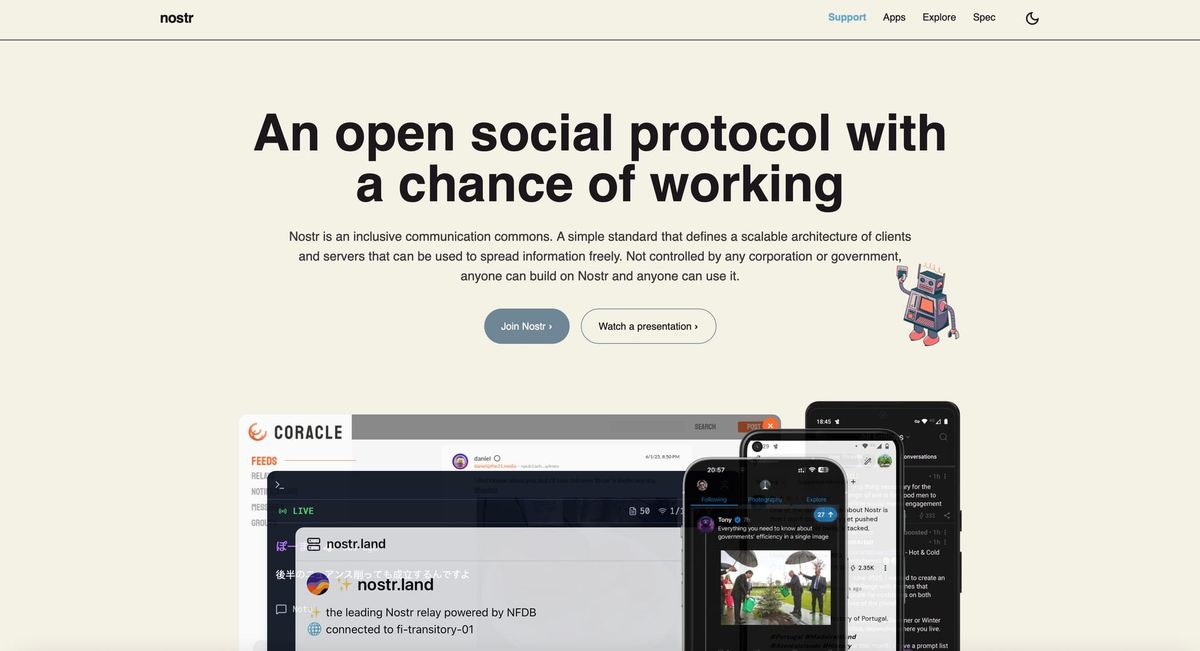 Dani
Dani


