Here's a number that should concern you: only 2-7 sources get cited in the average AI-generated answer. Not ten blue links. Not the entire first page of Google. Just a handful of websites that the AI deems worthy of mention. If your site isn't among them, you effectively don't exist to the 800 million people using ChatGPT every week.
Traditional SEO got you ranked on a results page. This new discipline—increasingly called Generative Engine Optimization, or GEO – gets you cited in AI-generated answers. The difference matters more than most marketers realize.
This guide breaks down everything we know about earning AI citations: the content structures that get extracted, the authority signals that matter, the technical requirements you can't skip, and the measurement strategies that actually work. Whether you're optimizing for ChatGPT, Perplexity, Google AI Overviews, or all three, the principles remain surprisingly consistent.
The New Rules of Search Visibility
To optimize for AI search, you first need to understand how fundamentally different it is from traditional search.

When someone searches Google the old way, they get a list of links. They click, they browse, they decide. The website's job is to rank high enough to get that click. With AI search, the model reads multiple sources, synthesizes information, and delivers a conversational answer, often with just a few citations attached. The user might never visit any website at all.
This creates what researchers call the "citation economy." Instead of competing for clicks, you're competing to be one of the few sources the AI chooses to quote. Instead of ranking positions, you're tracking mention rates. Instead of click-through rates, you're measuring reference rates.
But here's what makes this interesting: the sources AI cites don't always match Google's top results. Research shows only 12% of ChatGPT citations come from URLs ranking on Google's first page. Some studies found that 9.5% of AI Overview citations come from pages ranking 11-100 in traditional search, and 14.4% from pages ranking outside the top 100 entirely.
This means smaller publishers have genuine opportunities. If your content is structured correctly and demonstrates real expertise, you can earn AI citations without dominating traditional rankings. The playing field has tilted—not entirely level, but more accessible than Google's increasingly winner-take-all organic results.
What AI Engines Actually Want
Princeton researchers who coined the term "Generative Engine Optimization" tested various optimization strategies and measured their impact on AI visibility. Their findings were illuminating.
Adding relevant statistics to content increased visibility by over 40%. Including credible quotes from experts produced similar gains. Citing authoritative sources improved performance by 30-40%. Even simple readability improvements, better fluency, clearer language boosted visibility by 15-30%. Traditional SEO tactics like keyword stuffing? They actually decreased visibility. The AI could tell when content prioritized search engines over readers.
The pattern is clear: AI engines want content that's genuinely useful to humans. They want concrete data, expert perspectives, clear explanations, and proper sourcing. They want the kind of content that a knowledgeable person would actually want to read.
This aligns with what we see in citation data. An audit of 15 domains generating 7,500 direct referral sessions from ChatGPT found that 72.4% of cited blog posts included what the researchers called an "answer capsule" – a clear, self-contained block that directly addresses the query. Over half featured either original data or branded insights that couldn't be found elsewhere.
The strongest configuration? Content combining both an answer capsule and proprietary data. Pages with this structure earned citations at dramatically higher rates than those without.
The Domains ChatGPT Cites Most
Understanding which sites currently dominate AI citations helps clarify what characteristics AI engines value. Analysis of millions of ChatGPT citations reveals a consistent hierarchy.
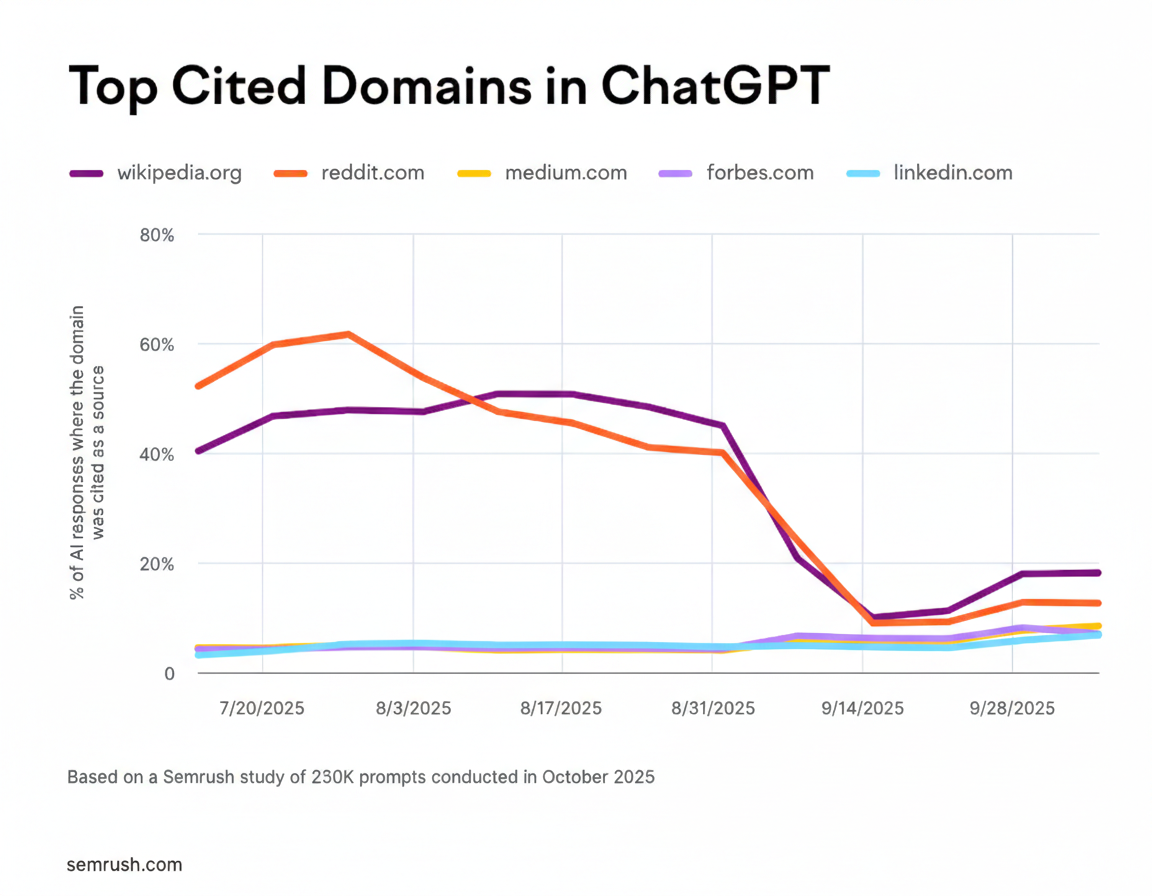
Wikipedia leads dramatically, appearing in roughly 16% of conversations that include citations. It's the AI's default knowledge layer, the first place it goes for baseline facts.
After Wikipedia, the picture varies by query type. For general information, authoritative publishers like Forbes, Business Insider, and major news outlets perform well. For technical queries, specialized sites like TechRadar, CNET, PCMag, and Tom's Guide dominate. For commercial queries, Amazon, Reddit, and product-specific sites take over.
Reddit deserves special mention. It ranks among the top five cited domains across platforms, appearing particularly strongly in Google AI Overviews (where it leads at 20% of citations) and in commercial/advice queries on ChatGPT. The AI engines apparently value authentic human perspectives—real people sharing real experiences—over polished marketing content.
The pattern suggests a few strategic implications:
- You're not going to out-Wikipedia Wikipedia for basic definitional content. Your job is to be the next source after it, providing the depth, recency, or specificity that Wikipedia can't.
- Community platforms where real humans share genuine experiences carry significant weight. Getting mentioned authentically on Reddit, Quora, or industry forums may matter more than another blog post.
- Domain-specific authority matters. TechRadar dominates tech citations not because of SEO tricks but because it's a trusted tech publication that's been covering the beat for years.
Content Structure That Gets Extracted
AI engines don't read content the way humans do. They extract. They scan for specific patterns that signal "this answers the question" and pull those chunks into their responses.
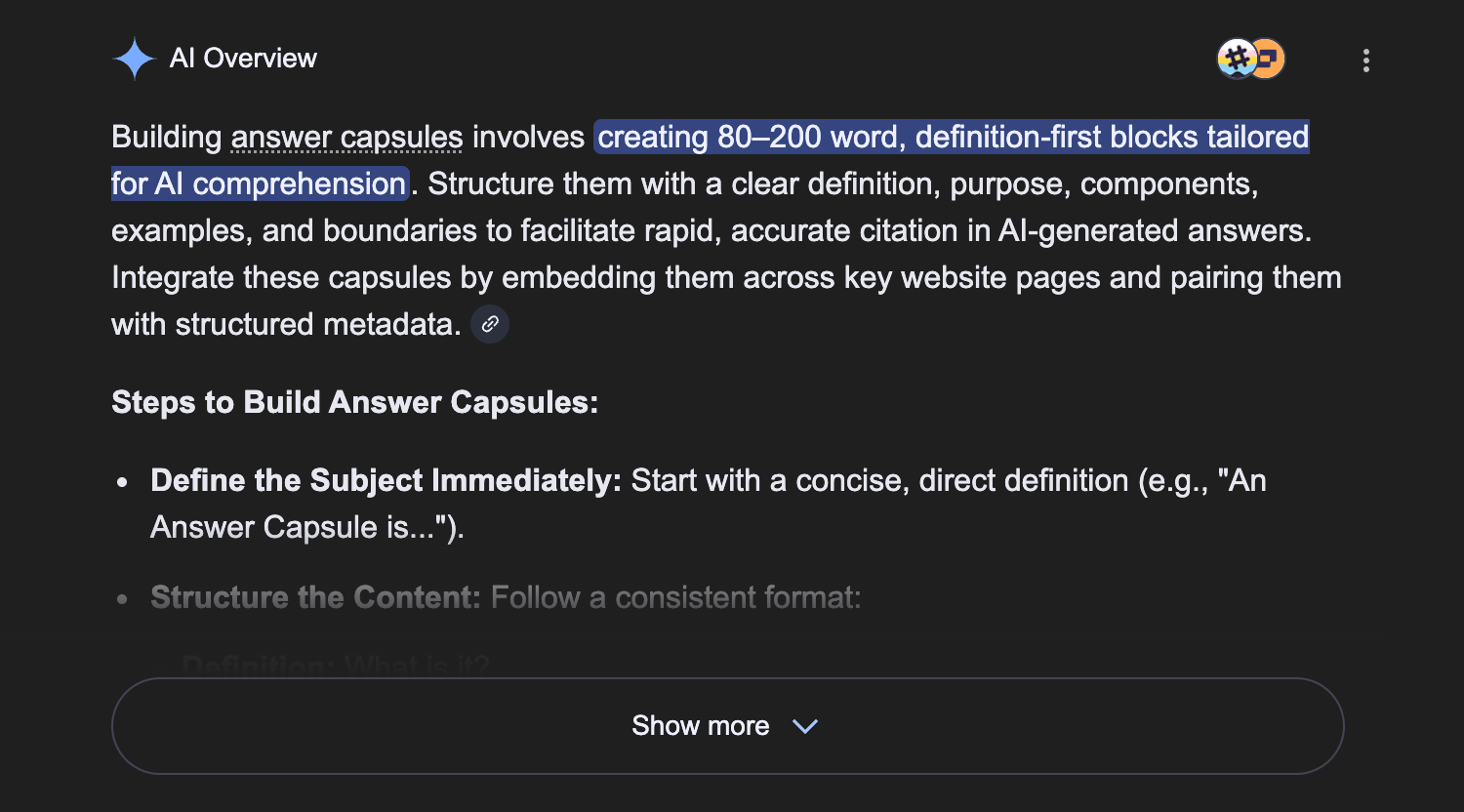
The most important structural element is what practitioners call the "answer capsule" – a concise, self-contained paragraph that directly answers the implied question of each section. This capsule should appear immediately after each header, before any supporting detail or context.
Think of it like the inverted pyramid from journalism: lead with the conclusion, then provide evidence. Don't build to your main point through three paragraphs of context. State the answer first, then explain why.
Beyond answer capsules, structural clarity matters enormously.
- Pages using clear H2/H3 hierarchies with short paragraphs are 40% more likely to be cited.
- Q&A formats perform especially well because they mirror how users actually ask questions.
- Short paragraphs (2-3 lines) reduce cognitive load for both humans and machines.
- Content length correlates with citations too, but not in a simple "longer is better" way.
- Pages under 800 words average 3.2 citations; those over 2,900 words average 5.1. But section structure matters more than raw length. Pages with section lengths of 120-180 words between headings perform best. Extremely short sections under 50 words actually hurt performance—they signal shallowness rather than depth.
The takeaway: comprehensive content broken into digestible, well-structured sections, with each section opening with a direct answer to its implied question. Depth without density.
Original Research and Proprietary Data
If there's one content strategy that consistently outperforms others for AI visibility, it's publishing original research and proprietary data.
The reason is straightforward: AI engines need to cite something. When you publish original research – a survey, an analysis, an experiment, you become the authoritative source. No one else has your data. If the AI wants to reference those findings, it has to cite you.
"Owned insights" – your organization's specific interpretation or framework around a topic also perform well. When you say "Based on our analysis of 1,200 customer interactions..." or "Our framework identifies three key factors..." you're creating citable content that positions you as an authority.
The key is framing. Don't just share generic advice that anyone could write. Frame your insights as distinctly yours. Give them names, attach data points and make them quotable.
For example, instead of: "It's important to respond quickly to customer complaints."
The second version is citable. It has a stat and name. It positions your organization as having done the work to understand this issue. An AI looking to answer "How quickly should I respond to complaints?" has something concrete to reference.
Authority Signals That Matter
AI engines can't manually verify every claim, so they rely on proxy signals for trustworthiness. Understanding these signals helps you demonstrate authority in ways the AI can recognize.
However, backlink quality matters more than quantity. A single mention from a topically relevant, high-authority site provides more value than dozens of generic links. The goal isn't volume—it's topical relevance and perceived authority within your domain.
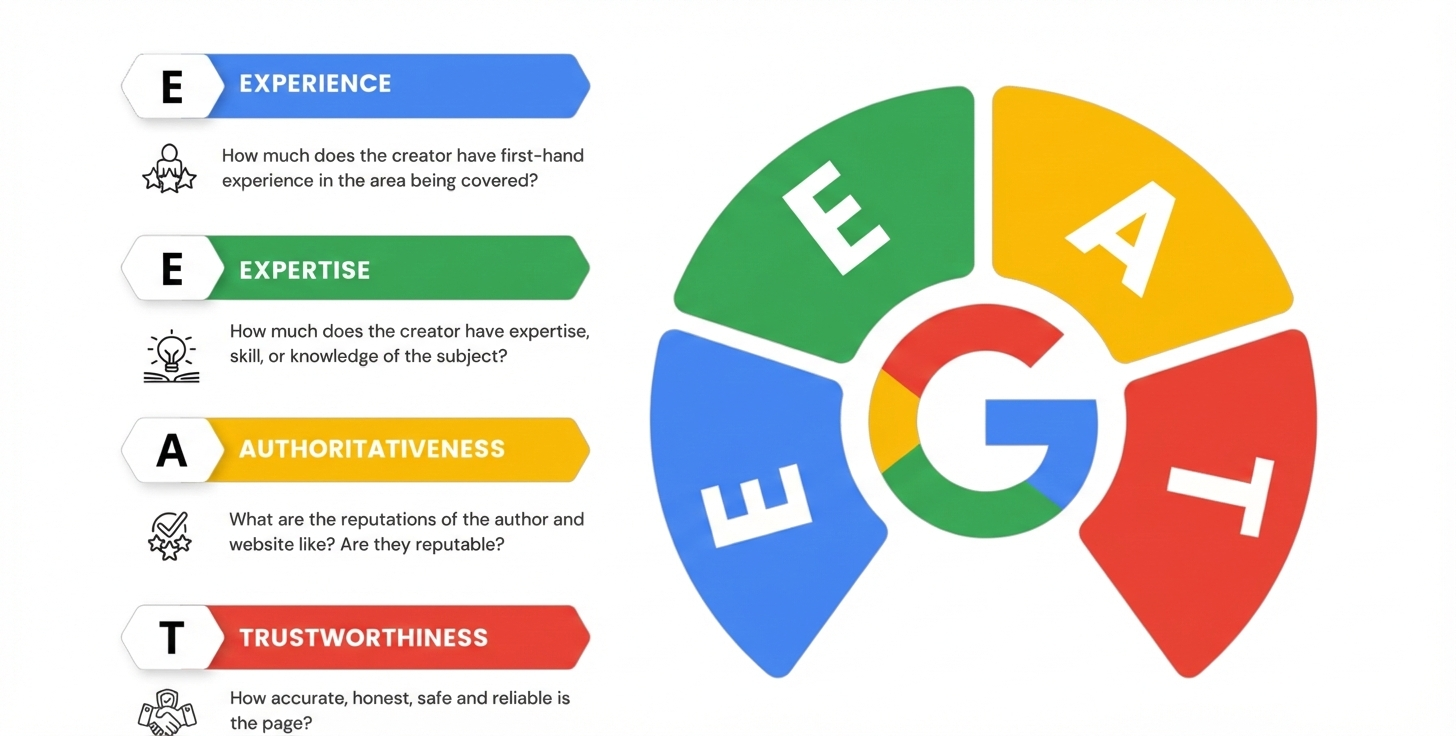
E-E-A-T signals Experience, Expertise, Authoritativeness, Trustworthiness – translate directly to AI visibility. Pages with expert quotes average 4.1 citations versus 2.4 for those without. Author bylines, credentials, and detailed "About" pages all contribute to the trust picture.
Brand mentions across the web create what researchers call "earned media authority." AI engines show systematic bias toward third-party, authoritative sources over brand-owned content. Getting mentioned in industry publications, professional forums, and community discussions builds the kind of distributed authority that AI engines trust.
Interestingly, .gov and .edu domains don't automatically outperform commercial sites. Research found government and educational domains averaged 3.2 citations compared to 4.0 for commercial sites.
Technical Requirements You Can't Ignore
Getting cited requires getting crawled. AI bots need to access your content before they can reference it.
- The technical foundation starts with your robots.txt file. Ensure you're not blocking GPTBot (OpenAI's crawler), ClaudeBot (Anthropic's crawler), or PerplexityBot. Many sites unknowingly block these bots while allowing Google's crawler, making themselves invisible to AI search while remaining visible in traditional results.
- Some organizations are now implementing llms.txt files – a proposed standard for providing AI-specific guidance about your content, similar to robots.txt but for language models. While adoption is still early, preparing for this standard positions you ahead of competitors.
- Schema markup tells AI engines exactly what your content means. Sites with proper schema show 30-40% higher visibility in AI-generated answers. Implement FAQ schema for question-answer content, Article schema for blog posts and news, Product schema for e-commerce pages, and Organization schema for company information.
- Page speed affects AI crawling just as it affects traditional crawling. Slow sites get crawled less frequently, which means newer content takes longer to enter the AI's knowledge base. Mobile optimization matters since 81% of AI Overview queries come from mobile devices.
One counterintuitive finding: pages with extremely fast interaction speeds (under 0.4 seconds) actually received fewer citations than those with moderate speeds. Researchers suggested that extremely simple or static pages may not signal the depth AI engines look for. The sweet spot appears to be fast but not bare-bones—pages that load quickly while still demonstrating substantive content.
Platform-Specific Strategies
While the fundamentals apply across AI platforms, each has distinct characteristics worth understanding.
ChatGPT
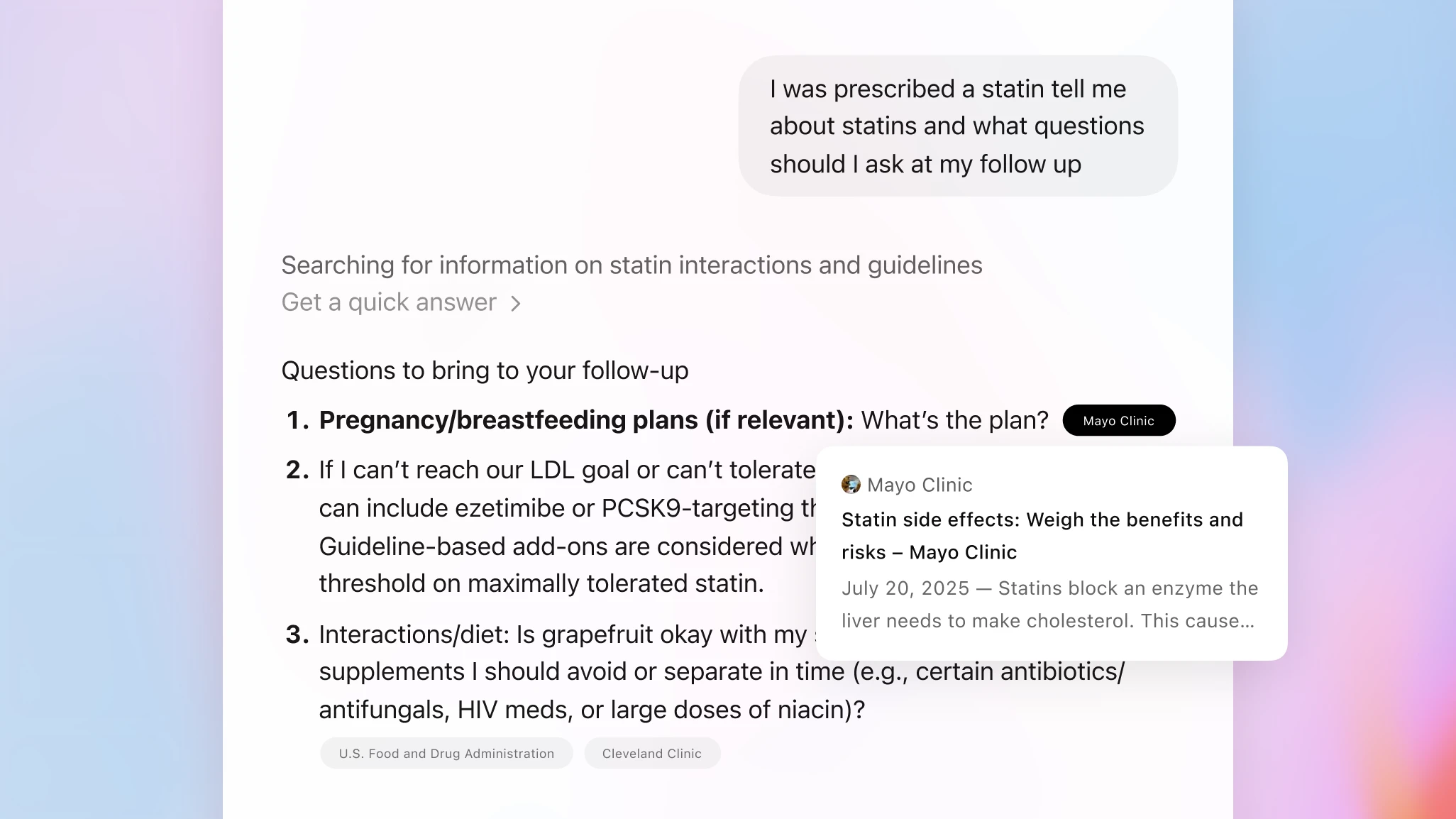
ChatGPT cites fewer sources per response than Perplexity but reaches far more users. Its citation patterns favor authoritative publishers, Wikipedia, and well-structured product pages. When ChatGPT does cite, those citations carry significant weight because they're the only sources the user sees. For ChatGPT optimization, focus on answer capsules, proprietary data, and domain authority.
Perplexity
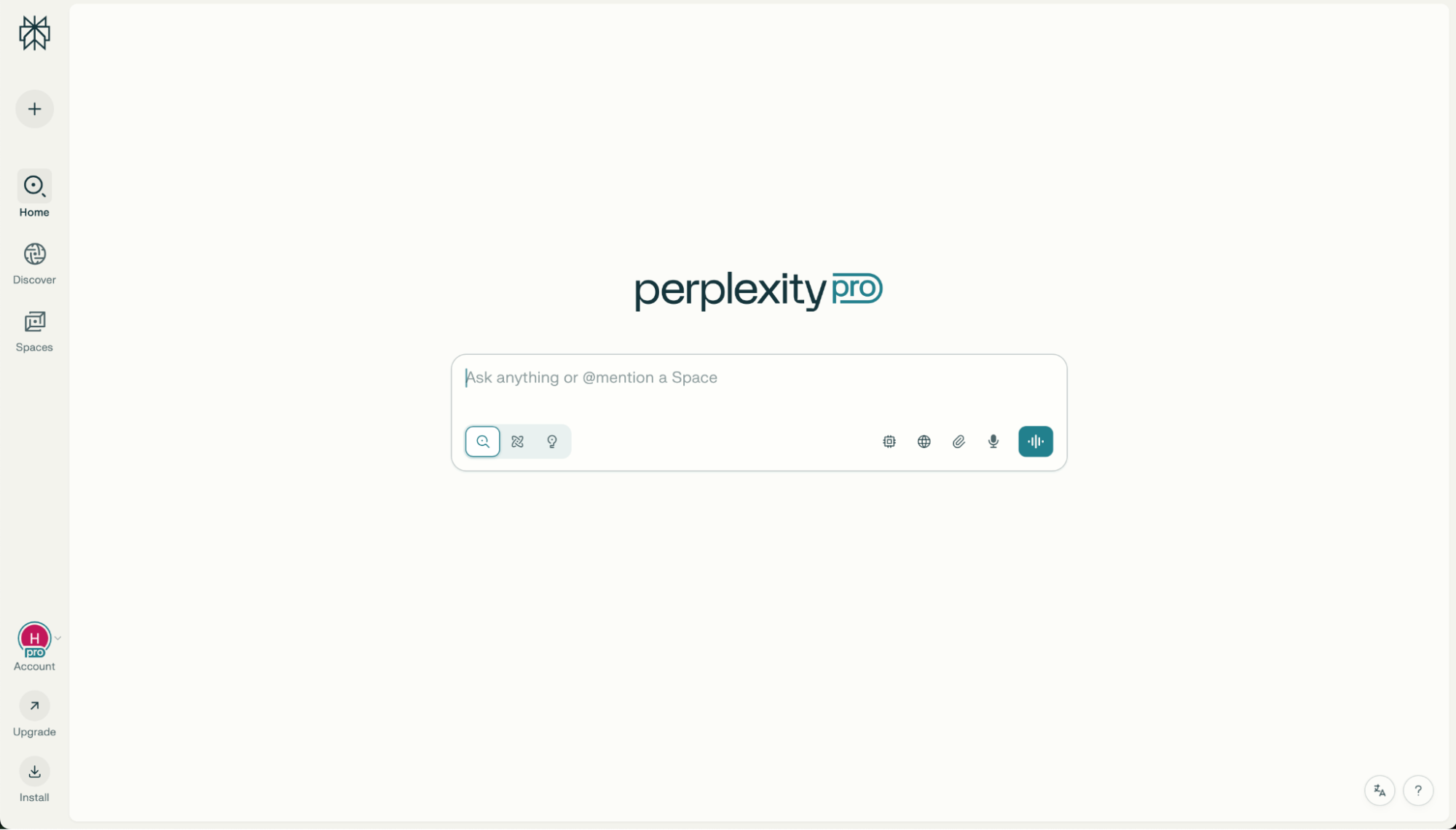
Perplexity cites more sources per answer, creating more opportunities for inclusion. It shows particular affinity for Reddit content and YouTube videos. The platform functions more like a research assistant, presenting multiple perspectives rather than single authoritative answers. For Perplexity optimization, ensure your content appears where discussions happen—community forums, video platforms, industry publications.
Google AI Overviews integrate directly with traditional search, meaning your SEO fundamentals still matter significantly.
Each platform's bot crawls at different frequencies and prioritizes different signals. Tracking your visibility across all three—rather than optimizing for just one—provides the most complete picture of your AI search presence.
Measuring What Matters
You can't manage what you can't measure. Unfortunately, AI visibility is harder to track than traditional SEO.

There's no "ChatGPT Search Console" giving you impression and click data. You can't see exactly when you were cited or how users reached you. The measurement infrastructure is still catching up to the new reality.
- Start with what you can track directly. Set up Google Analytics 4 segments for AI/LLM traffic by creating custom channel groupings for referrals from chatgpt.com, perplexity.ai, and similar domains. This shows you when AI platforms send traffic to your site though remember that many citations result in zero clicks.
- Track branded search volume as a proxy for AI exposure. When ChatGPT mentions your brand, some users will search for you directly. Spikes in branded searches following AI citation activity indicate real awareness impact even when direct clicks are minimal.
- Conduct regular manual audits by querying ChatGPT and Perplexity with questions your customers would ask. Document whether your brand appears, which URL gets cited, and which competitors show up alongside you. This manual monitoring, done weekly or monthly, provides ground truth that automated tools can't fully capture.
Tools like Ahrefs' Brand Radar, Semrush's AI Visibility Toolkit, and specialized platforms like Profound and Promptwatch are emerging to track AI citations at scale. These tools monitor mentions across platforms and provide trend data, though the space is evolving rapidly.
The metric to watch is "Share of Model"— your percentage of mentions within AI responses for your target queries. Think of it as market share for AI visibility. If ten queries about your category happen, and your brand appears in three AI responses, you have 30% Share of Model.
Common Mistakes to Avoid
- Treating AI optimization as separate from SEO creates unnecessary complexity. The foundations overlap heavily: quality content, clear structure, technical accessibility, and demonstrated authority. Do these well and you'll perform better across both traditional and AI search. The 50/50 resource split between SEO and GEO that some experts recommend makes sense because the work compounds.
- Optimizing for one platform while ignoring others leaves opportunity on the table. ChatGPT, Perplexity, and Google AI Overviews each reach different users with different intents. Platform-specific strategies have their place, but the fundamentals serve all three.
- Expecting immediate results leads to discouragement. Building citation authority takes 3-6 months of consistent effort. AI engines don't update their understanding of your authority overnight. Patience and consistency matter more than any single tactical trick.
- Burying answers in long introductions kills your chances. AI engines extract the first direct answer they find. If your content requires reading three paragraphs of context before reaching the point, the AI will move on to a source that gets there faster.
- Focusing on content volume over quality backfires. AI engines can assess content quality—they're not fooled by keyword-stuffed fluff. Publishing fewer, more authoritative pieces outperforms churning out thin content that no one would genuinely want to cite.
- Ignoring your "citation neighbors" means missing competitive context. AI platforms cite sources side-by-side, comparing you directly with competitors. Understanding what your competitors say—and how they say it—helps you differentiate and capture share of the conversation.
The Road Ahead
AI search is not a passing trend. It's the natural evolution of how people find information. ChatGPT doubled its user base from 400 million to 800 million weekly users in eight months. AI adoption rates jumped from 14% to 29.2% in six months. The shift is accelerating, not slowing.
Yet 47% of brands still have no deliberate GEO strategy. This creates genuine opportunity for early movers. The marketers who master AI visibility won't necessarily be those with the biggest budgets – they'll be the ones who moved early, tested consistently, and understood that AI search needs content structured differently.
The good news: you don't need to rebuild everything from scratch. Strong SEO fundamentals give you a head start. Content restructuring costs nothing but time. Schema markup uses free tools. The barrier to entry is knowledge and effort, not budget.
Start small:
- Test five queries your customers would ask in ChatGPT. Document whether your brand appears
- Add FAQ schema to your highest-traffic pages.
- Restructure one blog post with answer capsules, clear headers, and cited statistics.
Measure the results. Iterate.
The future of search is being written right now. The question isn't whether to adapt—it's whether you'll be among the handful of sources that AI engines choose to cite, or among the invisible majority they pass over.
FAQ
What is AI search optimization?
AI search optimization, also called Generative Engine Optimization (GEO), is the practice of structuring content to be cited in AI-generated answers from tools like ChatGPT, Perplexity, and Google AI Overviews. Unlike traditional SEO, which focuses on ranking in search results, GEO focuses on being selected as a source when AI synthesizes information to answer user questions.
How do I get my website cited by ChatGPT?
Focus on three elements: structure your content with clear answer capsules that directly address questions at the start of each section, include original data or proprietary insights that can't be found elsewhere, and build authority through quality backlinks and mentions across the web. Ensure your site allows GPTBot to crawl it and implement relevant schema markup.
Does traditional SEO still matter for AI visibility?
Yes, significantly. Research shows 76.1% of Google AI Overview citations also rank in Google's top 10. Strong SEO fundamentals – quality content, technical accessibility, and demonstrated authority benefit both traditional search and AI visibility. The recommendation is roughly 50% effort on traditional SEO and 50% on AI-specific optimization.
Which websites does ChatGPT cite most?
Wikipedia leads with approximately 16% of citations, serving as the default knowledge layer. After Wikipedia, authoritative publishers like Forbes, Business Insider, TechRadar, and CNET rank highly. Reddit appears prominently for advice and commercial queries. For any specific topic, domain-relevant authoritative sites tend to dominate.
What content formats perform best for AI citations?
FAQ formats perform particularly well because they mirror how users ask questions. Content with clear H2/H3 structures and short paragraphs is 40% more likely to be cited. Pages with answer capsules – concise summaries at the start of each section dramatically outperform content that builds slowly to its main points.
How important is original research for AI visibility?
Extremely important. Pages including original data tables earn 4.1x more AI citations. Adding specific statistics boosts visibility by over 5.5%. Content with first-party research gets cited 3x more often than aggregated content because it provides unique value that can only be found at the source.
Does ChatGPT prefer fresh or evergreen content?
ChatGPT shows a recency bias research indicates AI platforms prefer content that's 25.7% fresher than content cited in traditional search. However, freshness means meaningful updates with new data or changed recommendations, not cosmetic timestamp changes. Regular, substantive updates perform better than either stale content or artificial refresh tactics.
How do I track AI search visibility?
Set up GA4 segments for traffic from chatgpt.com, perplexity.ai, and similar domains. Monitor branded search volume as a proxy for AI exposure. Conduct regular manual audits by asking AI platforms questions your customers would ask. Tools like Ahrefs Brand Radar and Semrush's AI Visibility Toolkit provide automated citation tracking.
What technical requirements matter for AI search?
Ensure your robots.txt doesn't block GPTBot, ClaudeBot, or PerplexityBot. Implement schema markup (FAQ, Article, Organization, Product) to help AI understand your content. Maintain fast page speeds and mobile optimization. Create XML sitemaps and ensure your site architecture allows efficient crawling.
How long does it take to see results from AI optimization?
Building citation authority typically takes 3-6 months of consistent effort. AI engines don't update their understanding of your domain authority overnight. Expect gradual improvements rather than immediate results, and track progress through Share of Model metrics rather than expecting dramatic overnight changes.
What's the difference between ChatGPT, Perplexity, and Google AI Overviews?
ChatGPT cites fewer sources per response (typically 2-5) but reaches 800 million weekly users. Perplexity cites more sources, making it easier to appear but with less prominence per mention. Google AI Overviews integrate with traditional search, so SEO fundamentals matter more. Each platform also shows different source preferences – Reddit dominates AI Overviews, while Wikipedia leads ChatGPT.
Do I need to block AI from using my content?
That's a strategic choice. Blocking AI crawlers keeps your content out of AI training data and responses, but also makes you invisible to AI-driven discovery. Most businesses benefit from AI visibility. However, some publishers concerned about content licensing or traffic loss choose to block. Consider your business model and how AI visibility affects your goals.
How does E-E-A-T apply to AI search?
E-E-A-T (Experience, Expertise, Authoritativeness, Trustworthiness) directly influences AI citations. Pages with expert quotes average 4.1 citations versus 2.4 without. Author bylines with credentials, detailed About pages, citations to authoritative sources, and third-party mentions all contribute to the trust signals AI engines evaluate when selecting sources.
Can small businesses compete with big brands in AI search?
Yes. Research shows only 12% of ChatGPT citations match URLs in Google's top 10 results. AI engines evaluate content quality and relevance, not just domain authority. Small publishers with genuinely authoritative, well-structured content in their niche can earn citations that larger, less-focused competitors miss. The key is demonstrating deep expertise in your specific domain.
What mistakes hurt AI visibility most?
Burying answers in long introductions, using keyword-stuffed content, ignoring technical requirements like schema markup, publishing thin content at high volume, and blocking AI crawlers unintentionally. Also problematic: treating AI optimization as completely separate from SEO rather than building on shared fundamentals.
Related Articles
 Dani
Dani
 Dani
Dani
 Dani
Dani