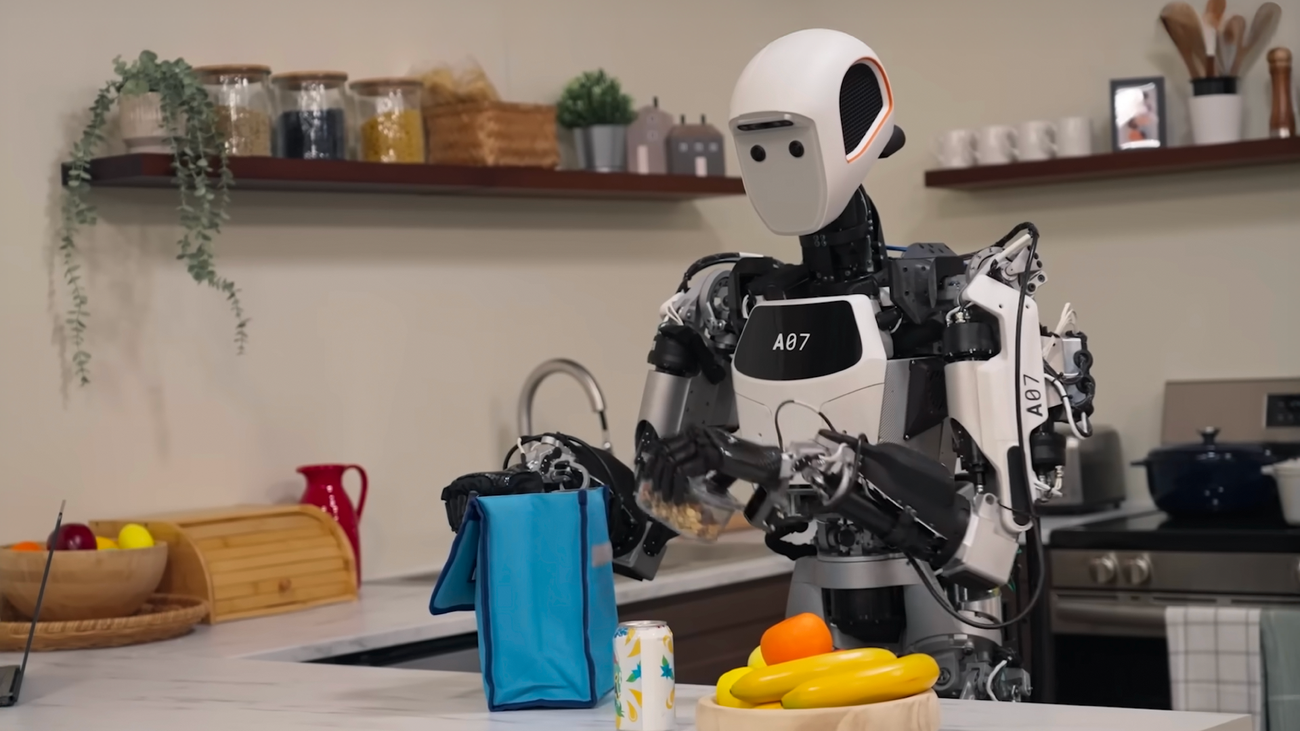
The humanoid robot race in 2026 has a competitive dynamic that keeps getting more interesting. One robot you can buy today. One that may eventually be the most capable machine ever built when it finally ships to external buyers.
The Unitree G1 is available, agile, affordable, and already deployed in universities and research labs worldwide. Tesla Optimus is larger, more capable in specific ways, backed by the world's most ambitious AI infrastructure, and currently not available for purchase.
Which one wins depends entirely on what you need from a humanoid robot in 2026.
The Fundamental Difference: Two Competing Definitions of Progress
Before getting into specs, it helps to understand what each company is actually trying to build and why those goals produce such different robots.
Unitree, a Hangzhou-based robotics company founded in 2016, built its reputation on aggressive pricing and rapid hardware iteration. Its quadruped robots like Go1 and Go2 pioneered affordable legged robotics in the research market. The G1 applies the same strategy to humanoids: a capable, developer-accessible platform at a price point that makes it genuinely purchasable for universities, startups, and serious researchers.
Unitree shipped more than 5,500 G1 units in 2025 and is targeting 10,000 to 20,000 in 2026.
Tesla's goal is something different. Optimus is designed to do useful work in Tesla's own factories at industrial scale before any external deployment. Elon Musk has described Optimus as potentially "the biggest product of all time," and Tesla's approach treats the factory floor as both the proving ground and the first customer. The Fremont factory lines that previously built the Model S and Model X are being converted to Optimus production in Q2 2026.
These are not competing designs for the same buyer. They are competing answers to the question of what "winning" humanoid robotics looks like right now.
Specs: Where Each Robot Actually Stands
Both robots have gone through significant updates. Here is where they stand in early 2026.
Unitree G1
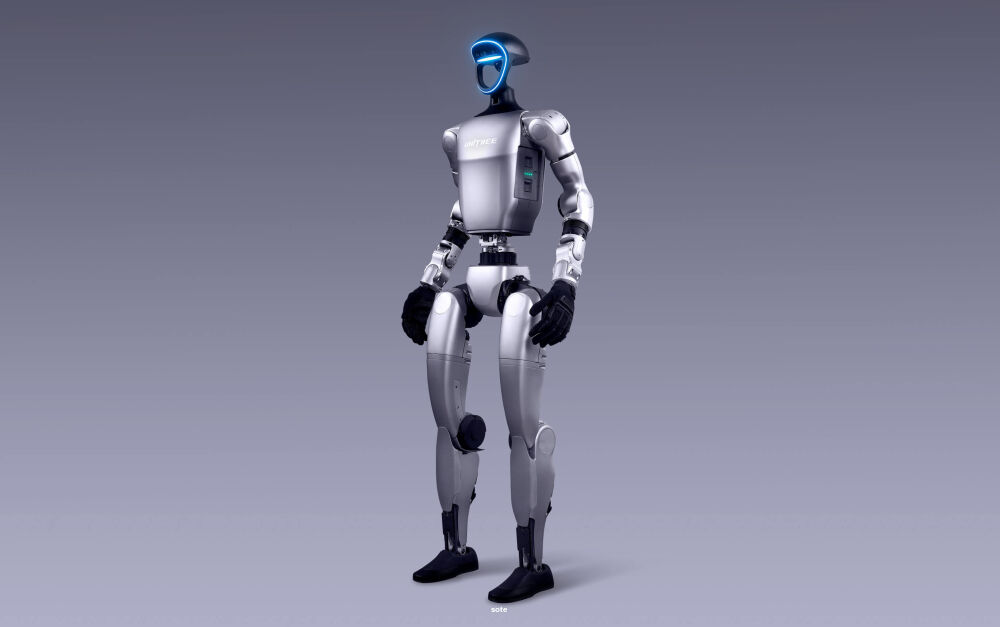
- Height: 127 cm (4 feet 2 inches)
- Weight: 35 kg (77 lbs)
- Degrees of freedom: 23 base model, up to 43 in the EDU configuration
- Top speed: Up to 12 km/h (7.5 mph)
- Payload: Approximately 3 kg arm payload
- Hands: Three-finger grippers with optional force-controlled Dex3-1 dexterous hands
- Sensors: LIVOX MID-360 3D LiDAR, Intel RealSense D435 depth cameras, IMU
- Compute: NVIDIA Jetson Orin NX (100 TOPS) in the EDU model
- Battery: 9,000 mAh, approximately 2 hours runtime, hot-swappable
- Price: Starting around $16,000; EDU configurations run $18,000 to $25,000 and above
Tesla Optimus (Gen 2, with Gen 3 hands)
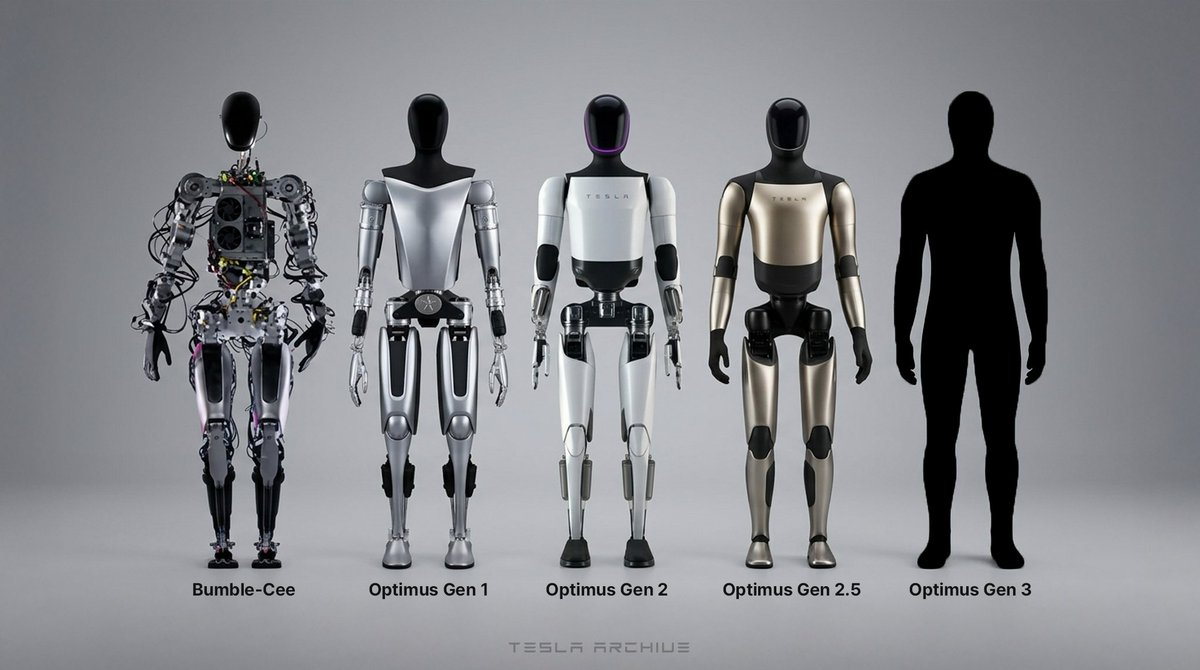
- Height: 173 cm (5 feet 8 inches)
- Weight: 57 kg (125 lbs)
- Degrees of freedom: 28 in the body, plus 22 in the recently updated Gen 3 hands (50 actuators total)
- Top speed: Up to 8 km/h (5 mph) at current operational speeds
- Payload: Approximately 20 kg carry capacity
- Hands: Five-finger design with 22 degrees of freedom and tactile sensing
- Sensors: Multiple cameras running Tesla's FSD computer vision stack
- Compute: Tesla's FSD computer; neural net trained on Dojo supercomputer
- Battery: Claimed full-day runtime; approximately 8 hours
- Price: Not commercially available. Target price $20,000 to $30,000 at scale; initial commercial units estimated at $100,000 or more
Physical Capability: Agility vs Strength
This is where the comparison gets genuinely interesting, and where the G1 has surprised most observers.
The Unitree G1 is faster, more athletic, and demonstrably more agile than Optimus in every documented test. It runs at 12 km/h, performs dynamic whole-body movements, executes kung fu and Tai Chi routines with fluid human-like motion, and recovers from being pushed or kicked without falling.
Researchers at Tsinghua University demonstrated the G1 playing tennis using the LATENT learning framework. MIT, Stanford, CMU, and ETH Zurich all run G1 EDU platforms. The G1 also set a humanoid standing long-jump record, achieving a jump distance-to-height ratio above 1.
The picture for Optimus is more complicated. Many of its demos have been recorded at 2x to 10x speed, which makes direct visual comparisons deceptive. At real speed, Optimus moves slowly and deliberately. Multiple demos have also relied on teleoperation rather than autonomous control, a fact that competitors and critics have repeatedly highlighted.
Where Optimus has a clear advantage is payload and hands. At approximately 20 kg carry capacity versus the G1's 3 kg arm payload, Optimus can handle significantly heavier loads, which matters for actual factory parts handling. Its upgraded Gen 3 hand, with 22 degrees of freedom and 50 actuators across five fingers plus tactile sensing, is more dexterous than the G1's standard three-finger gripper. The optional Dex3-1 hands for the G1 EDU narrow the gap, but Tesla's five-finger design remains the benchmark for humanoid hand capability at this price tier.
AI and Autonomy: Where the Gap Is Largest and Most Important
On paper, Tesla's AI advantage should be decisive. In practice, as of early 2026, the picture is more nuanced.
Tesla's Full Self-Driving neural network, trained on billions of miles of real-world driving data and refined on the Dojo supercomputer, is arguably the most capable vision-based AI system deployed at scale in any physical product. The theory is that the same architecture enabling cars to navigate complex traffic can enable a robot to navigate complex factory environments.
The reality, confirmed by Musk himself on Tesla's Q4 2025 earnings call, is that Optimus units in the factory are "still very much in the R&D phase" and are primarily for learning and data collection, not productive tasks.
The G1 uses reinforcement learning and imitation learning for locomotion and task execution, with the UnifoLM (Unitree Robot Unified Large Model) providing higher-level intelligence. The 3D LiDAR and depth cameras give it spatial awareness that supports autonomous navigation. Critically, the G1 is an open platform, meaning researchers and developers can program custom behaviors, integrate their own AI models, and build directly on Unitree's base capabilities.
This openness is why it has become the de facto standard research platform globally, with more than 30 published academic papers using G1 in 2025 alone.
The honest current state: neither robot is fully autonomous in complex, unstructured environments. Both rely on teleoperation or tightly scripted behaviors for anything beyond their core trained tasks. Tesla's AI infrastructure has a clearer path to scaling autonomous capability. Unitree's open platform has already enabled a global research community to extend its capabilities well beyond what the company built internally.
Availability and Real-World Deployment
This is the most practically important comparison for anyone making a purchase decision in 2026, and it is where the G1 wins without contest.
The Unitree G1 is available now. It ships internationally to more than 40 countries in four to eight weeks and comes with full SDK access in the EDU configuration, supporting ROS, Python, and C++. There is an active developer community, growing open-source resources, and institutional procurement support including NET-30 terms and grant documentation for universities.
Unitree's IPO application was accepted in March 2026, potentially making it China's first publicly traded humanoid robotics company.
Tesla Optimus is not commercially available. There are no pre-orders, no waitlist, and no announced public sales date. Musk has indicated external company sales could begin in late 2026, with consumer sales targeted for end of 2027, though the Optimus timeline has shifted multiple times since the project was announced in 2021.
The promise of $20,000 consumer pricing remains speculative. Current manufacturing costs are estimated at $50,000 to $100,000 per unit, and initial commercial pricing will likely reflect that reality.
Who Is Each Robot Actually For?
The G1 and Optimus are not competing for the same buyer in 2026, and understanding that clarifies who actually wins this comparison.
The Unitree G1 makes sense if you are a university lab, a robotics research institution, a startup building applications on a humanoid platform, or any organization that needs a capable robot it can actually receive, program, and deploy this year. The price, the SDK access, the active community, and the guaranteed availability make it the default answer for anyone who cannot wait.
Tesla Optimus makes sense if you are planning a 2027 or later deployment timeline, primarily need payload capacity and five-finger dexterity, and are building toward industrial-scale deployment in environments similar to what Tesla is already testing. It is a bet on a future product, not a purchase of a present one.
The deeper question is whether Unitree's head start in deployment, research partnerships, and developer ecosystem will compound into a durable advantage by the time Optimus reaches external buyers, or whether Tesla's AI infrastructure and manufacturing scale will allow it to leapfrog what Unitree has built once volume production arrives.
The Broader Field: Context for Both
Neither robot exists in isolation. The humanoid market in 2026 gives important context for where each one stands.
Boston Dynamics' Atlas has the most sophisticated hardware available but ships exclusively to Hyundai's RMAC and Google DeepMind in 2026, at an estimated $250,000 to $300,000 per unit. Figure AI's Figure 02 has demonstrated sophisticated autonomous reasoning through its Helix AI platform but remains available only to enterprise partners. Agility Robotics' Digit is the most proven humanoid in actual commercial logistics deployment, also at approximately $250,000 per unit.
In this landscape, the G1 is uniquely positioned: more capable than any robot at its price point, available when others are not, and open when others are closed. Optimus sits in a different position: more ambitious in scale, more deeply integrated with advanced AI infrastructure, and backed by a company with automotive manufacturing experience that no robotics-only company can match.
Wrap up
If winning means shipping units, building a developer ecosystem, enabling research, and demonstrating real-world deployment at scale in 2026, the Unitree G1 wins. It is the most deployed research humanoid in the world, available at a price that research institutions can actually budget, and actively used by some of the most respected robotics programs globally.
If winning means building the platform most likely to transform industrial automation at the scale Elon Musk is describing, with AI infrastructure to match, Optimus wins on trajectory, assuming that trajectory holds.
One analysis of the two approaches put it simply: "Tesla Optimus is the vision. Unitree G1 is the reality."
That framing is accurate for 2026. Whether it remains accurate in 2028 depends on whether Tesla's manufacturing and AI ambitions deliver on their timelines, which is a question the company's own history makes it reasonable to approach with measured skepticism.
Frequently Asked Questions
Can I buy the Unitree G1 right now?
Yes. The Unitree G1 is available for purchase starting at approximately $16,000 for the base model, with EDU configurations ranging from $18,000 to $25,000 and above depending on degrees of freedom, hand configuration, and compute. It ships internationally to more than 40 countries in four to eight weeks. The EDU model with NVIDIA Jetson Orin and full SDK access is the configuration for serious development work. Buyers in the US should be aware of an ongoing congressional review of Unitree's potential PLA connections, though no import restrictions had been imposed as of early 2026.
Can I buy Tesla Optimus right now?
No. Tesla Optimus is not commercially available as of mid-2026. Units are deployed only in Tesla's own factories, and Musk confirmed on the Q4 2025 earnings call that those units are primarily for learning and data collection rather than productive tasks. External company sales are targeted for late 2026, with consumer availability pushed to end of 2027 at the earliest. Tesla's timeline on Optimus has shifted multiple times since the project was announced in 2021.
Which robot is more physically capable?
The Unitree G1 is faster, with a top speed of 12 km/h versus Optimus's 8 km/h, and significantly more agile, demonstrating dynamic whole-body movements and athletic behaviors that Optimus has not matched. Tesla Optimus has a substantially higher payload capacity at around 20 kg versus the G1's 3 kg arm payload, and its five-finger Gen 3 hands with 22 degrees of freedom are more dexterous than the G1's standard three-finger design. The robots are optimized for different physical priorities.
Which has better AI?
Tesla's AI infrastructure, including the FSD neural network and Dojo training cluster, is more powerful in principle. In practice, as of early 2026, neither robot performs fully autonomous complex tasks in unstructured environments. Optimus units in Tesla's factory are primarily collecting data rather than doing productive work. The G1's open platform has enabled a global research community to extend its capabilities, with more than 30 academic papers published using G1 in 2025. The G1's advantage is deployable AI today; Optimus's advantage is AI potential at scale.
How much will Tesla Optimus cost?
Elon Musk has stated a long-term consumer price target of $20,000 to $30,000, which would make it highly competitive at scale. Current manufacturing costs are estimated at $50,000 to $100,000 per unit, and initial commercial pricing will likely reflect that before volume drives costs down. The $20,000 price point is contingent on production at a scale that has not yet been achieved.
What is the Unitree G1 used for in practice?
The G1 is primarily used for robotics research, AI development, and education. Universities including MIT, Stanford, CMU, and ETH Zurich run G1 EDU platforms. Research teams have demonstrated tennis playing, martial arts, dynamic locomotion, and object manipulation using the platform. More than 5,500 units were shipped in 2025, with 10,000 to 20,000 targeted for 2026.
What does Tesla Optimus do inside Tesla's factories?
As of early 2026, Optimus units in Tesla's Fremont factory are primarily engaged in learning and data collection rather than productive manufacturing tasks. Earlier deployments had Optimus performing basic material handling such as sorting parts. Tesla is treating factory deployment as the proving ground for the AI systems that will eventually enable external commercial sales, but the robots are not yet performing economically meaningful work at scale.
Related Articles
 Dani
Dani
 Mark
Mark
 Dani
Dani