I've walked miles through the Las Vegas Convention Center this week, and my feet are killing me. But honestly? My brain hurts more than my feet. CES 2026 has completely scrambled my understanding of what technology is supposed to be.
Every year, CES delivers the expected: bigger TVs, faster laptops, smarter speakers. But then there's the other stuff. The weird stuff. The products that make you stop mid-stride and ask, "Wait, is this real? Did someone actually build this? And more importantly... why?"
This year, the weird stuff is weirder than ever. We've got laptops with screens that roll around the lid like a yoga mat. AI companions that track your emotions and gaze back at you from your desk. Hair clippers that use sensors to prevent you from giving yourself a bowl cut. And yes, a lollipop that plays Ice Spice through your teeth.
I'm not making any of this up. I saw it all with my own eyes, touched it with my own hands, and in one unfortunate case, let someone put clippers near my head while an AI guided the cut.
So let's talk about the eight weirdest gadgets I've encountered at CES 2026. Some of them are legitimately brilliant. Some of them are legitimately concerning. And a few might actually change how we interact with technology. Just not in any way I could have predicted.
1. Lenovo ThinkPad Rollable XD
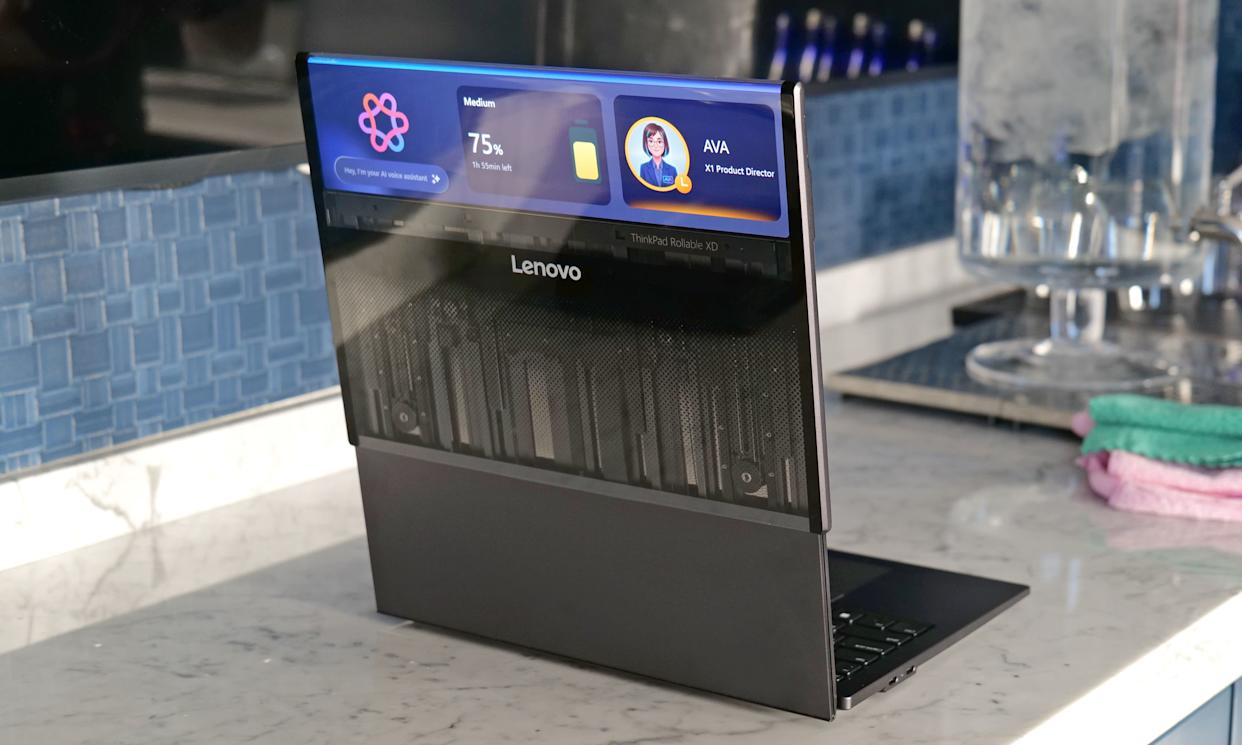
I've seen a lot of weird laptops over the years. Foldable screens. Dual displays. Keyboards that project onto tables. But I've never seen anything quite like the Lenovo ThinkPad Rollable XD Concept, and I'm still not entirely sure what I witnessed.
Here's the deal: this laptop starts as a completely normal 13.3-inch notebook. Standard ThinkPad design, complete with the iconic red TrackPoint nub and the solid keyboard that ThinkPad fans obsess over. Then you touch the top edge of the screen, or click a button, or just use your voice, and the display starts... growing. Hidden motors pull the flexible OLED panel upward until you're staring at a nearly 16-inch workspace—over 50% more screen real estate than you started with.
But here's where it gets properly weird: the extra screen doesn't hide underneath the keyboard like previous rollable concepts. Instead, it wraps around the back of the lid, creating what Lenovo calls a "world-facing display." When the laptop is closed or the screen isn't fully extended, that portion of the display is visible on the outside, showing notifications, widgets, or information to people sitting across from you.
I watched a Lenovo rep demonstrate this at their booth, and the crowd around me had the same slack-jawed expression I probably did. The mechanism is protected by a 180-degree curved Corning Gorilla Glass Victus 2 cover—developed specifically for this concept through a partnership with Corning—and you can actually see the gears and pulleys working through the transparent glass. It looks like something from a science fiction movie, except it was sitting on a table in Las Vegas while a guy in a Lenovo polo shirt handed out business cards.
Is it practical? Honestly, I'm not sure. The world-facing display seems a bit gimmicky—I can't imagine many situations where I need the person across from me to see my screen while I'm working. But the core idea of having a compact laptop that expands for more serious work? That's compelling. The ThinkPad Rollable XD also supports "Swipe to X" gestures and voice commands to control the extension, and Lenovo has packed in AI features for live translation and multimodal interactions.
The catch: This is still a concept, not a shipping product. Lenovo hasn't announced pricing or availability, and based on their track record with similar concepts, it could be a year or two before anything like this reaches consumers—if it ever does. But as a glimpse of where laptop design is headed, it's genuinely exciting.
2. iPolish Digital Nail Polish
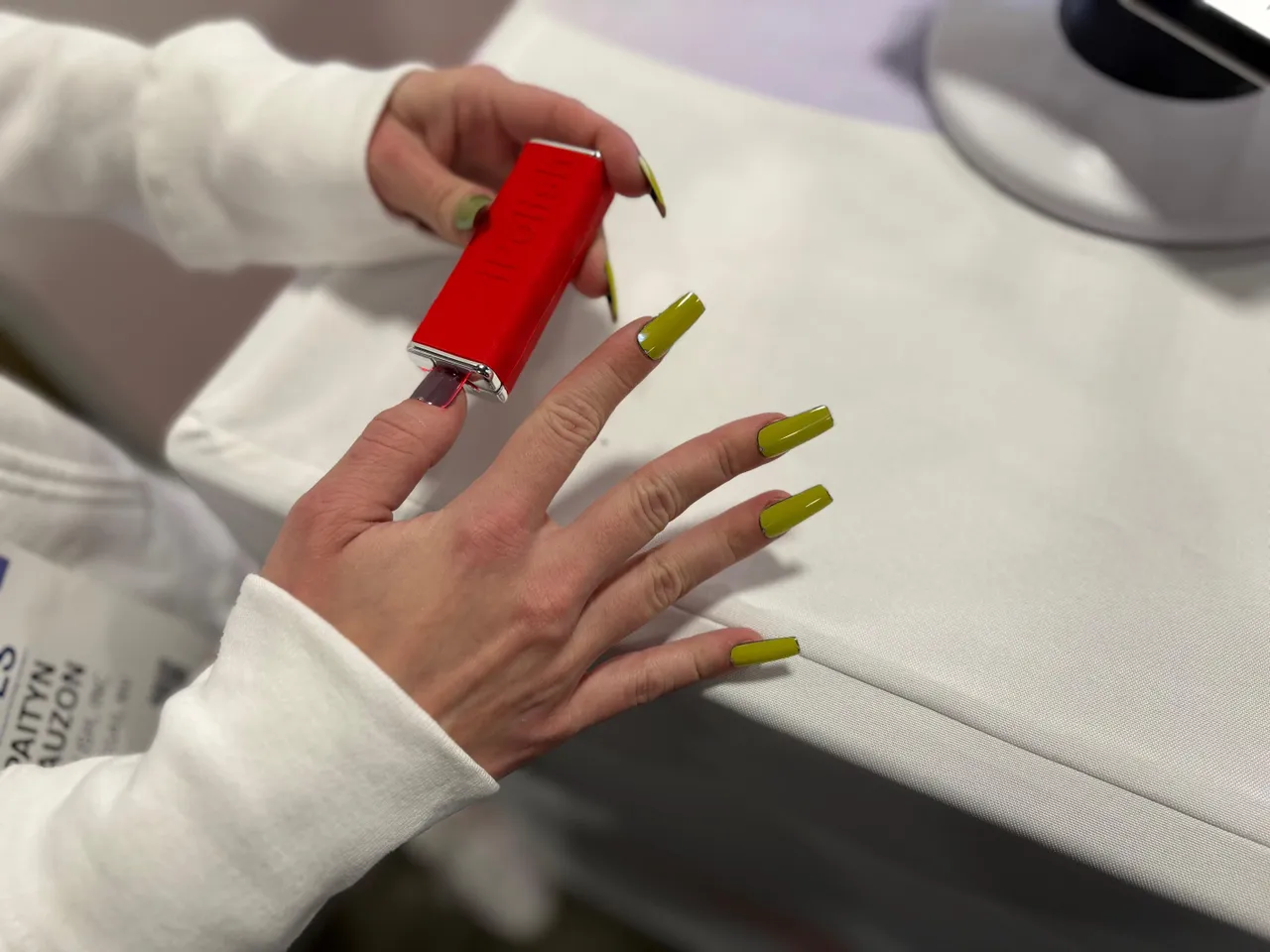
Beauty tech isn't usually my beat, but iPolish stopped me in my tracks. The company claims to have created the "world's first digital color-changing nails," and after watching their demonstration, I believe them.
The system works like this: you apply press-on acrylic nails embedded with electrophoretic film—the same technology that powers e-readers like the Kindle. These nails connect to a companion app with over 400 different colors. When you want to change your nail color, you place the tip of each nail into a small wand device that looks like a sleek portable power bank, select your new color in the app, and watch the transformation happen almost instantly.
I watched a demo where nails cycled from deep burgundy to pale pink to matte black in seconds. The color change is dramatic and complete—no weird transitional stages or incomplete coverage. And the finished result looks genuinely polished (pun intended), with a glossy, gel-like surface that you'd never guess was powered by technology.
The implications are significant if you think about it. No more nail salon appointments just to change colors. No acetone remover smell. No UV lamp exposure. No drying time. You could theoretically match your nail color to your outfit, your mood, or your meeting schedule—switching from professional nude to evening glam in the time it takes to answer an email.
The starter kit is available for preorder at $95, which includes the color-changing wand, top coat, bonding glue, and two sets of nails in either "Long Squoval" or "Medium Ballerina" shapes. Replacement nail sets will cost just $6, which makes the ongoing cost quite reasonable compared to regular salon visits.
The catch: iPolish won't actually ship until June 2026, so we're still months away from seeing how well this holds up in real-world use. Questions about durability, how the electrophoretic film handles daily wear, and whether the color-changing wand is travel-friendly remain unanswered. But as a concept? This is one of the most practically weird things I've seen at CES.
3. Lollipop Star

I should preface this by saying I did not expect to put a lollipop in my mouth while working at CES. And yet, here we are.
Lollipop Star is exactly what it sounds like: a lollipop that plays music. The "how" is bone conduction technology built into the stick. When you place the candy in your mouth and bite down gently with your molars, vibrations travel through your teeth, through your skull, and into your inner ear. Suddenly, you're listening to music that seems to originate from inside your own head.
The experience is surreal in a way that's hard to describe. I tried the peach flavor featuring Ice Spice, and while the audio quality wasn't exactly AirPods territory, I could genuinely hear "Munch" playing through my teeth. The music is quiet—even with the provided earplugs blocking external sound, you're not getting a concert experience. But it works. It actually, legitimately works.
Currently, Lollipop Star offers three flavors, each paired with a different artist: peach (Ice Spice), blueberry (Akon), and lime (Armani White). The flavors are decent, the candy is sturdy enough to last through multiple listens, and the whole thing costs $8.99.
Is this a novelty? Absolutely. You're not going to replace your wireless earbuds with a bag of musical lollipops. But as a conversation starter, a party trick, or a genuinely unique gift, Lollipop Star delivers something I've never experienced before. And in a world where so much technology feels derivative, that counts for something.
The catch: It's a one-time-use item. Once you've finished the lollipop, the experience is over. At nearly $9 per pop (sorry), that's an expensive snack. And the limited song selection means you're locked into whatever artist matches your flavor preference. But for pure novelty value? I'm genuinely considering buying a box.
4. Seattle Ultrasonics C-200 Chef's Knife
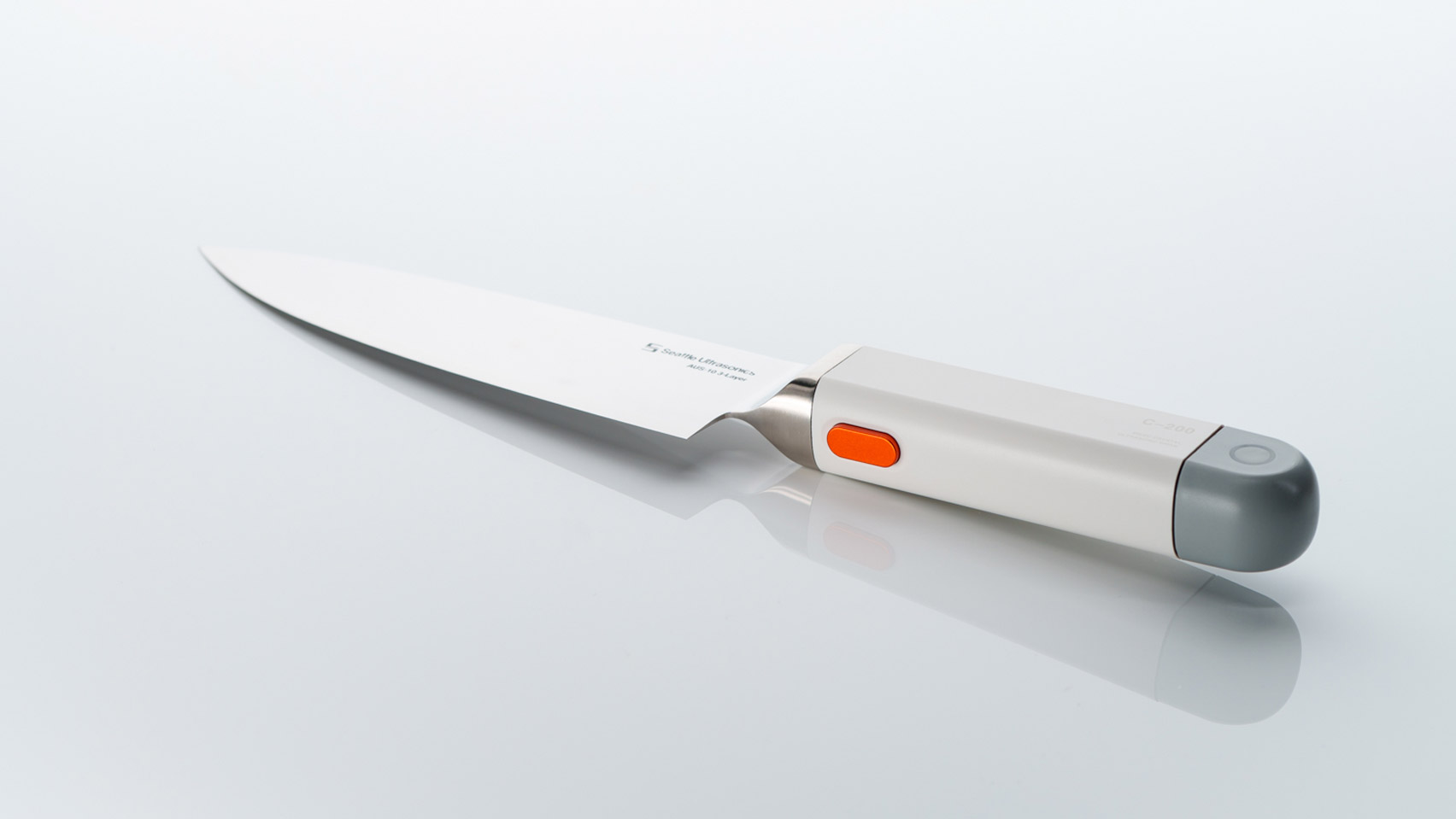
I've been following this knife since it was first announced, and finally getting hands-on time at CES confirmed my suspicions: this is either the most brilliant kitchen tool I've ever seen, or the most over-engineered solution to a problem nobody has.
The C-200 looks like a premium chef's knife—because it is one. The blade is made from Japanese AUS-10 steel in a three-layer construction, hardened to 60HRC. It's beautiful, balanced, and would be a perfectly excellent knife even if it didn't do anything special.
But then you press the small orange button on the handle.
Inside the knife, PZT-8 piezoelectric ceramic crystals begin vibrating the blade at over 30,000 times per second. You can't see the movement. You can't hear it. And crucially, you can't feel any vibration in your hand—the technology is engineered to direct all that energy into the blade itself, not into the handle.
What you do feel is the blade gliding through food like it's been possessed. Seattle Ultrasonics claims the ultrasonic vibration reduces cutting effort by up to 50%, and based on my experience slicing tomatoes and onions at their demo station, that number might actually be conservative. The blade moves through food with almost no resistance, and nothing sticks. Food releases cleanly every single time.
The company demonstrated some clever additional uses: because the vibration is so fine, you can touch the blade to citrus fruit and create a mist of juice—perfect for finishing cocktails or adding a spray of lemon over a dish. It's the kind of feature that sounds gimmicky until you see it, and then you start imagining all the applications.
The knife has a removable battery that charges via USB-C, offering about 20 minutes of continuous ultrasonic use per charge. There's also an optional wireless charging tile made from mahogany ($100 extra) that can mount on your wall or sit on your counter, doubling as elegant knife storage.
The catch: The C-200 is $399 for the knife alone, or $499 with the charging tile. That's expensive even for a premium chef's knife, and you're adding battery maintenance and charging to your kitchen routine. The first production batch already sold out, with preorders for the second batch shipping in March 2026. But for serious home cooks—or anyone with hand strength issues who struggles with traditional knife work—this might genuinely be worth the investment.
5. Vinabot Talking AI Picture Frame
Remember the moving, talking paintings in Harry Potter? The ones that held conversations with students, gossiped about faculty, and generally behaved like their subjects were still alive? Vinabot is trying to make that fantasy real.
The Vinabot AI Talking Frame is a digital picture frame with a significant twist: upload a photo and a short script, and the AI generates a video of that person—celebrity, fictional character, family member, whoever—that can actually hold a conversation with you. The image animates, the mouth moves, and thanks to advanced multimodal AI developed in partnership with LAiPIC, the digital person can understand your tone, evaluate context, and respond in real time.
I watched demonstrations where people uploaded photos of family members and received animated, responsive versions that could answer questions and engage in back-and-forth dialogue. The effect is simultaneously magical and deeply unsettling, which seems to be exactly what Vinabot was going for.
Beyond the AI conversation feature, the frame handles standard digital picture frame functions: photo and video slideshows, calendars, and AI-generated content. The hardware includes a premium anti-glare IPS display, 32GB of internal storage expandable via microSD, and dedicated flash memory for smooth performance.
The company is positioning this as everything from a novelty item to a memorial device for remembering lost loved ones—a use case that brings up some complicated emotional and ethical questions. Having a conversation with an AI version of a deceased relative is... a lot. Whether that's healing or harmful probably depends on the individual.
The catch: Vinabot hasn't announced pricing yet, but they're planning a Kickstarter launch in early February 2026. The technology is impressive, but questions remain about voice cloning capabilities, privacy implications, and whether the novelty holds up over extended use. And honestly, watching a photo of yourself come to life and start talking is an experience that takes some getting used to.
6. Lepro Ami
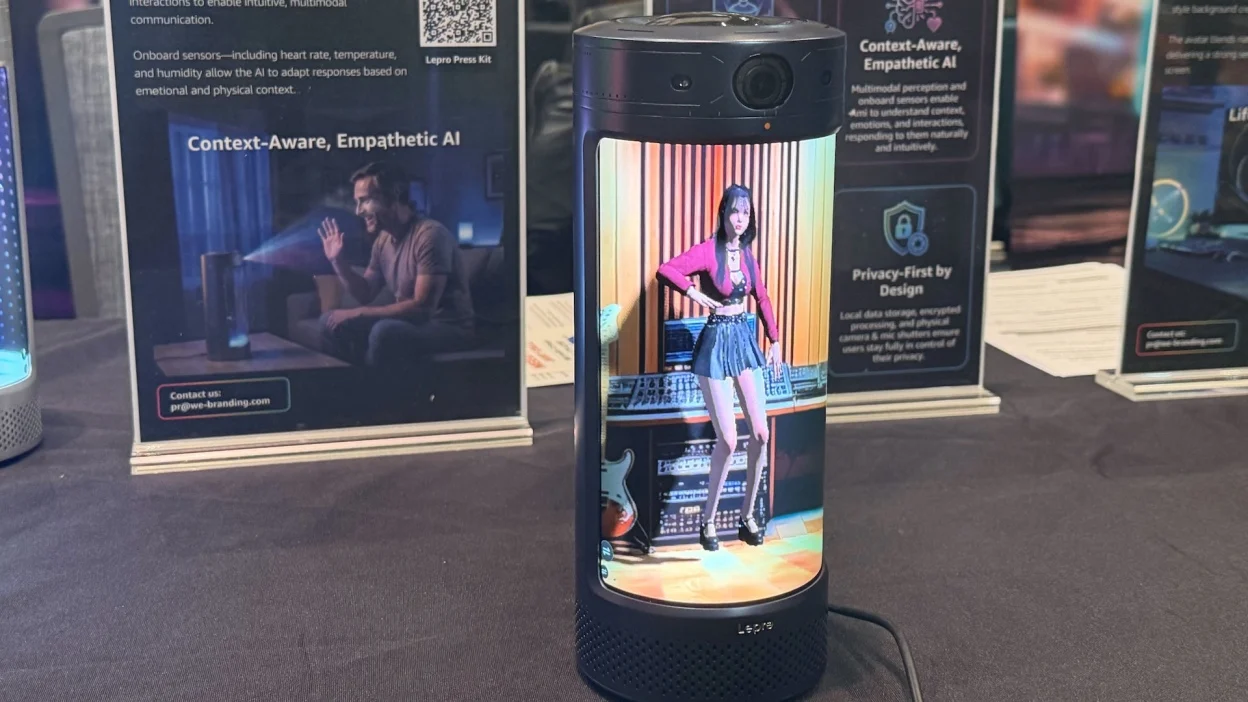
Okay, this one is going to require some unpacking, because Lepro is marketing this product as an "AI soulmate," and I need you to understand that I did not make up that terminology.
The Lepro Ami is a standalone desktop device featuring an 8.01-inch curved OLED display (2480 × 1860 resolution) that shows a holographic-style animated character—by default, a female avatar with real-time eye tracking. Two front-facing cameras follow your gaze. A rear camera creates an AR-style overlay that "anchors" the character to your environment. The whole thing sits on your desk and watches you.
I'll let that sink in for a moment.
Lepro's pitch is about emotional presence and companionship, particularly for remote workers who spend long hours alone. The company cites statistics about isolation being a primary challenge for remote employees and positions Ami as a solution—an always-on visual presence that can greet you in the morning, check in during moments of stress, and respond when your mood or environment appears to change.
The AI system uses multi-modal sensing to interpret facial expressions, recognize gestures like waves or smiles, understand voice tone, and even monitor environmental conditions like temperature and humidity. There's a touch sensor that can detect your heart rate. Rather than waiting for explicit commands, Ami is designed to proactively engage based on patterns and context.
To Lepro's credit, they've clearly thought about privacy concerns. Ami includes physical shutters for both cameras and microphones—not just software toggles, but actual physical barriers you can close. The company claims all interaction data is stored locally on the device rather than in the cloud.
But let's be honest: this is a product that raises more questions than it answers. Is an AI companion a healthy solution to loneliness, or does it risk replacing real human connection? What happens when people become emotionally attached to a character that only exists to make them feel better? And who exactly is the target market for a device that literally watches you all day?
The catch: Lepro Ami will be available starting July 2026, though pricing hasn't been announced. It's not the only product in this category at CES—Razer showed a similar device called Project AVA—which suggests multiple companies see a market for desktop AI companions. Whether that market should exist is a different question entirely.
7. Glyde AI-Powered Hair Clipper
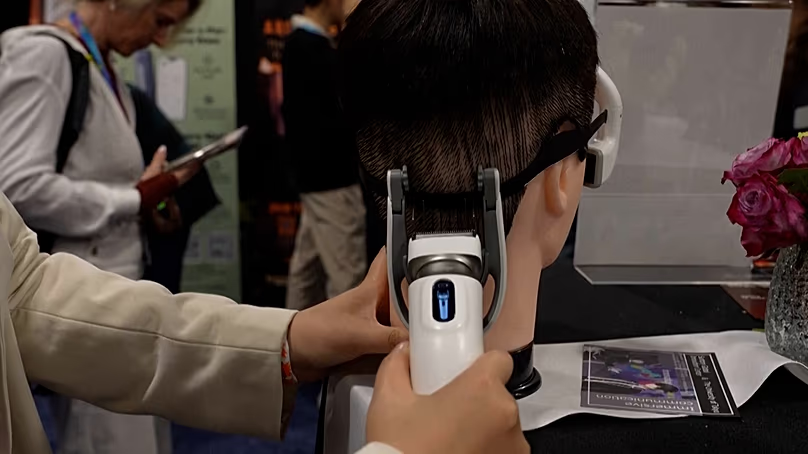
I did something at CES that I never thought I'd do: I let a complete stranger cut my hair with AI-guided clippers. And somehow, I don't look terrible.
Glyde bills itself as the world's first smart hair clipper, and the technology is genuinely impressive even if the concept makes you nervous. The system includes several components working together: an app that analyzes your head shape using your smartphone camera, a wearable "fade band" that marks exactly where a fade should begin, and clippers with built-in sensors that track speed, tilt, and angle in real time.
The key innovation is the auto-adjusting blade system. As you move the clippers, the AI monitors your movements and automatically adjusts the blade length to create a smooth taper. Move too fast? The blade retracts. Tilt at the wrong angle? It trims less. The system is designed to be "mistake-proof," preventing the uneven fades and overcuts that plague amateur home haircuts.
At their CES booth, Glyde had people cutting hair who had literally never done it before. I watched (and then experienced) a demonstration where someone from the business side of the company—not a trained stylist—gave a passable fade to a willing volunteer. The app provided step-by-step guidance with voice and visual cues, and the clippers did most of the heavy lifting.
Is this going to replace professional barbers? Absolutely not. There's an artistry to cutting hair that no AI can replicate. But for people who already do home haircuts to save money, families with multiple heads to maintain, or anyone who just wants to clean up between salon visits, Glyde makes a compelling case.
The whole experience requires trust. You're putting sharp, motorized blades near your head and hoping the AI knows what it's doing. That's not for everyone. But watching it work—and feeling confident that I wouldn't end up with a disaster—was genuinely impressive.
The catch: Glyde is expected to ship in summer 2026 for around $150. That's a significant investment compared to basic clippers, but potentially worth it if it prevents even a single bad haircut. The fade band is admittedly awkward-looking (it's essentially a large headband you wear during the cut), and the app requires downloading and configuring before you start. But for the target audience, those are minor inconveniences.
8. Skwheel Peak S: Electric Skis for Streets, Beaches, and Everywhere Else
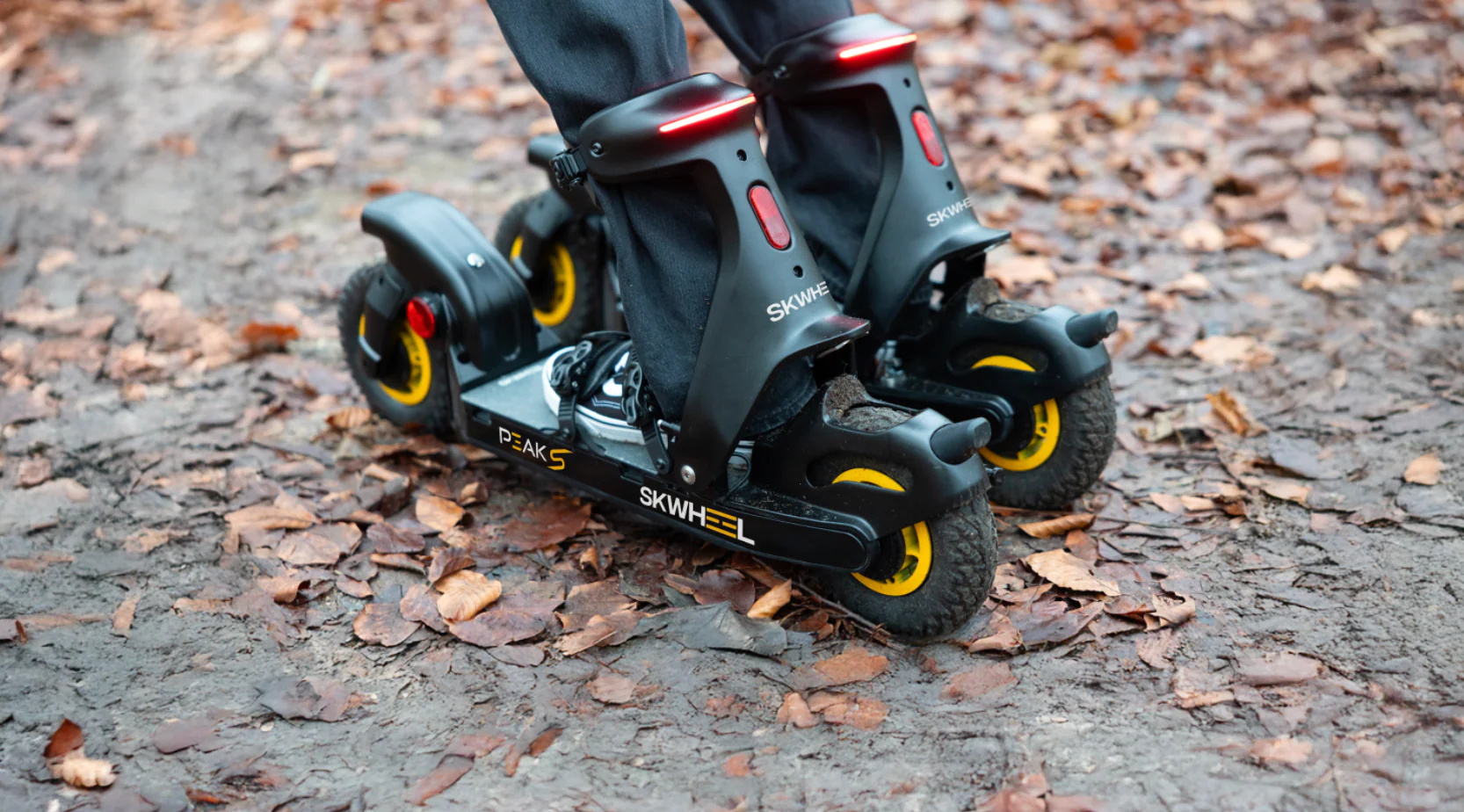
I saved this one for last because it's the most fun I had at CES—and also the closest I came to injuring myself.
Skwheel has created what they call "the world's first electric skis," and the Peak S model is their all-terrain beast. Imagine two electric scooters without handles, strapped to your feet with snowboard-style bindings, featuring a patented pivot system that mimics the carving sensation of downhill skiing. Now imagine riding that on cement floors, streets, grass, gravel, or sand at speeds up to 60 km/h.
The Peak S features four wheels with aggressive tread profiles, each containing its own hub motor. Combined power across both skis is substantial enough to tackle hills and varied terrain. Range is approximately 35-40 kilometers per charge, which is impressive given the speeds involved. A handheld wireless remote controls acceleration and braking.
At their CES booth, I strapped in and took off across the concrete floor at approximately walking speed (I wasn't about to test the 60 km/h top speed in a crowded convention center). Even at that conservative pace, the feeling was remarkable. Leaning into turns activated the pivot system, creating a sensation that genuinely reminded me of skiing—that specific feeling of carving an edge into a slope.
Skwheel says they designed the Peak originally for ski enthusiasts who wanted to practice during the off-season, but quickly discovered that people enjoyed the sensation regardless of whether they'd ever actually skied. It's a form of micromobility that's more fun than any electric scooter I've tried.
The company is French-based but ships to the US, and they've already delivered over 250 units to actual customers—this isn't vaporware. The Peak and Peak S are available for preorder now, with deliveries scheduled for fall 2026.
The catch: These things are expensive. The Peak S preorder price is €1,490 (roughly $1,600 USD), and the standard Peak is €990. That's serious money for what is essentially a very fun toy. There are also practical concerns: where exactly can you legally ride motorized electric skis? How do pedestrians react when you come carving down a sidewalk? And what happens when you inevitably fall—which I'm told happens to everyone at least once during the learning curve?
What Does All This Weirdness Mean?
Walking the CES floor this year, I kept asking myself a question: why is all of this so strange?
Part of the answer is that CES has always been a showcase for experimental ideas. Not everything is meant to ship in its current form—some products are proofs of concept, testing grounds for technologies that might mature over several years. The Lenovo ThinkPad Rollable XD might never become a consumer product, but the lessons Lenovo learns from building it could show up in laptops we actually buy.
But there's something else happening here. AI is making previously impossible products suddenly feasible. The Glyde hair clippers couldn't exist without machine learning models that understand hair cutting techniques and can make real-time adjustments. The Vinabot talking frame relies on advances in generative AI and voice synthesis that weren't available even two years ago. The Lepro Ami uses computer vision and emotional recognition systems that are only now becoming sophisticated enough for consumer applications.
When AI can handle the complexity, hardware designers are free to get creative. And at CES 2026, they got really creative.
Whether that creativity leads to products we actually want to buy is another question. Some of these gadgets solve real problems: the ultrasonic knife genuinely helps people cut food more easily; the iPolish system eliminates the hassle of traditional nail maintenance; the Glyde clippers could save families real money on haircuts.
Others feel like solutions looking for problems—or at least solutions that raise as many concerns as they address. Desktop AI companions that watch you all day, picture frames that resurrect conversations with the dead, holographic "soulmates" that track your emotions... these products push into territory that feels genuinely uncharted, and not necessarily in a comfortable way.
But that's what CES is for. It's where the industry throws ideas at the wall and sees what sticks. Most of these products won't become mainstream. A few might change everything. And the rest? They make for really good stories.
FAQ
What is the Lenovo ThinkPad Rollable XD? The ThinkPad Rollable XD is a concept laptop from Lenovo with a flexible OLED display that expands from 13.3 inches to nearly 16 inches. The screen wraps around the lid, creating both a larger user-facing display and a "world-facing" screen visible to others. It's protected by Corning Gorilla Glass Victus 2 and controlled via touch gestures or voice commands. It's currently a proof-of-concept with no announced release date or pricing.
How much does the iPolish digital nail kit cost? The iPolish starter kit is available for preorder at $95, which includes the color-changing wand, top coat, bonding glue, and two sets of press-on nails. Replacement nail sets will cost $6. The product ships in June 2026.
Does the Lollipop Star really play music through your teeth? Yes. Lollipop Star uses bone conduction technology built into the candy's stick. When you bite down gently with your molars, vibrations travel through your teeth and skull to your inner ear, producing audible music. It costs $8.99 and comes in three flavors paired with songs from Ice Spice, Akon, and Armani White.
Is the Seattle Ultrasonics knife worth $400? For serious home cooks or anyone with hand strength issues, the C-200 ultrasonic knife offers genuine benefits: up to 50% less cutting effort and food that releases cleanly from the blade. The Japanese AUS-10 steel blade is premium quality even without the ultrasonic feature. The knife is $399 alone or $499 with the wireless charging tile, with preorders shipping March 2026.
What is the Vinabot AI Talking Frame? Vinabot is an AI-powered digital picture frame that transforms uploaded photos into animated, conversational characters. Using multimodal AI, the generated characters can understand context, evaluate tone, and engage in back-and-forth dialogue. It's launching on Kickstarter in February 2026 with pricing to be announced.
Is the Lepro Ami really marketed as an "AI soulmate"? Yes. Lepro positions the Ami as a desktop AI companion designed for emotional presence, particularly for remote workers who experience isolation. It features an 8.01-inch curved OLED display, eye tracking, emotion recognition, and environmental sensors. Physical camera and microphone shutters provide privacy control. Available July 2026 with pricing to be announced.
How do the Glyde AI hair clippers prevent bad haircuts? Glyde uses built-in sensors to track speed, tilt, and angle in real time, automatically adjusting the blade length to create smooth tapers. A wearable "fade band" marks where the fade should begin, and a companion app provides step-by-step guidance. The system is designed to retract the blade if you move too fast or tilt incorrectly. Expected price is around $150, shipping summer 2026.
Can you really ski on streets with the Skwheel Peak S? Yes. The Skwheel Peak S uses four-wheel electric propulsion with a patented pivot system that mimics skiing sensations on virtually any surface—asphalt, gravel, grass, dirt, or sand. Top speed is 60 km/h with a range of 35-40 kilometers. The Peak S is available for preorder at €1,490 (approximately $1,600 USD) with deliveries starting fall 2026.
What's the weirdest product at CES 2026? This is subjective, but the Lollipop Star—candy that plays music through your teeth using bone conduction—is probably the most objectively strange product on this list. The Lepro Ami "AI soulmate" desktop companion is the most conceptually unsettling. And the Lenovo ThinkPad Rollable XD is the most technically impressive weird thing I encountered.
Are these products actually going to be available to buy? Most of them, yes. The iPolish nails, Lollipop Star, Seattle Ultrasonics knife, Lepro Ami, Glyde clippers, and Skwheel Peak S all have announced availability dates and pricing. The Vinabot frame is launching on Kickstarter. The Lenovo ThinkPad Rollable XD is currently just a concept with no confirmed commercial release.
Should I buy any of these? That depends entirely on your interests, budget, and tolerance for early-adopter risk. The ultrasonic knife solves a real problem for cooks. The Skwheel is genuinely fun if you have the budget and the space. The iPolish system could eliminate salon visits for nail color changes. The rest are either too early, too expensive, or too conceptually strange to recommend broadly—but they're all fascinating glimpses of where technology is headed.
CES 2026 reminded me that technology doesn't always progress in straight lines. Sometimes it spirals off into directions nobody expected, creating products that seem absurd until suddenly they don't. A few years ago, "a lollipop that plays music through your teeth" would have been a punchline. Now it's $8.99 and shipping soon.
The weird stuff matters. It's where innovation lives before it becomes ordinary.
Related Articles
 Dani
Dani
 Dani
Dani