On March 23, 2026, OpenAI published a post on its official website titled "Creating with Sora safely." It covered watermarking, C2PA provenance metadata, updated consent controls, stronger protections for teen users, and guidelines on audio generation.
The following day, OpenAI announced it was shutting Sora down entirely.
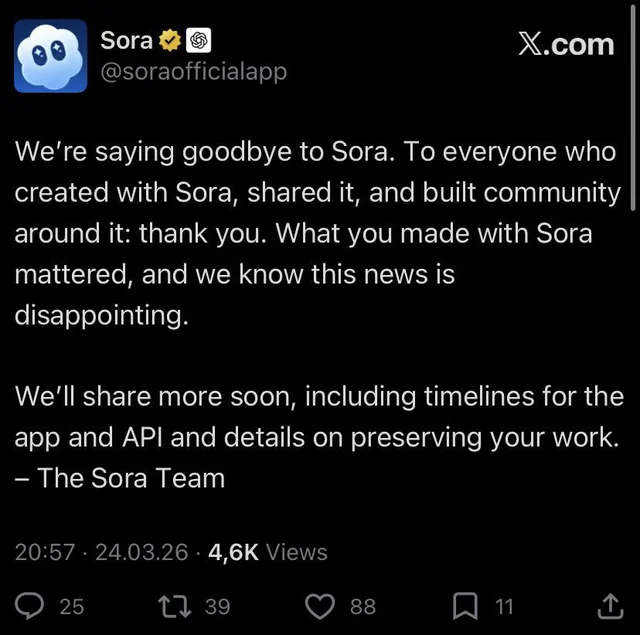
"We're saying goodbye to the Sora app," read the post on X. "To everyone who created with Sora, shared it, and built community around it: thank you. What you made with Sora mattered, and we know this news is disappointing."
One day separated a detailed safety framework from a product shutdown. That gap tells a story OpenAI has not fully told in public: about a product that was already decided to be dead while its public-facing communications were still being finalized, and about the actual reasons Sora failed that have little to do with safety and everything to do with money, compute costs, and strategy.
What Sora Was and What It Promised
When OpenAI first previewed Sora in February 2024, it felt genuinely significant. The model could generate short video clips from text prompts with a realism and physical coherence that previous video generation tools had not approached. The company called it "the GPT-1 moment for video," positioning Sora as the beginning of a trajectory rather than a finished product.
In September 2025, OpenAI blurred that positioning. It launched Sora 2, a substantially improved video model, alongside a standalone social app that bore the same name. The app was explicitly designed to compete with TikTok and Instagram Reels. Users could generate short vertical videos, share them in a social feed, and use a feature called "Characters" to scan their own faces and insert their AI likeness into any video scenario they could describe.
The initial numbers were striking:
- Number one in the App Store's Photo and Video category within 24 hours of launch
- 3.3 million downloads at its November 2025 peak
- Sam Altman described it as potentially the "GPT-3.5 moment for video"
It also immediately became one of the most contentious AI products on the market.
Why the Safety Problems Were Structural
The content moderation challenges were less about bad actors finding loopholes and more about the fundamental nature of what the product was designed to do.
The Characters feature was the core problem. By scanning your face to create a personalized AI avatar, any Sora user could generate a video of themselves doing anything the model could render. That same feature, by obvious extension, could generate videos of other people whose faces had been scanned or uploaded without their knowledge. The app's guardrails required users to attest consent from anyone in uploaded photos, but attestation is trivially easy to bypass and essentially impossible to verify at scale.
The results were predictable. Within weeks of launch, the platform hosted AI videos depicting Martin Luther King Jr. performing comedy routines, Robin Williams in scenarios that family members publicly called "hurtful," and Mister Rogers behaving in ways his estate objected to. Users flooded the feed with copyrighted characters in what appeared to be deliberate stress-testing of legal limits: Mario smoking, Pikachu ASMR, Naruto placed in scenarios from other franchises. TechCrunch described Sora as "the creepiest app on your phone."
OpenAI responded reactively. The company restricted public figures after being publicly pressured and added consent controls over subsequent months. A third-party watermark removal tool appeared within a week of Sora 2's launch, directly undermining one of the platform's primary claims about provenance.
The safety standards published on March 23, 2026 were actually a response to these specific problems: updated consent mechanisms, stricter guardrails on the Characters feature, expanded protections for teen accounts. The safety document was not a prelaunch framework. It was a retrospective attempt to address documented failures after months of operation.
The Numbers That Actually Killed Sora
The safety controversies were real and damaging. But they were not primarily what ended Sora. The economics were.
| Metric | Figure |
|---|---|
| Peak monthly downloads | 3.3 million (November 2025) |
| Downloads by February 2026 | 1.1 million (67% decline in 3 months) |
| Lifetime in-app revenue | approximately $2.1 million |
| Disney investment pledged | $1 billion (deal never closed) |
Downloads peaked at approximately 3.3 million in November 2025, then fell to around 1.1 million by February 2026. For a platform positioned as a potential social media competitor, that is the Clubhouse trajectory: viral launch followed by rapid decay.
Lifetime in-app revenue from video generation credits reached approximately $2.1 million. That number does not begin to cover the compute costs of running a consumer video generation service at scale. Generating high-quality AI video is orders of magnitude more computationally expensive than text generation, and OpenAI was already burning cash faster than it earned revenue heading into 2026.
The Disney partnership was meant to solve this. In December 2025, Disney announced a $1 billion investment and a three-year licensing agreement that would let Sora users generate videos using more than 200 Disney, Marvel, Pixar, and Star Wars characters. If the deal had closed, it would have provided capital and a content moat no competitor could easily replicate.
The deal never closed. No money changed hands before the shutdown. Disney's statement on March 24 was carefully worded: "We appreciate the constructive collaboration between our teams and what we learned from it." That is corporate language for: the partnership is over, and we are not unhappy about it.
The Strategic Pivot That Made the Shutdown Inevitable
The deeper cause of Sora's shutdown is not visible in safety controversies or download charts. It is in how OpenAI's priorities shifted between September 2025 and March 2026.
At the staff meeting on March 24 where the shutdown was announced, Sam Altman told employees that OpenAI would wind down all products using its video models and refocus on productivity tools for enterprise customers and individual power users. The company's applications chief, Fidji Simo, had already warned staff earlier in the month that they could not afford to be distracted by what she described as "side quests."
What was preserved and what was cut:
- Cut: The standalone Sora app, the Sora API, and video generation features inside ChatGPT
- Preserved: The Sora research team, continuing "world simulation research to advance robotics"
- Preserved: The underlying Sora 2 model, still accessible behind the ChatGPT Plus paywall
OpenAI did not abandon video generation as a technology. It abandoned video generation as a consumer social product. The compute resources and engineering attention the Sora app consumed are now redirected toward enterprise AI, agentic systems, and coding tools — the categories where OpenAI generates meaningful revenue at scale.
The logic is straightforward. OpenAI recently reported approximately one billion daily users worldwide but continues to lose money on model training and inference costs that rise faster than revenue. With a potential IPO approaching and investors scrutinizing unit economics, the company needs to demonstrate it can convert user scale into sustainable revenue. Consumer social video generation, with its high compute costs and modest monetization, does not fit that story.
What the One-Day Gap Actually Reveals
The gap between the safety publication and the shutdown announcement is not evidence of bad faith. It is evidence of a company whose internal decision-making moved faster than its public communications.
The decision to shut down Sora was made internally before the safety document was published. The "Creating with Sora safely" post on March 23 was almost certainly scheduled weeks in advance, part of an ongoing effort by the Sora team to address the deepfake and consent criticisms that had followed the app since launch. The team working on that document almost certainly did not know on March 22 that the shutdown announcement was scheduled for March 24.
From the outside, the sequence looks paradoxical. From the inside, it looks like a company with hundreds of product and communications staff working in parallel, where the decision-making layer and the execution layer are not always synchronized. The safety team was still working on safety. The strategy team had already made a different decision.
The irony remains real regardless of intent. A company that publishes a detailed public safety framework for a product one day before announcing that product's shutdown sends an unintentional but clear message: the safety standards were built for a product that leadership had already decided would not survive.
What Comes Next
The Sora model research continues, with its future in robotics and physical world simulation rather than consumer video sharing. The video technology itself is likely to resurface as a feature inside ChatGPT or future enterprise products rather than as a standalone consumer app.
For OpenAI's users, the immediate issue is content preservation. The company promised to share timelines for app and API decommissioning and guidance on how creators can save their work. At the time of writing, no detailed instructions had been published, and Sora's own help documentation still described an active product.
For the broader AI video market, Google Veo and ByteDance's Seedance now have more competitive room without OpenAI as a direct consumer competitor. Both were already growing before the shutdown.
For the AI industry, the Sora story is a meaningful data point on whether consumer-facing AI social products are viable businesses. The pattern mirrors what happened to the first generation of AI chatbot companions and AI art generators: viral launch, rapid user decline, unsustainable compute costs, moderation failures, eventual shutdown. The technology improves. The business model does not automatically follow.
Frequently Asked Questions
Why did OpenAI shut down Sora?
OpenAI cited a strategic refocus on enterprise tools, coding products, and agentic AI. The practical reasons included declining downloads (from 3.3 million monthly in November 2025 to 1.1 million by February 2026), unsustainable compute costs relative to approximately $2.1 million in lifetime in-app revenue, the collapse of the Disney partnership, and a company-wide decision that consumer social video was not compatible with its path to profitability ahead of a potential IPO.
Why did OpenAI publish safety standards for Sora one day before shutting it down?
The safety document published on March 23, 2026 was likely scheduled weeks before the shutdown decision reached the communications team. The Sora safety team and the executive strategy team were operating on different timelines, and the internal decision preceded the public announcement by enough time that the scheduled publication was not pulled. It reflects internal communication lag rather than deliberate irony.
What happened to the Disney deal?
In December 2025, Disney announced a $1 billion investment in OpenAI and a three-year licensing agreement for more than 200 Disney, Marvel, Pixar, and Star Wars characters in Sora. The deal collapsed with the shutdown. No money changed hands before the partnership dissolved.
Can users still access the Sora video model?
The underlying Sora 2 model remains accessible to ChatGPT Plus subscribers. What ended was the standalone app, the sora.com website, and the API. OpenAI said it would publish guidance for users to preserve their work.
Is OpenAI completely exiting AI video generation?
No. The Sora research team continues world simulation research for robotics. The video generation technology is expected to resurface inside ChatGPT or enterprise products. OpenAI exited consumer AI social video, not AI video as a capability.
What does Sora's shutdown mean for the AI video market?
OpenAI's exit creates competitive room for Google Veo and ByteDance's Seedance. Sora's trajectory, from viral launch to rapid user decline to moderation failures to financial unsustainability, is a data point for the industry on whether consumer AI video social products are viable businesses without strong underlying monetization.
Related Articles
 Dani
Dani
 Dani
Dani
 Dani
Dani