Let me tell you something that would have sounded absolutely crazy just a year ago: the most popular open AI model in the world right now isn't from OpenAI. It's not from Meta, Google, or any Silicon Valley giant. It's Qwen—pronounced "chwen"—and it comes from Alibaba, the Chinese e-commerce company most Americans associate with budget online shopping.
I know, I know. It sounds like the setup to a joke. But spend any time in AI development circles these days, and you'll hear the same thing over and over: developers are abandoning the models they've been loyal to for years. They're downloading Qwen in record numbers. They're building their products on it. And they're not looking back.
I've spent the past few months watching this shift unfold, talking to developers who've made the switch, and digging into what's actually happening here. What I've found is a story about hype versus reality, about the difference between slick marketing and genuine utility, and about how the AI industry might be entering a new phase that nobody predicted.
So grab your coffee. Let me walk you through the rise of Qwen, the fall of GPT-5, and why everything you thought you knew about the AI race might be wrong.
The GPT-5 Disaster Nobody Wants to Talk About
Let's start with the elephant in the room: GPT-5 has been, by almost any measure, a disappointment.
When OpenAI finally released GPT-5 in August 2025, it was supposed to be the next big leap. Sam Altman promised that even free ChatGPT users would get access to "Ph.D.-level intelligence." The hype was astronomical. After all, previous GPT releases had genuinely changed what we thought AI could do. GPT-2 wrote coherent paragraphs. GPT-3 could be prompted to do almost anything. GPT-4 leapfrogged the competition so dramatically that it took rivals a full year to catch up.
And then GPT-5 actually came out.
Users immediately started complaining. The new model struggled with basic tasks. People posted examples of GPT-5 making simple math mistakes, bungling geography questions, and failing to correctly list US presidents. The model couldn't accurately draw a map of the United States. Basic arithmetic was hit or miss. The "vibes," as one user put it, felt off—responses were shorter, more formulaic, somehow less warm than what people had grown accustomed to.

Within days, Sam Altman was in full damage-control mode, acknowledging "early glitches" and promising fixes. On Reddit and X, he explained that an auto-switching feature had broken, making GPT-5 "seem way dumber." But for many users, the damage was done. The mystique was gone.
The tech press wasn't kind either. Axios announced the model had "landed with a thud." Ars Technica called the launch "messy." Even longtime AI observers who generally give OpenAI the benefit of the doubt struggled to defend it. Gary Marcus, the AI researcher who's been skeptical of OpenAI's approach for years, declared his work "truly done"—arguing that GPT-5 proved that simply scaling up models wasn't going to lead to artificial general intelligence.
Now, in fairness, GPT-5 isn't actually bad. In my own testing, it performs well on many tasks. The problem is that it's not dramatically better than what came before, and it has some rough edges that feel inexcusable for a model that was supposed to represent the cutting edge. When you've been promising the moon and you deliver something that looks a lot like the previous version—just with new glitches—people notice.
The situation hasn't improved much with subsequent releases. GPT-5.1 came in November. GPT-5.2 followed just weeks later, released with what Fox News called a feeling of being "rushed." OpenAI's official announcement acknowledged that the company is "far from done" and is "working on known issues like over-refusals." Users report that GPT-5.2 often feels bland, refuses more, and hedges more—"like someone who just finished corporate compliance training and is scared to improvise," as one critic put it.
Behind the scenes, sources say there's been a "code red" at OpenAI, with Altman pushing teams to accelerate improvements as competition heats up. But for many developers who need reliable, predictable AI models for production applications, the message is clear: GPT-5 is not the slam dunk they were hoping for.
The Llama 4 Catastrophe
If GPT-5's reception was bad, Meta's Llama 4 launch was an outright disaster.
Meta had positioned Llama as America's answer to closed-source AI models—an open alternative that developers could download, modify, and deploy however they wanted. And for a while, it worked. Llama 3 created genuine excitement when it launched. Developers flocked to it. GPU rental prices spiked as everyone scrambled to run the new model.
Then came Llama 4 in April 2025, and everything fell apart.
Almost immediately, researchers noticed something fishy about the benchmark scores. It turned out that Meta had submitted a "specially crafted, non-public variant" of Llama 4 to LMArena—a popular AI model comparison site—that performed better than the version actually available for download. In other words, the company had gamed the system. It was like showing up to a drag race in a Formula 1 car, winning, and then selling people a Honda Civic while claiming it was the same vehicle.
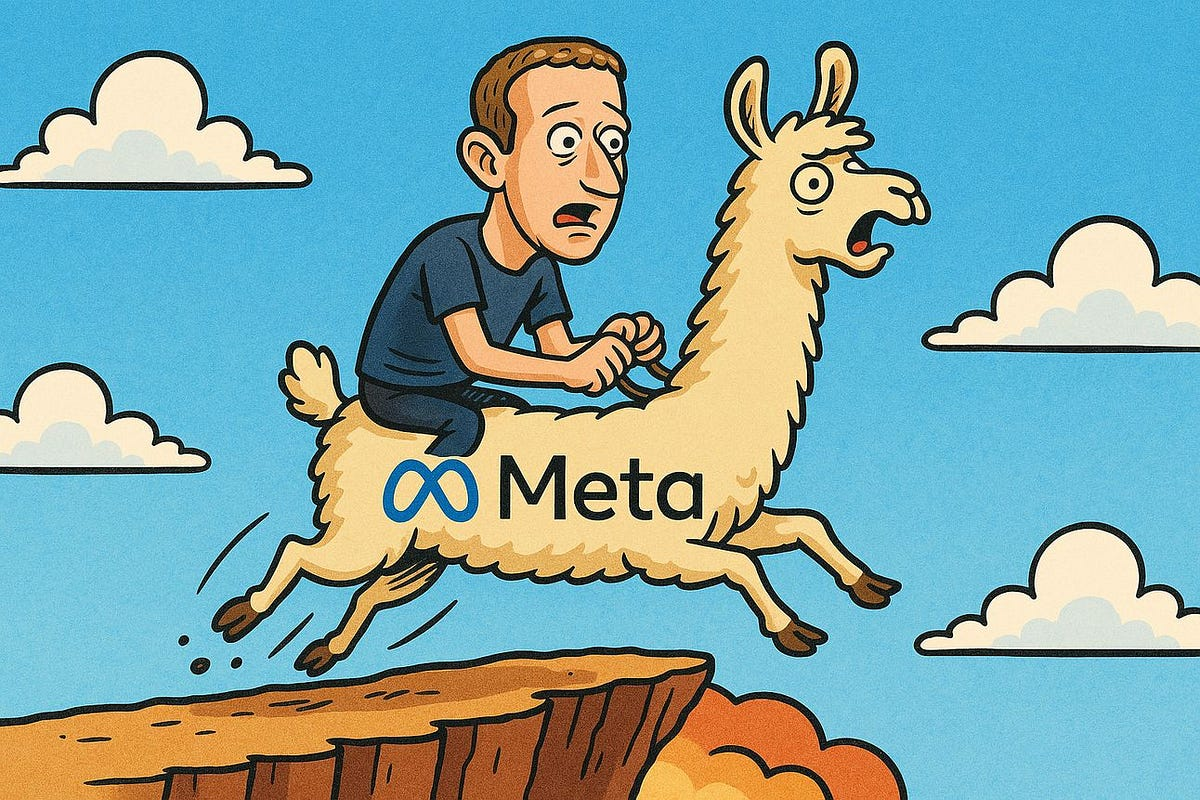
The community was furious. Trust, once lost in the open-source world, is incredibly hard to rebuild. Developers who had championed Llama felt betrayed. Reddit exploded with criticism. Some jokingly suggested renaming the model "LocalGemma."
But the benchmark manipulation was only the beginning of Llama 4's problems. Early adopters trying to leverage the model's promised multi-million-token context window faced crashes and inconsistent outputs. Meta blamed "early-stage deployment bugs," but the label "unstable" stuck.
The situation got bad enough that Meta's entire AI strategy is reportedly being overhauled. Chris Cox, the company's chief product officer and a 20-year veteran, no longer oversees the AI division after the botched release. Meta brought in Alexandr Wang, the former CEO of Scale AI, as its new chief AI officer. And according to CNBC, Meta is now developing a new model codenamed "Avocado" under tighter, more closed-source control—a major pivot from the open-source approach that defined Llama.
For developers who had built their workflows around Meta's open models, it was a gut punch. As one researcher told Business Insider, "It would be exciting if they were beating Qwen and DeepSeek. Qwen is ahead, way ahead of what they are doing in general use cases and reasoning."
Enter Qwen: The Model Nobody Saw Coming
Against this backdrop of disappointment from America's AI giants, something interesting was happening on the other side of the world.
Alibaba's Qwen team had been quietly cranking out updates. Qwen 2.5, released in late 2024, established the model as a serious contender. Then came Qwen 3 in April 2025, and suddenly the AI world took notice.
On paper, Qwen's capabilities are impressive. The flagship Qwen3-235B model delivers state-of-the-art performance across reasoning, coding, and mathematics benchmarks. On the 2025 American Invitational Mathematics Examination, Qwen3 scored 70.3—well above DeepSeek's 46.6 and dramatically higher than GPT-4o's 26.7. In coding tests, it matches or exceeds most competitors. The thinking mode variant, Qwen3-Max-Thinking, achieved a perfect 100% score on the AIME 2025 benchmark when combined with tool use and scaled compute.
But what really sets Qwen apart isn't raw benchmark performance—it's accessibility.
Qwen is open-weight, meaning you can download the model, modify it, fine-tune it for your specific needs, and deploy it on your own infrastructure. The Apache 2.0 license allows commercial use without major restrictions. Models range from tiny variants you can run on a smartphone to massive 235-billion-parameter behemoths for research labs. Need multilingual support? Qwen handles 119 languages and dialects. Need long context windows? Some versions support up to a million tokens.
I experienced this firsthand during a recent trip to China when I visited Rokid, a startup developing smart glasses. As I chatted with engineers, their words were translated from Mandarin to English and transcribed onto a tiny screen above my right eye—all powered by Qwen. The model ran on local servers, fine-tuned specifically for Rokid's use case. That kind of customization would be impossible with closed models from OpenAI or Anthropic.
The numbers tell the story. According to HuggingFace, downloads of open Chinese models on its platform surpassed downloads for US models back in July. By mid-December 2025, Qwen's cumulative downloads hit around 385 million—just ahead of Llama's 346 million. On OpenRouter, a platform that routes queries to different AI models, Qwen has rapidly risen to become the second-most-popular open model in the world.
More than 130,000 Qwen-based derivative models have been developed in the global open-source community—surpassing the number of Meta's Llama-based derivatives. When researchers presented papers at NeurIPS, the premier AI conference, hundreds used Qwen. One paper from the Qwen team, detailing a technique to enhance model intelligence during training, won a "best paper" award.
Why Developers Are Making the Switch
So what's driving this shift? Why are developers who used to swear by GPT or Llama now reaching for Qwen?
I've talked to dozens of developers and AI practitioners about this, and the answers tend to cluster around a few key themes.
First and most importantly: Qwen just works. While OpenAI has been dealing with "code red" situations and Meta has been putting out fires, the Qwen team has been methodically shipping updates that improve the model. They publish papers detailing their engineering and training techniques. They respond to community feedback. They don't hype features that don't exist.
This openness stands in stark contrast to what's happening at US companies. As Andy Konwinski, cofounder of the Laude Institute (a nonprofit advocating for open US models), puts it, Chinese AI companies are "routinely publishing papers detailing new engineering and training tricks," while big US companies "seem afraid of giving away their intellectual property."
Second, the economics make sense. Running Qwen on your own infrastructure is often cheaper than paying for API access to closed models. The FP8 version of Qwen3 cuts memory requirements dramatically, making it possible to run sophisticated AI on hardware that would never handle GPT-5. For startups watching every dollar and enterprises looking to reduce cloud costs, this matters enormously.
Third, customization is possible. When you can actually modify the model—not just prompt it, but fundamentally change how it works—you can build things that simply aren't possible with closed systems. BYD, China's leading electric vehicle maker, has integrated Qwen into dashboard assistants. US companies like Airbnb, Perplexity, and even Nvidia are using Qwen. According to reports, even Meta is now using Qwen to help build its next model.
Finally, there's the reliability factor. Developers who depend on AI models for production systems need predictability. They need to know that the model they deploy today will behave the same way tomorrow. The chaos around GPT-5's launch—the sudden removal of older models, the auto-switcher bugs, the inconsistent behavior—violated this trust in ways that are hard to rebuild.
The Irony of American AI Closedness
There's something deeply ironic about the current situation.
For years, American tech companies positioned themselves as champions of openness and innovation, while Chinese companies were portrayed as closed, copycat operations. Silicon Valley was supposed to be the place where disruptive ideas flourished and information flowed freely.
But look at what's actually happening. Meta, once the pioneer of open AI models, is reportedly shifting to closed-source development after Llama 4's disaster. OpenAI—the company with "Open" literally in its name—has become increasingly secretive about how its models are trained and optimized. Even the benchmarks that are supposed to help users compare models have become battlegrounds for manipulation and gaming.
Meanwhile, Alibaba publishes research papers. The Qwen team shares training techniques. Models are released under permissive licenses. Community feedback shapes development priorities.
The result is that researchers and developers around the world are gravitating toward Chinese open models not because of nationalism or politics, but because those models better serve their needs. As one AI scientist told me, "A lot of us are using Qwen because it's the best open-weight model, period."
This shift has geopolitical implications that go far beyond the AI industry. US policy has been predicated on maintaining technological leadership over China, particularly in AI. Export controls restrict Chinese access to advanced chips. Investment restrictions limit capital flows. But if the most innovative AI development is happening in China's open ecosystem while American companies retreat behind closed doors, those policies may be missing the point entirely.
What This Means for You
Okay, let's get practical. What does the rise of Qwen actually mean for someone trying to build products or use AI effectively?
If you're a developer, the message is simple: it's time to at least experiment with Qwen. The model is available on HuggingFace and ModelScope. You can try it through chat.qwen.ai or access it via API. Small versions run on consumer hardware. The Apache 2.0 license means you can use it commercially without major restrictions. Even if you ultimately stick with other models for your main projects, understanding Qwen's capabilities will make you a better-informed developer.
If you're running a startup or small business, Qwen offers options that didn't exist a year ago. You can deploy sophisticated AI on your own infrastructure instead of paying per-token to cloud providers. You can fine-tune models for your specific use case. You can ensure that your AI-powered features work even when internet connectivity is unreliable. These aren't theoretical benefits—they're real competitive advantages.
If you're an enterprise decision-maker, the lesson is about diversification. The AI landscape is shifting faster than anyone predicted. Companies that bet everything on a single provider are exposed to risks—whether that's unexpected model changes, pricing increases, or quality regressions. Having the capability to evaluate and deploy multiple models, including open-weight options like Qwen, is increasingly essential.
And if you're just someone who uses AI tools in your daily life, the takeaway is that the best models aren't always the most famous ones. ChatGPT has the brand recognition, but that doesn't necessarily mean it's the right tool for every job. Being willing to try alternatives—including ones you might not have heard of six months ago—can lead you to tools that work better for your specific needs.
Looking Ahead: What 2026 Will Bring
So what happens next?
If current trends continue, 2026 will be the year that Qwen fully establishes itself as the default choice for open AI development. The model family is expanding rapidly—Qwen3-Omni handles text, images, audio, and video in a unified system. Qwen3-Next introduces architectural innovations that dramatically reduce compute costs. New specialized variants are released almost monthly.
The competition won't stand still, of course. OpenAI will keep iterating on GPT. Anthropic's Claude continues to advance. Google's Gemini 3 reportedly outperforms ChatGPT on several benchmarks. But none of these alternatives offer the combination of capability, accessibility, and openness that makes Qwen so attractive to developers.
There's also DeepSeek, another Chinese AI company that's been making waves. DeepSeek's models are released under the MIT license—even more permissive than Qwen's Apache 2.0. Between DeepSeek and Qwen, China now dominates the open AI landscape in ways that would have seemed unthinkable two years ago.
For American AI companies, the path forward isn't clear. Meta is reportedly developing its "Avocado" model under closed-source conditions—a significant retreat from the open approach that made Llama popular. OpenAI has never been truly open despite its name. Anthropic focuses on safety and alignment more than accessibility.
This could change. American companies could embrace openness, publish their research, and compete on the merits. But given current trends, I wouldn't bet on it.
What I would bet on is that developers will continue to follow quality, convenience, and value—regardless of where those come from. Right now, that path leads to Qwen.
Frequently Asked Questions
What is Qwen and who makes it?
Qwen (pronounced "chwen") is a family of large language models developed by Alibaba Cloud, the cloud computing division of Chinese e-commerce giant Alibaba Group. The name comes from 通义千问 (Tōngyì Qiānwèn) in Chinese. Alibaba first released Qwen in August 2023 and has since expanded it into a comprehensive family of models including text, vision, audio, and multimodal variants. All models are available as open-weight releases under the Apache 2.0 license, allowing commercial use and modification.
Why is Qwen suddenly so popular?
Qwen's popularity surge stems from several factors: it performs excellently on benchmarks, it's genuinely open-weight (meaning you can download, modify, and deploy it), it comes in many sizes from tiny to massive, it's regularly updated with improvements, and competitors have stumbled. GPT-5's disappointing launch and Llama 4's troubled release left developers looking for reliable alternatives. Qwen delivered where others didn't.
Is Qwen better than GPT-5?
It depends on what you're measuring and what you need. On some benchmarks, Qwen3-Max surpasses GPT-5. On others, results are mixed. The real difference is accessibility: GPT-5 is a closed model you can only access through OpenAI's API, while Qwen can be downloaded, modified, and run on your own hardware. For many developers, this flexibility matters more than marginal benchmark differences.
Can I run Qwen on my own computer?
Yes. Qwen comes in multiple sizes, from the tiny 0.6B parameter model that runs on smartphones to the massive 235B parameter version that requires significant compute resources. You can run smaller versions on consumer hardware like a MacBook or a gaming PC with a decent graphics card. The FP8 optimized versions reduce memory requirements further. Tools like Ollama make local deployment straightforward.
Is it legal to use Qwen for commercial purposes?
Yes. Qwen models are released under the Apache 2.0 license, which allows commercial use, modification, and redistribution with minimal restrictions. This is one of the most permissive licenses available and a major advantage for businesses considering the model.
How does Qwen compare to Meta's Llama?
Both are open-weight models that can be downloaded and modified. However, Qwen has recently overtaken Llama in downloads on HuggingFace, with about 385 million downloads compared to Llama's 346 million as of late 2025. More importantly, Llama 4's troubled release damaged Meta's reputation, while Qwen has maintained consistent quality. Llama also has usage restrictions that Qwen's Apache 2.0 license doesn't impose.
What languages does Qwen support?
Qwen3 supports 119 languages and dialects, with particularly strong performance in Chinese and English. It excels at multilingual instruction following and translation tasks. This broad language support makes it especially useful for global applications and non-English markets.
Is Qwen safe to use given it's from a Chinese company?
This is a complex question without a simple answer. From a technical perspective, because Qwen is open-weight, you can examine the model, run it on your own infrastructure, and ensure that data doesn't leave your systems. This is actually more transparent than closed models where you have no visibility into how they work. From a business perspective, many Western companies including Airbnb, Perplexity, and Nvidia use Qwen without reported issues. The model is licensed under standard open-source terms. That said, enterprises in sensitive industries should evaluate any AI model—regardless of origin—against their security requirements.
What can I actually build with Qwen?
Almost anything you could build with other leading AI models: chatbots, content generation tools, code assistants, translation services, document analysis systems, customer service automation, and more. Companies are using Qwen for smart glasses interfaces, electric vehicle dashboard assistants, medical AI applications, and enterprise search. The model's flexibility and the ability to fine-tune it for specific domains opens up possibilities that closed models don't offer.
Where can I try Qwen?
You can try Qwen directly at chat.qwen.ai through your web browser. For developers, models are available on HuggingFace (huggingface.co/Qwen), ModelScope (Alibaba's model hosting platform), and GitHub (github.com/QwenLM/Qwen3). API access is available through Alibaba Cloud Model Studio. Tools like Ollama, vLLM, and llama.cpp support local deployment.
Will GPT-5 or Llama recover?
Probably, to some extent. OpenAI has enormous resources and continues to iterate on GPT-5. Meta is reportedly developing new models under different conditions. But the window where American companies dominated the open AI landscape has clearly closed. Even if GPT and Llama improve significantly, Qwen and other Chinese open models have established themselves as credible alternatives that will continue competing.
The Bigger Picture
As I finish writing this, I can't help but reflect on how quickly things change in AI.
A year ago, the conversation was about whether GPT-5 would achieve artificial general intelligence. Whether OpenAI would become the most valuable company in history. Whether American AI dominance was assured.
Now the conversation is about why GPT-5 disappointed, why Llama 4 flopped, and why developers are flocking to a model from a Chinese e-commerce company that most Americans have never heard of.
This isn't to say that OpenAI or Meta or Anthropic are doomed. The AI industry is evolving too fast for any outcome to be certain. But it does suggest that the narratives we've been told about AI—that bigger is always better, that closed is more advanced than open, that Western companies hold all the cards—might need some revision.
The rise of Qwen is a reminder that good technology wins, regardless of where it comes from. Developers don't care about geopolitics; they care about models that work, licenses that let them build, and teams that ship improvements instead of excuses.
Right now, that's Qwen.
And based on everything I'm seeing, 2026 will be its year.
Related Articles
 Mark
Mark
 Dani
Dani
 Mark
Mark