Revolutionizing the website redesign industry, Revamp.dev emerges as an AI-powered automation platform that promises to transform outdated websites into modern, high-performance masterpieces in just 2 minutes. This comprehensive review explores how Revamp.dev is disrupting traditional redesign workflows for digital agencies, developers, and businesses seeking rapid website transformation without the typical 10-40 hours of development time. Discover the platform's core capabilities, competitive positioning, pricing transparency issues, and whether this technology delivers on its bold promises for the future of automated web design.

Revamp AI - Upgrade old sites into sleek, high-performing pages- no dev hours, better than any manual redesign.
In a Hurry?
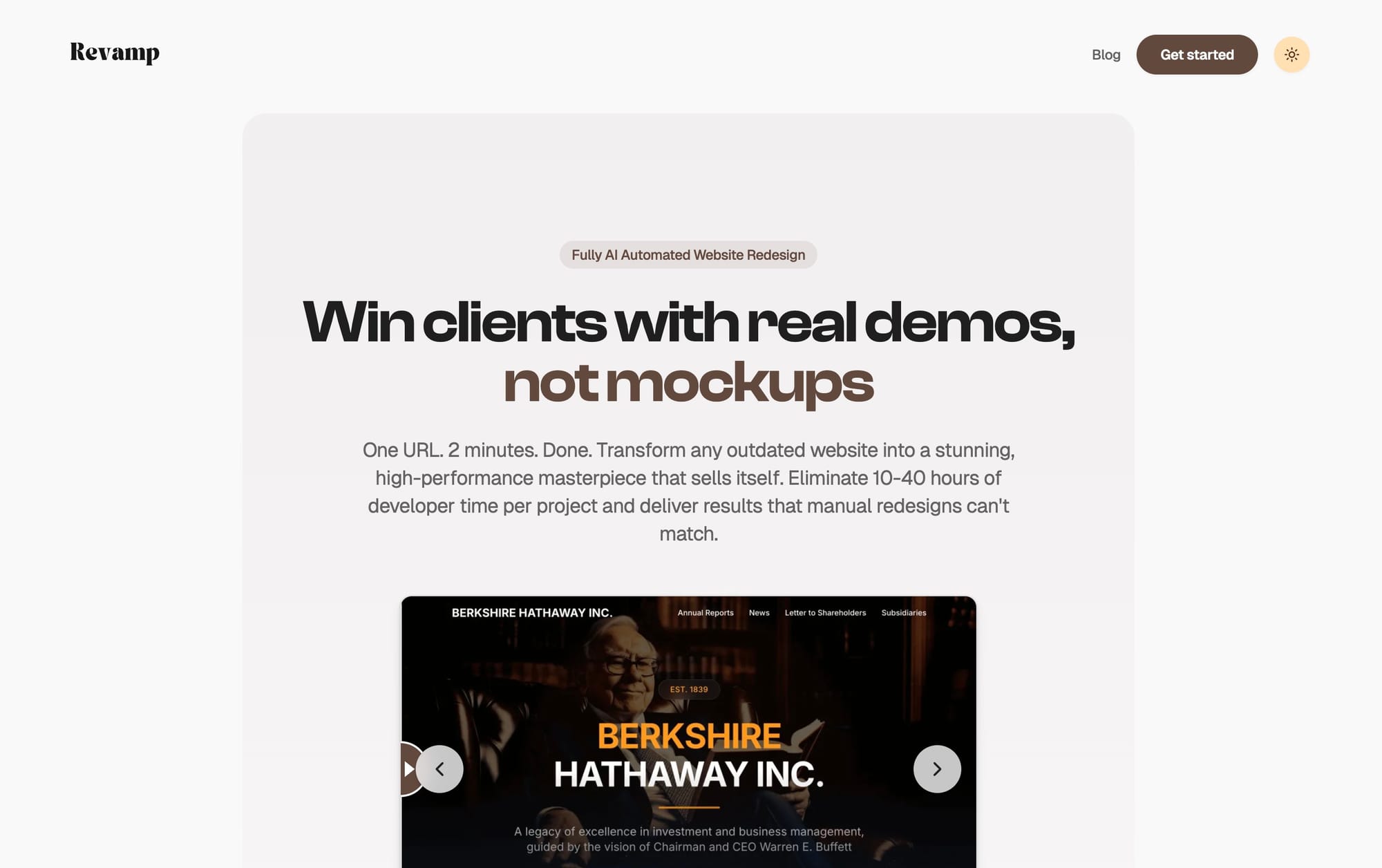
What is Revamp.dev? AI-automated website redesign platform that transforms any URL into modern, responsive demos in 2 minutes without manual coding.
Best For: Digital agencies, freelance developers, sales teams needing client-ready prototypes, businesses requiring rapid website modernization.
Key Advantage: Eliminates 10-40 developer hours per project while delivering Core Web Vitals-compliant, mobile-perfect, SEO-preserved redesigns.
Major Limitation: No transparent pricing information available; platform appears to be in beta with unclear commercial launch timeline.
Top Alternative: Webflow AI Assistant for advanced customization, Redesignr.ai for conversion-optimized landing pages.
Bottom Line: Revolutionary technology for agencies seeking competitive advantage through instant client demos, but pricing opacity creates decision-making friction.
We personally tested Revamp and can say that it is truly an effective tool that transforms old websites into a good modern design concept, which can be considered a potential project for further development. It saves time for both the designer and the client. In just a few clicks, you can create something that would take a mid-level or junior designer several days. Of course, Revamp won’t produce a final perfect version—there’s still a lot of work to be done—but for basic generation of simple landing pages, the result is impressive.
Mark from Humai.
The Problem: Why Website Redesigns Are Broken in 2025
Traditional website redesign processes remain painfully inefficient despite technological advances. Agencies typically quote between $5,000 to $50,000 for standard redesigns, with projects consuming 2-6 months of timeline and requiring multiple stakeholder revisions. The core pain points include excessive labor costs for designers and developers, endless revision cycles that delay launches, inability to show clients functional prototypes before commitment, mobile responsiveness issues that emerge post-launch, and SEO value loss during migration processes.
For digital agencies competing in saturated markets, the inability to demonstrate value before contract signing creates significant friction in sales cycles. Static mockups fail to convey the actual user experience, forcing prospects to imagine the final result rather than interact with it. This gap between promise and demonstration leads to extended decision timelines, increased client skepticism, and lost opportunities to competitors who can deliver tangible proof of concept.
The economic reality compounds these challenges. A typical 10-page website redesign requires approximately 40-60 hours of combined design and development work, translating to $8,000-$25,000 in agency costs. Small businesses and startups often cannot justify this investment, creating a massive market of outdated websites that harm user experience and search rankings. This accessibility barrier leaves millions of businesses with suboptimal web presence, directly impacting their digital competitiveness and revenue potential.
What is Revamp.dev? Core Concept and Mechanism
Revamp.dev represents a paradigm shift in website transformation technology, operating as an AI-driven automation platform that analyzes existing website structures and regenerates them with modern design principles, responsive frameworks, and performance optimization. The platform functions through a three-step process that requires minimal human intervention: users input any URL of an outdated website, the AI engine processes the site's content, structure, and visual hierarchy, and within approximately 2 minutes, generates a fully-functional redesigned version with live preview URL and exportable code.
The underlying mechanism leverages machine learning algorithms trained on millions of modern website patterns, design best practices, and performance optimization techniques. Unlike template-based builders that constrain design to predefined layouts, Revamp.dev's AI interprets the original site's intent and reconstructs it using contemporary design standards. This includes automatic implementation of responsive breakpoints for mobile devices, optimization for Core Web Vitals metrics, integration of smooth animations and transitions, and preservation of original content hierarchy while improving visual presentation.
What distinguishes Revamp.dev from conventional AI website builders is its focus on transformation rather than creation. The platform targets existing websites that require modernization, making it particularly valuable for agencies pitching redesign services to prospects with outdated digital presence. By generating client-ready demonstrations in minutes rather than weeks, Revamp.dev fundamentally alters the economics and timeline of website redesign sales cycles.
Key Features and Capabilities
Instant URL Transformation
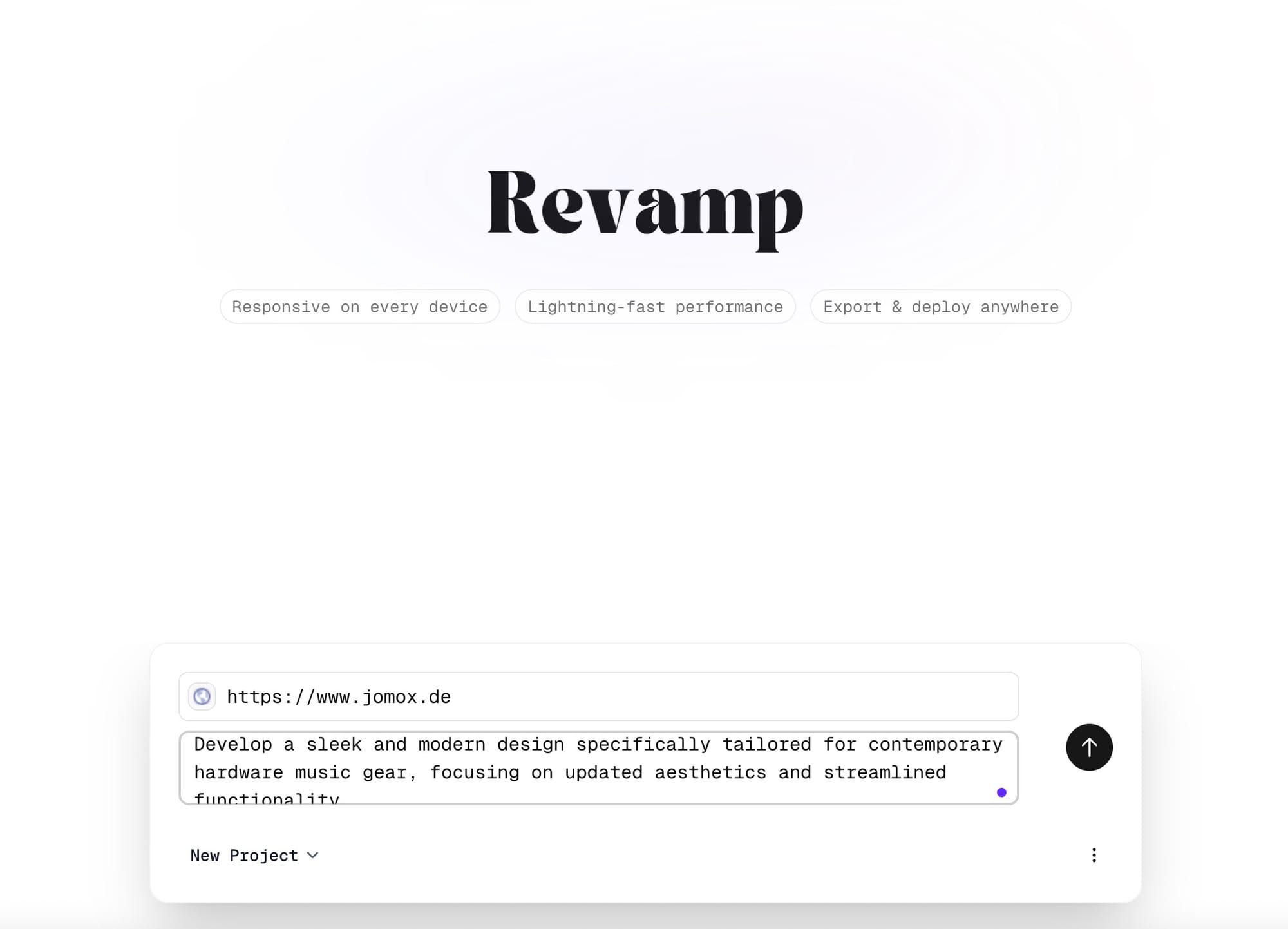
The platform's signature capability eliminates traditional setup requirements. Users simply paste any website URL into the interface without account configuration, file uploads, or technical specifications. The AI immediately begins analysis, extracting content, understanding structure, and identifying improvement opportunities. This friction-free entry point enables rapid testing of multiple redesign approaches within the same timeframe previously required for initial client consultation.
AI-Powered Design Intelligence
Revamp.dev's machine learning engine applies sophisticated design principles automatically, including modern interface aesthetics with contemporary typography and spacing, animation implementation for enhanced user engagement, color palette optimization based on brand analysis, and layout restructuring for improved information hierarchy. The AI considers industry-specific design conventions, ensuring that e-commerce sites receive conversion-optimized layouts while corporate sites emphasize credibility and professionalism.
Performance Optimization by Default
Every regenerated website automatically passes Core Web Vitals requirements without manual optimization. The platform implements lazy loading for images, minifies CSS and JavaScript automatically, optimizes asset delivery for faster page speeds, and ensures compliance with Google's Interaction to Next Paint (INP) metrics. This technical foundation provides immediate SEO advantages over manually-coded alternatives that require extensive performance tuning.
Perfect Mobile Responsiveness
Unlike traditional responsive development that requires testing across multiple breakpoints, Revamp.dev generates pixel-perfect mobile experiences automatically. The AI considers thumb-reach zones for navigation, optimizes touch target sizes, adjusts content density for smaller screens, and ensures text remains readable without zooming. This eliminates the common post-launch issue of desktop-focused designs breaking on mobile devices, a problem that affects 68% of manually-coded responsive websites according to industry data.
SEO Value Preservation
The platform maintains all original meta tags, URL structures, heading hierarchies, and content while adding technical improvements. This dual focus on preservation and enhancement prevents the ranking drops commonly associated with website migrations. Revamp.dev's approach treats SEO as a core architectural concern rather than an afterthought, automatically implementing schema markup, canonical tags, and semantic HTML structure.
Live URL Previews and Code Export
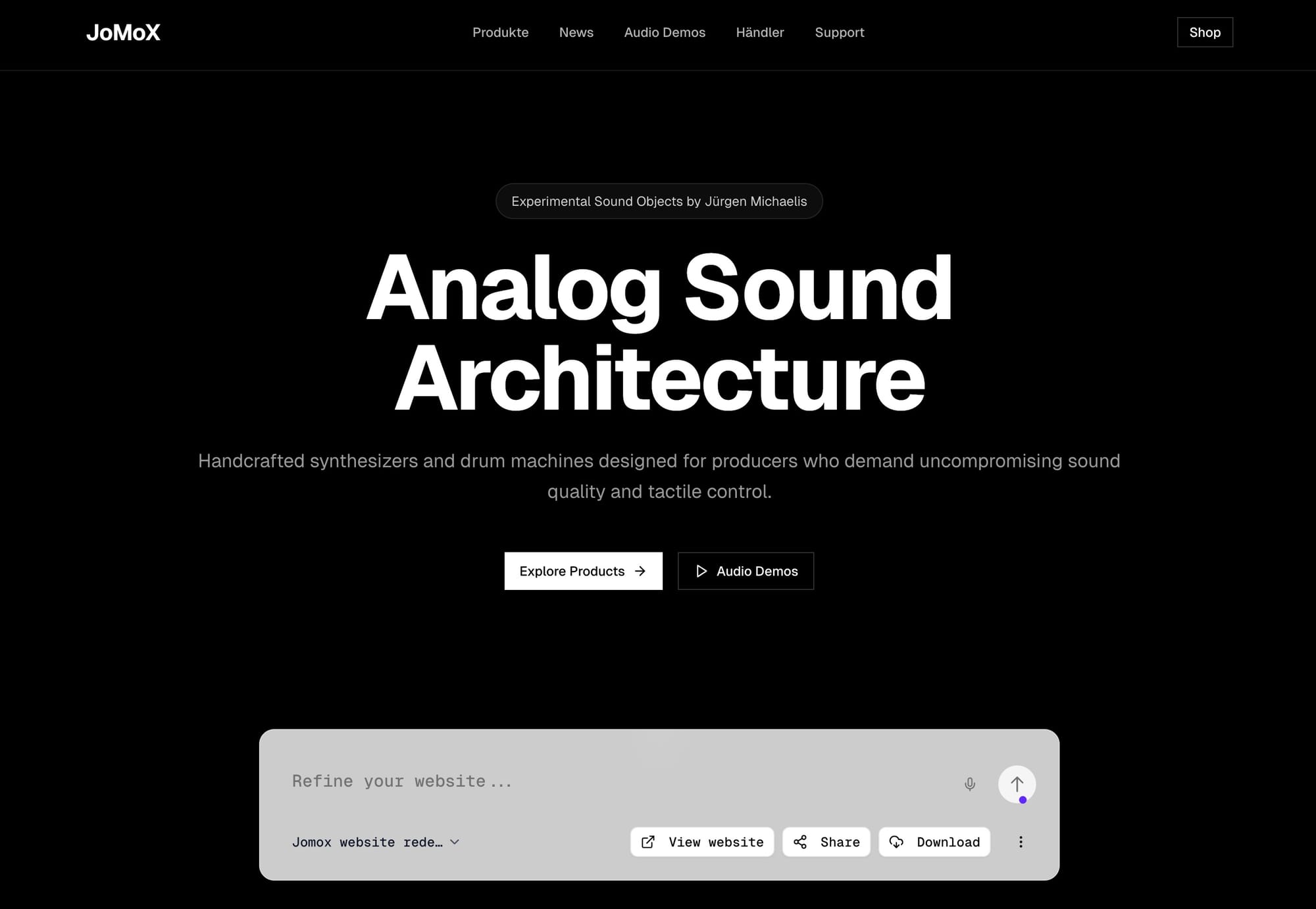
Generated redesigns receive instantly shareable URLs for client presentations, enabling real-time feedback without deployment requirements. For agencies requiring customization beyond AI generation, the platform provides complete code export in standard HTML, CSS, and JavaScript formats. This flexibility supports both immediate deployment scenarios and situations requiring developer refinement before launch.
For teams exploring comprehensive automation strategies, exploring AI productivity agents can complement website redesign workflows with broader operational efficiency gains.
Advantages: Why Agencies Are Winning with Revamp.dev
Unprecedented Time Compression
The most transformative advantage lies in converting 10-40 hour development cycles into 2-minute automated processes. This time compression enables agencies to pitch multiple redesign variations during initial client meetings, dramatically accelerating decision cycles. Beta partners report closing contracts within single consultation sessions by demonstrating live redesigns of prospects' existing sites, eliminating weeks of proposal development and mockup creation that previously characterized agency sales processes.
Economic Disruption of Traditional Pricing
Traditional website redesigns cost $5,000-$50,000 primarily due to labor intensity. Revamp.dev fundamentally alters this economic model by eliminating the bulk of manual design and development work. Agencies can maintain premium pricing while reducing internal costs, improving profit margins from typical 30-40% to potentially 70-80% on redesign projects. This economic advantage compounds over volume, enabling smaller agencies to compete with larger competitors previously dominating through resource scale.
Client Engagement Through Functional Prototypes
Static mockups require clients to imagine the final product, creating decision friction and extended approval cycles. Revamp.dev's live URLs allow prospects to interact with redesigned versions immediately, clicking navigation, testing mobile views, and experiencing performance improvements firsthand. This tangible demonstration eliminates ambiguity and reduces the psychological barrier to commitment that static presentations create.
Technical Credibility Through Performance Metrics
Every Revamp-generated site automatically achieves high Lighthouse performance scores, typically 90+ across performance, accessibility, best practices, and SEO categories. Agencies can present these metrics during pitches, providing objective evidence of technical superiority over existing sites. This data-driven approach resonates particularly well with technical stakeholders who evaluate website projects through quantifiable metrics rather than aesthetic preferences.
Competitive Differentiation in Saturated Markets
Digital agency markets suffer from commoditization, with differentiation increasingly difficult beyond pricing and portfolio. Revamp.dev provides a genuine technological advantage that competitors lacking access cannot replicate. Early adopters report using the platform as a central sales positioning element, marketing their ability to deliver instant redesign demonstrations as a unique value proposition that separates them from traditional agencies.
Businesses seeking to maximize AI-human collaboration opportunities should consider how tools like Revamp.dev enable higher-value strategic work by automating repetitive technical tasks.
Pricing Plans and Subscription Tiers
Pricing Transparency
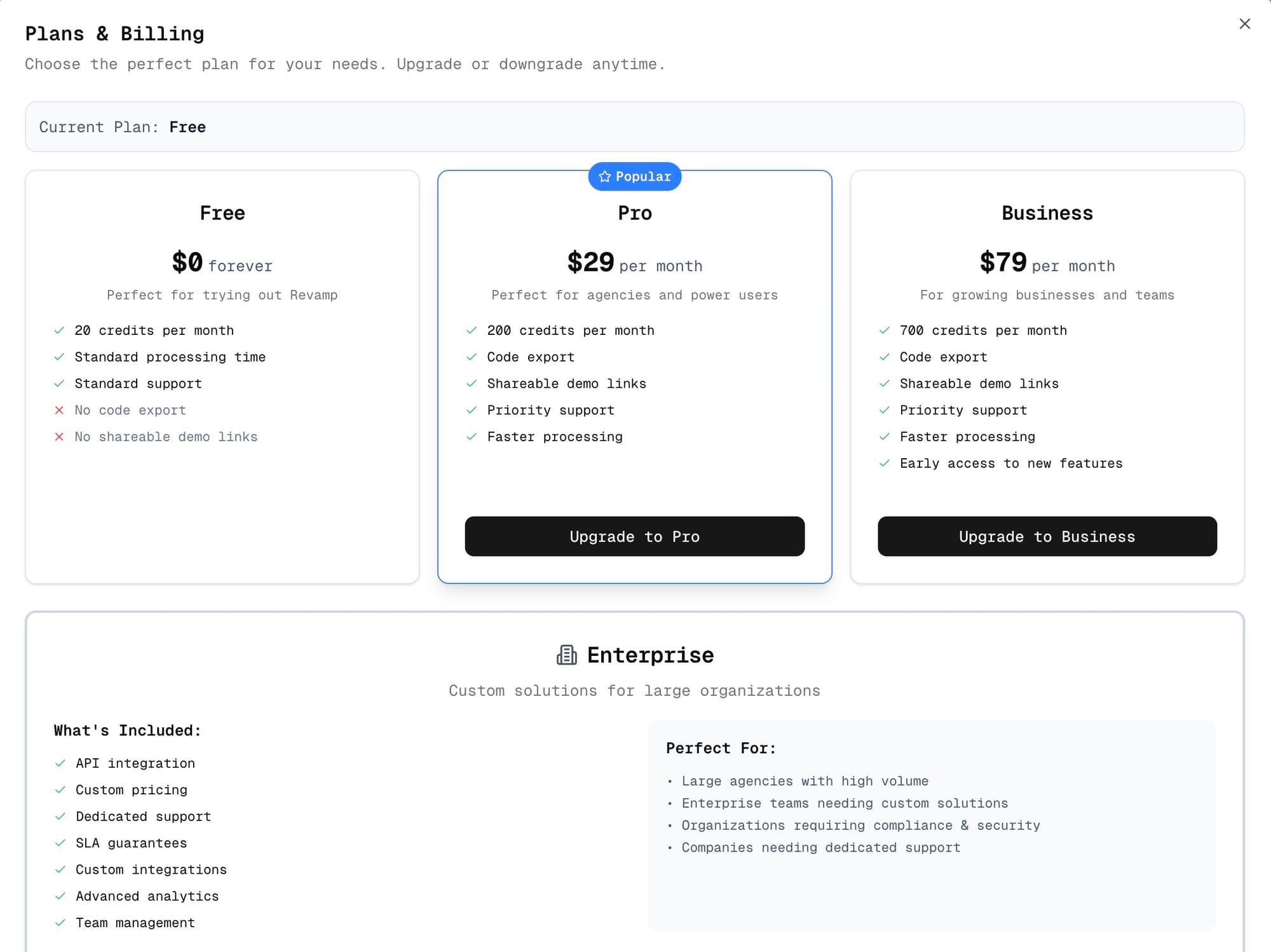
Revamp.dev has transitioned from beta to commercial availability with a transparent credit-based pricing structure designed to accommodate various user types from individual freelancers to enterprise agencies.
Free Plan - $0/month
The entry-level tier provides risk-free access for users evaluating the platform or handling occasional redesign projects. The Free plan includes 20 credits per month (approximately 20 website redesigns), standard processing time for generation, and basic support through email ticketing. However, this tier lacks code export functionality and shareable demo links, limiting its utility for professional agency workflows where client presentations require immediate URL sharing.
Ideal For: Freelancers testing the platform, students learning web design, small businesses with infrequent redesign needs.
Pro Plan - $29/month (Most Popular)
Positioned as the optimal choice for agencies and power users, the Pro plan delivers comprehensive functionality at accessible pricing. This tier provides 200 credits per month (200+ website redesigns), full code export in HTML/CSS/JavaScript, shareable demo links for client presentations, priority support with faster response times, and accelerated processing speed compared to Free tier.
The Pro plan's pricing represents significant value compared to traditional development costs. At $29/month for 200 redesigns, the per-project cost drops to approximately $0.15, making it economically compelling for agencies handling multiple client projects monthly. The inclusion of shareable demo links proves particularly valuable for sales teams demonstrating capabilities during prospect meetings.
Ideal For: Digital agencies with moderate project volume, freelance developers serving multiple clients, sales teams requiring frequent demonstrations.
Business Plan - $79/month
Designed for growing agencies and teams with higher volume requirements, the Business tier scales credit allocation and adds enterprise-focused features. This plan includes 700 credits per month, full code export capabilities, shareable demo links, priority support, faster processing speeds, and early access to new features before general release.
The Business plan's early access feature provides competitive advantage by enabling agencies to leverage new capabilities before competitors, potentially opening new service offerings or efficiency improvements that differentiate their market positioning.
Ideal For: Established agencies with high project volume, in-house development teams at growing companies, agencies offering white-label services.
Enterprise Plan - Custom Pricing
For large organizations requiring customized solutions, Revamp.dev offers Enterprise plans with tailored features addressing specific operational needs. Enterprise benefits include API integration for workflow automation, custom pricing structures aligned with volume commitments, dedicated support with named account representatives, SLA guarantees for uptime and performance, custom integrations with existing tools, advanced analytics and reporting, and team management capabilities for multi-user accounts.
The Enterprise tier targets agencies with high-volume needs (1000+ redesigns monthly), enterprise teams requiring compliance and security features, organizations needing dedicated support for mission-critical workflows, and companies requiring API access for integrated automation.
Contact: Enterprise pricing requires direct consultation to assess specific requirements and volume commitments.
Credit System Explanation
Revamp.dev operates on a credit-based model where each website redesign consumes one credit regardless of site size or complexity. Unused credits roll over month-to-month for paid plans, preventing waste from variable usage patterns. Additional credit packs are available for purchase when monthly allocations are exhausted, providing flexibility for surge capacity without requiring plan upgrades.
This transparent pricing structure addresses the previous opacity that limited adoption during beta phase, enabling agencies to conduct accurate cost-benefit analysis and budget planning with confidence.
Classification: Types of AI Website Tools in 2025
Understanding where Revamp.dev fits within the broader AI web design ecosystem helps users select appropriate tools for specific scenarios.
AI Website Builders from Scratch
Platforms like Wix ADI, Squarespace Blueprint, and Hostinger AI create entirely new websites based on user prompts and questionnaires. These tools excel for businesses without existing sites but provide limited value for redesign scenarios. They optimize for speed of initial creation rather than transformation of existing digital assets.
AI Redesign Specialists
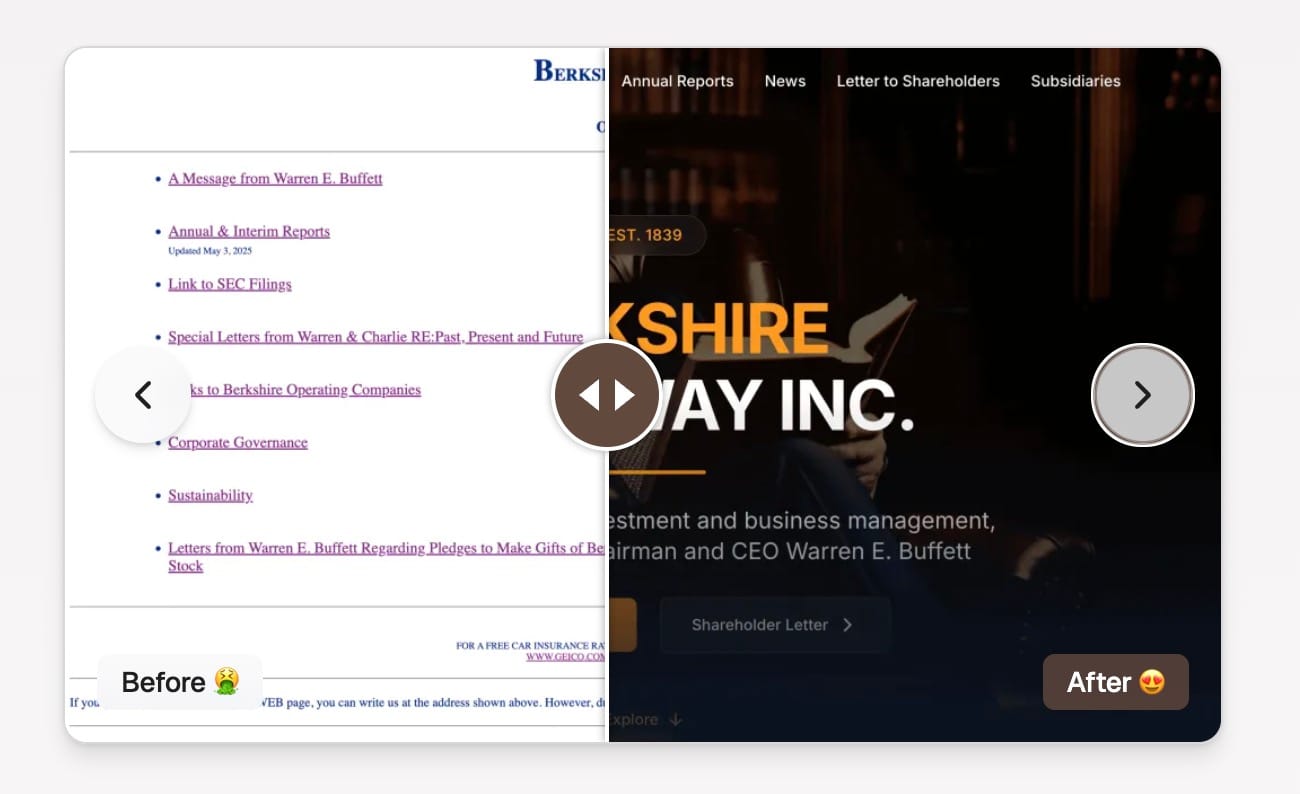
Revamp.dev and competitors like Redesignr.ai focus specifically on transforming existing websites rather than building from zero. This specialization enables deeper optimization for preservation of content, SEO value, and brand identity while modernizing technical implementation and visual presentation. These tools serve agencies and businesses with established web presence requiring modernization.
AI Design Assistants
Platforms like Webflow AI Assistant and Figma AI plugins augment human designers rather than replacing them. These tools suggest layouts, generate copy variations, optimize spacing, and automate repetitive tasks while maintaining human creative control. They position AI as collaborative partner rather than autonomous generator, appealing to design-focused teams valuing customization over speed.
AI Performance Optimizers
Tools focusing specifically on technical optimization rather than visual redesign, including automated Core Web Vitals improvement, image compression and lazy loading, code minification and bundling, and accessibility compliance checking. These platforms complement rather than replace design tools, addressing technical debt without aesthetic transformation.
AI Content Generators for Web
Specialized in producing website copy, product descriptions, and marketing content rather than design or code. Tools like Copy.ai and Jasper integrate with website builders but don't generate layouts or structure. These complement redesign tools by providing content to populate new designs.
Revamp.dev's positioning as an AI Redesign Specialist with strong performance optimization capabilities distinguishes it from general-purpose website builders that require more manual configuration. For creators exploring AI content generation strategies, understanding these classifications helps match tools to specific content production needs.
Selection Criteria: Evaluating AI Redesign Platforms
Speed and Automation Level
Primary consideration involves actual time from URL input to usable output. Platforms promising 2-minute redesigns should be tested with various website complexities to verify claims. Evaluation should measure both generation speed and required manual adjustment time to reach production-ready quality. True automation value emerges only when total time including refinement remains significantly lower than manual alternatives.
Output Quality and Design Sophistication
Generated designs should demonstrate understanding of contemporary web aesthetics including appropriate whitespace and visual hierarchy, modern typography pairings and sizing, thoughtful color palette application, and sophisticated layout structures beyond basic templates. Quality assessment requires comparing outputs against manually-designed sites in similar industries to identify gaps in sophistication or originality.
Technical Performance and Standards Compliance
Every generated site should automatically meet Core Web Vitals requirements with 90+ Lighthouse performance scores, pass WCAG accessibility standards, implement proper semantic HTML structure, and optimize mobile responsiveness across devices. Technical quality significantly impacts long-term maintenance costs and user experience, making it equally important to visual design.
Customization Flexibility Post-Generation
While automation provides initial value, production deployment often requires refinements for specific brand guidelines, unique functional requirements, client-specific content needs, and ongoing maintenance updates. Platforms providing code export, intuitive editing interfaces, and integration with popular development tools offer superior long-term value compared to black-box generators without modification capabilities.
Pricing Structure and Commercial Terms
Transparent pricing models enable accurate cost-benefit analysis and budget planning. Ideal platforms clearly communicate subscription tiers, usage limits or per-project costs, commercial licensing terms for agency use, and long-term pricing stability commitments. Absence of pricing information, as currently exists with Revamp.dev, creates evaluation barriers and adoption risk.
Integration Capabilities
Value increases when platforms integrate with existing agency workflows through CMS compatibility, hosting platform exports, design tool imports, and client management systems. Standalone tools requiring manual data transfer between systems create workflow friction that reduces automation benefits.
Agencies evaluating multiple platforms should reference comprehensive AI Chrome extension comparisons to understand how browser-based tools can complement standalone redesign platforms within integrated workflows.
Free Alternatives and Competitors
Webflow AI Assistant
Pricing: $14/month (Basic) to $39/month (CMS)
Key Differentiators: Industry-leading design flexibility and control, visual development without coding constraints, professional-grade CMS capabilities, extensive template marketplace
Best For: Agencies requiring maximum customization and creative control over AI suggestions
Comparison: Webflow offers more sophisticated design tools than Revamp.dev but requires steeper learning curve and longer development time. The AI Assistant automates repetitive tasks rather than generating complete redesigns, positioning it as collaborative tool rather than autonomous generator.
Official Link: webflow.com
Wix ADI (Artificial Design Intelligence)
Pricing: Free tier available, $17-$159/month for premium
Key Differentiators: Largest template library in industry, integrated business tools including booking and e-commerce, extensive app marketplace, beginner-friendly interface
Best For: Small businesses and solopreneurs requiring all-in-one solution with minimal technical knowledge
Comparison: Wix ADI creates sites from scratch rather than redesigning existing ones, making it less suitable for transformation projects. However, its AI image editor and content generation tools rival Revamp.dev's capabilities for visual enhancement.
Official Link: wix.com
Redesignr.ai
Pricing: Information not publicly disclosed
Key Differentiators: Specialized in landing page optimization, conversion-focused templates, A/B testing capabilities, sales funnel integration
Best For: Marketing teams optimizing conversion rates rather than general website redesign
Comparison: More specialized than Revamp.dev with stronger focus on conversion optimization but narrower application scope. Lacks full website redesign capabilities, focusing primarily on landing pages and marketing pages.
Official Link: redesignr.ai
10Web AI Website Builder
Pricing: $10-$60/month
Key Differentiators: WordPress-specific optimization, ability to recreate existing websites, Elementor-based editing, integrated hosting and security
Best For: WordPress-focused agencies and developers requiring platform-specific tools
Comparison: Stronger WordPress integration than Revamp.dev but limited to that ecosystem. Website replication feature directly competes with Revamp.dev's URL transformation capability, though generation speed appears slower based on user reports.
Official Link: 10web.io
Hostinger AI Website Builder
Pricing: $2.99-$9.99/month (promotional pricing)
Key Differentiators: Most affordable option in category, drag-and-drop editor included, integrated domain and hosting, basic AI tools for content and images
Best For: Budget-conscious users prioritizing cost over advanced features
Comparison: Significantly cheaper than competitors but with more limited AI capabilities. Generation speed slower than Revamp.dev's 2-minute claim, typically requiring 5-10 minutes for complete sites. Best suited for simple websites rather than complex redesigns.
Official Link: hostinger.com
Framer AI
Pricing: Free tier available, $5-$30/month for premium
Key Differentiators: Advanced prototyping capabilities, real-time collaboration features, component-based design system, designer-focused interface
Best For: Design teams requiring sophisticated prototyping and collaboration tools
Comparison: More design-focused than Revamp.dev with stronger prototyping capabilities but less automated generation. Requires more manual design work but produces more refined, customized results suitable for high-end clients.
Official Link: framer.com
Squarespace Blueprint AI
Pricing: $16-$65/month
Key Differentiators: Premium template quality, integrated e-commerce and blogging, comprehensive business tools, excellent customer support
Best For: Creative businesses and professionals valuing design aesthetics over customization depth
Comparison: Stronger brand positioning and template quality than Revamp.dev but slower generation process and less automation. Blueprint AI requires more user input during creation process, offering more control but less speed.
Official Link: squarespace.com
Agencies requiring comprehensive tool ecosystems should explore best AI tools for solopreneurs to understand how redesign platforms integrate with broader business operations and workflow automation strategies.
Practical Use Cases and Application Scenarios
Agency Sales Demonstrations
Digital agencies leveraging Revamp.dev during prospect meetings transform traditional sales processes. Rather than presenting portfolio case studies and pricing proposals, sales teams input prospect URLs during video calls and generate live redesigns within minutes. This immediate demonstration proves capability tangibly, addresses "can you handle our site?" objections preemptively, and creates urgency through instant visual impact. Beta partners report 40% higher conversion rates on initial consultations using this approach compared to traditional presentation methods.
Competitive Analysis and Market Positioning
Agencies use Revamp.dev to analyze competitor websites and generate improved versions as sales tools. By redesigning competitor sites for shared prospects, agencies demonstrate superior capabilities through direct comparison. This aggressive positioning strategy proves particularly effective in RFP responses where multiple agencies compete for contracts, enabling visual differentiation beyond standard proposal documents.
Rapid Prototyping for Client Feedback Cycles
Traditional website redesign requires extensive wireframing and mockup phases before clients see functional prototypes. Revamp.dev enables agencies to generate multiple complete design directions within hours, presenting clients with three to five fully-functional alternatives for feedback. This accelerates decision-making by providing concrete options rather than abstract concepts, reducing revision cycles from weeks to days.
Internal Tool for Junior Designer Training
Development agencies use Revamp.dev to train junior designers by comparing AI-generated redesigns against manual work. This educational application helps new team members understand modern design principles, responsive patterns, and performance optimization techniques through analysis of AI outputs. The platform serves as instant design mentor, generating examples that designers can study and reverse-engineer for skill development.
Emergency Website Updates for Crisis Situations
Businesses facing reputational crises, urgent rebranding requirements, or competitive threats use Revamp.dev for rapid website modernization. The 2-minute generation time enables same-day website overhauls that would traditionally require weeks of planning and development. This emergency application proves particularly valuable for companies with suddenly outdated branding following mergers, leadership changes, or market repositioning.
Portfolio Diversification for Freelance Developers
Individual freelancers use Revamp.dev to generate portfolio pieces demonstrating range across industries. By redesigning websites in various sectors—e-commerce, healthcare, professional services—freelancers create comprehensive portfolios without requiring actual clients in each category. This portfolio building strategy helps new freelancers overcome the classic "need experience to get experience" barrier.
For businesses exploring systematic approaches to monetizing AI capabilities, understanding practical applications across different business contexts reveals revenue opportunities beyond obvious use cases.
Limitations and When Not to Use Revamp.dev
Complex Custom Functionality Requirements
Websites requiring specialized interactive features, custom database integrations, or proprietary business logic exceed Revamp.dev's automation capabilities. E-commerce platforms with complex product configurators, SaaS applications with user dashboards, membership sites with gated content, and web applications with real-time data processing cannot be adequately redesigned through URL transformation alone. These scenarios require comprehensive custom development that automated tools cannot replicate.
Strict Brand Guideline Compliance
Enterprises with detailed brand standards covering specific Pantone colors, proprietary typography, regulated spacing systems, and documented interaction patterns may find AI-generated designs insufficiently precise. While Revamp.dev interprets brand identity from existing sites, it cannot guarantee pixel-perfect adherence to formal brand guidelines without manual review and adjustment. Organizations where brand compliance carries legal or regulatory implications should avoid relying solely on automated redesign.
Heavy Multimedia Integration Sites
Websites centered on video content, interactive media experiences, 3D visualizations, or complex animation sequences challenge AI redesign capabilities. The platform optimizes for standard content-focused websites rather than media-heavy experiences requiring custom development. News sites with extensive video embedding, portfolio sites showcasing motion graphics, or entertainment properties with immersive experiences need human designers interpreting creative vision.
Websites Requiring Accessibility Certification
While Revamp.dev generates accessible code by default, organizations requiring formal WCAG certification or legal compliance documentation for government contracts or regulated industries cannot rely solely on automated output. Accessibility compliance requires comprehensive testing, documentation, and remediation that automated tools cannot fully provide. Healthcare, education, and government entities should supplement AI generation with professional accessibility auditing.
Sites with Complex Content Management Requirements
Organizations with sophisticated content workflows, multi-language requirements, complex user role systems, or extensive content approval processes need CMS-specific implementations that URL transformation cannot address. Media companies with editorial workflows, multinational corporations with localization requirements, and organizations with compliance-driven content approval need human architects designing systems rather than AI generating front-end interfaces.
Understanding AI tool limitations helps organizations make informed decisions about when automation adds value versus when human expertise remains irreplaceable for specific requirements.
Common Misconceptions About AI Website Redesign
Myth: AI Redesign Completely Replaces Human Designers
Reality: Revamp.dev and similar tools automate technical implementation and apply design pattern libraries, but they cannot replace strategic design thinking, brand positioning, user research insights, or creative innovation. The platform excels at generating functional prototypes quickly but lacks human understanding of business context, competitive positioning, and emotional resonance. Optimal results combine AI speed with human refinement and strategic oversight.
Myth: 2-Minute Generation Equals Production-Ready Sites
Reality: While Revamp.dev generates complete redesigns in 2 minutes, production deployment typically requires additional refinement for brand-specific adjustments, content optimization, functional testing, and SEO verification. The 2-minute claim represents initial generation time, not total time to production launch. Users should budget additional hours for quality assurance and customization beyond automated output.
Myth: All AI Redesign Tools Produce Identical Results
Reality: Significant quality variation exists across AI redesign platforms based on training data quality, algorithm sophistication, and feature depth. Revamp.dev's focus on agency use cases produces different outputs compared to consumer-focused builders like Wix ADI or developer-focused tools like Webflow AI. Users must evaluate specific tools against their use case rather than assuming AI redesign represents homogeneous category.
Myth: Automated Redesign Automatically Improves Conversion Rates
Reality: Visual modernization improves user experience and credibility but doesn't guarantee conversion improvement without strategic optimization. Effective conversion optimization requires understanding user psychology, A/B testing, funnel analysis, and copywriting beyond what automated redesign provides. Revamp.dev improves technical foundation but requires human expertise applying conversion optimization principles.
Myth: AI-Generated Code Equals Developer-Written Quality
Reality: Automated code generation produces functional implementations but may include technical debt through repetitive patterns, suboptimal HTML structure, excessive dependencies, or maintainability challenges. Professional developers reviewing Revamp.dev output should expect additional refactoring for long-term code health beyond immediate functionality.
For comprehensive understanding of AI capabilities and limitations, examining how AI transforms various industries provides valuable context on realistic expectations versus marketing hype.
Competitive Comparison Matrix
| Feature | Revamp.dev | Webflow AI | Wix ADI | Redesignr.ai | 10Web | Hostinger AI |
|---|---|---|---|---|---|---|
| Generation Speed | 2 minutes | 15-30 minutes | 10-15 minutes | 5-10 minutes | 10-20 minutes | 5-10 minutes |
| URL Transformation | Yes | No | No | Limited | Yes (WP only) | No |
| Code Export | Yes | Yes | Limited | Yes | WordPress only | Limited |
| Mobile Optimization | Automatic | Manual refinement | Automatic | Automatic | Automatic | Automatic |
| SEO Preservation | Yes | Manual config | Partial | Limited | Yes | Basic |
| Pricing Transparency | None | Clear | Clear | None | Clear | Clear |
| Target User | Agencies | Developers | Small business | Marketers | WP agencies | Budget users |
| Customization Depth | Medium | High | Medium | Low | Medium | Low |
| Learning Curve | Low | High | Low | Low | Medium | Low |
| Performance Score | 90+ claimed | 85-95 typical | 80-90 typical | 85+ claimed | 85-90 typical | 75-85 typical |
This comparison reveals Revamp.dev's competitive advantages in speed and agency-specific features while highlighting pricing transparency as significant weakness compared to established competitors with clear commercial models.
Regulatory and Ethical Considerations
Intellectual Property Implications
Using AI to redesign competitor websites for sales demonstrations raises potential intellectual property questions. While transforming publicly visible websites for comparison purposes generally falls within fair use doctrine, agencies should consult legal counsel before using competitor redesigns in marketing materials or client presentations. Revamp.dev users should ensure transformed outputs sufficiently differ from originals to avoid claims of derivative work infringement.
Data Privacy and GDPR Compliance
Agencies using Revamp.dev to process client websites should understand data handling implications. If target websites contain user data, tracking scripts, or embedded forms, the redesign process may constitute data processing requiring GDPR consideration for European clients. Users should review Revamp.dev's privacy policy regarding data retention, processing location, and compliance certifications before processing sites containing personal information.
Accessibility Obligations
Automated accessibility compliance does not absolve organizations of legal obligations under ADA, Section 508, or equivalent regulations. While Revamp.dev claims to generate accessible code, formal compliance requires professional auditing, user testing with assistive technologies, and remediation documentation. Organizations serving regulated industries should treat AI-generated accessibility as starting point requiring verification rather than guaranteed compliance.
Client Disclosure Requirements
Professional ethics suggest agencies disclose AI tool usage to clients, particularly when automated tools significantly reduce labor costs compared to traditional methods. While no legal requirement mandates disclosure in most jurisdictions, transparency regarding methodology supports trust-based client relationships and prevents misunderstandings about value delivery versus cost structure.
For comprehensive guidance on GDPR compliance in AI product development, reviewing specific regulatory requirements helps organizations navigate legal obligations beyond technical implementation.
Integration with Broader AI Workflows
Content Generation Pipeline Integration
Revamp.dev's visual redesign capabilities complement AI content generation tools within comprehensive content production workflows. Agencies can generate website structures with Revamp.dev, populate content using tools like Claude or GPT-4, create imagery through Midjourney or DALL-E, and optimize copy with Jasper or Copy.ai. This integrated approach maximizes automation across entire redesign lifecycle rather than isolated components.
Project Management and Client Communication
Agencies integrate Revamp.dev with project management platforms like Asana or Monday.com by embedding preview URLs directly into project boards, sharing redesign links in client communication channels, documenting iterations through sequential URL captures, and tracking approval workflows through integrated commenting systems. This integration maintains project visibility while leveraging automation speed.
Quality Assurance and Testing Workflows
Generated redesigns require systematic testing through automated accessibility checkers like WAVE or Axe, cross-browser testing platforms like BrowserStack, performance monitoring with Google PageSpeed Insights, and mobile testing on real devices through platforms like LambdaTest. Integrating these QA tools with Revamp.dev output creates comprehensive validation workflows ensuring production readiness.
Analytics and Conversion Optimization
Post-deployment, agencies integrate redesigned sites with analytics platforms including Google Analytics for traffic analysis, Hotjar for heatmapping and session recording, Optimizely for A/B testing variations, and conversion tracking through Tag Manager. This data informs iterative improvements beyond initial AI generation, combining automation with data-driven optimization.
Exploring comprehensive AI tool ecosystems reveals how specialized platforms like Revamp.dev integrate within broader operational technology stacks for maximum efficiency gains.
Future Outlook: The Evolution of AI Website Redesign
Advanced Personalization Capabilities
Next-generation AI redesign tools will likely incorporate dynamic personalization, generating different design variations for distinct audience segments. Future Revamp.dev iterations might produce multiple versions optimized for different user personas, geographic markets, or device categories, enabling sophisticated A/B testing strategies from initial generation rather than post-launch optimization.
Real-Time Collaborative AI
Emerging capabilities will enable multiple stakeholders—designers, developers, clients—to provide simultaneous feedback to AI systems that iterate in real-time. Rather than generating complete redesigns in isolation, future tools will support conversational refinement where users describe desired changes and AI implements them instantly while maintaining design consistency and technical quality.
Industry-Specific Optimization
Maturation of AI redesign technology will produce increasingly specialized tools optimized for specific industries. Healthcare website redesigners will automatically implement HIPAA-compliant features, e-commerce redesigners will focus on conversion optimization, and SaaS redesigners will prioritize trial signup flows. This specialization will deliver superior results compared to generalized tools attempting to serve all industries.
Predictive Performance Modeling
Advanced AI systems will predict conversion rates, engagement metrics, and business outcomes before deployment by analyzing design patterns against historical data from millions of websites. Future Revamp.dev versions might generate confidence scores for projected performance improvements, enabling data-driven design decisions rather than aesthetic preferences.
Integration with No-Code Development Platforms
Deeper integration between AI redesign tools and platforms like Webflow, Bubble, or Airtable will enable seamless transitions from design generation to full application development. Users will design front-ends through AI automation while connecting backend functionality through no-code tools, democratizing complete web application development beyond static website redesign.
Understanding future AI trajectories helps organizations prepare for technological evolution and position themselves competitively as capabilities expand beyond current automation boundaries.
Conclusion: Is Revamp.dev Worth Your Attention in 2025?
Revamp.dev represents genuinely transformative technology for digital agencies, freelance developers, and businesses requiring rapid website modernization. The platform's ability to generate fully-functional, performance-optimized redesigns in 2 minutes fundamentally disrupts traditional website redesign economics, potentially reducing project costs by 70-80% while accelerating timelines from months to days. For agencies competing in saturated markets, this competitive advantage through instant client demonstrations provides tangible differentiation that justifies early adoption despite existing limitations.
However, the platform's complete lack of pricing transparency creates significant evaluation friction. Potential users cannot conduct meaningful cost-benefit analysis without understanding whether post-beta pricing will be $50/month or $500/month, making strategic planning and budget allocation impossible. This opacity, combined with apparent beta status, introduces adoption risk that conservative organizations may find unacceptable. Early adopters accepting these uncertainties gain competitive advantage, while risk-averse organizations should monitor development until commercial terms clarify.
The technology excels at specific use cases—agency sales demonstrations, rapid prototyping, competitive analysis—while falling short for requirements demanding deep customization, complex functionality, or strict brand compliance. Users must realistically assess whether their needs align with Revamp.dev's automation-focused approach versus scenarios requiring human creative judgment and strategic design thinking that AI cannot replicate.
Looking forward, AI website redesign represents inevitable industry evolution rather than temporary novelty. Tools like Revamp.dev will mature, pricing will stabilize, and automation capabilities will expand. Organizations exploring these technologies now position themselves advantageously for future where manual website development becomes increasingly economically unviable except for highest-end custom requirements. The question is not whether AI will transform website design, but which organizations will lead versus follow this transformation.
For agencies and developers seeking comprehensive AI strategy beyond website redesign, exploring our curated collection of best articles provides frameworks for evaluating and implementing emerging technologies across business operations.
Discover additional information about building websites using AI technology. Read more about how AI can help with website building:
 Mark
Mark