I've been following AI hardware with a mixture of fascination and skepticism for years now. We've watched the Humane AI Pin crash and burn. We've seen the Rabbit R1 become a punchline. And yet here I am, genuinely intrigued by what OpenAI is cooking up with their new project—an AI-powered pen codenamed "Gumdrop" that could launch sometime between 2026 and 2027.
What makes this one different? Two words: Jony Ive.
Yes, that Jony Ive. The man who designed the iMac, the iPod, the iPhone, the iPad, the Apple Watch, and pretty much every piece of technology that made you go "wow, that's beautiful" over the past two decades. OpenAI didn't just hire a consultant—they acquired his entire hardware startup for $6.5 billion in 2025. That's not a partnership. That's a statement of intent.
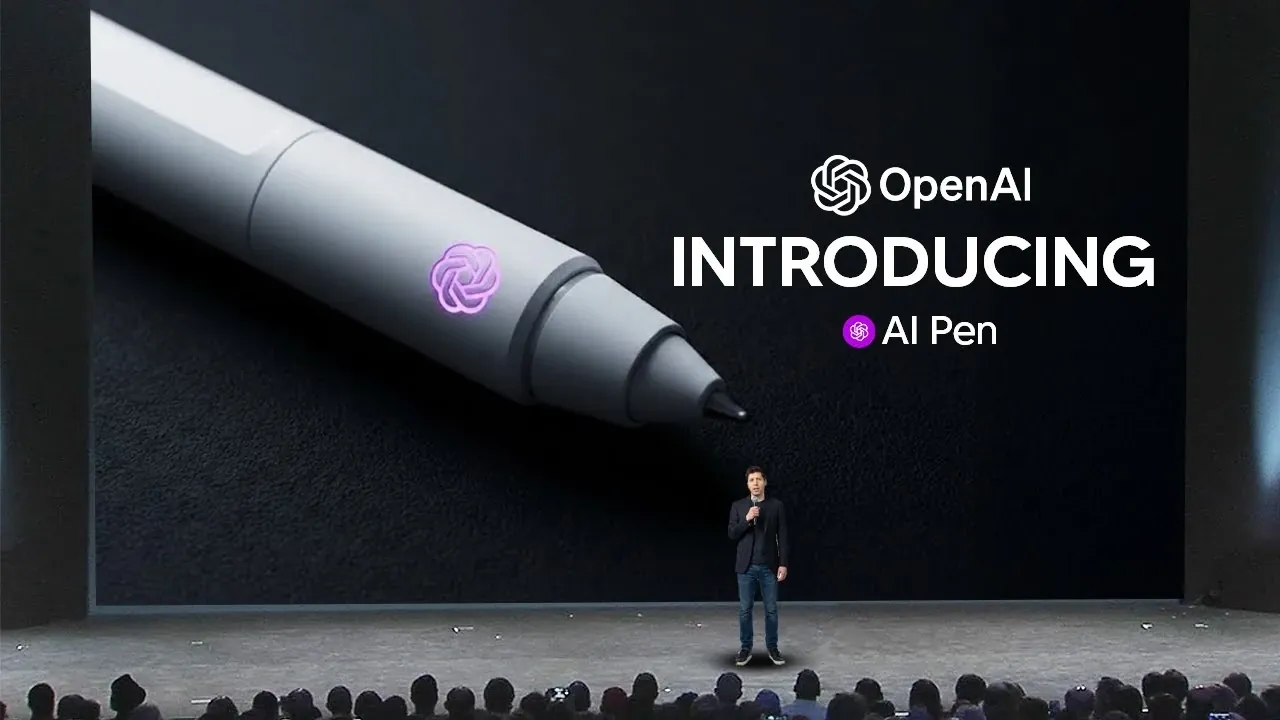
So let me walk you through everything we know about this project, why I think it has a real shot at succeeding where others have failed, and what you should realistically expect if you're considering being an early adopter.
What Exactly Is the OpenAI Gumdrop Pen?
Let's start with the basics, because the details here matter a lot.
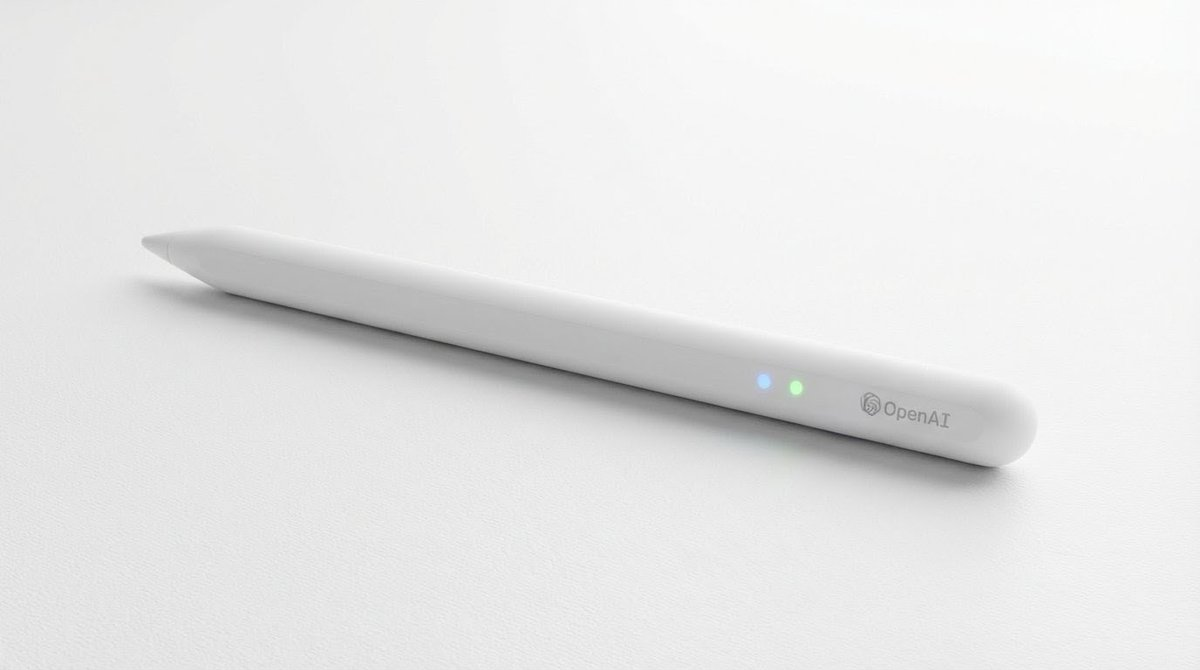
The Gumdrop—and yes, that's really the internal codename—is a pen-shaped device roughly the size of an old iPod Shuffle. It doesn't have a screen. That's intentional. OpenAI is positioning this as what they call a "third device"—something that sits alongside your smartphone and laptop rather than trying to replace either one.
According to reports from Taiwan's Economic Daily and various industry sources, the device will pack some seriously sophisticated technology into that small form factor. There's a suite of sensors including cameras and microphones that provide contextual awareness, meaning the pen can understand its environment and adapt to what you're doing. The device will run OpenAI's AI models locally for fast responses, with cloud computational support available when you need more processing power for complex tasks.
The killer feature, at least on paper, is the handwriting-to-text conversion. You write something by hand, and the pen captures it, digitizes it, and can instantly upload it to ChatGPT for processing, organization, or enhancement. Think about that for a second—you jot down meeting notes the old-fashioned way, and suddenly they're searchable, summarizable, and integrated with your AI assistant.
There's also two-way voice communication, so you can have hands-free conversations with ChatGPT through the device. Ask a question while you're cooking, get an answer while your hands are covered in flour. Need to brainstorm while you're on a walk? Just talk to your pen.
The form factor is deliberately not a wearable in the traditional sense. You might carry it in your pocket, wear it around your neck, or just keep it clipped to a notebook. The flexibility here seems intentional—OpenAI is letting users figure out how the device fits into their lives rather than dictating exactly how it should be used.
Why Jony Ive's Involvement Changes Everything
I cannot overstate how significant Jony Ive's involvement is in this project.
When OpenAI acquired his startup io Products for $6.5 billion in May 2025, they weren't just buying technology. They were buying a design philosophy that transformed an entire industry. Ive's work at Apple wasn't just about making things look nice—it was about making technology feel inevitable, like it couldn't have been designed any other way.
His design philosophy, heavily influenced by German industrial designer Dieter Rams, centers on the principle that good design is as little design as possible. Products should be simple, intuitive, and focused entirely on their core function. The best technology, in Ive's view, fades into the background—you stop noticing the device and just notice what the device lets you do.
This philosophy is exactly what AI hardware has been missing. The Humane AI Pin tried to be revolutionary with its laser projector displaying information on your palm. The Rabbit R1 packed in a bunch of features and a colorful design that made it look more like a toy than a tool. Both devices felt like they were showing off, demanding your attention rather than earning it.
If anyone can make an AI device that just works—that feels natural and unobtrusive—it's the person who made the iPhone feel like it had always existed the moment you picked it up.
Ive and OpenAI CEO Sam Altman published an open letter in May 2025 describing their vision for the collaboration. They wrote about creating tools that celebrate human achievement, that help people learn, explore, and create. They specifically mentioned wanting to build something that felt "optimistic and hopeful, inspiring and reminiscent of a time when we celebrated human achievement." That's not just marketing language. That's a design brief.
The collaboration reportedly began quietly in 2023 and gained momentum throughout 2024. By late 2025, OpenAI executives had confirmed the existence of early prototypes, with a public launch targeted for 2026 or 2027. The device was described internally as "simpler than an iPhone," which is fascinating—Ive's most famous creation, and now he's trying to make something even more focused and minimal.
Learning From the Wreckage of Failed AI Devices
To understand why the Gumdrop might succeed, you need to understand why previous AI hardware devices failed so spectacularly.
The Humane AI Pin was supposed to free us from our phones. Priced at $699 plus a $24 monthly subscription, it promised a screenless future where you could just ask your chest-mounted AI assistant anything and get answers projected onto your palm. The reality was devastating. Reviews described it as slow, inaccurate, prone to overheating, and fundamentally unable to do the basic tasks it promised. The company predicted 100,000 sales in its first year and achieved roughly 10% of that. By 2025, the product was discontinued entirely after HP acquired Humane's assets for just $116 million—far less than the $230 million the company had raised.
The Rabbit R1 wasn't quite as catastrophic, but it wasn't far behind. At $199, it was more affordable, but it still couldn't justify its existence. Reviews called it "barely reviewable" at launch. Its signature feature, a Large Action Model that was supposed to autonomously complete tasks, simply didn't work as advertised. The device ended up with only about 5,000 daily active users—a number so low it borders on irrelevant.
The pattern in both failures is clear. These devices tried to replace your smartphone without being able to do what your smartphone does. They created problems instead of solving them. They required learning new behaviors without offering enough benefit to justify the effort.
OpenAI appears to have learned from these mistakes in several crucial ways.
First, the Gumdrop isn't trying to replace your phone. It's explicitly positioned as a complement to your existing devices. You'll still have your iPhone or Android for messages, social media, apps, and all the other smartphone things. The pen is for something specific: capturing thoughts, notes, and conversations in a way that integrates with AI.
Second, OpenAI has the AI expertise to actually deliver on their promises. The Humane AI Pin and Rabbit R1 were essentially startups trying to build both cutting-edge AI and cutting-edge hardware simultaneously. OpenAI already has ChatGPT, already has voice capabilities, already has the models. They just need to package them in a useful form factor.
Third, they're taking their time. The 2026-2027 launch window gives them at least another year of development. The Humane AI Pin and Rabbit R1 both felt rushed to market, probably because their companies needed to show investors something tangible. OpenAI, with billions in funding and a proven business model, can afford to get it right.
The Technical Details That Actually Matter
Let's get into some of the technical specifics that have emerged from various reports and leaks.
Manufacturing has shifted from the original plan to use China's Luxshare. Given geopolitical tensions and supply chain concerns, OpenAI has reportedly approached Foxconn to build the device in either Vietnam or the United States. This isn't just about politics—it's about quality control. Foxconn is already OpenAI's primary manufacturing and engineering partner, handling everything from co-designing AI data centers to overseeing their deployment. Having them build the pen means a level of integration and oversight that wouldn't be possible with a different manufacturer.
The device will feature local AI processing, which is crucial for responsiveness. One of the biggest complaints about existing voice assistants is the lag—you ask a question, wait while it processes in the cloud, and eventually get an answer. By running AI models directly on the device, OpenAI can make interactions feel instant. Cloud processing will still be available for more compute-intensive tasks, but the basics should happen in real-time.
The always-on cameras and microphones are clearly the most controversial aspect. These sensors enable the contextual awareness that makes the device useful—understanding what you're doing, what you're writing, what's happening around you. But they also raise legitimate privacy concerns. Unlike your phone, which you can put face-down or in a bag, a pen might be constantly observing your environment.
OpenAI hasn't detailed their privacy approach yet, but this will be make-or-break for many potential users. The Humane AI Pin faced significant backlash over its always-on camera, with some venues banning the device entirely. OpenAI will need to implement clear visual indicators when recording is happening, robust data handling policies, and probably some form of physical privacy control.
There's also been mention of the device being able to communicate with peers—essentially, multiple Gumdrop pens being able to interact with each other. The specifics here are unclear, but you could imagine scenarios where two people in a meeting both have pens that create a shared transcript, or where notes from multiple devices automatically merge into a collaborative document.
The Pricing Question Everyone's Asking
Reports suggest the Gumdrop will be priced somewhere between $400 and $600, potentially with additional subscription fees for full functionality.
That's a significant investment. It's cheaper than the Humane AI Pin was, but more expensive than the Rabbit R1. The real question is whether the value proposition justifies that cost.
For professionals who take a lot of notes—journalists, researchers, executives, students—the ability to instantly digitize and AI-process handwritten notes could be genuinely transformative. If you're someone who fills multiple notebooks per year and struggles to organize that information, a device that handles that automatically might be worth several hundred dollars.
For the average consumer, the value proposition is less clear. Most people don't take enough handwritten notes to justify a dedicated device. They might use ChatGPT occasionally, but they access it just fine through their phone or computer.
This suggests OpenAI is probably targeting niche audiences initially—productivity enthusiasts, tech early adopters, creative professionals, and the general category of people who care intensely about how they capture and organize information. That's actually a smart approach. Build a devoted user base first, then expand as the product matures and prices come down.
The potential subscription fees are more concerning. If basic functionality requires an ongoing payment, that significantly changes the math on whether the device is worth it. OpenAI already has ChatGPT Plus at $20/month—it's unclear whether that subscription would cover the pen's features or whether there would be additional costs.
Competition and Market Position
The Gumdrop enters a market that's increasingly crowded with AI wearables, though none have achieved mainstream success yet.
Meta's Ray-Ban smart glasses are probably the closest thing to a working AI wearable right now. They combine regular sunglasses functionality with AI assistance and have been reasonably well-received. The key difference is that they're designed around an existing behavior—wearing sunglasses—rather than asking users to adopt an entirely new device category.
Apple, Google, and other major players are integrating AI directly into their existing products. Apple Intelligence puts AI features on your iPhone and Mac. Google's Gemini is baked into Android and various Google services. These implementations have the advantage of meeting users where they already are.
The Gumdrop's positioning as a "third device" could be brilliant or it could be a fundamental miscalculation. On one hand, it means OpenAI isn't competing directly with smartphones—they're offering something different. On the other hand, convincing people to carry and care for yet another device is a significant ask in an era where most people feel they have too many gadgets already.
The pen form factor is interesting because it connects to something people already understand. Everyone knows what a pen is. Everyone knows how to use one. By choosing this shape, OpenAI is building on existing mental models rather than asking users to learn something completely new. Compare this to the Humane AI Pin, which required you to understand laser projection, palm gestures, and a completely novel interaction paradigm.
What Could Go Wrong
I want to be balanced here, because there are legitimate concerns about this project.
Privacy remains the elephant in the room. An always-on device with cameras and microphones raises serious questions about data collection, storage, and potential misuse. OpenAI's track record on privacy isn't spotless—there have been concerns about how ChatGPT conversations are used for training, about data leaks, and about the general opacity of how user information is handled. A physical device that's constantly monitoring its environment amplifies all of these concerns.
Consumer skepticism is real. After the Humane AI Pin and Rabbit R1 debacles, people are understandably wary of dedicated AI hardware. The phrase "solution looking for a problem" has been applied to so many failed tech products that it's become a cliché. OpenAI will need to demonstrate clear, compelling use cases that justify the device's existence.
Entrenched habits are hard to break. People have very established relationships with their phones and laptops. Adding a third device to that mix requires building new habits, and habit formation is notoriously difficult. Even if the Gumdrop works exactly as promised, users might simply forget to use it because their existing devices are so ingrained in their routines.
The technology itself still needs to prove out. We've seen plenty of impressive AI demos that fell apart in real-world conditions. Voice recognition that works great in quiet rooms struggles in noisy environments. Handwriting recognition that handles neat print struggles with messy scrawls. The gap between a polished demo and a reliable daily-use product is often larger than companies expect.
Why I'm Cautiously Optimistic
Despite all the potential pitfalls, I find myself cautiously optimistic about the Gumdrop in a way I never was about the Humane AI Pin or Rabbit R1.
The Jony Ive factor is real. This isn't some random startup trying to figure out hardware design—it's the person who literally defined what consumer technology products look like for the past 25 years. His track record speaks for itself: iMac, iPod, iPhone, iPad, Apple Watch. He knows how to make technology that people actually want to use.
OpenAI's AI expertise gives them an unfair advantage. While other AI hardware companies had to build or license their AI capabilities, OpenAI is the source. They have ChatGPT. They have GPT-4 and beyond. They have voice models, vision models, and the engineering teams that built them. The AI in the Gumdrop will be exactly as good as OpenAI's best technology, because it is OpenAI's technology.
The focused use case is smart. Instead of trying to do everything, the pen focuses on a specific problem: capturing and processing thoughts, notes, and conversations. That's a real need for real people. If the device does that one thing exceptionally well, it could find an audience even without trying to replace smartphones.
The extended timeline allows for iteration. OpenAI has the luxury of time and money. They can test extensively, gather feedback, fix problems, and launch when the product is actually ready. Too many hardware startups launch prematurely because they're running out of runway. OpenAI doesn't have that constraint.
The Bigger Picture
The Gumdrop represents something larger than just another gadget. It's OpenAI's first serious attempt at consumer hardware, and it's a bet on a particular vision of the future.
That vision says we're too dependent on screens. It says AI should be ambient, available, helpful—but not demanding constant attention. It says the best technology disappears into the background, becoming a natural extension of how we think and work.
Whether OpenAI can deliver on that vision remains to be seen. The history of consumer technology is littered with products that promised transformation and delivered disappointment. But it's also filled with products that seemed impossible until someone figured out how to make them work.
The iPhone itself was dismissed by many experts when it launched. A phone without a keyboard? Who would want that? The iPod faced similar skepticism—just an expensive MP3 player. Jony Ive was instrumental in proving those skeptics wrong.
Now he's trying to do it again, this time with AI. I wouldn't bet against him.
FAQ
What is OpenAI's Gumdrop AI pen?
The Gumdrop is OpenAI's first consumer hardware device, developed in collaboration with legendary designer Jony Ive. It's a pen-shaped, screenless device roughly the size of an iPod Shuffle that features AI capabilities including handwriting-to-text conversion, voice communication with ChatGPT, and contextual awareness through cameras and microphones. It's designed as a "third device" to complement smartphones and laptops rather than replace them.
When will the OpenAI AI pen be available?
Current reports suggest a launch window between 2026 and 2027. OpenAI hasn't announced an official release date. The extended timeline is intentional, allowing for thorough development, testing, and refinement before the product reaches consumers.
How much will the Gumdrop AI pen cost?
Pricing is expected to fall between $400 and $600, with potential additional subscription fees for full functionality. Final pricing hasn't been confirmed and may change before launch.
Who is designing the OpenAI pen?
The device is being designed by Jony Ive, the former Apple Chief Design Officer responsible for iconic products including the iMac, iPod, iPhone, iPad, and Apple Watch. OpenAI acquired Ive's hardware startup io Products for $6.5 billion in May 2025, making him responsible for design and creative direction at both io and OpenAI.
What can the Gumdrop AI pen do?
Key features include handwriting-to-text conversion with instant upload to ChatGPT, two-way voice communication with AI, contextual awareness through sensors, local AI processing for fast responses, and cloud integration for complex tasks. The device can capture handwritten notes and make them searchable, summarizable, and integrated with your AI assistant.
Does the OpenAI pen have a screen?
No. The Gumdrop is deliberately screenless, focusing on voice interaction and handwriting capture. This design choice reflects a philosophy of reducing screen time and creating calmer, more focused technology interactions.
How does the Gumdrop differ from the Humane AI Pin and Rabbit R1?
Unlike those failed devices, the Gumdrop doesn't try to replace your smartphone—it complements it. It's designed by one of the world's most accomplished product designers rather than a startup team. It's backed by OpenAI's proven AI technology rather than untested models. And it's being given adequate development time rather than being rushed to market.
Is the OpenAI pen a wearable?
Not in the traditional sense. While it can be worn around the neck or clipped to clothing, it's primarily designed to be carried in a pocket or kept with a notebook. The form factor is deliberately flexible, allowing users to integrate it into their lives however makes sense for them.
What about privacy concerns with always-on cameras and microphones?
This is a legitimate concern that OpenAI hasn't fully addressed yet. The sensors enable the contextual awareness features but also raise questions about data collection and surveillance. OpenAI will need to implement clear privacy controls, visual indicators when recording, and robust data handling policies to address these concerns.
Where will the Gumdrop be manufactured?
Manufacturing has reportedly shifted from China to Vietnam and/or the United States, with Foxconn expected to handle production. This change reflects both geopolitical considerations and quality control preferences.
Will the AI pen require a subscription?
Reports suggest there may be subscription fees for full functionality, though details haven't been confirmed. It's unclear whether existing ChatGPT Plus subscribers would receive the pen's features as part of their subscription or whether additional fees would apply.
Who is the Gumdrop designed for?
The device appears to target productivity-focused users, creative professionals, researchers, journalists, students, and tech enthusiasts—people who take a lot of notes and want better ways to capture and organize their thoughts. It's not designed to be a mass-market replacement for smartphones.
Can multiple Gumdrop pens communicate with each other?
Reports suggest the device will be able to communicate with peers, potentially enabling features like shared transcripts in meetings or collaborative note-taking. Specific details about peer communication haven't been confirmed.
Is this OpenAI's only hardware project?
Reports indicate OpenAI has multiple devices in development under the Gumdrop project codename. A separate portable audio device designed for voice-first AI interaction has also been mentioned. The pen appears to be the first product planned for release.
Will the Gumdrop work without an internet connection?
The device will run AI models locally for basic functionality, enabling fast responses without constant cloud connectivity. However, more complex tasks will require cloud computational support. The exact capabilities available offline versus online haven't been detailed.
Related Articles
 Dani
Dani
 Mark
Mark
 Mark
Mark