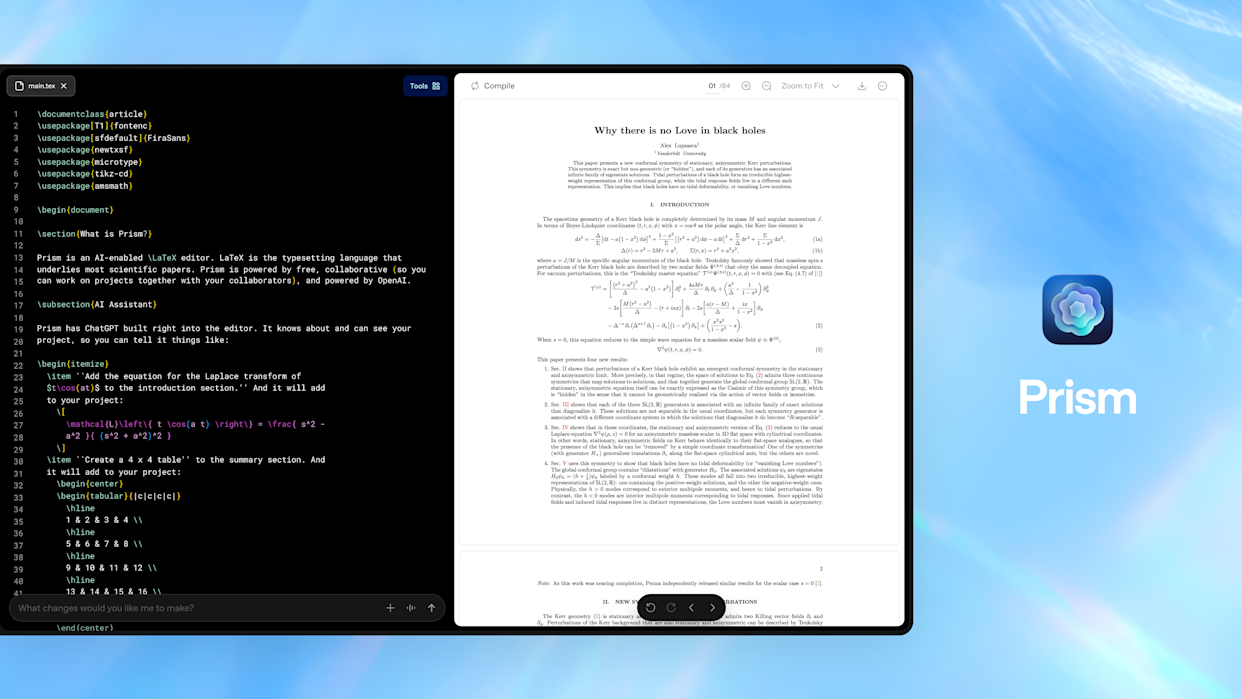
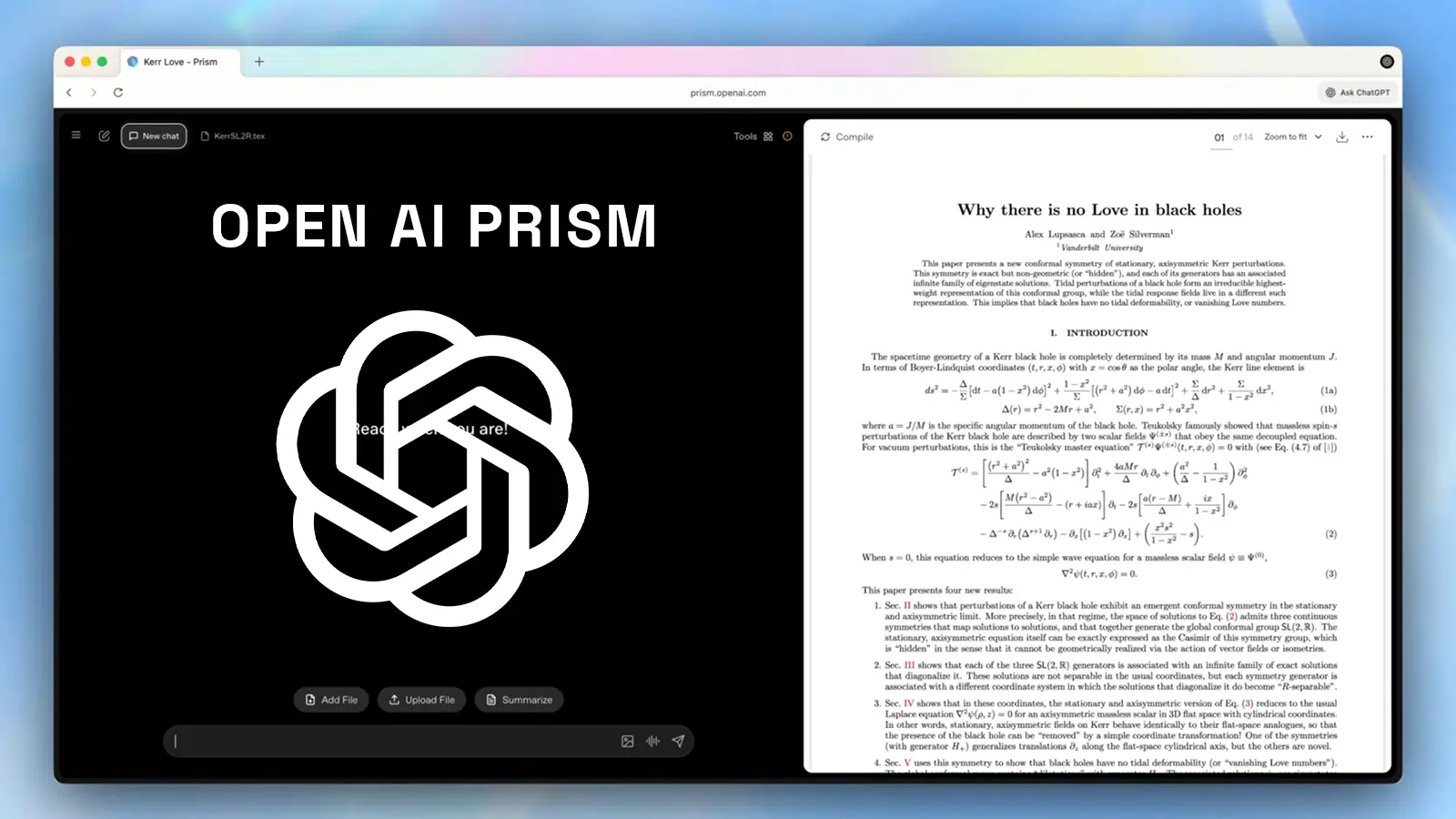
OpenAI released Prism on Tuesday, a free workspace for scientists writing research papers. The tool runs on GPT-5.2 and integrates directly into LaTeX, the typesetting system that nearly every physicist, mathematician, and computer scientist uses to format their work.
Kevin Weil, OpenAI's VP for Science, made a bold claim at the launch: "I think 2026 will be for AI and science what 2025 was for AI and software engineering."
The comparison isn't random. Last year, AI coding tools like Cursor and Windsurf changed how developers work. Cursor's parent company hit a $29.3 billion valuation. NVIDIA moved 40,000 engineers onto AI-assisted workflows. OpenAI wants the same shift to happen in research.
Prism isn't a chatbot you talk to on the side. It's a full environment where GPT-5.2 understands your entire paper and helps at every step. OpenAI hopes this will pull researchers away from their current fragmented workflows and into a single AI-powered space.
How Prism Works
Prism grew out of Crixet, a cloud-based LaTeX platform that OpenAI acquired. The old Crixet had its own AI assistant called Chirp. Now it runs GPT-5.2 Thinking instead. Crixet no longer exists as a standalone product.
For those unfamiliar with LaTeX: it's how researchers format papers with complex math. The system handles equations, citations, and figures better than Word or Google Docs. But it has a steep learning curve, and tasks like drawing diagrams through TikZ commands can eat hours.
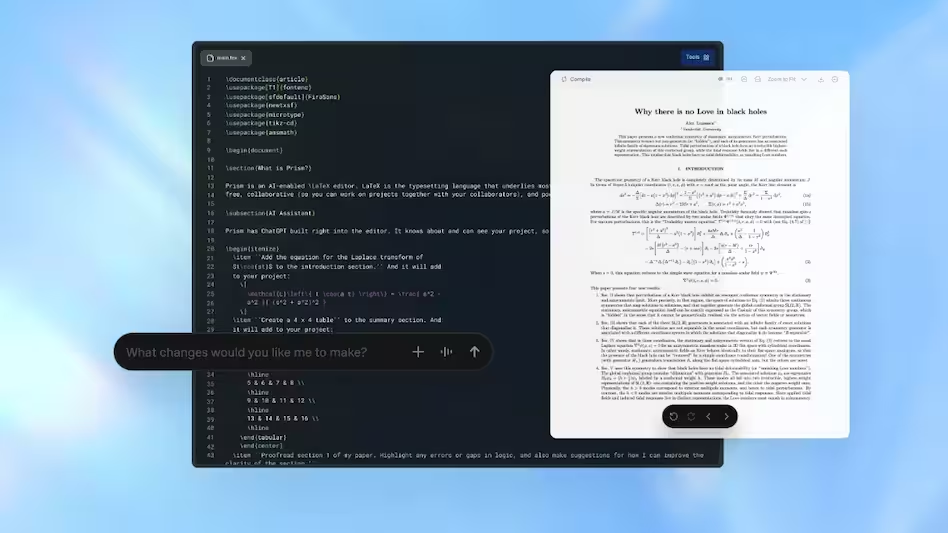
The key difference from using ChatGPT directly: Prism gives the model access to your entire paper. When you ask for help, GPT-5.2 sees the surrounding text, equations, citations, figures, and structure. It understands what argument you're building and where the current section fits.
What the tool actually does:
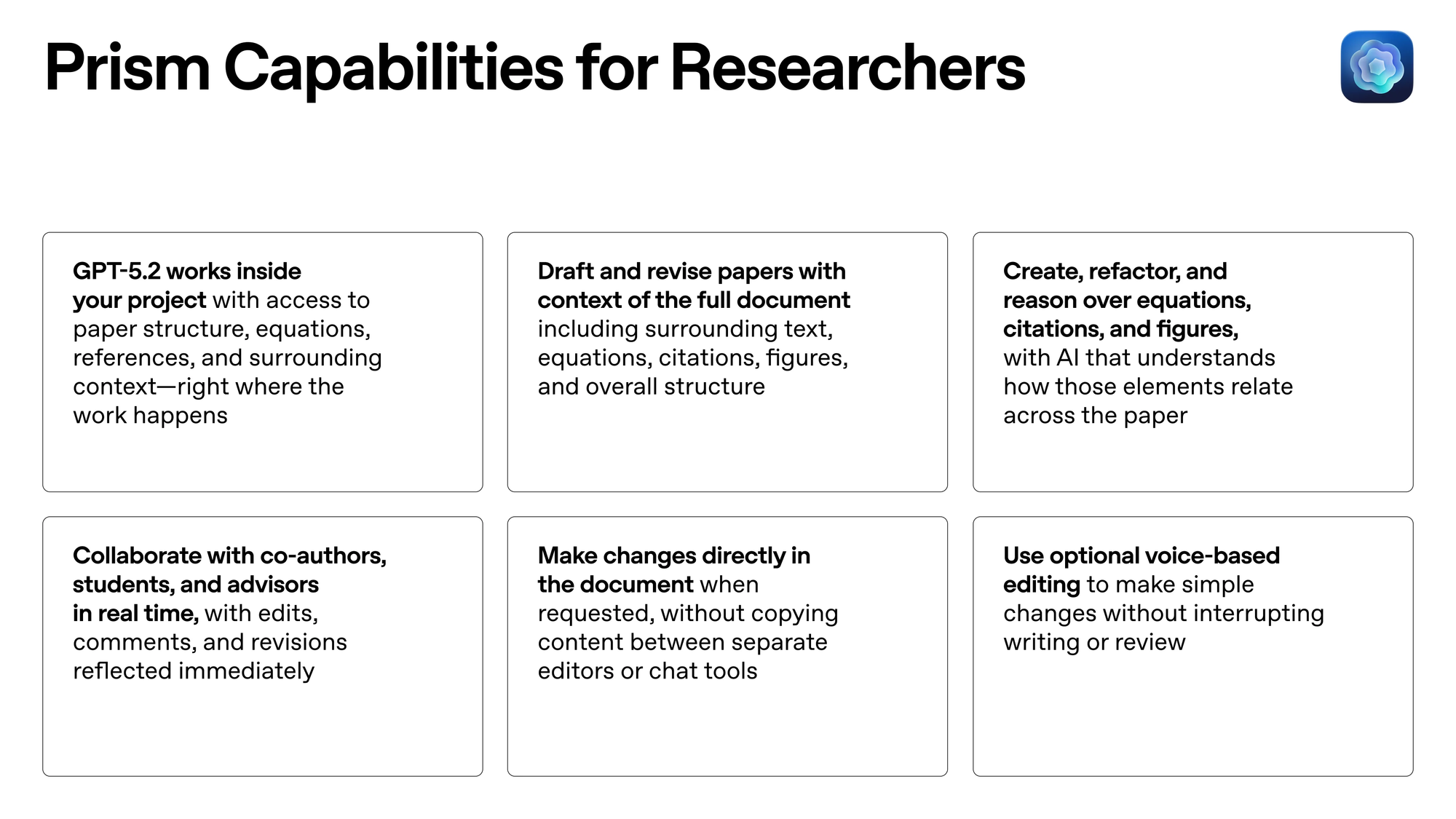
- GPT-5.2 can draft and revise text with the full document as context. It reasons through equations and suggests related papers from arXiv. It converts photos of handwritten formulas into LaTeX code. It handles citations and helps build diagrams without the usual TikZ headaches.
- OpenAI demonstrated Prism generating a lesson plan for a graduate course on general relativity, complete with problem sets for students. The demo also showed the AI finding and incorporating scientific references into a paper. These tasks aren't revolutionary individually, but having them in one context-aware environment is new.
The product is free for anyone with a ChatGPT account. Unlimited projects, unlimited collaborators. OpenAI plans to add Business, Enterprise, and Education tiers later.
The Workflow Problem Prism Solves
Research writing currently involves too many disconnected tools. A typical workflow bounces between a text editor, PDF reader, LaTeX compiler, reference manager like Zotero or Mendeley, and a separate AI chat window. Each tool does one thing. None of them talk to each other.
- Prism puts everything in one place. Cloud-based, no local LaTeX installation needed, real-time collaboration built in. Version conflicts get minimized because everyone works on the same document.
- OpenAI calls this "deep workflow integration." The phrase comes from what made coding tools successful. Cursor didn't just add autocomplete to VS Code. It rebuilt the environment so AI understood the entire codebase. Prism aims for the same thing with research papers.
The company explicitly compares Prism to Cursor, Windsurf, and its own Codex platform. All three tools went beyond simple suggestions to become full development environments. Prism wants to be the research equivalent.
The Demand Already Exists
The company released a report called "AI as a Scientific Collaborator" that details these numbers. The growth suggests researchers want AI assistance but lack purpose-built options. Prism fills that gap.
Privacy matters here. Researchers working on grant proposals, unpublished results, or competitive projects worry about their work ending up in training data. If you've turned off conversation training in your ChatGPT settings, that carries over to Prism. OpenAI confirmed this in the press call.
The Math Results That Preceded the Launch
The timing of Prism's release follows notable results in AI-assisted mathematics. These results give OpenAI a story to tell about what AI can do in research.
In January 2026, Erdős Problem #728 became the first problem from the famous collection solved fully autonomously by AI. Paul Erdős was a Hungarian mathematician who posed over 1,000 problems during his career. Many remain unsolved. Mathematicians track progress on erdosproblems.com.
The combination of GPT-5.2 Pro and a theorem-proving system called Aristotle generated a formal proof in Lean, a language where proofs can be verified computationally. Kevin Barreto ran the systems. The result stood up to scrutiny.
Terence Tao, the Fields Medal winner often called the greatest living mathematician, verified the results personally. He now maintains a GitHub wiki tracking AI contributions to Erdős problems. His involvement lends credibility to claims that would otherwise sound like hype.
Since Christmas, 15 problems moved from "open" to "solved" on the Erdős website. Eleven credited AI involvement. The first batch came from Google's AlphaEvolve in November 2025, but GPT-5.2 has been particularly active since then.
Tao's take is measured. He calls these "lowest-hanging fruit." Problems solvable with standard techniques that nobody had bothered to tackle. The unsolved Erdős problems follow a long-tail distribution. Many aren't actually hard; they just lack attention from busy mathematicians. AI can harvest these systematically.
But the gap between performance levels matters. GPT-5.2 scores 77% on competition-level math. It scores 25% on open-ended research requiring genuine insight. The model can solve problems with known techniques. It struggles to generate new ideas.
OpenAI published a blog post presenting human-AI collaboration as a model for future research: "In domains with axiomatic theoretical foundations, frontier models can help explore proofs, test hypotheses, and identify connections that might otherwise take substantial human effort to uncover."
The statement scopes the claim carefully. "Axiomatic theoretical foundations" means math, parts of physics, maybe formal logic. Fields where problems have precise statements and solutions can be checked. Most science doesn't work this way.
What Prism Can't Do
OpenAI positions Prism as an accelerator, not a replacement. The tool helps write papers. It doesn't design experiments, collect data, or generate novel insights.
This matters because the marketing could suggest otherwise. "Do for science what Cursor did for coding" implies transformation. But coding and research differ in important ways. Code either runs or it doesn't. Research requires creativity, domain expertise, and experimental validation that current AI lacks.
AI systems hallucinate. They produce confident-sounding nonsense. In mathematics, formal verification through systems like Lean catches this. The proof either checks or it doesn't. Most scientific fields don't have equivalent safety nets. Biologists, chemists, and physicists must verify claims through experiments, not computation.
The same pattern played out with coding tools. They made developers faster but also introduced new categories of bugs. Studies show developers sometimes over-trust AI suggestions. Prism will likely follow the same trajectory: useful but not trustworthy without human oversight.
The 25% score on open-ended research problems deserves emphasis. Three-quarters of the time, GPT-5.2 fails when faced with questions requiring genuine insight. Prism can help polish papers and check equations. It can't replace the scientist doing the thinking.
The Competition
Anthropic launched Claude for Healthcare recently, targeting hospitals and medical researchers. The product includes tools for clinical documentation, medical coding, and research applications. Different focus than Prism, but the same bet that scientific applications matter.
Google's AlphaEvolve solved Erdős problems in November 2025, before GPT-5.2 got involved. DeepMind continues work on protein structure prediction and materials science. Microsoft is integrating AI into its research tools across the Office suite.
None of these competitors have released a dedicated research writing environment like Prism. That's OpenAI's opening. The company gets to define what an AI-native research tool looks like.
Prism's advantage is workflow integration. Generic chatbots don't understand your paper's structure. Prism does. The model sees context that improves every suggestion. Whether that's enough to win the research market depends on execution and what competitors ship next.
The free pricing creates pressure. Competitors must either match it or justify their costs. OpenAI can afford to give Prism away because the real goal is establishing GPT-5.2 as infrastructure. Once researchers build workflows around the tool, they're unlikely to switch.
What Happens Next
Weil's stated goal: "Achieve in 2030 the scientific breakthroughs that we would otherwise only have in 2050." That's ambitious and probably oversold. Twenty years of progress in four requires more than better writing tools.
But the math results suggest AI can accelerate certain types of work. Problems that sat open for decades are falling in hours when AI gets applied systematically. Formal verification ensures the solutions are correct. The process scales in ways human effort doesn't.
Whether that generalizes beyond mathematics remains unclear. Physics has mathematical foundations but requires experimental validation. Biology and chemistry involve messy real-world data that doesn't fit neat axioms. Medicine requires clinical trials that take years regardless of how fast papers get written.
Prism is free, available now, and represents a real attempt to bring the AI transformation that reshaped coding to scientific research. The product is solid. The claims are ambitious. The results will show up in papers over the coming years.
For researchers tired of fighting with LaTeX, managing citations across tools, and copying text into ChatGPT one section at a time, Prism offers something better. Whether it changes science as much as OpenAI hopes depends on factors nobody can predict yet.
Frequently Asked Questions
What is OpenAI Prism?
Prism is a free workspace for scientists to write research papers, powered by GPT-5.2. It's built on LaTeX and integrates AI directly into the writing process. The model sees your entire document, not just individual prompts.
Is Prism free?
Yes. Free for anyone with a ChatGPT account, with unlimited projects and collaborators. Business and Enterprise tiers coming later.
What happened to Crixet?
OpenAI acquired Crixet, a cloud LaTeX platform, and rebuilt it as Prism. Crixet's old AI assistant Chirp was replaced with GPT-5.2. Crixet no longer exists as a separate product.
Can Prism do research on its own?
No. It helps write papers but can't design experiments, collect data, or generate original scientific insights. Human researchers still do the actual science.
What can GPT-5.2 do in Prism?
Draft and revise text with full document context. Reason through equations. Suggest papers from arXiv. Convert handwritten formulas to LaTeX. Build and refactor citations and figures.
Will my research be used to train AI?
If you've disabled conversation training in ChatGPT settings, that applies to Prism too. Your unpublished work stays private.
How is this different from just using ChatGPT?
ChatGPT sees only what you paste into the chat. Prism sees your entire paper: text, equations, citations, figures, structure. Context makes the AI more useful.
Has AI actually solved real math problems?
Yes. In January 2026, GPT-5.2 and the Aristotle system solved Erdős Problem #728, verified by Terence Tao. Fifteen Erdős problems moved to "solved" since Christmas, eleven with AI involvement.
What are the limits?
GPT-5.2 hits 77% on competition math but only 25% on open-ended research. AI hallucinations remain a problem. Most sciences lack the formal verification that math has.
Why compare this to Cursor?
Cursor and similar tools transformed coding in 2025. Cursor's company reached $29.3 billion valuation. OpenAI thinks Prism can do the same for research by combining strong models with deep workflow integration.
Related Articles
 Dani
Dani
 Dani
Dani
 Dani
Dani