OpenAI just made its most aggressive move into the enterprise market yet. On Thursday, the company launched Frontier, an end-to-end platform designed to help large organizations build, deploy, and manage AI agents that can actually do work inside their businesses.
The pitch is ambitious: treat AI agents like employees. Give them onboarding. Connect them to your systems. Let them learn from experience and improve over time. And manage them all from a single platform, whether those agents come from OpenAI, your own developers, or third-party vendors like Google, Microsoft, or Anthropic.
"What's really missing still, for most companies, is just a simple way to unleash the power of agents as teammates that can operate inside the business without the need to rework everything underneath," said Denise Dresser, OpenAI's chief revenue officer. "That's exactly why we've built Frontier."
What Frontier Actually Does
At its core, Frontier solves the integration problem that's been slowing enterprise AI adoption. Most organizations have data scattered across systems, complex permission structures, and dozens of applications that don't talk to each other. Every AI integration becomes a one-off project that takes months.
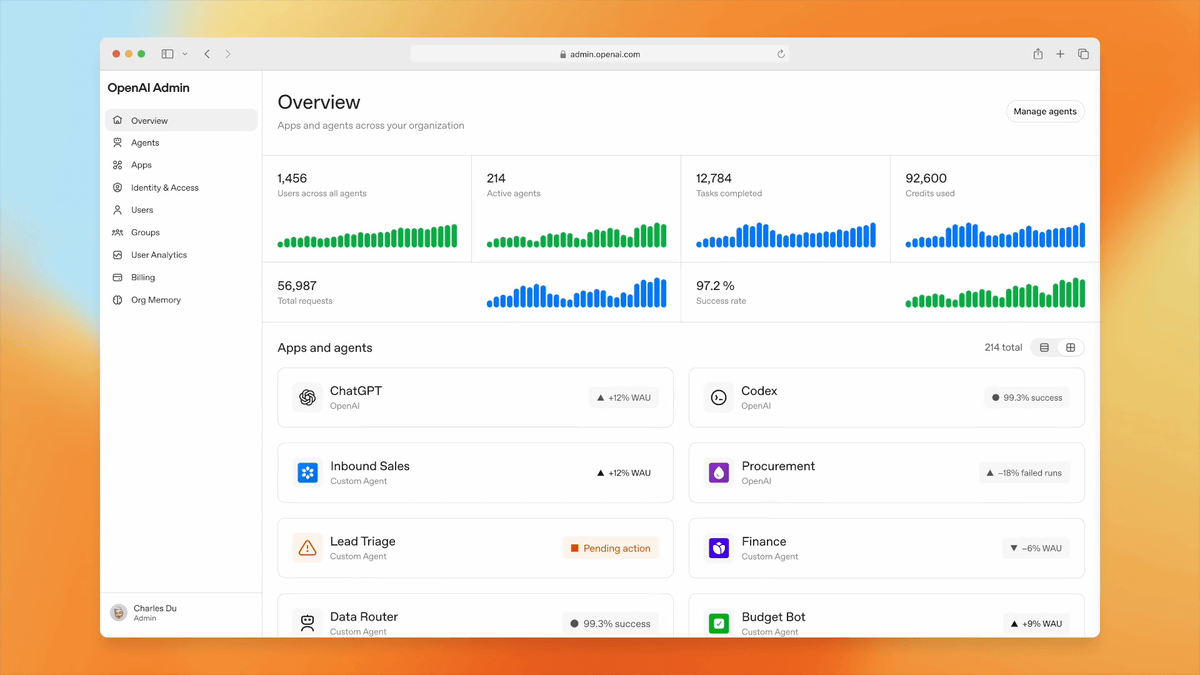
Frontier acts as an intelligence layer that stitches together these disparate systems. It connects to data warehouses, CRM platforms like Salesforce, ticketing tools, internal applications, and other business systems. Once connected, AI agents can access the information they need to actually do useful work rather than operating in isolation.
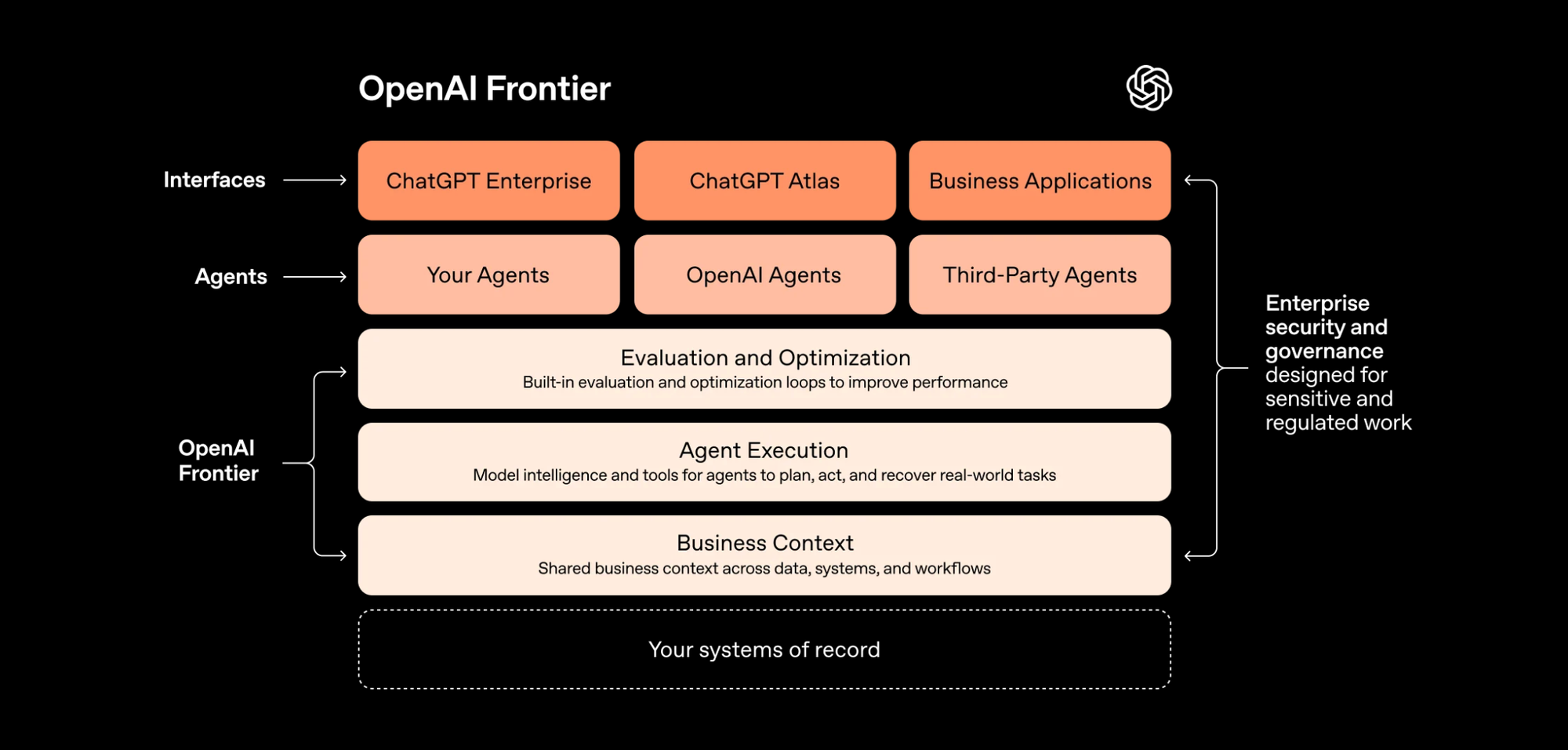
The platform handles four critical functions.
- Business Context connects enterprise systems so AI agents work with the same information people do, building what OpenAI calls "durable institutional memory" over time.
- Agent Execution enables AI agents to apply model intelligence to real business situations, working together in parallel across workflows and environments.
- Built-in evaluation and optimization loops track what's working and what isn't, so agents can improve with experience.
- Enterprise security provides comprehensive controls, explicit permissions, and auditable actions.
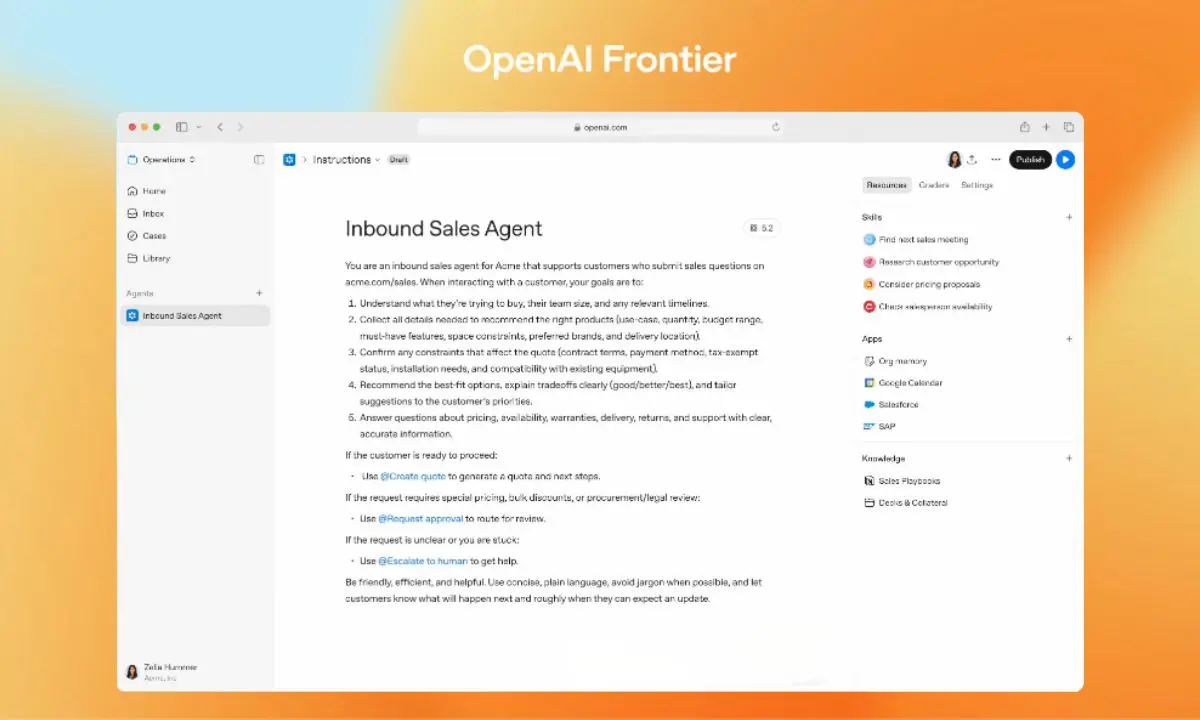
Frontier offers an onboarding process for agents, similar to how companies bring on new hires. There's a feedback loop meant to help agents improve over time, just like performance reviews help employees develop. Each agent gets a defined identity with explicit permissions and guardrails, similar to how human workers have job descriptions and access levels.
"What we're fundamentally doing is basically transitioning agents into true AI co-workers," said Barret Zoph, OpenAI's general manager of business-to-business.
The Open Platform Strategy
Perhaps the most notable aspect of Frontier is that it's an open platform. Users can manage agents built by OpenAI, agents developed in-house, and agents from competing vendors. This includes agents built on Google, Microsoft, and Anthropic technology.
The approach differs from the walled-garden strategies common in enterprise software. By supporting competitors' agents, OpenAI is betting that controlling the management layer matters more than controlling every agent that runs on the platform. If Frontier becomes how companies orchestrate their AI workforce, OpenAI captures value regardless of whose models power individual agents.
OpenAI is also working with what it calls Frontier Partners, AI-native builders like Abridge, Clay, Ambience, Decagon, Harvey, and Sierra. These partners commit to building deeply integrated solutions on the platform, helping validate use cases and supporting enterprise deployments.
Early Customers and Results
Frontier is currently available to a limited set of customers, with plans to roll out more broadly in the coming months. Initial users include HP, Oracle, State Farm, Uber, Intuit, and Thermo Fisher Scientific.
OpenAI shared several results from early implementations. A global financial services firm using Frontier got 90% more time back for their client-facing team. A tech company reported saving 1,500 hours monthly in product development. A major manufacturer reduced production optimization work from 6 weeks to one day. A large energy producer increased output by up to 5%, translating to over a billion dollars in additional revenue.
The company declined to disclose pricing details during press briefings, and did not respond to requests for comment on pricing structure.
Why Now?
The timing reflects both market opportunity and competitive pressure. Enterprise adoption has become a stated priority for OpenAI, with the company announcing major deals with ServiceNow and Snowflake this year.
The need for agent management infrastructure has become increasingly clear. In December, Gartner called agent management platforms "the most valuable real estate in AI" and described them as necessary infrastructure for enterprises to adopt AI at scale. The research firm predicts that by 2028, 33% of enterprise software applications will include agentic AI, up from less than 1% in 2024.
"AI agent sprawl is rapidly becoming the biggest challenge for CIOs," Gartner noted in its report.
The competitive landscape has also intensified. Salesforce launched Agentforce in fall 2024 and has arguably the best-known agent management product. LangChain, founded in 2022, has raised more than $150 million in venture capital to build agent frameworks. CrewAI has raised over $20 million. And Anthropic has been aggressively pursuing enterprise customers with Claude Code and Cowork, reportedly capturing 32% of the enterprise market.
The SaaS Disruption Question
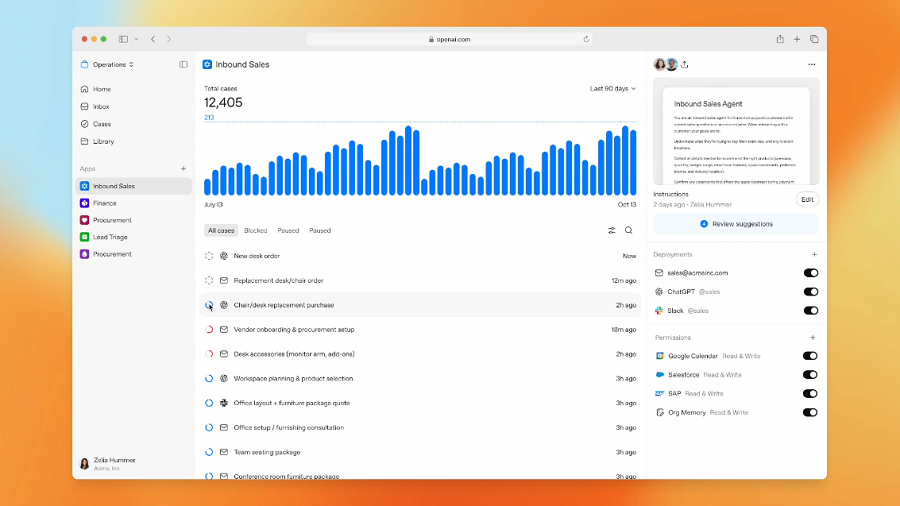
The launch has spooked investors in traditional enterprise software companies. The concern is that AI-native platforms like Frontier could disintermediate relationships between businesses and their existing SaaS vendors.
Consider the implications: if an AI agent can execute sales workflows without a human ever logging into Salesforce, the per-seat licensing model that powers the SaaS economy starts to lose justification. Why pay for user seats when autonomous agents do the work?
Shares of companies like Salesforce, ServiceNow, Workday, and SAP have felt pressure as both OpenAI and Anthropic expand their enterprise agent capabilities. The worry is that AI startups will increasingly obviate the need for customers to upgrade to the AI agent features that legacy vendors are rushing to build.
Simo acknowledged this tension indirectly. Drawing from her experience as CEO of Instacart, she described the pain of evaluating hundreds of software vendors and spending months integrating each selected tool. "We didn't even get what we actually wanted, because each tool was good for one use case, but they weren't integrated or talking to one another, so we were just reinforcing silos upon silos."
Frontier positions OpenAI as the platform that eliminates those silos, but that value proposition works precisely by reducing dependence on individual SaaS applications.
Real Constraints Remain
Despite the ambition, Frontier faces meaningful challenges. Enterprise sales cycles move slowly, and companies already using Anthropic's tools won't migrate without compelling reasons. Building trust for AI agents that execute operational workflows affecting revenue and customer relationships takes time.
Gartner has warned that over 40% of agentic AI projects will be canceled by end of 2027 due to escalating costs, unclear business value, or inadequate risk controls. The firm estimates only about 130 of the thousands of agentic AI vendors are legitimate, with many engaging in "agent washing" by rebranding existing automation products.
OpenAI addresses security and governance concerns directly. Frontier includes enterprise identity and access management, agent-level permissions, and comprehensive audit logging. The platform meets standards including SOC 2 Type II, ISO/IEC 27001, and CSA STAR. But whether these controls satisfy the most risk-averse enterprises remains to be seen.
The Bigger Picture
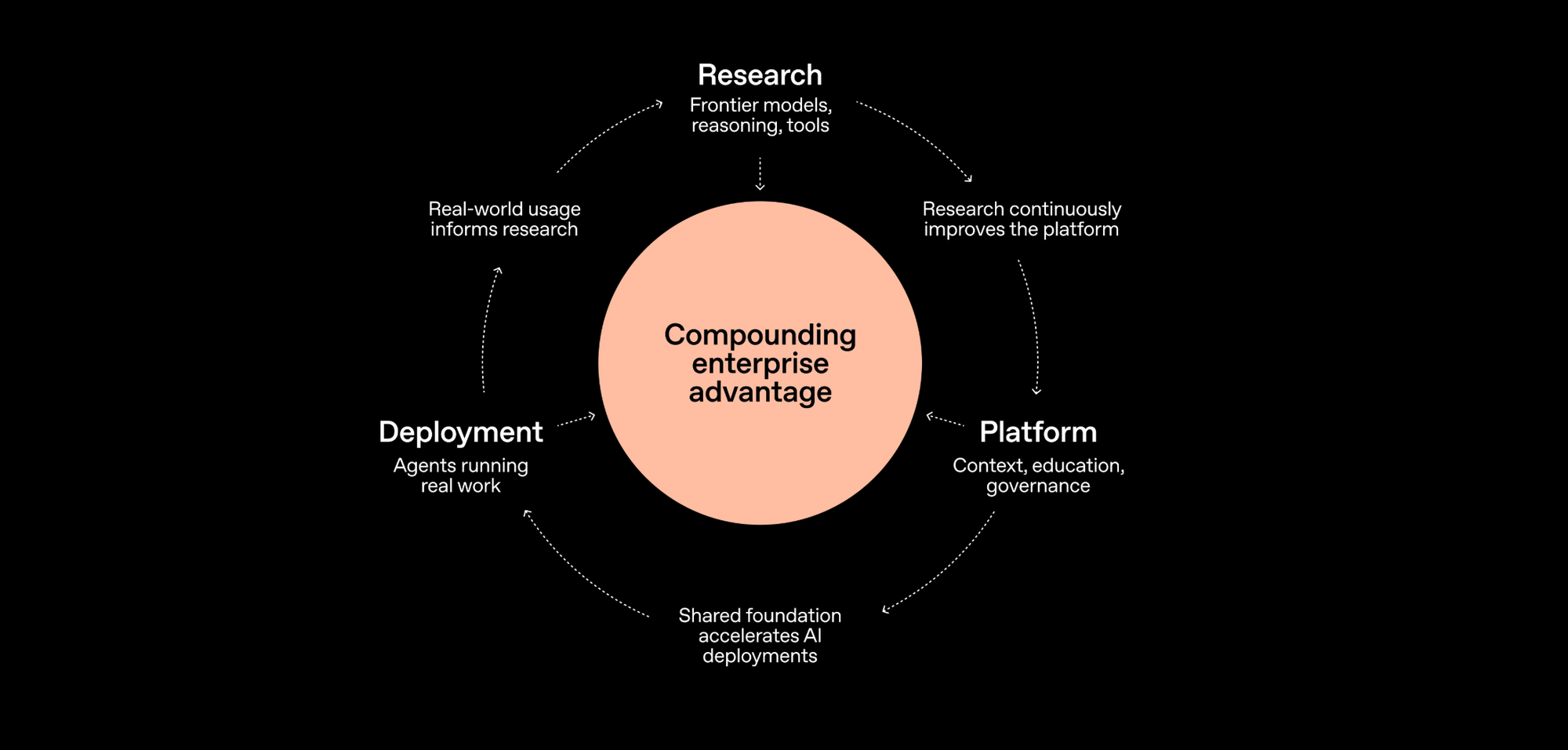
Frontier represents a philosophical shift in how OpenAI approaches the enterprise market. When the company launched ChatGPT Enterprise in 2023, the pitch centered on empowering human employees. Frontier is explicitly about automating workflows, with agents that log into applications, execute tasks, and manage processes without much human oversight.
Whether this transition succeeds depends on whether businesses trust AI agents with operational work that directly affects their bottom line. Early case studies suggest potential, but scattered implementations don't prove scalability across diverse business contexts. Companies will evaluate Frontier based on results, not roadmaps.
For now, OpenAI is making a clear bet: the future of enterprise AI isn't just about better models. It's about the infrastructure that lets those models actually work inside businesses. Frontier is OpenAI's play to own that layer.
FAQ
What is OpenAI Frontier?
OpenAI Frontier is an enterprise platform launched in February 2026 for building, deploying, and managing AI agents. It connects to existing business systems like CRM platforms, data warehouses, and internal applications, allowing AI agents to access information and execute tasks across an organization. The platform is designed to treat AI agents like employees, with onboarding processes, permissions, and performance feedback loops.
How much does OpenAI Frontier cost?
OpenAI has not disclosed pricing details for Frontier. The company declined to share pricing information during press briefings and has not responded to requests for comment on pricing structure. Frontier is currently available to a limited number of enterprise customers, with plans to expand availability in the coming months.
Which companies are using OpenAI Frontier?
Early Frontier customers include HP, Oracle, State Farm, Uber, Intuit, and Thermo Fisher Scientific. OpenAI is also working with Frontier Partners including Abridge, Clay, Ambience, Decagon, Harvey, and Sierra, which are AI-native companies building integrated solutions on the platform.
Can Frontier manage AI agents from other companies?
Yes. Frontier is an open platform that can manage agents built by OpenAI, agents developed in-house by enterprises, and agents from third-party vendors including Google, Microsoft, and Anthropic. OpenAI designed the platform this way because enterprises need to work with multiple AI partners.
How does Frontier compare to Salesforce Agentforce?
Both platforms help enterprises build and manage AI agents, but they come from different starting points. Salesforce Agentforce launched in fall 2024 and integrates closely with Salesforce's CRM ecosystem. Frontier is model-agnostic and focuses on connecting disparate enterprise systems rather than extending a specific application. Agentforce is arguably better known, while Frontier offers broader system integration.
What security features does Frontier include?
Frontier includes enterprise identity and access management that applies across both human employees and AI agents. Each agent gets a defined identity with explicit permissions and guardrails. The platform provides comprehensive audit logging for agent actions and meets security standards including SOC 2 Type II, ISO/IEC 27001, ISO/IEC 27017, ISO/IEC 27018, ISO/IEC 27701, and CSA STAR.
Why did OpenAI launch Frontier now?
OpenAI has made enterprise adoption a stated priority, with enterprise customers accounting for approximately 40% of the company's business. The company expects this to reach 50% by year end. Additionally, Gartner has identified agent management platforms as critical infrastructure for enterprise AI adoption, calling them "the most valuable real estate in AI."
What results have early Frontier customers reported?
OpenAI shared several early results: a global financial services firm got 90% more time back for client-facing teams, a tech company saved 1,500 hours monthly in product development, a manufacturer reduced production optimization from six weeks to one day, and an energy producer increased output by 5%, adding over a billion dollars in revenue.
Is Frontier available to all businesses?
Not yet. Frontier is currently available only to a limited number of enterprise customers. OpenAI plans to roll out the platform more broadly in the coming months, though the company has not announced a specific timeline for general availability.
How does Frontier treat AI agents like employees?
Frontier applies employee management concepts to AI agents. Agents go through an onboarding process where they learn institutional knowledge and internal language. They have defined identities with specific permissions and access levels. A feedback loop helps agents improve over time, similar to how performance reviews help human employees develop. Agents can learn from experience and adapt to changing work requirements.
Related Articles
 Mark
Mark
 Dani
Dani
 Dani
Dani