I woke up this morning to news that genuinely surprised me: OpenAI just launched ChatGPT Health, a dedicated space within ChatGPT specifically designed for health and wellness questions. And honestly? This feels like one of those announcements that could either be incredibly useful or incredibly concerning, depending on how you look at it.
Let me walk you through everything we know, what it actually does, the privacy implications you need to understand, and my honest take on whether this is something you should consider using.
What Is ChatGPT Health?
Here's the basic idea: ChatGPT Health is a separate section within ChatGPT—think of it as a private room—where you can ask health-related questions and optionally connect your actual medical data to get more personalized answers.
OpenAI announced this on January 7, 2026, and the numbers they shared are staggering. According to their data, over 230 million people globally already ask health and wellness questions on ChatGPT every week. That's not a typo—230 million people, every single week, turning to an AI chatbot for health information.
The company clearly saw this trend and decided to build something more intentional around it. Instead of having health questions mixed in with your other random ChatGPT conversations about recipes and work emails, ChatGPT Health creates a dedicated environment with enhanced privacy protections specifically for sensitive medical discussions.
But here's where it gets interesting: you can now connect your actual health data to ChatGPT. We're talking medical records, lab results, data from your Apple Watch, information from fitness apps like MyFitnessPal and Peloton. The idea is that by grounding ChatGPT's responses in your real health information, the answers become more relevant and useful to your specific situation.
How Does It Actually Work?
When you open ChatGPT Health from the sidebar, you're entering what OpenAI describes as an isolated environment. Your health conversations, files, and connected apps are stored completely separately from your regular ChatGPT chats. The company says this separation is enforced through "purpose-built encryption and isolation."
You can connect several types of data sources. Medical records integration is available through a partnership with b.well, a health data network. In practice, this means you'll see a login through your healthcare provider's portal—often a MyChart login page—to authenticate and pull your records. This is currently US-only and requires you to be over 18.
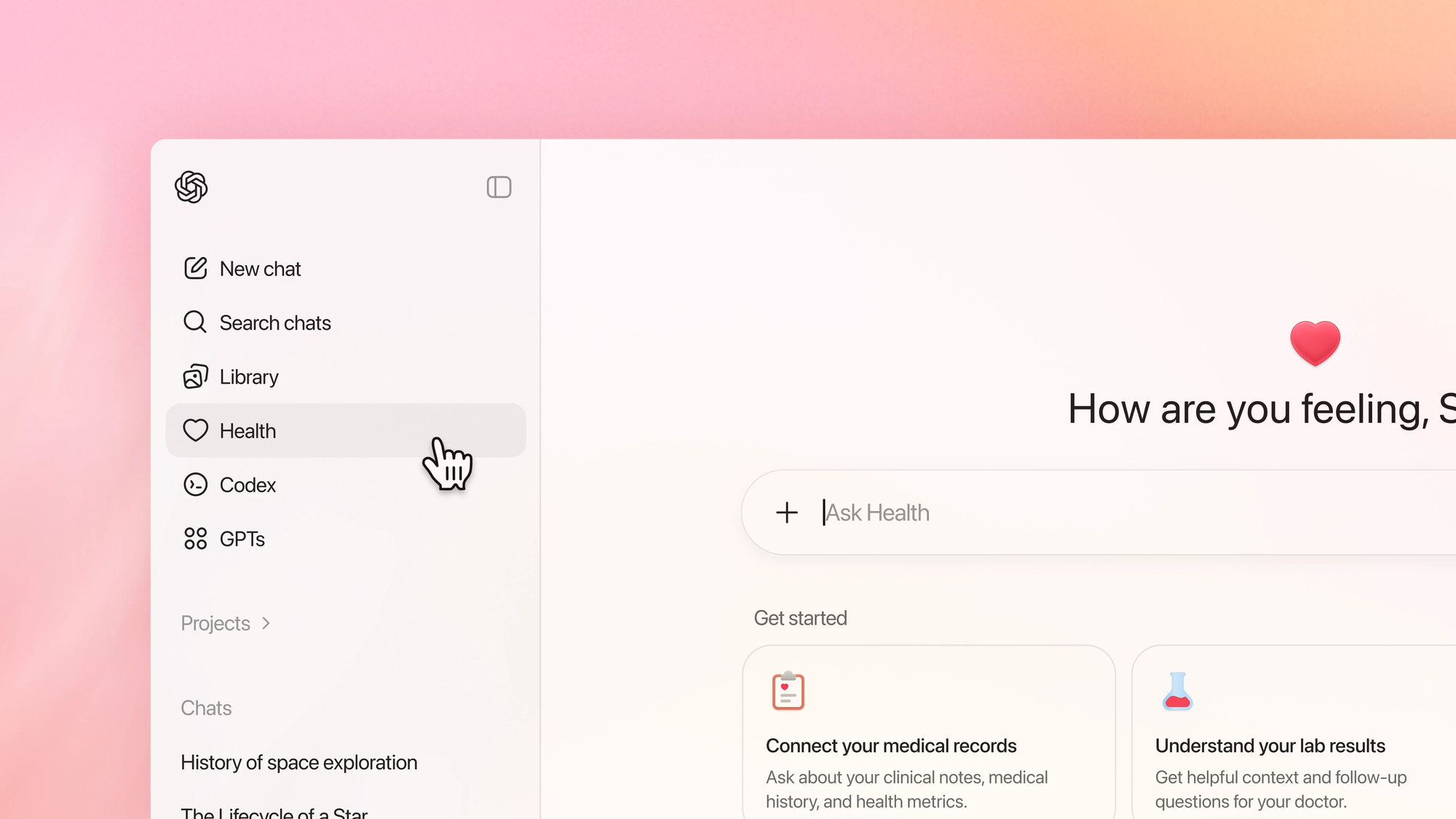
For wellness data, you can connect Apple Health (iOS only), which syncs movement, sleep, heart rate, and activity patterns. There's also MyFitnessPal for nutrition tracking, Peloton for workout data, Function Health for lab insights, Weight Watchers for meal planning, AllTrails for outdoor activities, and even Instacart for turning meal recommendations into actual grocery orders.
Once connected, you can have conversations that reference all this data. Ask "How's my cholesterol trending?" and ChatGPT can actually look at your lab results over time. Ask "Based on my sleep data, why might I be feeling tired?" and it can analyze patterns from your Apple Watch. Ask "Help me prepare questions for my doctor's appointment tomorrow" and it can review your recent test results to suggest relevant things to discuss.
The conversations work like regular ChatGPT—you can upload photos and files, use voice mode, and even use the search and deep research features. But everything stays within the Health section.
The Privacy Question Everyone's Asking
Let's be real: the moment you start talking about connecting medical records to an AI chatbot, privacy alarm bells should be ringing. And they should be.
OpenAI has implemented several protections. Health conversations are not used to train their foundation models—this is a significant commitment. The data is encrypted and stored separately from your other ChatGPT information. Apps can only connect with your explicit permission, even if they're already connected to regular ChatGPT. You can disconnect any app at any time and it immediately loses access. You can view and delete your health memories whenever you want.
But here's what you need to understand: ChatGPT Health is not HIPAA compliant in the traditional sense.
HIPAA—the Health Insurance Portability and Accountability Act—applies to "covered entities" like hospitals, doctors, and insurance companies. Consumer health apps, including ChatGPT, fall outside HIPAA's protections. This is a crucial distinction that many people don't realize.
As Andrew Crawford from the Center for Democracy and Technology explained it: "When your health data is held by your doctor or your insurance company, the HIPAA privacy rules apply. The same is not true for non-HIPAA-covered entities, like developers of health apps, wearable health trackers, or AI companies."
OpenAI does say that all apps available in ChatGPT Health must meet their privacy and security requirements, including collecting only the minimum data needed, and undergo additional security review. But these are OpenAI's internal standards, not federal law.
There's another wrinkle worth considering. As part of their copyright battles with news organizations, companies have been able to obtain access to ChatGPT logs—including from temporary chats that were supposedly deleted after 30 days. Health information could theoretically be made available to litigants or government agencies via subpoena or court order. Sam Altman has publicly called for some sort of legal privilege to protect sensitive health and legal information, but that doesn't currently exist.
What ChatGPT Health Can and Cannot Do
OpenAI is being very explicit about the limitations here, and I think that's actually a good sign.
ChatGPT Health is designed to support, not replace, medical care. It is not intended for diagnosis or treatment. The company states this clearly in their terms of service, their announcement, and throughout the product itself.
What it can do is help you navigate everyday health questions, understand patterns over time, prepare for medical appointments, interpret complex lab results in plain language, and organize scattered health information into something coherent.
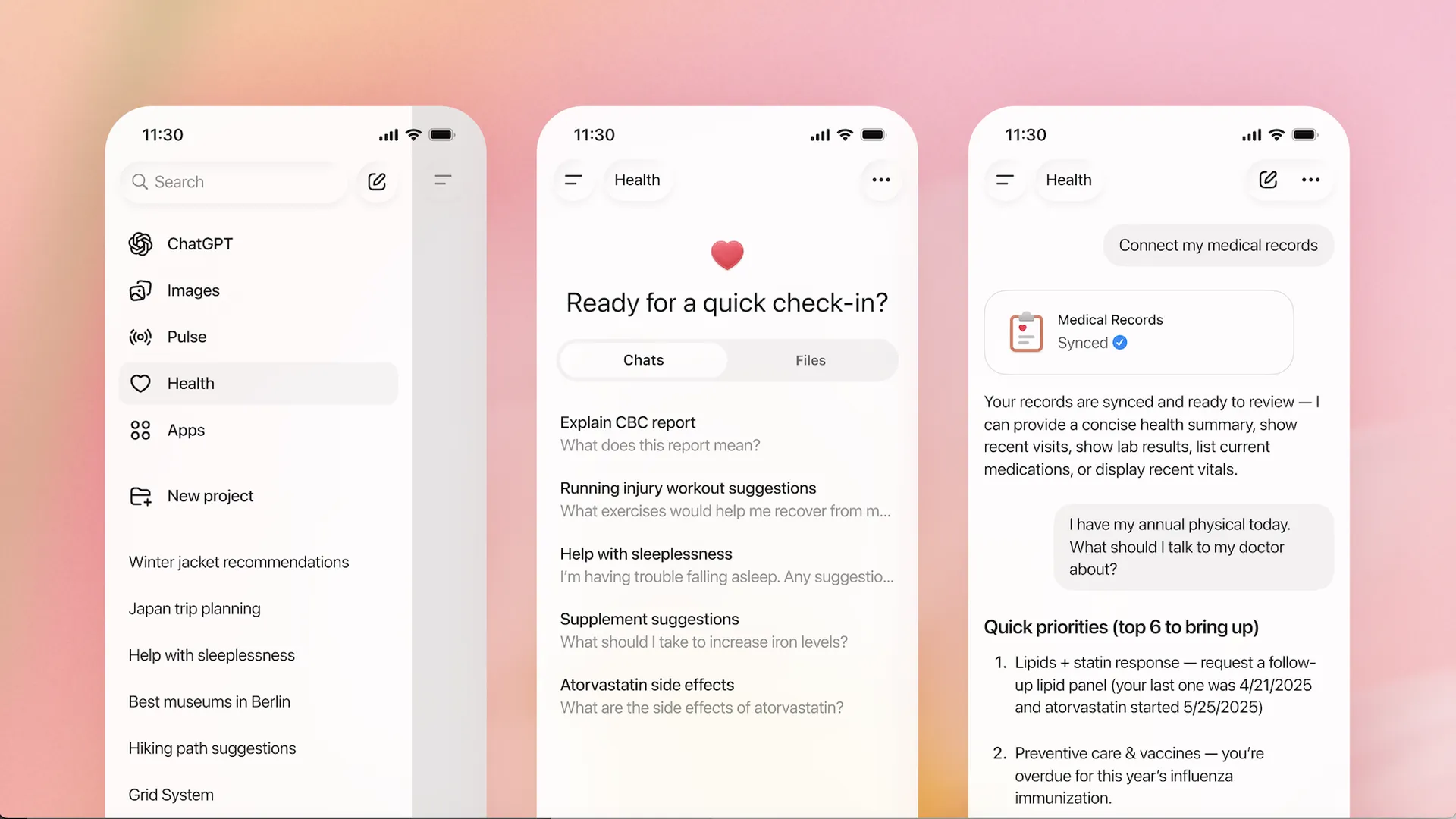
Think of it as a really knowledgeable friend who can help you understand what your doctor told you, prepare better questions for your next appointment, and spot trends in your data that you might have missed. Not a replacement for your doctor—a supplement to your healthcare experience.
For higher-risk questions, OpenAI says ChatGPT Health will provide high-level information, flag potential risks, and encourage you to talk with a healthcare provider who knows your specific situation. If you're experiencing a medical emergency, it will tell you to seek immediate help.
The feature was developed over two years in collaboration with more than 260 physicians across 60 countries and dozens of specialties. They've provided feedback on model outputs more than 600,000 times. OpenAI also created something called HealthBench, a benchmark with over 48,000 physician-written rubrics for evaluating AI-generated answers to medical questions.
Why This Matters Beyond the Obvious
There's a bigger picture here that's worth considering.
Healthcare in America is complicated, expensive, and often frustrating to navigate. The average doctor's appointment is 15-20 minutes, and much of that time gets eaten up by administrative tasks. Patients often leave appointments with more questions than they came in with, struggling to understand what their test results mean or what their treatment options actually involve.
ChatGPT, by contrast, has infinite patience. It's available 24/7. It can explain things multiple ways until you understand. It can put your specific question in the context of your entire medical history—something even your doctor might struggle to do in a brief appointment if your records are spread across multiple providers.
As Fidji Simo, OpenAI's CEO of Applications, put it: "It's great at synthesizing large amounts of information. It has infinite time to research and explain things. It can put every question in the context of your entire medical history."
This doesn't mean AI should replace doctors. But it does suggest there's a meaningful role for AI in helping people become more informed and engaged participants in their own healthcare.
The challenge is doing this responsibly, with appropriate guardrails, and without creating a false sense of certainty or undermining the doctor-patient relationship.
The Competitive Landscape
OpenAI isn't the only company eyeing this space. Google has its own partnership with b.well, announced in October 2025, that could enable similar functionality for Gemini. Amazon has been testing a Health AI assistant that answers general wellness questions and connects to its pharmacy and One Medical services.
By launching ChatGPT Health, OpenAI is staking its claim as a central hub for personal health data—a position that could become increasingly valuable as AI continues to improve and healthcare becomes more data-driven.
The company is also positioning this as part of a broader vision. "ChatGPT Health is another step toward turning ChatGPT into a personal super-assistant that can support you with information and tools to achieve your goals across any part of your life," Simo wrote on Substack.
That's an ambitious goal, and health is obviously one of the highest-stakes areas to tackle.
Who Can Use It and When
ChatGPT Health is rolling out gradually. Right now, it's available via waitlist to users on ChatGPT Free, Go, Plus, and Pro plans. However, users in the European Economic Area, Switzerland, and the United Kingdom are not eligible at launch—likely due to stricter data protection regulations in those regions.
Medical record integrations and some app connections are currently US-only. Apple Health integration requires an iOS device. Android support is coming but isn't available yet.
OpenAI says it will expand access to all eligible users on web and iOS in the coming weeks. If you're interested, you can sign up for the waitlist through the ChatGPT interface.
My Honest Take
Here's where I land on this.
The potential benefits of ChatGPT Health are real. If you've ever felt confused leaving a doctor's appointment, struggled to understand lab results, or wished you had a better way to track patterns in your health data, this could genuinely help. The ability to synthesize scattered information from multiple sources into coherent insights is something AI is genuinely good at.
But I also think you need to go in with eyes wide open about the privacy tradeoffs.
You're giving a for-profit technology company access to some of your most sensitive personal information. Even with OpenAI's stated protections, that data could potentially be accessed through legal processes, could be vulnerable to breaches, or could be used in ways you don't anticipate as the company's business model evolves. OpenAI has mentioned exploring advertising—imagine the value of health data for ad targeting.
My advice: be thoughtful about what you connect. You don't have to link everything. Maybe start with just Apple Health fitness data before connecting your full medical records. Use the feature for lower-stakes questions initially and see how it performs. And always, always remember that this is a tool to help you have better conversations with your actual healthcare providers—not a replacement for professional medical advice.
The technology is impressive. The convenience is real. But so are the risks. Make informed choices about how much of yourself you're willing to share.
FAQ
What is ChatGPT Health?
ChatGPT Health is a dedicated space within ChatGPT specifically designed for health and wellness conversations. It allows you to optionally connect medical records and wellness apps so ChatGPT's responses can be grounded in your actual health data. It operates as an isolated environment with enhanced privacy protections separate from your regular ChatGPT chats.
Is ChatGPT Health free?
ChatGPT Health is available to users on ChatGPT Free, Go, Plus, and Pro plans. However, access is currently limited via waitlist, with broader rollout expected in the coming weeks.
Can ChatGPT Health diagnose medical conditions?
No. OpenAI explicitly states that ChatGPT Health is not intended for diagnosis or treatment of any health condition. It's designed to help you understand your health information, prepare for doctor's appointments, and navigate everyday wellness questions—not to replace professional medical care.
What apps can I connect to ChatGPT Health?
At launch, you can connect Apple Health (iOS only), MyFitnessPal, Peloton, Function Health, Weight Watchers, AllTrails, and Instacart. Medical records connect through b.well's provider network, which often uses your existing MyChart login.
Is ChatGPT Health HIPAA compliant?
ChatGPT Health is not HIPAA compliant in the traditional sense. HIPAA applies to covered entities like hospitals and insurance companies, not consumer health apps. OpenAI has implemented their own privacy protections including encryption, data isolation, and commitments not to use health data for model training, but these are internal standards rather than federal law.
Is my health data used to train AI models?
OpenAI states that health conversations, files, and memories are not used to train their foundation models. This is a default setting for ChatGPT Health specifically.
Can I delete my health data from ChatGPT?
Yes. You can view and delete health memories at any time through Settings. You can disconnect apps instantly, which immediately revokes their access. You can also delete individual health conversations.
Who can access ChatGPT Health?
Users on ChatGPT Free, Go, Plus, and Pro plans outside the European Economic Area, Switzerland, and the United Kingdom are eligible. Medical record integrations are currently US-only. Apple Health integration requires iOS.
Does ChatGPT Health work on Android?
Currently, ChatGPT Health is available on web and iOS. Android support is coming soon but isn't available at launch.
Will my regular ChatGPT conversations see my health data?
No. Health information and memories never flow back into your non-Health chats. The isolation is enforced in both directions—your Health section stays separate from your regular ChatGPT experience.
How was ChatGPT Health developed?
OpenAI developed ChatGPT Health over two years in collaboration with more than 260 physicians across 60 countries and dozens of specialties. They created HealthBench, an evaluation tool with over 48,000 physician-written rubrics for testing AI health responses.
What happens if I ask a health question in regular ChatGPT?
If you start a health-related conversation in regular ChatGPT, the system will suggest moving the conversation into the Health section to take advantage of the enhanced privacy protections.
Can ChatGPT Health access my complete medical history?
If you connect your medical records through b.well, ChatGPT Health can access the information available through that integration, which may include lab results, visit summaries, and clinical history. The extent depends on what your healthcare providers make available through the integration.
Is ChatGPT Health available in Europe?
No. Users in the European Economic Area, Switzerland, and the United Kingdom are not eligible at launch, likely due to stricter data protection regulations like GDPR.
Related Articles
 Dani
Dani
 Mark
Mark
 Mark
Mark