LinkedIn has done something its competitors have talked about for years and mostly not delivered: it replaced its entire content recommendation system with one built around large language models. The engineering team published a detailed account of the new architecture on March 12, 2026, and it explains a great deal of the reach and engagement shifts that creators and marketers have been experiencing since late 2025.
This is not a tuning adjustment or a new ranking signal. LinkedIn replaced the multi-system pipeline it had used for years, a patchwork of keyword matching, collaborative filtering, and separate models for different tasks, with two unified AI components: a Causal LLM retrieval system and a Generative Recommender ranking model known internally as 360Brew. Understanding how these two systems work explains why the old playbook is producing diminishing returns.
What Actually Changed Under the Hood
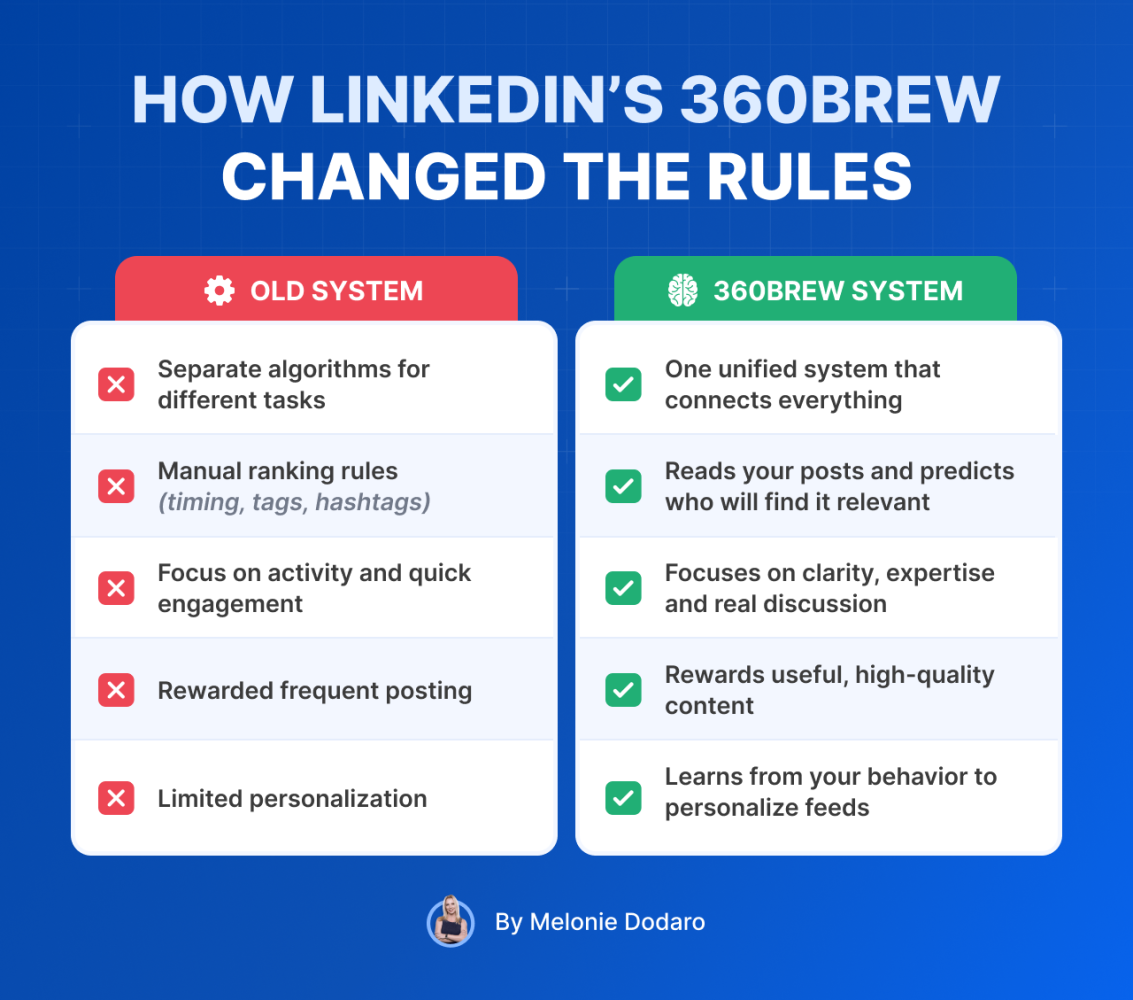
The old feed used a fragmented retrieval system with multiple sources pulling content from different angles, each optimized for a different signal. The new system replaces this with a unified retrieval pipeline powered by LLM-generated embeddings.
When you log into LinkedIn, the system needs to decide which posts from across 300 million daily posts are relevant to you. Previously, this was done using a combination of keyword matching and collaborative filtering, methods that work well at scale but struggle with semantic nuance.
If a user was interested in electrical engineering but had recently been engaging with posts about small modular reactors, the old system might not connect those two topics because the keywords don't overlap. The new system uses an LLM to understand that these topics are semantically related, because the model knows from its pre-training that electrical engineers often work on power grid optimization and energy infrastructure.
That world knowledge allows the algorithm to surface semantically relevant content even when exact keyword matches don't exist. Technically, this is achieved through a dual encoder architecture: the system converts your profile data, engagement history, and behavioral signals into a dense vector embedding, then finds the nearest content candidates by running a search across those embeddings on GPU infrastructure. According to LinkedIn's own engineering documentation, the system narrows 300 million posts down to roughly 2,000 candidates per user in under 50 milliseconds. Those candidates then move to the second model for ranking.
360Brew: The Ranking Model
360Brew is a 150-billion-parameter decoder-only foundation model that performs the actual ranking of those 2,000 candidates. Unlike traditional ranking systems that score each post in isolation, 360Brew uses a transformer architecture with causal attention to treat your entire interaction history as an ordered sequence, a professional story over time.
The question the system is asking is not "is this post engaging?" in a vacuum. It is asking "given everything this person has read, engaged with, and spent time on over the past two to three months, is this post the right next piece of content for them?" That is a fundamentally different question, and it requires a fundamentally different kind of model to answer.
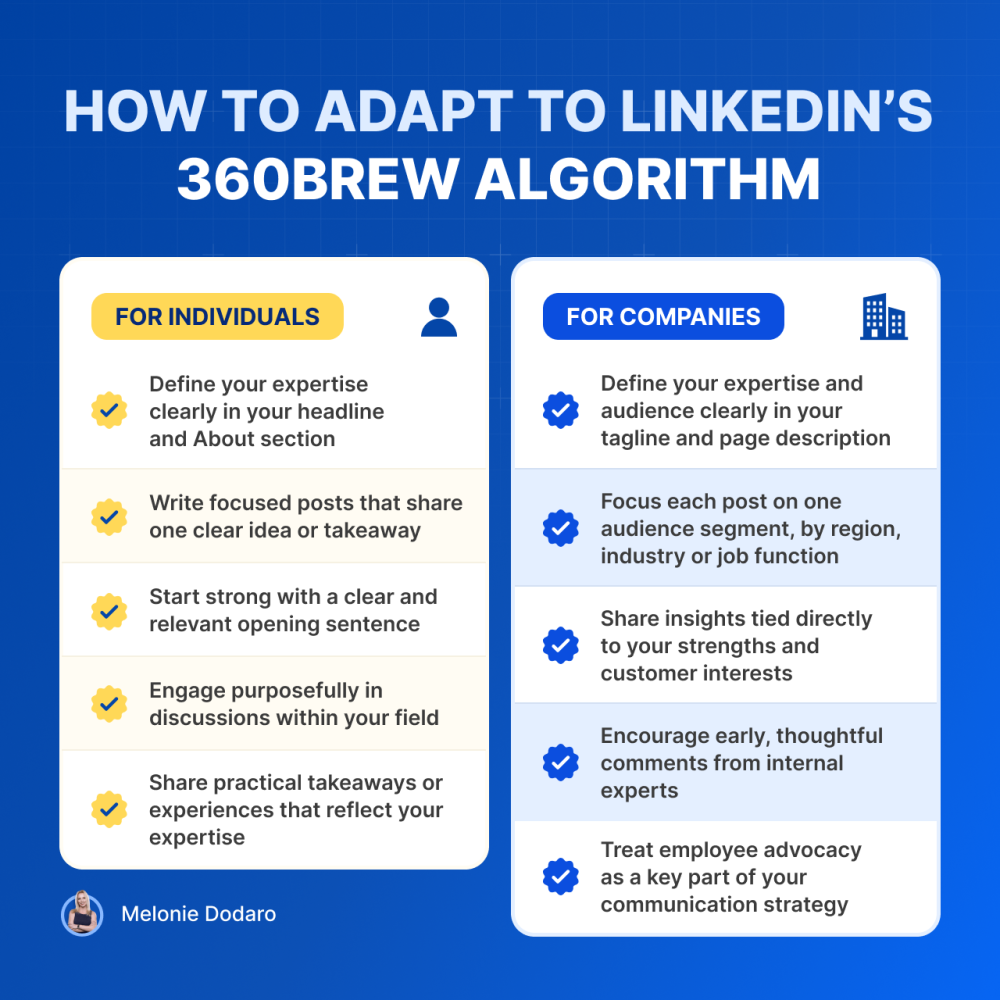
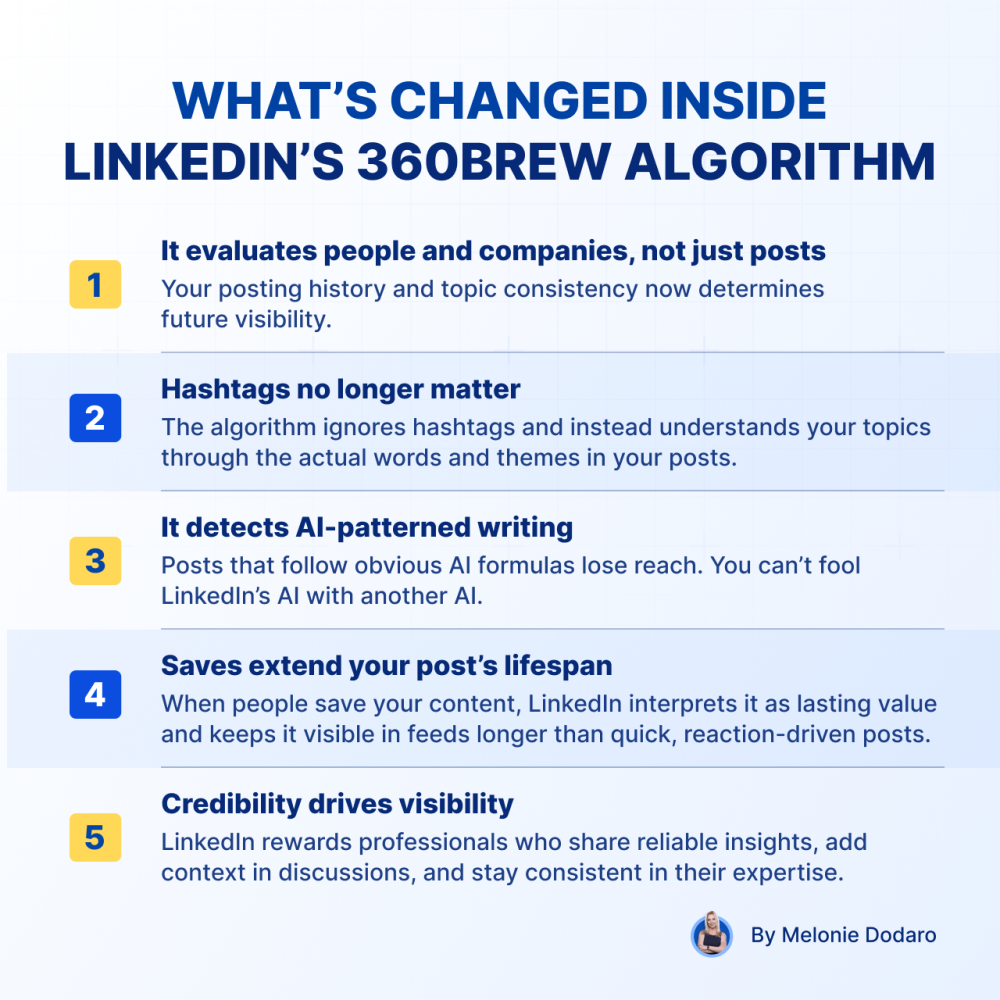
360Brew also performs a semantic cross-reference between each post and the author's profile. It reads the author's headline, About section, and Experience, then compares that against the post's content. If a profile describes someone as a graphic designer but the post is about crypto trading, the system detects the mismatch and suppresses distribution. If a RevOps director posts about Salesforce integration, the system recognizes the alignment and amplifies accordingly. Your profile is not just an introduction; it is an input that 360Brew reads every time one of your posts is being evaluated.
What This Means for Reach Numbers
The reach data from late 2025 through early 2026 is striking. Richard van der Blom, whose annual LinkedIn algorithm reports are widely referenced in the professional marketing community, found average post views down approximately 50%, engagement down around 25%, and follower growth down nearly 60% compared to prior periods. A separate Q3 2025 analysis of over 300,000 posts found organic reach down 65% from earlier in the year.
These numbers are real, but they require context. The decline in broad reach is in part a deliberate consequence of the relevance-first design philosophy. When the feed shows each user fewer posts but filters them for higher relevance to that specific professional's career stage and interests, the audience for any individual post naturally narrows. The algorithm is trading impressions for quality of impressions: a narrower audience that is more likely to find the content genuinely useful.
For company pages, the picture is starker. According to the Algorithm InSights 2025 Report, organic posts from LinkedIn company pages now reach only about 1.6% of their followers, and company page content accounts for roughly 1 to 2% of the overall LinkedIn feed. LinkedIn's stated philosophy prioritizes authentic professional voices and genuine expertise over branded content, and the feed allocation reflects that directly.
What the New System Is Actually Rewarding
LinkedIn's engineering documentation explicitly states the goals of the new system: genuine engagement, dwell time, and professional relevance. What that means in practice diverges significantly from what drove reach under the previous algorithm.
- Saves and sends are now the most valuable engagement signals. LinkedIn added these to post analytics in late 2025, and their visibility was not accidental. Content people save to return to later, or send directly to a colleague, signals relevance in a way that a passive like does not. Some analyses estimate that saves carry roughly five times the ranking weight of likes in the new system.
- Dwell time is a confirmed ranking factor. Even lingering on a post without clicking any interaction counts as a positive signal. Well-structured, substantive posts that hold attention without driving clicks are being rewarded in ways they were not before.
- Engagement bait is actively suppressed. The system scans for low-value tactics including vague teasers, "comment YES if you agree" prompts, recycled generic advice, and posts designed primarily to drive external traffic. These patterns are now detected and downranked. The AI understands the difference between a post that earns attention and one engineered to trigger a click.
- AI-generated content is being penalized. LinkedIn's new system is sophisticated enough to detect patterns characteristic of AI-generated posts and is not rewarding them. Posts that once pulled thousands of impressions through keyword-optimized, templated structure are now sitting at a few hundred. LinkedIn has been explicit that the system prioritizes "obviously human" signals over polished AI output, partly as a response to the proliferation of generative content across the feed.
- Comment quality matters more than comment volume. Substantive comments that add context, start a thread, or demonstrate genuine engagement still serve as the strongest visible signal. Shallow comments from engagement pods are being suppressed, and the system is detecting coordinated engagement behavior and treating it as a manipulation signal.
How the System Reads Your Profile
One of the most practically important aspects of 360Brew is something creators often overlook: the system does not evaluate your posts independently from your profile. Every ranking decision includes a semantic cross-reference between what you post and what your profile says you do.
The system generates an embedding of your professional identity from your headline, About section, and experience history. Posts you publish are encoded in the same embedding space. If the distance between your profile embedding and your post's embedding is large, the system interprets this as misalignment and reduces distribution confidence. If the distance is small, alignment is rewarded with broader distribution.
LinkedIn's engineering research also confirms that LLMs perform best when the most important information appears at the beginning of the input. The first sentence of your About section and the opening line of every post carry disproportionate weight in how both the retrieval and ranking systems categorize you. Anyone who posts across multiple unrelated topics, or who has a vague multi-purpose profile description, is now operating at a structural disadvantage.
Cold-Start Handling: A Genuine Improvement
One area where the new system represents a meaningful improvement is how it handles new or low-activity accounts. Under keyword-based or shallow collaborative filtering systems, new users with limited engagement history were effectively invisible until they built up enough signal data for the system to calibrate.
The LLM-based approach uses world knowledge learned during pre-training to infer interests from profile data alone. A new electrical engineering graduate who has never posted but has filled in their headline, skills, and About section accurately will start receiving relevant content immediately, and their content will start being distributed to semantically aligned professionals from day one.
This also matters for creators posting in niche technical domains. The old system required a critical mass of users engaging with specific keywords before collaborative filtering could work. The new system can identify relevant audiences based on conceptual relationships it learned during training, meaning niche expertise has a better distribution path than it previously did.
What Is Being Penalized
The list of content patterns being downranked covers most of the growth tactics that worked on LinkedIn in 2022 and 2023.
- External links have taken a significant hit. LinkedIn's system has long reduced distribution for posts that direct users off the platform, and the new architecture formalizes this. Posts with external links, particularly those where the link is the primary content rather than supporting context, receive reduced organic reach.
- Hashtag-heavy posts and posts relying on polling mechanics for superficial engagement are receiving lower distribution. The generative recommender is evaluating the semantic substance of a post, not the metadata appended to it.
- Generic professional advice, the kind that applies to everyone and therefore to no one, is being systematically crowded out. LinkedIn's feed has historically amplified motivational career content at scale. The new system's focus on professional relevance and niche expertise disadvantages content that lacks a specific audience in the first place.
Practical Implications for 2026
Based on LinkedIn's engineering documentation and the behavioral patterns that have emerged since the rollout began, here is what is working and what is not.
Profile alignment is now a prerequisite, not a nice-to-have. Your headline and About section need to clearly and specifically describe the domain you post about. Vague positioning like "helping leaders achieve their potential" gives the system nothing to work with when matching your posts to audiences. Specific positioning like "B2B SaaS pricing strategy for Series A and B companies" gives the system clear semantic anchors.
Posting in one lane consistently matters more than ever. The 360Brew system takes approximately 90 days to fully categorize your profile's expertise and optimize distribution within your topic areas. Posting across unrelated domains within that window creates conflicting signals. The system rewards topic coherence over time, not breadth.
The quality of initial engagement matters more than the quantity. The system pushes a post to a small initial audience of 2 to 5 percent of your network within the first 60 minutes. Engagement quality during this window, specifically saves, substantive comments, and dwell time, determines whether the post gets amplified to second and third-degree connections.
Company pages need a fundamentally different strategy. With organic reach at 1.6% of followers, company pages have become amplification and credibility infrastructure rather than primary organic distribution channels. The brands seeing the most organic success are empowering founders, executives, and employees to post as individuals, with company pages supporting and amplifying rather than leading.
Conclusion
LinkedIn's rebuild of the feed around large language models is the most significant change to the platform's content infrastructure in its history. The shift from keyword matching and collaborative filtering to semantic understanding and sequential behavior modeling changes what good content means on the platform in a fundamental way.
For creators and marketers who have been chasing reach through volume, engagement tricks, and broadly appealing content, the new system represents a genuinely difficult environment. For those building genuine expertise in a defined professional domain and posting substantively and consistently, the new system's ability to find and match relevant audiences, including from outside an existing network, represents a meaningful improvement over what the old algorithm could deliver.
The core insight from the engineering documentation is straightforward: the new system is designed to understand what a post is actually about and whether the person posting it genuinely knows the subject. Engagement bait, keyword stuffing, AI-generated filler, and generic inspirational content are now actively working against distribution. What the system rewards is professional relevance, genuine expertise, and content that earns sustained attention.
Frequently Asked Questions
What is 360Brew and how does it work?
360Brew is LinkedIn's 150-billion-parameter AI model that replaced traditional signal-based feed ranking. Unlike previous systems that counted clicks, likes, and hashtags, 360Brew reads and understands the meaning of posts and profiles using transformer architecture. It treats each user's engagement history as an ordered sequence, producing personalized rankings based on professional identity and career trajectory rather than historical engagement patterns.
Why has organic reach on LinkedIn dropped so significantly?
Multiple independent analyses have documented declines in average post reach of 50 to 65% since late 2025. The decline is partly by design: the new LLM-based system prioritizes relevance over broad distribution, showing each user fewer posts filtered for higher semantic relevance to their specific professional context. The trade-off is fewer impressions overall, but a higher-quality audience for posts that do get distributed.
How does 360Brew evaluate whether a post is relevant?
The system generates a semantic embedding of both the post and the author's profile, then measures alignment between them. It also models the potential audience's professional interests based on their own profile data and engagement history. Posts that align closely with the author's stated expertise and address a clearly defined professional audience receive broader distribution. Posts that mismatch the author's profile or address no specific professional context receive suppressed distribution.
Does LinkedIn penalize AI-generated content?
Yes, according to reporting on the new system's architecture. LinkedIn's AI is sophisticated enough to detect patterns characteristic of AI-generated posts and is not rewarding them. The system prioritizes "obviously human" signals over polished AI output, partly as a response to the proliferation of generative content. Posts that were once generating thousands of impressions through AI-assisted keyword-optimized structure have seen significant reach declines.
What engagement signals matter most now?
Saves and sends have become the highest-weight engagement signals, with some analyses estimating they carry five times the ranking weight of likes. Dwell time, even without any visible click, is also confirmed as a ranking factor. Substantive comments that add context or start a thread remain the strongest visible signal. Engagement bait tactics and coordinated engagement pod behavior are actively suppressed.
How does the algorithm treat company pages versus personal profiles?
LinkedIn's new system substantially favors personal profiles over company pages. Organic posts from company pages now reach only about 1.6% of their followers, and company page content accounts for roughly 1 to 2% of the overall LinkedIn feed. Brands seeing the most organic success in 2026 are using personal profiles of founders, leaders, and employees as the primary distribution channel, with company pages providing supporting infrastructure.
How long does it take for the new system to calibrate to a profile?
360Brew takes approximately 90 days to fully categorize a creator's expertise and optimize distribution within their topic areas. Posting across unrelated domains during this window creates conflicting signals. The system rewards topic coherence over a sustained period, making consistency within a defined professional niche especially important during the calibration period.
Is LinkedIn's new system better for niche or technical content?
Yes, in a meaningful way. The old keyword-based system required a critical mass of users engaging with specific terms for collaborative filtering to work effectively, which disadvantaged niche technical content. The LLM-based system can identify relevant audiences based on conceptual relationships learned during pre-training, meaning subject-matter experts in technical fields should see better distribution to relevant professional audiences than the previous system could achieve.
Related Articles
 Dani
Dani
 Dani
Dani
 Dani
Dani