Imagine Anything AI represents a new generation of multi-modal content generators that democratize creative production. This comprehensive platform transforms natural language prompts into professional-grade images, videos, music, voiceovers, and sound effects within seconds. Unlike specialized tools that focus on a single content type, Imagine Anything delivers an all-in-one solution for creators, marketers, and businesses seeking rapid content generation without technical expertise. For those exploring the broader landscape of AI-powered creativity, our comprehensive guide to AI content generators provides valuable context for understanding where multi-modal platforms fit in the current ecosystem.

Image Anything - Free Multi-Modal Content Generator with Images, Videos & Audio
In a Hurry?
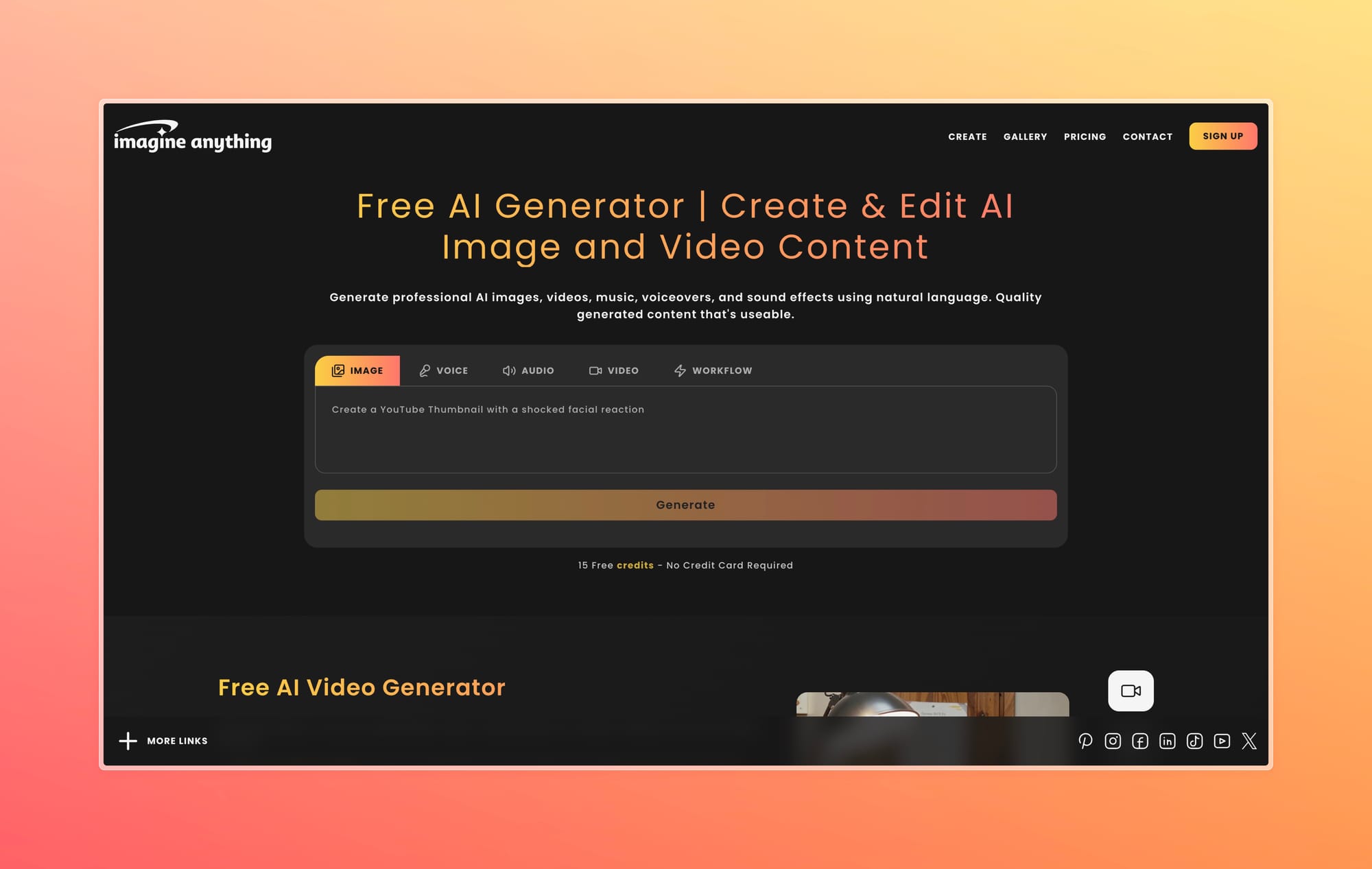
What it is: Imagine Anything AI is a free multi-modal content generator that creates images, videos, music, voiceovers, and sound effects from text prompts. No credit card required for the free tier.
✨ Best for: Content creators, social media managers, marketers, and designers who need diverse content types quickly without learning multiple specialized tools.
💵 Pricing: Free plan with 15 credits; Pro plan at $9.99/month with 500 generations, unlimited downloads, and commercial licensing.
Key strength: Multi-modal versatility—generate five different content types from a single platform with an intuitive interface that requires no design experience.
Main limitation: Free tier limitations and lower specialized quality compared to dedicated tools like Midjourney for images or ElevenLabs for voiceovers.
Best alternative: For image-only generation, consider Midjourney for superior artistic quality.
The Content Creation Problem: Why Multi-Modal Generation Matters
Modern content creators face an exhausting reality: producing engaging content requires juggling multiple specialized tools, subscriptions, and workflows. A single social media campaign might demand custom graphics from Canva, videos from Premiere Pro, music from Epidemic Sound, and voiceovers from Descript. This fragmentation creates three critical pain points that Imagine Anything addresses directly.
First, the financial burden of maintaining multiple subscriptions drains budgets rapidly. Professional creators often spend $100-300 monthly across various platforms, pricing out independent creators and small businesses. Second, the learning curve for mastering diverse specialized tools consumes weeks or months, delaying project launches and reducing competitive agility. Third, workflow inefficiency from switching between platforms, managing different file formats, and maintaining design consistency wastes hours that could be spent on strategic creative work.
Imagine Anything solves these challenges by consolidating five content generation capabilities into one accessible platform. Whether you're a solopreneur building a brand presence, a marketing team producing campaign assets, or an educator creating engaging learning materials, this unified approach eliminates tool sprawl while maintaining professional output quality. For entrepreneurs specifically, our guide on best AI tools for solopreneurs demonstrates how consolidating creative tools drives business efficiency.
What is Imagine Anything AI?
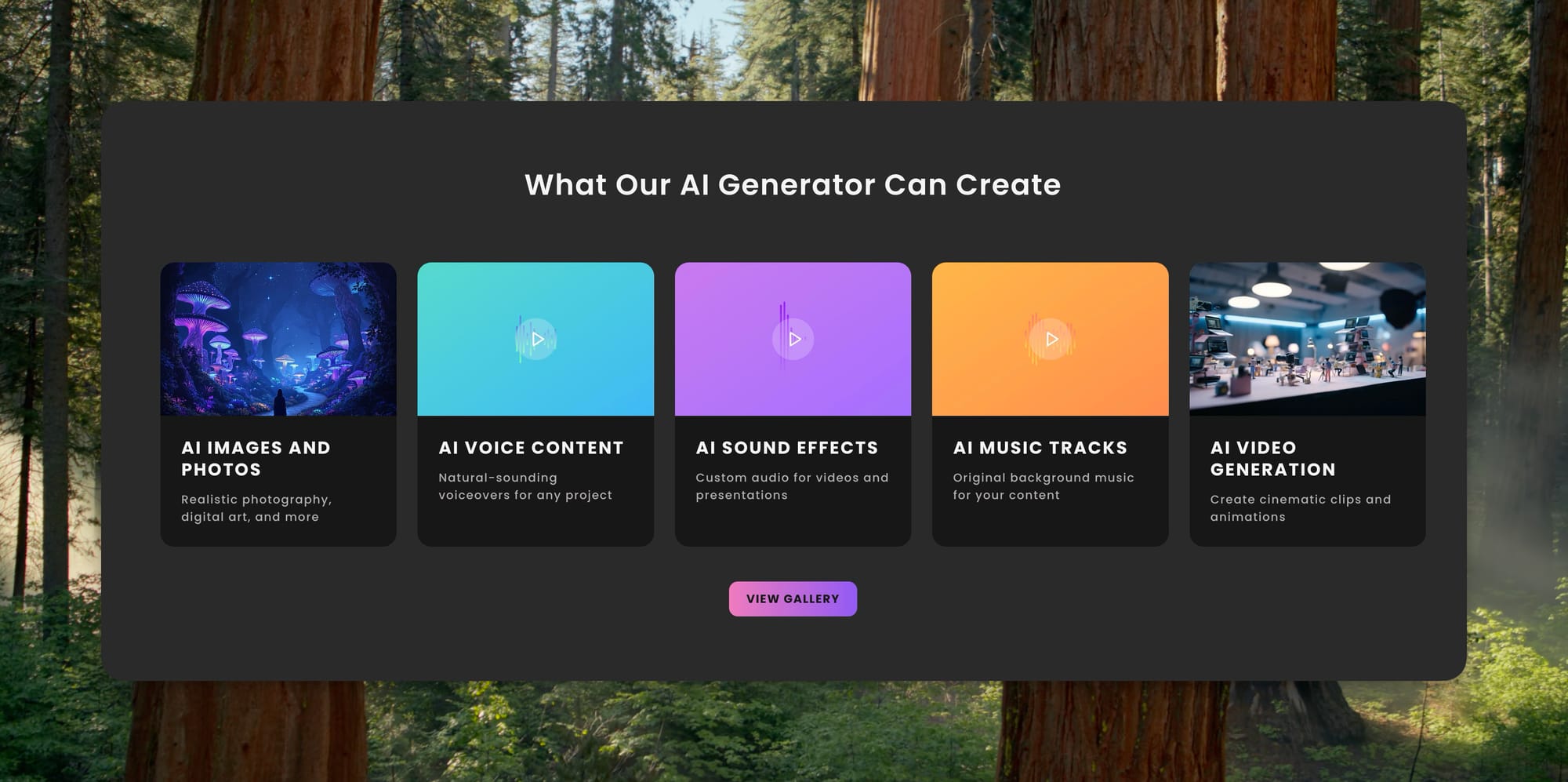
Imagine Anything AI is a web-based artificial intelligence platform that transforms natural language descriptions into five distinct content types: images, videos, music, voiceovers, and automated workflows. Built on advanced machine learning models including GPT-4o for voice synthesis, MiniMax for audio generation, and the Seadance model for video creation, the platform enables users to generate professional-grade creative assets without technical skills or design experience.
The core value proposition centers on accessibility and speed. Users input simple text prompts describing their desired output, select basic parameters like aspect ratio or style, and receive production-ready content within seconds. Unlike traditional creative software requiring manual editing, layering, and technical adjustments, Imagine Anything automates the entire generation process from concept to deliverable asset.
What distinguishes Imagine Anything from competitors is its genuine multi-modal capability. While platforms like DALL-E focus exclusively on images and Descript specializes in audio, Imagine Anything provides native generation across media types without requiring separate tools or export-import workflows. This integration proves particularly valuable for content creators producing multimedia campaigns where visual, audio, and motion elements must maintain thematic coherence.
The platform operates entirely through web browsers, eliminating installation requirements and ensuring cross-platform compatibility. This cloud-based architecture means creators can generate content from any device with internet access, facilitating mobile workflows and collaborative projects where team members work remotely.
Core Features and Capabilities
AI Image Generation with Style Customization
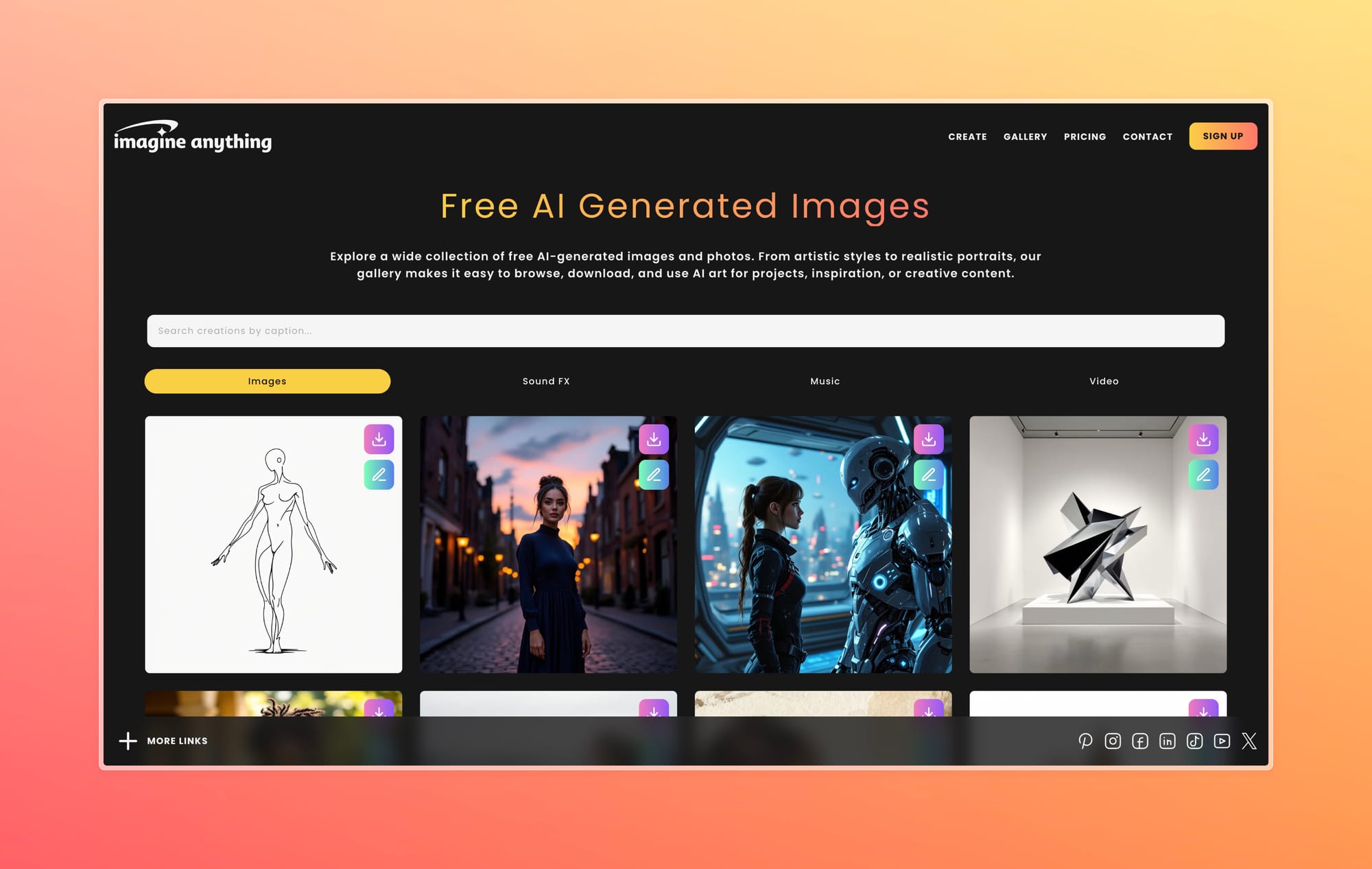
The image generation engine supports text-to-image and image-to-image creation with extensive style presets spanning photorealistic, anime, abstract, fantasy, and commercial design aesthetics. Users can specify the number of variations generated simultaneously (typically 4-8 options), select aspect ratios for different platforms (square for Instagram, vertical for Stories, landscape for YouTube thumbnails), and adjust model settings to control artistic interpretation.
The customization toolkit includes color saturation controls, text overlay capabilities, perspective adjustments, and negative prompting to exclude unwanted elements. This granular control enables users to refine outputs iteratively without regenerating entire images, saving credits and accelerating workflow. For instance, a marketer creating product mockups can generate base images, then adjust lighting and background without starting from scratch.
Image quality reaches commercial standards suitable for social media posts, blog headers, presentation slides, and digital advertisements. While not matching the artistic sophistication of Midjourney's latest models or the photorealistic precision of DALL-E 3, Imagine Anything delivers consistently usable results across diverse style categories. For creators interested in maximizing image generation capabilities, our collection of high-end AI image prompts provides advanced techniques.
AI Video Creation with the Seadance Model
Video generation represents one of Imagine Anything's most distinctive features, enabling text-to-video and image-to-video conversion through the Seadance model. Users describe desired scenes, actions, camera movements, and visual styles through text prompts, optionally uploading reference images to guide aesthetic direction. The platform generates videos ranging from 6 to 15 seconds with synchronized motion, camera dynamics, and basic physics simulation.
The video engine excels at creating short-form content for social media platforms like TikTok, Instagram Reels, and YouTube Shorts. Common use cases include product demonstrations, animated logos, character animations, concept visualizations, and educational explainers. While video length limitations restrict long-form content production, the rapid generation speed (10-30 seconds per video) enables high-volume content creation for daily posting schedules.
Technical specifications include standard resolution downloads in the free tier with high-resolution exports available through premium plans. Videos include integrated motion layers and basic environmental effects, though advanced physics simulation and complex scene choreography remain limited compared to specialized video AI platforms. For creators seeking more comprehensive video solutions, exploring AI video tools like Kapwing provides additional editing capabilities.
AI Music and Sound Effect Generation
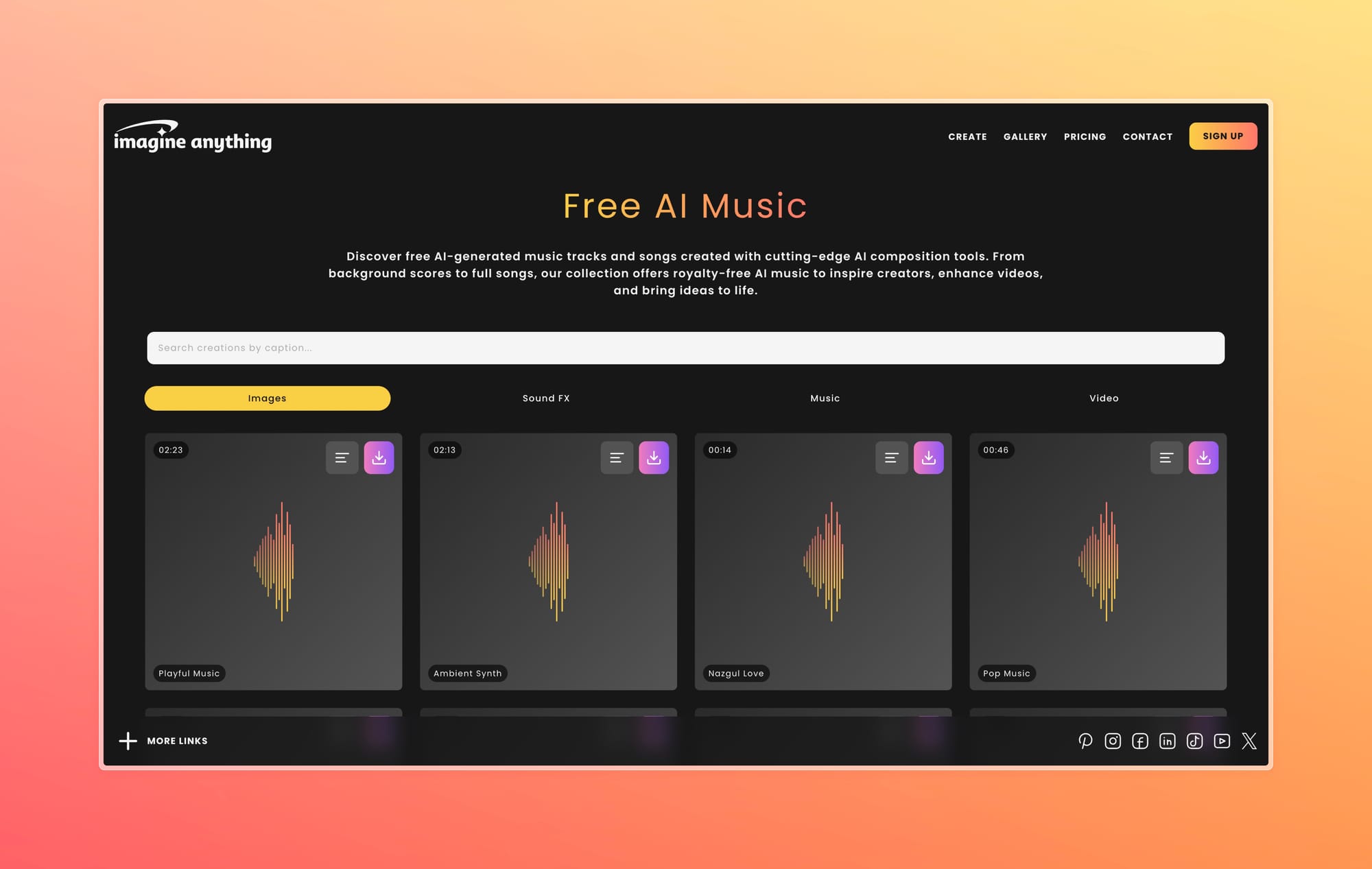
The audio synthesis engine creates custom music tracks and sound effects based on text descriptions specifying genre, mood, tempo, and duration. Users can generate background music for videos, podcast intros, ambient soundscapes, or specific sound effects like footsteps, door creaks, or environmental ambiance. The MiniMax model powering audio generation produces royalty-free tracks suitable for commercial projects under the Pro plan license.
Music generation supports diverse genres including cinematic orchestral, electronic dance, acoustic folk, corporate background, and experimental ambient styles. Duration controls allow tracks from 10 seconds to several minutes, accommodating various content formats. The output quality suits most multimedia projects, though professional music producers will find limitations in mixing control, instrument isolation, and mastering sophistication.
Sound effects generation proves particularly valuable for video editors, game developers, and multimedia designers who need custom audio elements without licensing restrictions. Rather than searching stock audio libraries, creators describe desired sounds and receive multiple variations instantly. This accelerates video post-production significantly, especially for creators producing content at scale.
AI Voiceover Synthesis
The voiceover engine leverages GPT-4o and MiniMax models to convert written text into natural-sounding speech across multiple languages, accents, and vocal styles. Users input scripts, select voice characteristics (gender, age, tone, pacing), and generate audio files suitable for video narration, podcast content, audiobook production, or e-learning materials.
Voice quality reaches near-human levels for most languages, with particularly strong performance in English, Spanish, French, German, and Mandarin. The synthesis captures appropriate emotional inflection based on script content, though complex emotional nuance and character voice acting remain less developed than specialized platforms like ElevenLabs or Descript.
Practical applications include narrating explainer videos, creating audio versions of blog posts, producing multilingual marketing content, and generating voiceovers for animated characters. The commercial license included with Pro plans enables use in client work, advertising, and revenue-generating content, removing legal concerns about voice rights.
Workflow Automation and Templates
The workflow generation feature creates automated processes for repetitive content creation tasks. Users select from templates for social media posting schedules, email campaign sequences, content repurposing workflows, and project management automation. This feature bridges creative generation with operational efficiency, particularly valuable for marketing teams managing multiple campaigns simultaneously.
Templates include pre-configured prompts, scheduling parameters, and distribution settings that users customize for specific needs. For example, a "Weekly Social Media Campaign" template might automatically generate coordinated images, videos, and captions across multiple platforms based on a single content brief. This systematization reduces manual planning while maintaining creative consistency.
Pricing Plans and Value Analysis
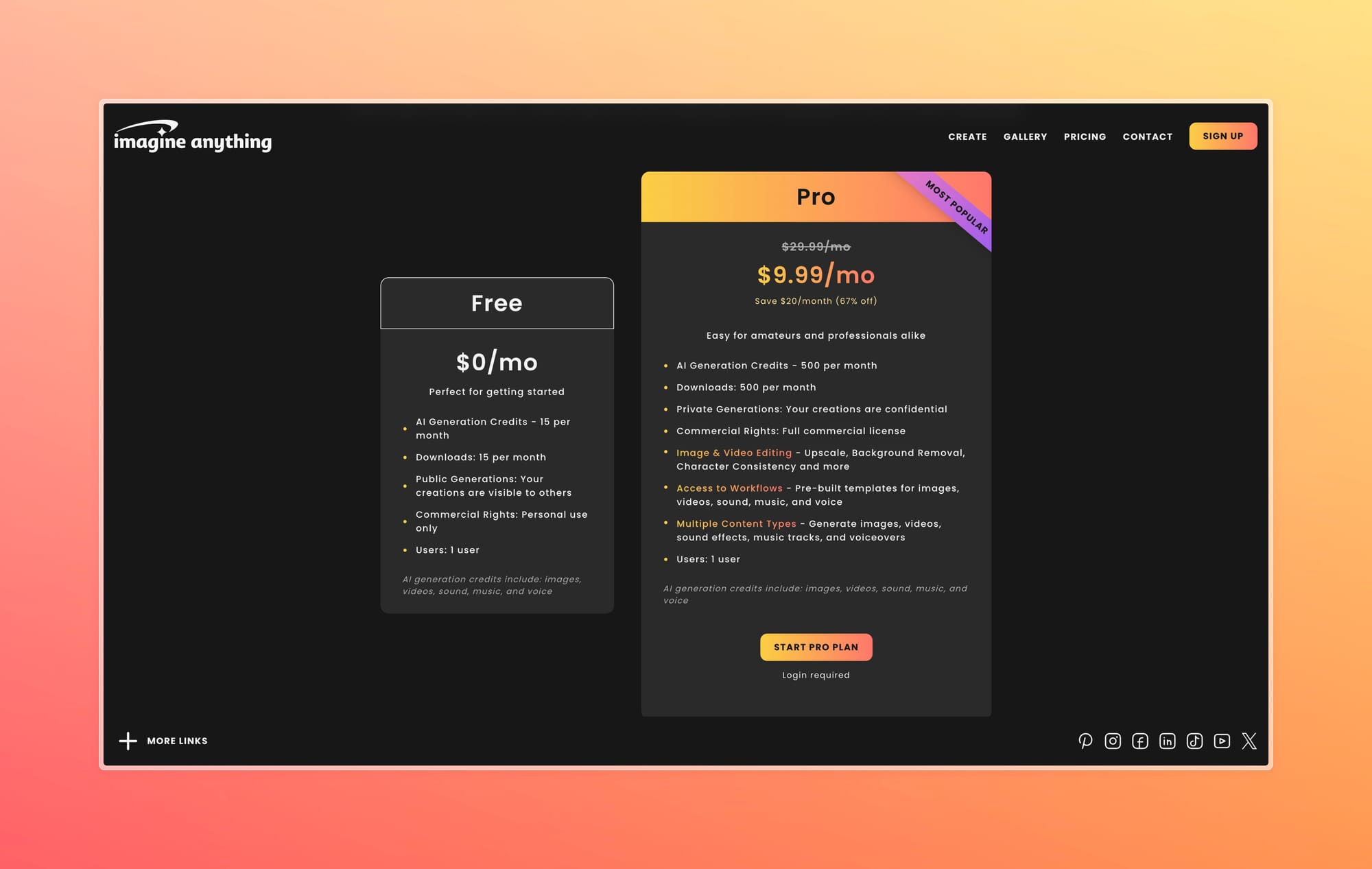
Free Plan: Entry-Level Access
The free tier provides 15 credits without requiring payment information, enabling new users to test all platform features before committing financially. Credits deplete based on generation complexity, with image creation typically consuming 1-2 credits, videos using 3-5 credits, and audio generation requiring 2-4 credits depending on duration. This allocation allows approximately 5-10 pieces of content creation for initial evaluation.
Limitations include standard resolution downloads, basic style options, and the absence of commercial licensing. Free users can download generated content for personal projects, portfolio development, and non-commercial social media posts, but cannot use assets in client work or revenue-generating applications. For individuals exploring AI's creative potential or students learning content generation techniques, the free tier offers substantial value without financial commitment.
Pro Plan: Professional Content Creation
The Pro subscription at $9.99 monthly (currently offered at a promotional rate) delivers 500 generations per month with full commercial licensing, unlimited downloads, high-resolution exports, and priority rendering. This pricing positions Imagine Anything competitively against specialized tools: Midjourney's basic plan costs $10 monthly for 200 image generations only, while comprehensive creative suite subscriptions like Adobe Creative Cloud start at $54.99 monthly.
The 500-generation allocation supports moderate content creation volumes. A social media manager posting daily across Instagram, TikTok, and LinkedIn might use 100-150 generations weekly (creating 3-5 assets per post across platforms), making the monthly limit suitable for consistent but not excessive production schedules. High-volume creators producing 10+ daily posts may require credit pack purchases or workflow optimization to stay within limits.
Value calculation reveals competitive positioning: at $0.02 per generation, Imagine Anything undercuts most specialized alternatives while providing multi-modal capabilities. Equivalent content production using separate platforms (Midjourney for images, Runway for videos, ElevenLabs for voice) would cost $40-80 monthly, demonstrating 75-90% cost savings for creators needing diverse content types.
Credit Packs: Flexible Scaling
Credit pack purchases starting at $10 for 100+ generations provide overflow capacity beyond monthly subscriptions. This flexible pricing accommodates seasonal demand spikes, special campaigns requiring high content volumes, or testing new content formats without upgrading subscriptions permanently. Packs never expire, allowing users to maintain reserves for future projects.
For businesses comparing total cost of ownership, Imagine Anything's pricing structure suits small to medium-scale operations. Enterprises requiring thousands of monthly generations across large teams might find per-generation costs add up, potentially justifying enterprise licenses from specialized platforms with volume discounts. However, for independent creators and small marketing teams, the pricing delivers exceptional value relative to capability breadth.
Free Alternatives and Competitors
DALL-E 3 by OpenAI
DALL-E 3 represents the current pinnacle of AI image generation, producing photorealistic imagery with exceptional prompt adherence and fine detail rendering. Integrated into ChatGPT Plus ($20/month) and available through Microsoft Bing Image Creator (free with limitations), DALL-E excels at complex compositions, accurate text rendering within images, and nuanced style interpretation.
Key differentiators: Superior image quality, better text-in-image capability, stronger content safety filters, integration with ChatGPT for iterative refinement.
Best for: Users prioritizing image quality over multi-modal capabilities, those already subscribing to ChatGPT Plus, creators needing photorealistic product mockups.
Pricing: Free via Bing (limited generations), $20/month via ChatGPT Plus.
Trade-offs: Image-only generation (no video or audio), higher cost for equivalent image volume, stricter content policies limiting creative flexibility.
Midjourney
Midjourney dominates artistic AI image generation with unmatched aesthetic quality, diverse style mastery from hyperrealism to abstract expressionism, and a vibrant creator community sharing techniques. The platform operates through Discord servers, offering collaborative feedback and inspiration unavailable in isolated web applications.
Key differentiators: Superior artistic quality, extensive style range, strong community for learning and inspiration, regular model updates improving capabilities.
Best for: Artists and illustrators seeking premium aesthetic quality, creators building branded visual identities, users comfortable with Discord-based workflows.
Pricing: $10/month Basic (200 generations), $30/month Standard (unlimited slow generations), $60/month Pro (maximum speed).
Trade-offs: Image-only focus (no video/audio/voice), Discord learning curve, higher cost for multi-modal content needs, no free tier.
For detailed comparisons of Midjourney's capabilities, see our comprehensive Midjourney guide.
Stable Diffusion (Open Source)
Stable Diffusion provides open-source image generation with complete customization freedom, allowing users to train custom models, modify code, and run generation locally without usage limits or content restrictions. The platform supports extensive community-developed extensions, custom styles, and integration with existing creative workflows.
Key differentiators: Open-source freedom, local processing (privacy-focused), unlimited generations, extensive community resources, complete customization control.
Best for: Technical users comfortable with command-line interfaces, privacy-conscious creators, developers building custom AI workflows, users needing unlimited generation volumes.
Pricing: Free (requires technical setup and hardware), cloud services like DreamStudio charge per-generation ($10 for ~5,000 images).
Trade-offs: Technical complexity barriers, requires GPU hardware or cloud costs, no multi-modal capabilities, steeper learning curve.
Runway ML
Runway specializes in AI video editing and generation with professional-grade tools including text-to-video, video-to-video style transfer, motion tracking, and advanced post-production effects. The platform targets professional video editors, filmmakers, and content creators requiring cinematic quality and extensive editing control.
Key differentiators: Professional video editing suite, advanced motion controls, higher video resolution options, integration with Adobe Premiere, extensive export formats.
Best for: Professional videographers, filmmakers requiring cinematic quality, brands producing high-end video marketing, creators needing advanced editing controls.
Pricing: Free tier (limited), $15/month Standard, $35/month Pro, $95/month Unlimited.
Trade-offs: Video-focused (limited image/audio generation), higher cost, steeper learning curve, overkill for simple social media content.
For creators interested in video-specific AI tools, our guide on AI video generators including PixVerse provides additional options.
ElevenLabs
ElevenLabs delivers industry-leading AI voice synthesis with emotional nuance, accent accuracy, and voice cloning capabilities that rival professional voice actors. The platform supports extensive language coverage, custom voice creation, and commercial licensing suitable for audiobooks, podcasts, and video narration.
Key differentiators: Superior voice quality and emotional range, voice cloning technology, extensive language support, professional audio export formats.
Best for: Podcasters, audiobook creators, video narrators, multilingual content producers, creators needing character voices.
Pricing: Free (limited), $5/month Starter, $22/month Creator, $99/month Pro.
Trade-offs: Voice-only specialization (no images/video), higher cost for voice-specific needs, complex pricing based on character limits.
Leonardo.ai
Leonardo.ai combines AI image generation with extensive editing tools, offering fine-tuned control over compositions, consistent character generation, and custom model training. The platform targets game developers, concept artists, and commercial designers requiring brand consistency across large asset libraries.
Key differentiators: Advanced editing controls, consistent character/asset generation, custom model training, extensive style presets, game asset optimization.
Best for: Game developers, concept artists, commercial designers, creators needing consistent brand assets, users requiring batch processing.
Pricing: Free tier, $12/month Apprentice, $30/month Artisan, $60/month Maestro.
Trade-offs: Image-focused, more complex interface than Imagine Anything, higher learning curve for advanced features.
Practical Use Cases and Application Scenarios
Social Media Content Creation
Social media managers utilize Imagine Anything to maintain consistent daily posting schedules across multiple platforms without exhausting budgets or creative energy. A typical workflow involves generating carousel images for Instagram, short video clips for Reels and TikTok, background music for video posts, and voiceovers for educational content, all from unified prompts ensuring thematic coherence.
The platform particularly excels at creating variations on core themes. A fashion brand launching a summer collection might generate 50+ product showcase images with different backgrounds, lighting conditions, and styling approaches in under an hour, then select the strongest performers for actual posting. This volume-through-iteration approach proves impossible with manual design but becomes trivial with AI generation.
For influencers and personal brands, the multi-modal capability enables complete content production without team collaboration. A fitness coach can generate workout demonstration videos, motivational quote graphics, background music for meditation sessions, and voiceover explanations for exercise techniques, publishing comprehensive content without videographers, designers, or audio engineers.
Marketing Campaign Asset Development
Marketing teams deploy Imagine Anything for rapid campaign prototyping and asset development across channels. A product launch campaign requires coordinated visuals for email headers, social media ads, website banners, presentation decks, and video trailers. Rather than commissioning separate creative work for each format, teams generate aligned assets using consistent prompt frameworks, ensuring visual cohesion while dramatically reducing production timelines from weeks to days.
The speed advantage proves particularly valuable for reactive marketing responding to trending topics, news events, or competitive moves. When a relevant cultural moment emerges, brands must move within hours to capture attention. Imagine Anything enables this agility, generating campaign assets within the decision-making cycle rather than waiting for traditional creative production pipelines.
A/B testing benefits substantially from low-cost generation. Marketers can create dozens of headline variations, color schemes, image styles, and call-to-action formats, testing them simultaneously to identify optimal combinations before investing in polished final production. This data-driven approach to creative optimization reduces waste on underperforming concepts.
For those interested in leveraging AI across the entire marketing function, our guide on AI marketing assistants demonstrates comprehensive AI-augmented strategies.
Educational Content and E-Learning
Educators and instructional designers leverage Imagine Anything to create engaging learning materials that maintain student attention in competitive digital environments. Custom illustrations explaining complex concepts, animated diagrams showing processes, voiceover narration in multiple languages, and background music for video lessons all emerge from simple text descriptions of educational objectives.
The cost implications transform educational content production economics. Traditional e-learning development costs $7,000-$15,000 per finished training hour when using professional studios. Imagine Anything reduces this to software subscription costs, enabling educators to produce equivalent content volumes for under $200 monthly, democratizing high-quality educational content creation for independent instructors and small institutions.
Language learning applications benefit particularly from voiceover capabilities. Teachers create pronunciation guides, conversational examples, and listening comprehension exercises across multiple languages without native speaker recordings, expanding language offerings affordably. The ability to generate cultural context imagery and music further enriches immersive learning experiences.
Content Repurposing and Format Adaptation
Content creators maximize reach by adapting core content across formats and platforms. A podcast episode becomes Instagram quote graphics, TikTok video clips with subtitles, YouTube thumbnail images, and audiogram videos for social sharing. Imagine Anything accelerates this repurposing workflow, generating format-specific adaptations from source transcripts or show notes.
Blog writers transform articles into multi-format content ecosystems. A 2,000-word post on productivity techniques generates accompanying Pinterest infographics, Facebook video summaries, Instagram carousel posts, and Twitter thread images, multiplying content reach across platforms from a single foundational piece. For strategies on maximizing AI-assisted content creation, see our article on making money with AI blogging.
The workflow reduction proves substantial. Manual repurposing requires 3-5 hours per article to design graphics, edit video clips, and optimize for each platform. AI-assisted repurposing compresses this to 30-60 minutes, enabling creators to maintain cross-platform presence without full-time content teams.
Rapid Prototyping and Concept Visualization
Product designers, entrepreneurs, and creative professionals use Imagine Anything for rapid concept visualization during ideation phases. Rather than investing in professional mockups before validating ideas, they generate dozens of concept variations, test with focus groups or stakeholders, and iterate based on feedback before committing to expensive development.
Startup founders pitch investors using AI-generated product visualizations, interface mockups, and promotional materials created before hiring designers. This speeds fundraising timelines and reduces burn rate during pre-revenue stages, when conserving capital proves critical for survival.
Architectural firms visualize exterior renderings, interior design concepts, and landscape proposals for client presentations without full 3D modeling workflows. While final deliverables require professional rendering, Imagine Anything accelerates the concept approval process, reducing revision cycles and improving client satisfaction through rapid iteration.
Limitations, Risks, and When Not to Use Imagine Anything
Quality Ceiling for Specialized Applications
Imagine Anything's generalist approach necessarily sacrifices specialized quality for breadth of capability. Professional photographers, illustrators, and video producers will find output quality insufficient for premium commercial work requiring technical perfection. The image quality, while suitable for social media and web content, lacks the resolution, color accuracy, and compositional sophistication demanded by print publications, large-format displays, or gallery exhibitions.
Video generation limitations include short duration constraints (6-15 seconds), limited complex motion choreography, and occasional physics inconsistencies with object interactions or character movements. Brands requiring cinematic advertising quality or narrative storytelling videos should use dedicated platforms like Runway ML or commission professional production.
Audio synthesis produces functional background music and sound effects but lacks the mixing sophistication, instrument realism, and emotional depth of professional music production. Musicians, sound designers, and audio engineers will find limitations in harmonic complexity, dynamic range, and sonic character compared to traditional composition or specialized AI music platforms like Soundraw or AIVA.
Prompt Engineering Learning Curve
Despite marketing accessibility, optimal results require understanding prompt engineering techniques. Vague descriptions produce generic outputs, while precise prompts specifying composition, lighting, mood, style references, and negative constraints yield substantially superior results. New users often experience frustration during initial sessions before developing prompting literacy.
The multi-modal nature amplifies this challenge, as effective prompts differ significantly across content types. Image prompts benefit from visual style descriptors and compositional directions, video prompts require motion and camera movement specifications, while audio prompts need genre, mood, and instrumentation details. Users must learn distinct prompting languages for each modality, increasing the cognitive load beyond single-purpose tools.
For creators seeking to master prompting techniques, our comprehensive prompt engineering guide provides foundational principles, while our prompt checklist offers practical pre-generation verification steps.
Content Originality and Copyright Concerns
AI-generated content raises ongoing questions about originality, copyright ownership, and derivative work status. While Imagine Anything provides commercial licensing for Pro subscribers, legal frameworks surrounding AI art remain unsettled, with ongoing litigation challenging the validity of AI-generated work for copyright protection. Creators using AI assets in commercial projects should consult legal counsel regarding intellectual property claims.
The training data controversy presents ethical considerations. AI models learn from existing creative works, potentially incorporating stylistic elements, compositions, or thematic approaches from artists who did not consent to their work's inclusion in training datasets. This raises questions about attribution, compensation, and the ethical use of AI tools in professional creative practice.
Brand safety concerns emerge when AI generates unexpected content containing trademarked elements, recognizable public figures, or potentially offensive imagery. While Imagine Anything implements content filters, no system proves perfect, and users must review generated content carefully before publication to avoid legal liability or reputational damage.
Credit Consumption and Cost Management
The credit-based pricing model can create unexpected costs for users unfamiliar with consumption patterns. Complex generations consume more credits than simple requests, and iterative refinement workflows quickly deplete monthly allocations. Users accustomed to unlimited access in other subscription models may experience frustration when hitting credit limits mid-project.
Video generation proves particularly credit-intensive, with single video attempts consuming 3-5 credits. Users creating video-heavy content might exhaust 500 monthly credits in 100-150 video generations, equivalent to 3-5 videos daily, which may prove insufficient for high-frequency posting schedules. Understanding credit economics before committing to workflows prevents mid-campaign surprises.
Free tier limitations restrict serious evaluation. With only 15 credits, users can test basic functionality but cannot properly assess platform performance under realistic production workflows. This creates pressure to upgrade before fully understanding whether the tool meets specific needs, potentially leading to subscription regret.
Platform Dependency and Vendor Lock-In
Cloud-based generation creates dependency on platform availability, service continuity, and pricing stability. Users building business models around Imagine Anything face risks if the service experiences downtime, changes pricing dramatically, or discontinues features. Unlike local software providing perpetual licenses, cloud services can alter terms unilaterally, affecting business operations.
Content portability concerns arise when workflows integrate deeply with platform-specific features, templates, or automation. Migrating to alternative tools might require rebuilding workflows, recreating templates, and adapting to different interfaces, creating switching costs that lock users into suboptimal solutions even when better alternatives emerge.
The lack of API access for most users limits integration with existing creative workflows, project management systems, or content distribution platforms. Enterprise teams requiring automated generation triggered by external events, integrated with asset management systems, or coordinated with publishing schedules cannot fully leverage Imagine Anything within established operational infrastructure.
Myths and Reality: Debunking Common Misconceptions
Myth: AI Replaces Human Creativity
Reality: Imagine Anything augments rather than replaces human creativity, functioning as a production accelerator that executes creative direction rather than originating it. Users must still conceptualize ideas, craft effective prompts, curate generated outputs, and make aesthetic judgments about which assets serve their objectives. The creative intelligence remains human, while AI handles technical execution.
Professional creatives using AI tools report shifted rather than eliminated responsibilities. Instead of manually designing each visual element, they focus on creative strategy, brand alignment, and quality curation, producing higher volumes of work with maintained or improved quality. The skill shifts from technical execution to creative direction, analogous to how photography shifted from chemical darkroom work to digital post-processing.
Myth: AI-Generated Content Is Always Inferior to Human Creation
Reality: Quality differences depend on use case, output type, and comparison standards. For specific applications like social media graphics, blog post imagery, or background music, AI-generated content frequently matches or exceeds average human work, particularly when considering speed and cost constraints. Professional-grade work in specialized domains still favors human expertise, but the gap narrows continuously.
Blind tests reveal audiences often cannot distinguish AI-generated social media content from human-created equivalents, suggesting perceptual quality meets practical standards for most digital applications. The "inferiority" assumption often reflects bias rather than measurable quality differences in relevant contexts.
Myth: Using AI Content Violates Authenticity
Reality: Authenticity relates to honest representation and brand truthfulness rather than production methods. A brand using AI-generated imagery in marketing materials while honestly representing products and services maintains authenticity. Deceptive practices violate authenticity regardless of whether content is human or AI-generated.
Many successful creators transparently incorporate AI tools while maintaining authentic voices and genuine audience relationships. The tool choice matters less than whether content serves audience needs, provides real value, and reflects truthful representation of the creator's perspective and expertise.
Myth: Free AI Tools Match Paid Platform Quality
Reality: Significant quality differences exist between free and premium tiers within Imagine Anything and across competing platforms. Free access typically provides limited generations, lower resolution outputs, basic features, and restricted commercial usage. Premium tiers deliver substantially higher quality, more creative control, and legal protection for commercial applications.
Users expecting professional results from free tiers often experience disappointment, not because AI tools fail but because expectations misalign with tier capabilities. Evaluating tools requires testing at the subscription level matching intended use case rather than assuming free trials represent full platform potential.
Myth: AI Content Generation Requires No Skill
Reality: Effective AI content generation demands distinct skills in prompt engineering, output curation, and strategic application. High-quality results require understanding model capabilities, crafting precise descriptions, selecting optimal settings, and recognizing which outputs succeed or fail for specific purposes.
The skill transition from manual creation to AI direction mirrors historical technology shifts. Photography didn't eliminate skill requirements, it transformed them from painting technique to compositional awareness, lighting control, and moment capture. Similarly, AI generation transforms creative skills from technical execution to strategic direction, maintaining skill requirements while changing their nature.
Comparison with Direct Competitors
Imagine Anything vs. Midjourney
Image Quality: Midjourney delivers superior artistic quality with more sophisticated style interpretation, better composition balance, and stronger aesthetic coherence. Imagine Anything produces functional imagery suitable for web and social media but lacks Midjourney's artistic refinement.
Ease of Use: Imagine Anything provides simpler web interface accessible to non-technical users, while Midjourney requires Discord familiarity and command syntax learning, creating steeper initial adoption curves.
Content Variety: Imagine Anything offers multi-modal generation (images, videos, audio, voice), while Midjourney focuses exclusively on image generation with exceptional depth and quality in that domain.
Pricing Value: At $9.99 monthly for multi-modal generation, Imagine Anything delivers broader capability coverage, while Midjourney's $10 monthly Basic plan provides superior image quality but no other content types.
Best use alignment: Choose Imagine Anything for diverse content needs across media types with moderate quality requirements. Choose Midjourney for image-focused work requiring premium artistic quality and style sophistication.
Imagine Anything vs. Leonardo.ai
Feature Depth: Leonardo.ai provides advanced editing tools, consistent character generation, custom model training, and game asset optimization unavailable in Imagine Anything. However, Leonardo focuses exclusively on images without video, audio, or voice capabilities.
User Interface: Both platforms offer web-based access, but Leonardo's interface complexity serves advanced users with greater control needs, while Imagine Anything prioritizes simplicity for rapid generation without extensive parameter adjustment.
Consistency Controls: Leonardo excels at generating consistent characters, assets, and styles across multiple images, critical for game development and brand asset libraries. Imagine Anything lacks this specialized consistency tooling but offers broader content type coverage.
Pricing Structure: Leonardo's free tier provides more generous allocations for testing, while paid plans ($12-60 monthly) price competitively with Imagine Anything while offering different feature tradeoffs favoring image specialists over generalists.
Best use alignment: Choose Leonardo for consistent visual asset generation, game development, or projects requiring advanced editing controls. Choose Imagine Anything for multi-format content production across images, video, and audio.
Imagine Anything vs. Runway ML
Video Capabilities: Runway provides professional video editing suite with advanced motion controls, style transfer, motion tracking, and cinematic quality outputs exceeding Imagine Anything's basic video generation. However, Runway focuses primarily on video without integrated image, audio, and voice generation.
Target Audience: Runway serves professional videographers and filmmakers requiring sophisticated controls, while Imagine Anything targets general content creators needing simple video generation alongside other content types.
Learning Curve: Runway's professional tooling demands significant learning investment, while Imagine Anything enables immediate video generation from simple prompts without training.
Pricing Positioning: Runway's pricing ($15-95 monthly) reflects professional-grade capabilities but costs more than Imagine Anything's generalist approach, making Imagine Anything more accessible for casual or multi-format creators.
Best use alignment: Choose Runway for professional video projects requiring cinematic quality and extensive editing control. Choose Imagine Anything for quick social media videos and multi-format content campaigns prioritizing speed over professional polish.
Imagine Anything vs. DALL-E 3
Image Fidelity: DALL-E 3 produces higher-fidelity photorealistic images with superior prompt adherence, better text rendering within images, and more nuanced style interpretation than Imagine Anything's image engine.
Multi-Modal Coverage: Imagine Anything provides video, audio, and voice generation absent from DALL-E 3, making it more versatile for creators needing diverse content types from unified platforms.
Integration Advantages: DALL-E 3's ChatGPT integration enables conversational refinement and iterative improvement through natural dialogue, while Imagine Anything requires manual prompt adjustment for refinements.
Access Models: DALL-E 3 availability through free Bing Image Creator and $20 ChatGPT Plus subscription provides flexible access options, while Imagine Anything's standalone platform offers independent pricing without requiring ChatGPT subscription.
Best use alignment: Choose DALL-E 3 for highest-quality image generation, especially when already subscribing to ChatGPT Plus. Choose Imagine Anything for multi-modal content needs beyond images or when prioritizing lower subscription costs.
Strategic Recommendations for Different User Types
For Independent Content Creators
Best fit: Imagine Anything excels for solopreneurs and independent creators managing multiple content channels without dedicated creative teams. The multi-modal capability enables complete content production from ideation to publication without external collaboration, particularly valuable for maintaining consistent posting schedules across platforms.
Recommended workflow: Develop content themes weekly, generate asset variations in batch sessions, curate strongest outputs for scheduling, and maintain content reserves for consistent publishing despite creative variation. Use the Pro plan's 500 generations strategically, prioritizing hero content for primary channels while using free alternatives for secondary platforms.
Complementary tools: Pair Imagine Anything with scheduling platforms like Buffer or Later for distribution, Canva for final polish and branding consistency, and analytics tools for performance tracking. This combination enables solo creators to compete with team-based content operations.
For Small Business Marketing Teams
Best fit: Teams of 2-5 marketers managing multiple campaigns benefit from Imagine Anything's rapid asset generation for testing and iteration before investing in polished final production. The platform accelerates concept validation, A/B testing, and reactive marketing responses.
Recommended workflow: Generate concept variations during campaign planning sessions, test with stakeholder groups or limited audiences, identify winning approaches, then either proceed with AI assets for digital channels or commission professional production for premium placements. Use Imagine Anything for volume and speed while reserving budget for high-stakes creative work.
Complementary tools: Integrate with project management platforms like Asana or Monday, connect to analytics suites for performance measurement, and combine with professional tools like Adobe Creative Cloud for final production when quality demands exceed AI capabilities. Consider exploring AI productivity agents for workflow automation.
For Educators and Course Creators
Best fit: Instructional designers and educators producing e-learning content benefit from Imagine Anything's ability to generate custom illustrations, explanatory animations, voiceovers, and background audio aligned with specific educational objectives without stock asset limitations.
Recommended workflow: Develop content scripts and learning objectives first, generate supporting visuals and audio based on pedagogical needs, integrate into learning management systems or video editing platforms, then iterate based on learner feedback and comprehension metrics.
Complementary tools: Combine with video editing software like DaVinci Resolve or Camtasia for final lesson assembly, learning management systems like Teachable or Thinkific for distribution, and assessment tools for measuring content effectiveness. The cost savings enable producing more comprehensive courses within fixed budgets.
For Social Media Managers
Best fit: Professionals managing multiple brand accounts across platforms benefit from Imagine Anything's speed for maintaining consistent posting schedules with varied content formats tailored to each platform's optimal formats and audience preferences.
Recommended workflow: Plan content calendars with thematic cohesion, generate asset variations matching each platform's specifications (aspect ratios, durations, styles), maintain content reserves for scheduled posting, and analyze performance to refine generation prompts toward higher-engagement aesthetics.
Complementary tools: Essential integrations include scheduling platforms (Hootsuite, Sprout Social), analytics dashboards (native platform analytics, Dash Hudson), and community management tools. Imagine Anything accelerates content production, allowing managers to focus on strategy, community engagement, and performance optimization. For additional AI-powered social strategies, see our guide on AI marketing tactics.
Getting Started: Practical Implementation Guide
Initial Setup and Platform Familiarization
Begin by accessing Imagine Anything through any modern web browser without installation requirements. Create an account using email authentication, receiving 15 free credits for initial experimentation. Spend the first session exploring all five content generation modes without pressure to produce finished assets, focusing instead on understanding prompt syntax, available controls, and output characteristics.
Test each generation mode with simple prompts to establish baseline expectations. Generate a basic image with a descriptive prompt like "modern office workspace with natural lighting," create a short video describing "coffee being poured into a white mug," produce background music requesting "upbeat electronic track 30 seconds," and synthesize a voiceover reading "Welcome to our tutorial series." These foundational experiments reveal platform capabilities and limitations before committing to specific projects.
Review the prompt inspiration hub and community gallery to observe effective prompt structures and stylistic approaches. Note how successful users phrase requests, specify details, and structure descriptions to achieve desired outcomes. This observational learning accelerates prompt engineering skill development compared to trial-and-error experimentation alone.
Developing Effective Prompt Engineering Skills
Effective prompts balance specificity with flexibility, providing clear direction while allowing the AI creative interpretation space. Structure prompts with: (1) subject description, (2) style or aesthetic direction, (3) compositional elements, (4) mood or atmosphere, and (5) negative constraints specifying elements to avoid.
For images, incorporate visual style references (photorealistic, anime, watercolor, corporate), lighting conditions (golden hour, studio lighting, dramatic shadows), compositional directions (close-up portrait, wide landscape, overhead view), and color palette preferences (warm tones, monochromatic, vibrant colors). Example: "Professional business portrait of a woman in her 30s, corporate office background, natural window lighting, warm color grading, confident expression, modern business attire, blurred background, high-resolution photography style."
For videos, specify subject actions and movements (person walking toward camera, product rotating 360 degrees, time-lapse of sunset), camera movements (slow zoom, pan left to right, static wide shot), scene environment (minimalist studio, bustling city street, natural outdoor setting), and duration preferences. Example: "10-second product demonstration video showing smartphone rotating 360 degrees on white surface, slow smooth rotation, studio lighting with soft shadows, modern tech aesthetic, close-up detail focus."
Audio prompts should specify genre or style (cinematic orchestral, upbeat electronic, acoustic folk), mood or energy level (relaxing, energetic, dramatic, playful), instrumentation preferences when relevant (piano-focused, guitar-driven, synthetic sounds), and intended use context (background music for video, podcast intro, ambient soundscape). Example: "30-second upbeat electronic background music, moderate tempo around 120 BPM, energetic but not aggressive, suitable for tech product video, modern production style with synthesizer lead."
Workflow Integration and Productivity Optimization
Develop systematic workflows that batch similar generation tasks to maintain creative momentum and credit efficiency. Rather than generating assets individually as needs arise, dedicate focused sessions to creating asset libraries organized by project, theme, or platform requirements. This batch approach reduces context-switching overhead and enables more strategic curation.
Implement a three-tier curation system: (1) immediate use for assets meeting quality standards and project requirements, (2) asset library for future potential use in related projects, and (3) reject for substandard outputs. This systematic evaluation prevents wasting time on marginal assets while building reusable content reserves. Organize approved assets in cloud storage (Google Drive, Dropbox) with consistent naming conventions and metadata tags enabling quick retrieval.
Establish feedback loops measuring content performance across channels. Track engagement metrics (likes, shares, comments, click-through rates) for AI-generated assets compared to manually created content, identifying which styles, formats, and approaches resonate most with audiences. Use these insights to refine prompts toward higher-performing aesthetics and content strategies.
For teams, document effective prompt templates in shared knowledge bases, enabling consistent quality across multiple users. Create prompt libraries organized by content type, brand guidelines for style consistency, and best practice documentation capturing lessons from successful and failed generation attempts.
Quality Control and Brand Consistency
Implement review processes ensuring AI-generated content aligns with brand guidelines before publication. Check for (1) visual consistency with brand color palettes, typography, and design systems, (2) appropriate representation of people and cultures avoiding stereotypes or problematic imagery, (3) technical quality including resolution, aspect ratio correctness, and format suitability, and (4) content safety ensuring absence of unintended elements, recognizable third-party intellectual property, or potentially offensive material.
For businesses with established brand identities, create style guides documenting approved aesthetic directions, prohibited elements, and brand-appropriate prompt structures. Train team members on these guidelines, ensuring consistent interpretation across multiple content creators. Regular brand consistency audits identify drift from guidelines, enabling corrective adjustments before significant misalignment occurs.
Maintain human oversight in the creative decision-making process. AI tools execute creative direction but shouldn't autonomously determine brand strategy, messaging, or content approach. Use generated assets as raw materials requiring human judgment about appropriateness, effectiveness, and strategic fit rather than automatically publishing all AI outputs.
Future Outlook and Platform Evolution
The AI content generation landscape evolves rapidly, with platforms like Imagine Anything continuously enhancing capabilities, expanding features, and improving output quality. Understanding likely evolution trajectories helps users make informed decisions about platform investment and workflow development.
Quality improvements through model upgrades will incrementally close gaps between generalist and specialist tools. As underlying AI models advance, platforms like Imagine Anything will deliver higher-resolution images, longer video durations, more realistic voiceovers, and more sophisticated music composition, gradually approaching specialized tool quality while maintaining multi-modal convenience.
Integration expansions seem inevitable, with API access for enterprise users, direct publishing to social platforms, native integration with creative software like Adobe and Canva, and workflow automation connecting generation with distribution channels. These integrations reduce friction in end-to-end content production pipelines, making AI tools more valuable within existing operational infrastructure.
Customization capabilities will likely expand, enabling custom model training on brand-specific aesthetics, consistent character generation across content, fine-tuned voice cloning for personalized narration, and branded templates encoding style guidelines directly into generation parameters. This increased customization addresses current limitations around brand consistency and content uniqueness.
Ethical frameworks and content governance will mature as legal precedents clarify copyright status, usage rights, and liability questions. Platforms implementing robust content provenance, transparent training data disclosure, and ethical use guidelines will differentiate themselves as responsible choices for risk-conscious organizations. Users should monitor these developments, adjusting platform choices as regulatory landscapes evolve.
Competitive dynamics will intensify as major tech companies expand into multi-modal content generation. Google's integration of generative AI across Workspace, Adobe's Firefly expansion, and Microsoft's Copilot evolution create formidable competitors with existing user bases and distribution advantages. Imagine Anything's sustained competitiveness depends on maintaining ease-of-use advantages, competitive pricing, and innovation velocity matching or exceeding larger competitors.
For creators seeking to explore the expanding universe of AI-powered productivity and creativity, our thematic catalog of best articles provides curated guidance across AI tools, strategies, and emerging trends shaping the future of digital creation.
Whether you're an independent creator testing AI's potential, a marketing team accelerating campaign production, or an educator enriching learning experiences, Imagine Anything offers accessible entry into multi-modal content generation. Success depends not on the tool's inherent capabilities but on how strategically you integrate it within broader creative workflows, maintain quality standards through human oversight, and continuously adapt approaches based on performance feedback. The technology provides unprecedented production acceleration—your creativity, judgment, and strategic direction determine whether that acceleration produces meaningful impact.
Read more:
 Mark
Mark
 Dani
Dani
 Mark
Mark