For decades, creating virtual worlds required armies of artists, programmers, and level designers working for years. Building a single explorable environment in Unreal Engine or Unity meant crafting every asset by hand, writing physics systems, debugging collision detection, and iterating endlessly until the experience felt right.
Google just threw that playbook out the window.
On January 29, 2026, Google DeepMind launched Project Genie, an experimental tool that generates fully navigable 3D environments from nothing more than a text description. You type what you want to see and the AI builds it. Then you walk around inside it while the system generates more of the world in real time, frame by frame, as you move.
The catch is significant: each session lasts only 60 seconds. The resolution caps at 720p. The frame rate hovers around 24 fps. Physics can be unreliable and characters sometimes lag behind your inputs.
What matters is that this technology exists at all and you can now describe a world in plain English and watch it materialize around you in seconds. What matters is that Google is explicitly positioning this as a stepping stone toward artificial general intelligence and the path runs directly through the gaming industry.
What Project Genie Actually Does
Project Genie is a web-based prototype built on top of Genie 3, a "world model" that Google DeepMind has been developing since 2024. Unlike traditional game engines that render pre-built assets, Genie 3 generates the visual environment procedurally as you interact with it. There are no pre-made textures or 3D models waiting in memory. The AI predicts what should appear next based on your actions and the original prompt.
The experience centers on three core capabilities.
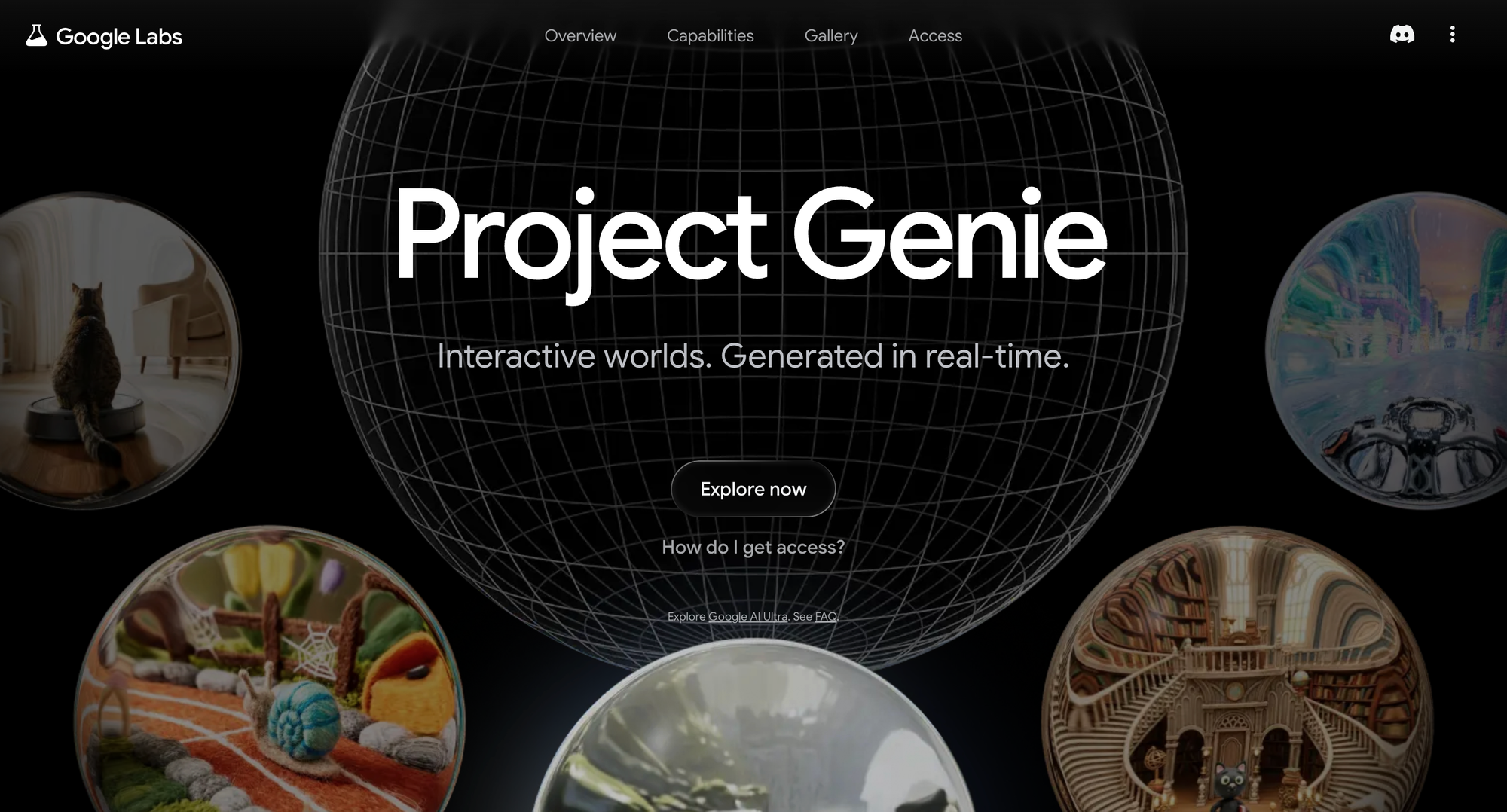
The process begins with world sketching, where you describe the environment and your character using text prompts or reference images. You can define almost any scenario you want, whether that means exploring a coral reef from the perspective of a sea turtle, driving a vintage muscle car through a neon-lit cyberpunk city, or even navigating a cluttered living room as a cat riding on a Roomba – a scenario Google itself has used in demos to show how flexible the system can be.
Before entering the world, you can also choose how you experience it by setting the camera perspective, such as first-person, third-person, or an isometric view. The system then generates a visual preview using Google’s Nano Banana Pro image generation model, allowing you to adjust the visual style and overall atmosphere before committing to the experience.
Once inside, the focus shifts to exploration. The environment becomes navigable using familiar keyboard and mouse controls, while the AI generates the space ahead of you dynamically as you move. When you turn around, the system recalls what was previously behind you, and when you walk toward distant landmarks, such as mountains or buildings, the terrain gradually unfolds as you approach. Although the world is generated on demand rather than fully prebuilt, it maintains enough internal consistency that you can return to previously visited areas and find them largely unchanged.
The final layer is world remixing. Any existing world, whether created by you or another user, can be modified by adjusting its original prompt to produce variations. A medieval castle can be reimagined as a futuristic space station, or a calm forest can be transformed into a darker, more unsettling environment with only a few changes. A built-in gallery makes it possible to browse curated worlds for inspiration, and explorations can be recorded and downloaded as videos for sharing or documentation.
The Technology Under the Hood
Genie 3 represents a fundamentally different approach to creating interactive environments. Traditional game development relies on deterministic systems: if a player presses the jump button, the character's trajectory follows a pre-programmed physics formula. Every asset, every animation, every interaction is explicitly defined by human developers.
World models work differently. They're trained on vast amounts of video data – gameplay footage, movies, real-world recordings — and learn to predict what should happen next in any given scenario. When you press forward in a Genie 3 environment, the model doesn't execute a movement script. It generates the next frame of video based on its learned understanding of how movement looks and feels.
This is autoregressive generation, the same fundamental technique that powers large language models like GPT-4 and Gemini. Just as a language model predicts the next word in a sequence, a world model predicts the next frame of an interactive experience. The difference is that world models must also account for user input, maintaining consistency not just with the narrative but with the laws of physics and spatial coherence.
The technical challenges are staggering. To achieve real-time interactivity, Genie 3 must generate 20-24 frames per second while simultaneously tracking the user's position, recalling previously generated environments, and maintaining visual consistency across everything the user might see. If you turn around after walking for 30 seconds, the model needs to remember what was behind you and regenerate it consistently. Google claims Genie 3 can maintain visual memory extending back approximately one minute.
Resolution and frame rate limitations are direct consequences of the computational intensity. Generating a single 720p frame requires processing billions of parameters. Doing it 24 times per second while responding to real-time input pushes current hardware to its limits. The 60-second session cap likely exists to manage both server load and accumulated inconsistencies that grow over longer interactions.
Why This Matters for Gaming
The gaming industry is watching Project Genie with a mixture of fascination and existential dread.
Their concern is not unfounded. The same GDC report found that 33% of U.S. game developers experienced at least one layoff in the past 2 years. Studios are shrinking. Budgets are tightening. And now Google has released a tool that can generate explorable 3D environments from a sentence.
Google is careful to clarify that Project Genie "is not a game engine and can't create a full game experience." A spokesperson told The Register that the company sees potential to "augment the creative process, enhancing ideation, and speeding up prototyping."
That's a diplomatic way of describing technology that could fundamentally reshape who makes games and how they're made.
Consider the current state of game development. Creating a single AAA title requires hundreds of people working for three to five years at budgets exceeding $100 million. Most of that time and money goes into content creation — building environments, crafting characters, designing levels, scripting interactions. It's slow, expensive, and risky. Most games fail to recoup their development costs.
Now imagine a future where environment creation happens in real time. Where a designer can describe a level in plain language and walk through it seconds later. Where iteration cycles that currently take weeks compress into minutes. Where small teams can explore visual concepts that would otherwise require entire art departments.
The implications extend beyond AAA development. Indie creators could prototype ideas without any technical knowledge. Educators could build historical simulations by describing them. Filmmakers could pre-visualize scenes by walking through AI-generated sets. Architects could let clients explore buildings that exist only as concepts.
One anonymous machine learning engineer quoted in the GDC study put it bluntly: "We are intentionally working on a platform that will put all game devs out of work and allow kids to prompt and direct their own content."
The Limitations
Project Genie’s current limitations are significant enough that it does not pose any immediate disruption to professional game development workflows. A single session capped at roughly 60 seconds, rendered at 720p and 24 frames per second, places it much closer to a technical demonstration than to a tool that could support real production pipelines. Inconsistent physics make it unsuitable for gameplay that depends on precise or repeatable interactions, the inability to render readable text rules out entire classes of mechanics and interfaces, and the lack of reliable multi-agent interaction prevents the creation of complex, shared worlds.
That said, the long-term direction of the technology matters far more than its present state.

Genie 1, introduced in early 2024 as a research project, demonstrated the generation of simple 2D platformer levels from learned patterns. Later that same year, Genie 2 expanded the concept into coherent 3D environments that could remain stable for roughly twenty seconds at a time. Genie 3, announced in August 2025, pushed that boundary further by sustaining world consistency for several minutes and enabling real-time generation at 720p. Project Genie marks the first time this line of research has been exposed in a publicly accessible, interactive form.
Each iteration has closed gaps that previously appeared fundamental, delivering capabilities that would have seemed unrealistic only months earlier. If this rate of progress continues, and there is little evidence to suggest it will slow the technical constraints that currently define Project Genie are likely to diminish quickly rather than persist.
Google has been clear that this work extends far beyond entertainment or interactive media. In its announcement of Project Genie, the company frames world models as a core building block for artificial general intelligence, arguing that systems capable of navigating and reasoning about the diversity of real-world environments are a prerequisite for broader intelligence. Models that can generate and explore simulated worlds effectively create training spaces where AI agents can learn how environments behave before operating in physical reality.
Viewed through that lens, Project Genie is not primarily about games at all. It is about giving machines a way to learn how the world works by allowing them to explore endlessly varied environments, observe cause and effect, and build internal models of reality through experience rather than static data alone.
What You Can Actually Do With Project Genie Today
If you're a Google AI Ultra subscriber in the United States and at least 18 years old, you can access Project Genie now through Google Labs. The Google AI Ultra plan costs $250 per month and includes various other features like higher AI usage limits, 30 terabytes of cloud storage, and access to Google's Antigravity agentic coding tool.
The experience is straightforward.
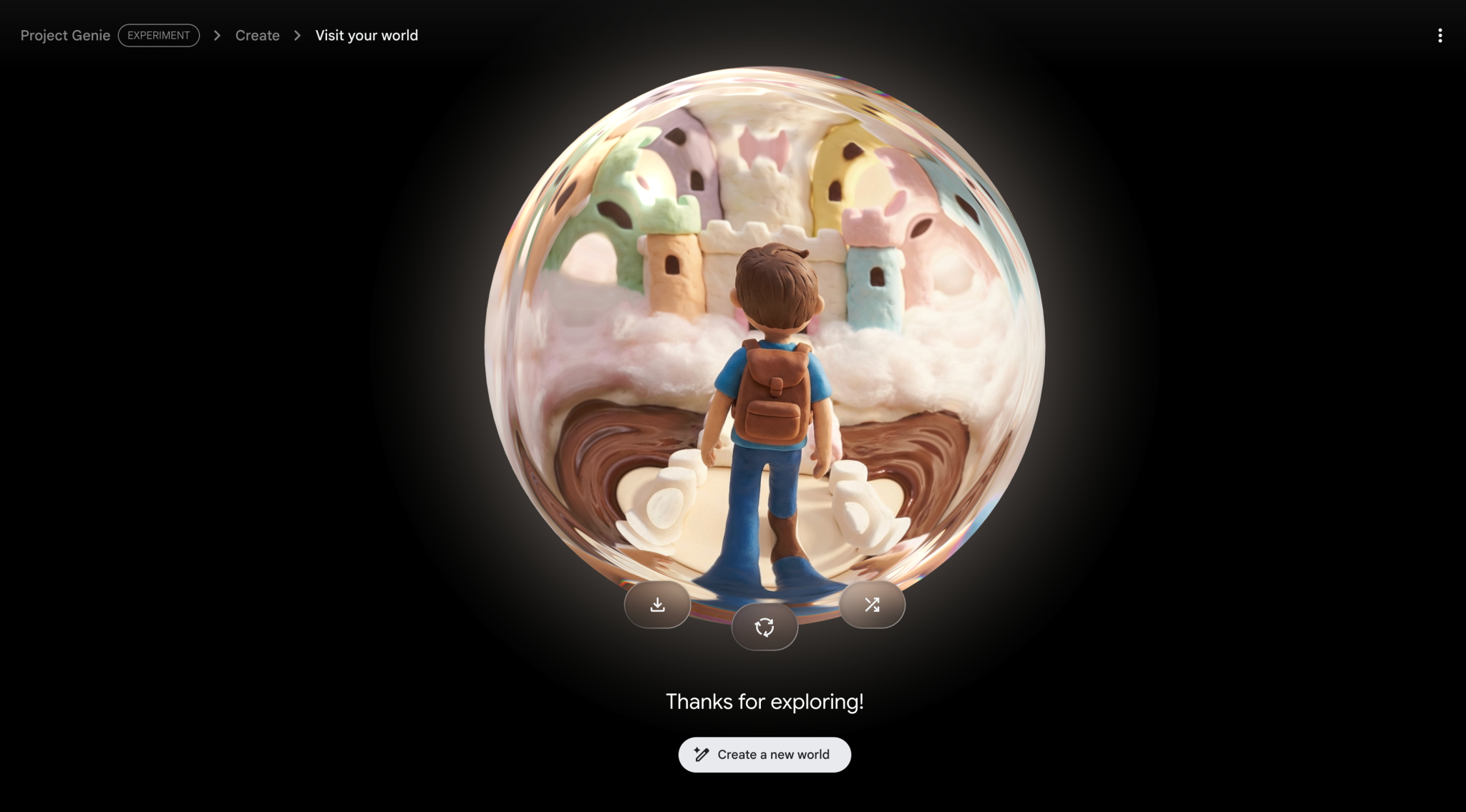
Google emphasizes that this is an experimental research prototype. The company is gathering data on how people use world models to inform future development. Expect bugs, inconsistencies, and limitations. Also expect occasional moments of genuine wonder when the AI generates exactly what you imagined from nothing but words.
International availability is planned but not yet scheduled. Google's statement says only that access will expand "in due course."
The Bigger Picture
Project Genie arrives at an inflection point for artificial intelligence. After years of steady progress on text and image generation, the field is shifting toward systems that can understand and interact with complex environments. World models represent this next phase — AI that doesn't just describe reality but can simulate it.
The gaming industry serves as an ideal proving ground. Games provide structured environments with clear rules, measurable outcomes, and billions of hours of training data. Google DeepMind's history includes landmark achievements in game-playing AI, from the Atari-conquering DQN to AlphaGo to AlphaStar. World models continue this lineage while expanding toward more general capabilities.
For creators, the implications are both exciting and unsettling. The barrier to entry for building interactive experiences is collapsing. Tools that required years of specialized training are being replaced by natural language interfaces. The question is no longer whether you can build a virtual world, but whether you can imagine one worth building.
For users, Project Genie offers a glimpse of entertainment's potential future. Imagine describing the movie you want to watch and having it generated in real time. Imagine video games that adapt their environments to your preferences as you play. Imagine virtual spaces that exist only for you, shaped by your words and your movements.
We're not there yet. Sixty seconds of 720p exploration is a far cry from living in a procedurally generated universe. But the distance between here and there is measured in years, not decades. And the journey has clearly begun.
What Happens Next
Google is very likely to expand Project Genie’s capabilities in the near future, with longer interactive sessions, higher visual resolution, more advanced physics simulation, and finer character control being the most obvious areas for improvement. Features that Google has already hinted at but did not include in the current prototype, such as dynamic weather systems, objects appearing or disappearing in real time, and changing environmental conditions are also expected to be introduced in future iterations.
The more significant question, however, is what happens once this technology moves beyond the research phase and into real-world use. Google Cloud already distributes AI models through developer-facing APIs, and a version of Genie 3 made accessible to external teams could give rise to an entirely new category of applications. Game studios could incorporate on-demand world generation directly into their production pipelines, VR companies could create endlessly explorable environments, educational platforms could build interactive and immersive historical simulations, and film productions could use the technology to generate real-time previews of complex visual effects before committing to final renders.
At the same time, the legal and ethical implications are only beginning to surface. Questions around ownership of procedurally generated worlds remain unresolved, particularly when a model trained on existing games produces environments that closely resemble copyrighted material. Responsibility, attribution, and liability become increasingly complex, as does the broader issue of economic disruption for creative professionals whose skills may be partially automated by these systems.
These challenges do not have straightforward answers, and they echo the debates that have accompanied every major advance in artificial intelligence, from image generation tools to large language models. What makes world models different is that they combine visual creation with interactive agency, significantly raising the stakes for creative industries and for society as a whole.
For now, Project Genie remains an experiment rather than a fully realized product – glimpse into what is possible rather than something users can fully inhabit. The current 60-second limit reinforces this experimental nature, allowing people to observe and test the technology without truly living inside the worlds it creates.
That limitation will not last forever. The real question is how quickly these constraints will disappear, and how we will choose to use—and govern—the worlds that emerge once they do.
Frequently Asked Questions
What is Project Genie and how does it work?
Project Genie is an experimental web application from Google that generates explorable 3D virtual environments from text descriptions. You describe a world and a character using natural language, the AI creates a starting image, and then you can navigate through the environment using keyboard and mouse controls. As you move, the system generates the world around you in real time, creating new terrain, objects, and scenery frame by frame. The technology is powered by Google DeepMind's Genie 3 world model, which was trained on vast amounts of video data to understand how environments look and behave.
How much does Project Genie cost and who can use it?
Project Genie is currently available only to Google AI Ultra subscribers in the United States who are 18 or older. The Google AI Ultra plan costs $250 per month and includes various features beyond Project Genie, including higher AI usage limits, 30 terabytes of cloud storage, and access to other Google AI tools. Google has stated that access will expand to more countries "in due course," but no specific timeline has been announced. There's currently no free tier or standalone pricing for Project Genie.
What are the current limitations of Project Genie?
The main limitations are significant but expected for experimental technology. Sessions are capped at 60 seconds. Resolution maxes out at 720p. Frame rate hovers around 24 fps. Physics simulation can be inconsistent, meaning objects don't always behave realistically. Character controls sometimes lag or respond unpredictably. The system struggles to render legible text. Multiple characters or agents can't reliably interact in the same environment. Some features announced for Genie 3, like promptable events that change the world as you explore, aren't yet available in Project Genie.
Can Project Genie create actual video games?
Not in its current form. Google explicitly states that Project Genie "is not a game engine and can't create a full game experience." The technology can generate explorable environments, but it lacks the mechanics, rules, progression systems, and designed challenges that define games. There's no way to add objectives, scoring, enemies, puzzles, or any of the structured elements that turn an environment into gameplay. The tool is better understood as a world visualization system or a prototyping aid rather than a game development platform.
Will AI like Project Genie replace game developers?
This is the central anxiety in the gaming industry right now. The honest answer is that AI will certainly change what game development looks like, but replacement is too simple a frame. World models can accelerate environment creation and prototyping, potentially reducing the need for certain technical and artistic roles. But games require design vision, narrative craft, balanced mechanics, and countless decisions that AI cannot reliably make. The most likely near-term outcome is that AI becomes a powerful tool that skilled developers use to work faster and explore more ideas — not a replacement for human creativity, but an amplifier of it.
How does Project Genie compare to traditional game engines like Unreal or Unity?
They're fundamentally different technologies solving different problems. Traditional game engines like Unreal and Unity render pre-built assets that artists and programmers have explicitly created. Every texture, model, animation, and interaction is hand-crafted and assembled into a game. World models like Genie 3 generate environments procedurally based on learned patterns, with no pre-existing assets. Game engines offer precision, control, and the ability to create polished commercial products. World models offer speed, flexibility, and the ability to visualize concepts instantly. Currently, they're complementary rather than competitive — you wouldn't ship a commercial game using Project Genie, but you might use it to explore ideas before building them properly in Unity.
What is a "world model" in AI terms?
A world model is an AI system that learns to simulate how environments work by observing them. Rather than being programmed with explicit rules about physics and objects, world models are trained on video data and learn to predict what should happen next in any given scenario. When you move forward in a world model environment, the AI generates the next frame based on its understanding of how movement looks and how environments respond to observer actions. This is fundamentally different from traditional simulation, where physics and rendering are computed according to mathematical formulas. World models are considered important for advancing AI toward general intelligence because they help machines develop intuitions about physical reality.
What other companies are working on similar technology?
Several major players and well-funded startups are pursuing world models. World Labs, founded by Stanford professor Fei-Fei Li, launched its Marble product in 2025 for creating 3D worlds from various inputs. Yann LeCun, formerly of Meta, started Advanced Machine Intelligence Labs specifically to build world-understanding AI systems. Microsoft Research has published work on AI-generated game frameworks. Meta has demonstrated world models for video generation. Elon Musk's xAI has announced plans for AI-generated games. The space is heating up rapidly, with significant venture capital investment flowing into companies working on related technologies.
How might Project Genie affect the future of VR and metaverse experiences?
If world model technology matures as expected, it could dramatically change how virtual reality content is created. Currently, VR experiences require extensive hand-built environments, limiting the diversity of available content. With reliable world generation, VR users could explore infinite procedurally created spaces tailored to their preferences. The "metaverse" concept of persistent shared virtual worlds could incorporate AI-generated regions that expand based on user interest. The 60-second limitation of current technology would need to extend dramatically for this vision to materialize, but the foundational capability — turning descriptions into explorable spaces — is now demonstrated.
Is Project Genie safe? What about content moderation?
Google states that it has worked closely with its Responsible Development & Innovation Team on Project Genie. The company acknowledges that open-ended generation capabilities introduce new safety challenges. Details on specific content moderation measures haven't been publicly disclosed, but Google's other AI products include filters for harmful content requests. As world models become more capable and accessible, questions about generated content — including violence, adult material, and potential misuse for training purposes — will become increasingly important. The experimental nature of Project Genie likely means Google is gathering data on how users interact with the system to inform future safety measures.
When will Project Genie be available internationally?
Google has only said that international availability will come "in due course" without providing specific dates or regions. The initial U.S.-only launch likely reflects both regulatory considerations and the need to manage demand on what is presumably limited server capacity. Given Google's typical product rollout patterns, expansion to other English-speaking countries and major markets could happen within months, but this is speculation. Users outside the U.S. will need to wait for official announcements about availability in their regions.
Related Articles
 Dani
Dani
 Dani
Dani
 Dani
Dani