The browser wars have officially entered a new era. While OpenAI, Perplexity, and other tech giants race to reinvent how we interact with the internet, Google quietly unveiled something that might just change the game entirely: Disco, an experimental AI browser that generates interactive mini-applications based on your requests.
This isn't another AI chatbot bolted onto a search bar. Disco represents Google's most ambitious vision yet for what web browsing could become — a future where you don't search for answers, but where your browser builds the exact tool you need, right when you need it.
What Is Google Disco?
Disco is a new experimental browser from Google Labs that reimagines how people discover and interact with information online. Unlike traditional browsers that display static web pages, Disco uses Google's most advanced AI model, Gemini 3, to understand what you're trying to accomplish and automatically creates interactive web applications to help you complete your tasks.
The name itself is a clever play on words — Disco stands for "discovery," and Google describes it as their "discovery vehicle designed to reimagine browsing and building for the modern web."
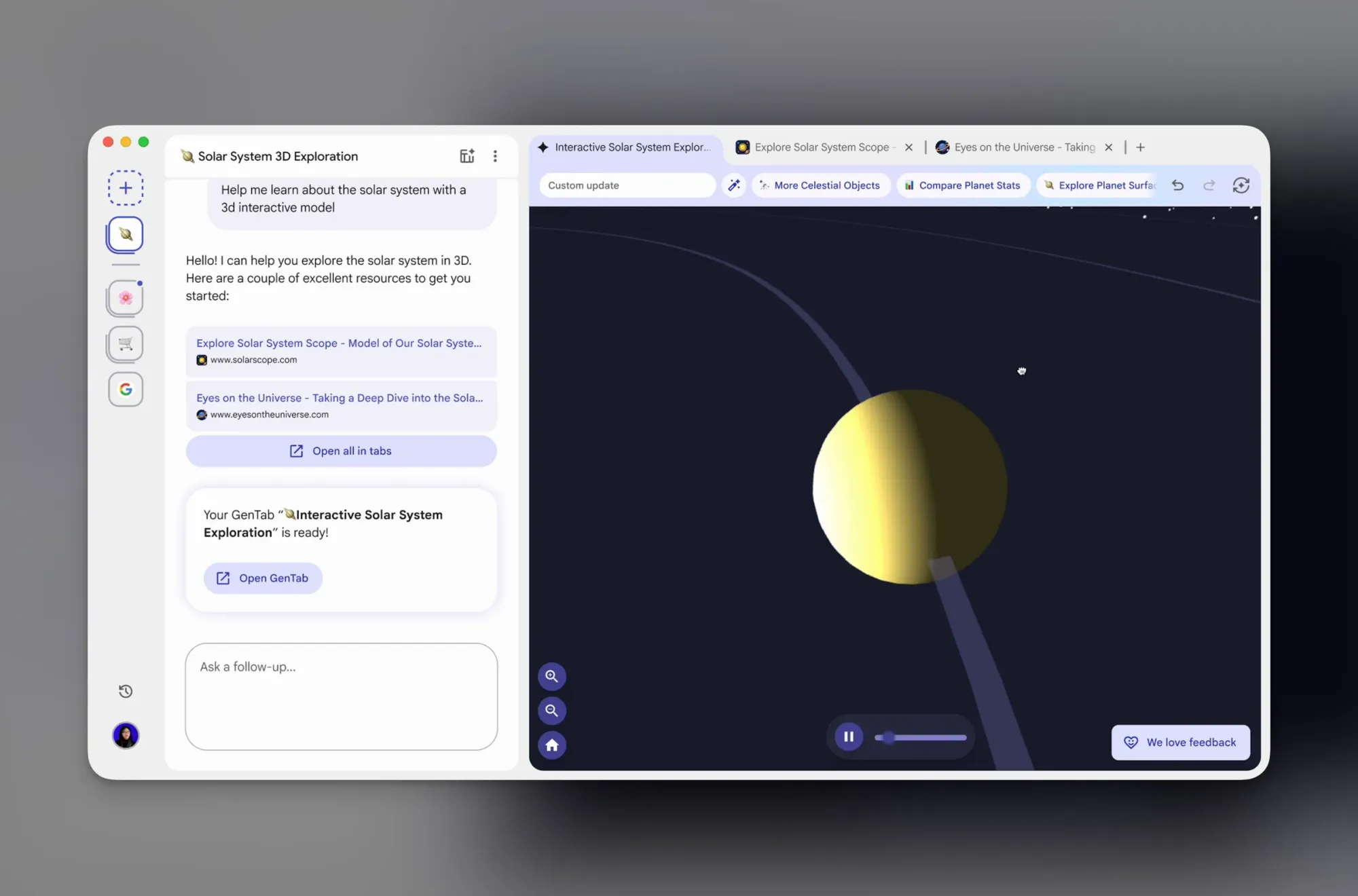
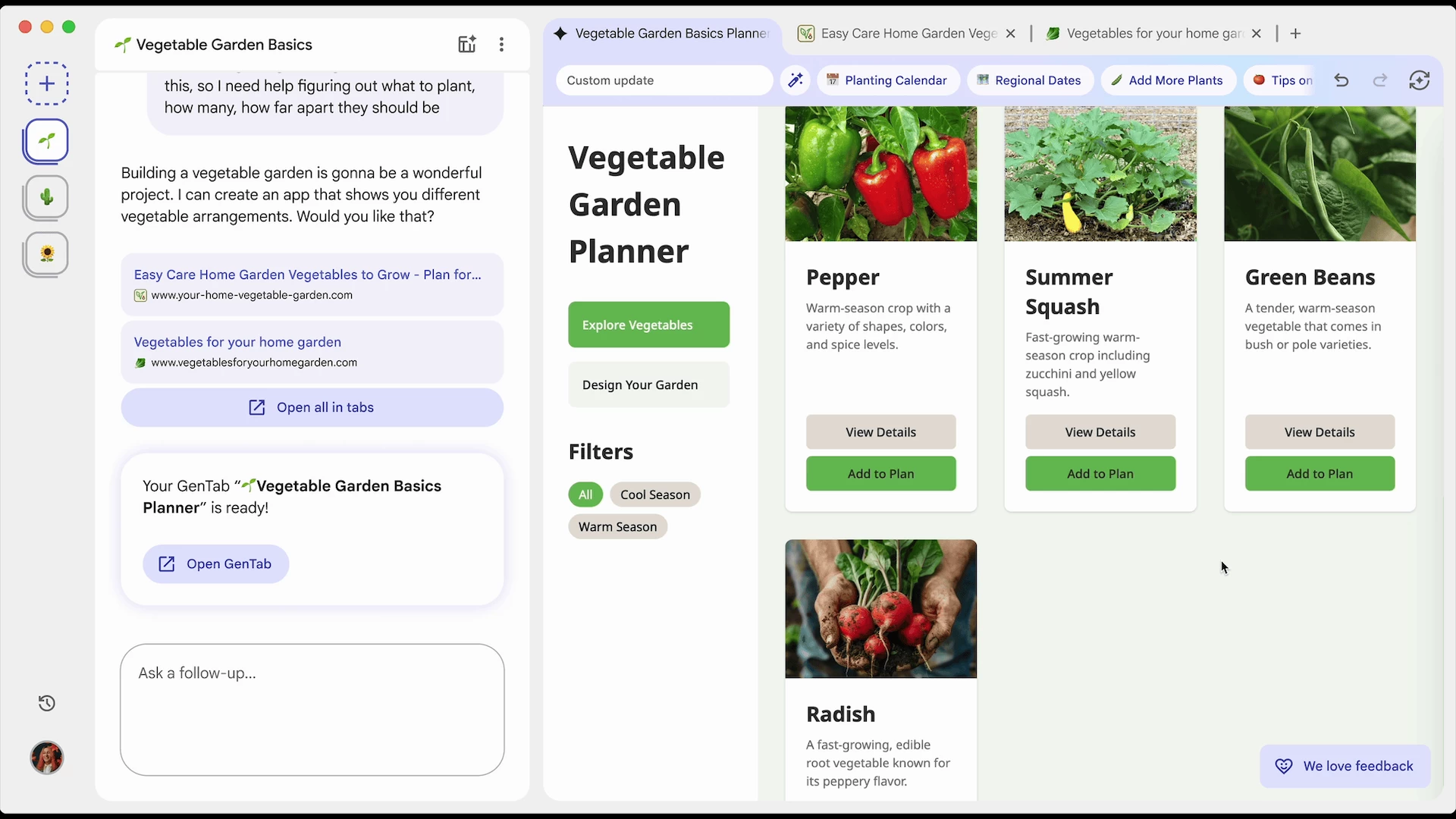
At its core, Disco introduces a revolutionary feature called GenTabs. These aren't your ordinary browser tabs. GenTabs are AI-generated mini-applications that Disco builds on the fly based on your open tabs, chat history, and current goals. Instead of giving you a list of blue links or a wall of text, Gemini 3 analyzes your request and codes a custom interface specifically tailored to what you're trying to accomplish.
Think of it this way: If you ask a traditional browser about planning a trip to Japan, you'll get search results. If you ask ChatGPT, you'll get a text response with suggestions. But if you ask Disco? You'll get an interactive trip planner complete with maps, calendars, timelines, crowd level indicators, and booking options — all generated instantly as a functional web application.
How GenTabs Work: The Technology Behind the Magic
GenTabs represents a fundamentally different approach to web browsing. Here's how the technology works:
- Context Understanding: Disco's AI continuously monitors your open tabs and chat history to understand the bigger picture of what you're working on. If you have several recipe websites open and you've been asking about cholesterol management, Disco recognizes you're likely planning a heart-healthy meal schedule.
- Intelligent App Generation: Based on this understanding, Gemini 3 generates interactive web applications without requiring you to write a single line of code. You simply describe what you need using natural language, and Disco builds it.
- Source Integration: Every element in a GenTab links back to original web sources. This means you can always verify where information came from and dive deeper into any topic. Unlike some AI tools that abstract away the underlying content, Disco keeps you connected to the actual web.
- Proactive Suggestions: Perhaps most impressively, Disco doesn't wait for you to ask. It proactively suggests GenTabs that might help with your current task — apps you hadn't even thought of yet.
The interface itself features two side-by-side windows: one with an ongoing conversation with Google's AI, and another showing a traditional browser with tabs. The chat interface doubles as an address bar, creating a hybrid experience where you can seamlessly switch between conversational AI assistance and conventional web navigation.
What Can You Build with GenTabs?
GenTabs is designed to handle a wide range of real-world tasks by transforming information from multiple open tabs into interactive, easy-to-use tools. It can be used for planning trips by combining flights, accommodation, attractions, and dates into a single itinerary; organizing meal plans with nutritional data and recipes; and supporting education through interactive learning materials and visual explanations.
GenTabs is also useful for shopping and decision-making, as it can compare products, prices, specifications, and reviews in one unified view. For students and researchers, it helps turn scattered sources into structured study aids, summaries, or comparison tables. Beyond that, it can assist with practical planning tasks such as gardening schedules or financial planning by creating calculators and visual planners. Overall, GenTabs helps users move from browsing many tabs to actively building structured, interactive solutions for everyday needs.
Disco vs. The Competition
Google isn't alone in the AI browser race. The market has exploded in 2025 with major players all vying to redefine how we interact with the web. Here's how Disco compares:
OpenAI's ChatGPT Atlas
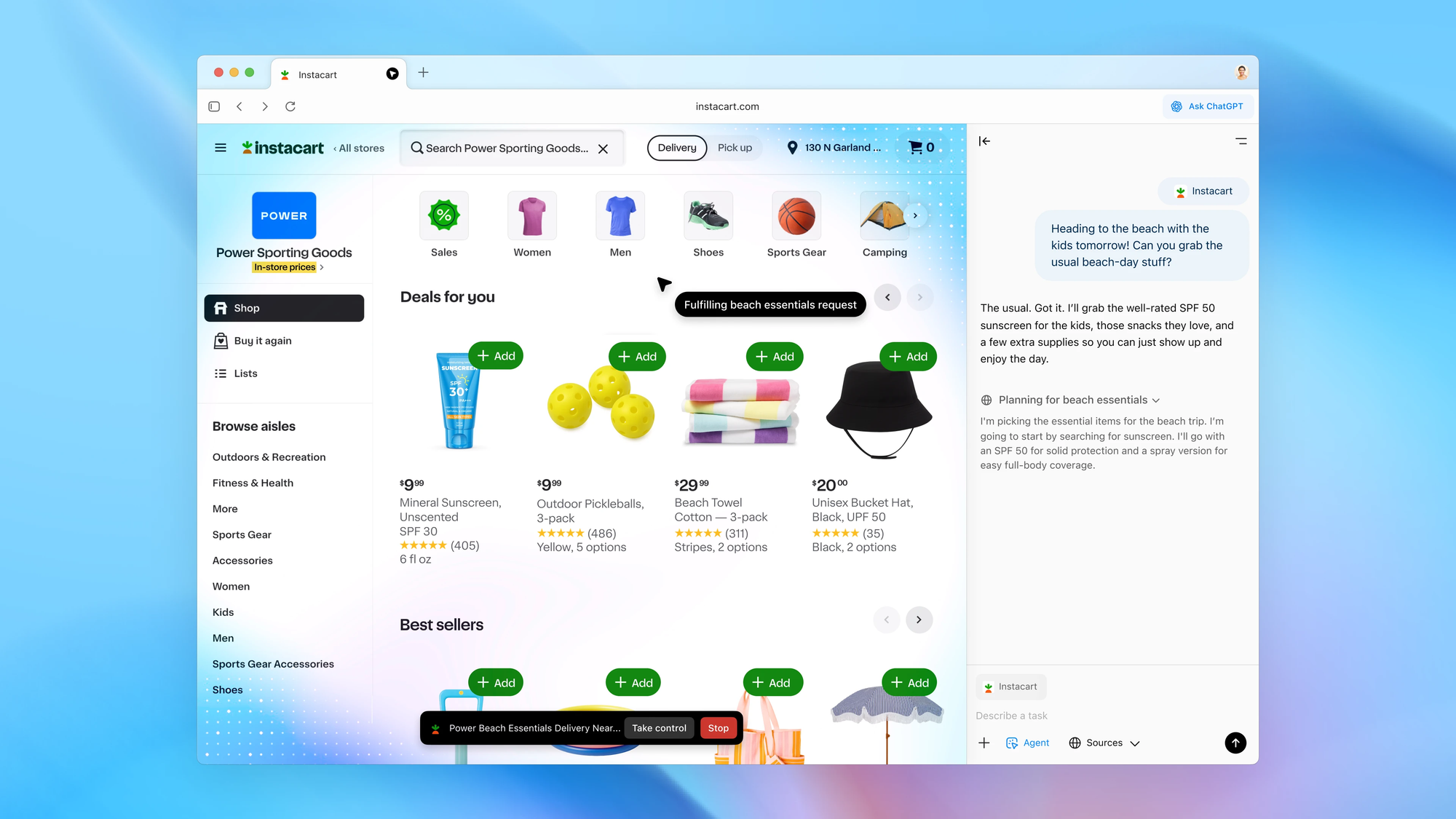
Launched in October 2025, Atlas embeds ChatGPT directly into the browsing experience. It features "agent mode" that can click around the internet on your behalf, executing tasks based on your browser history and stated goals. The key difference? Atlas focuses on conversational assistance and task execution within existing websites, while Disco's GenTabs actually generates new, custom interfaces.
Perplexity's Comet
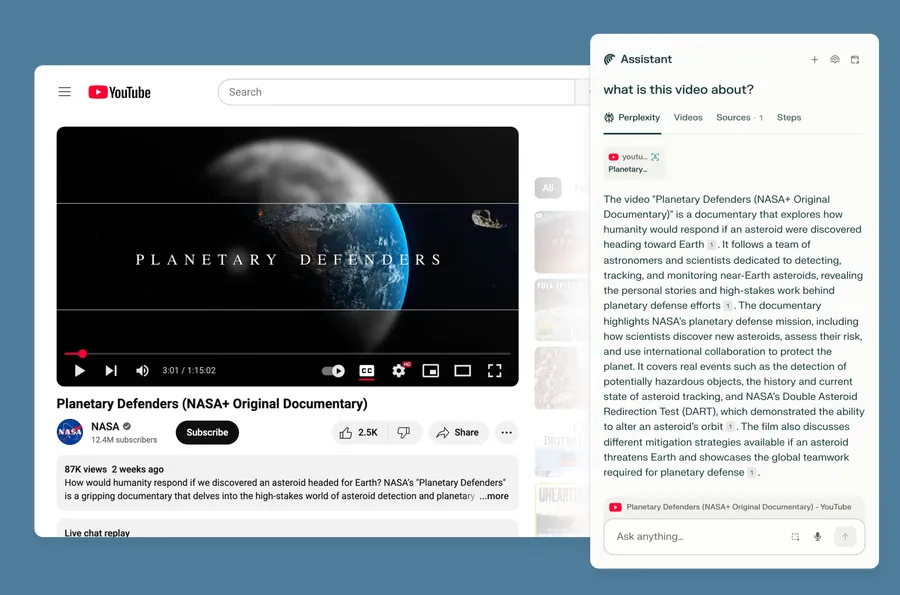
Available since July 2025, Comet emphasizes agentic capabilities — it can log into websites, book reservations, send emails, and complete multi-step tasks automatically. Comet excels at collapsing complex workflows into fluid conversations. However, it works primarily with existing web interfaces rather than creating new ones.
Arc's Dia Browser
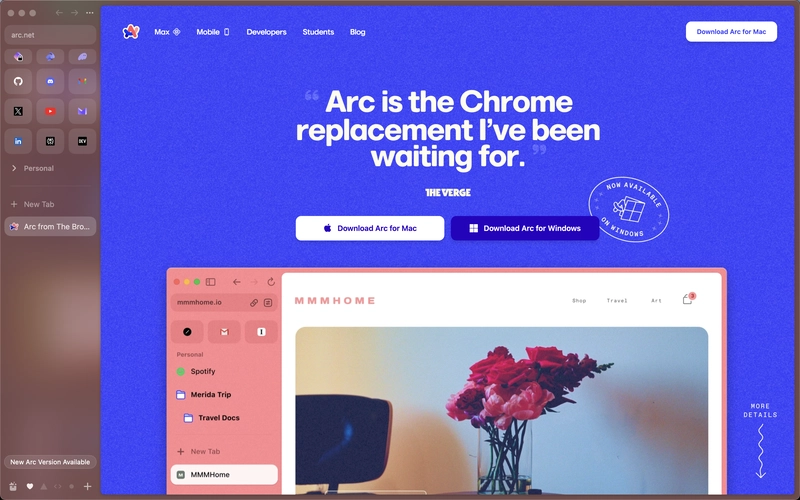
From The Browser Company (recently acquired by Atlassian), Dia turns the address bar into a natural language interface and lets users create custom automation scripts. It's tab-aware and can compare content across open pages, but lacks the app-generation capabilities of GenTabs.
Opera Neon
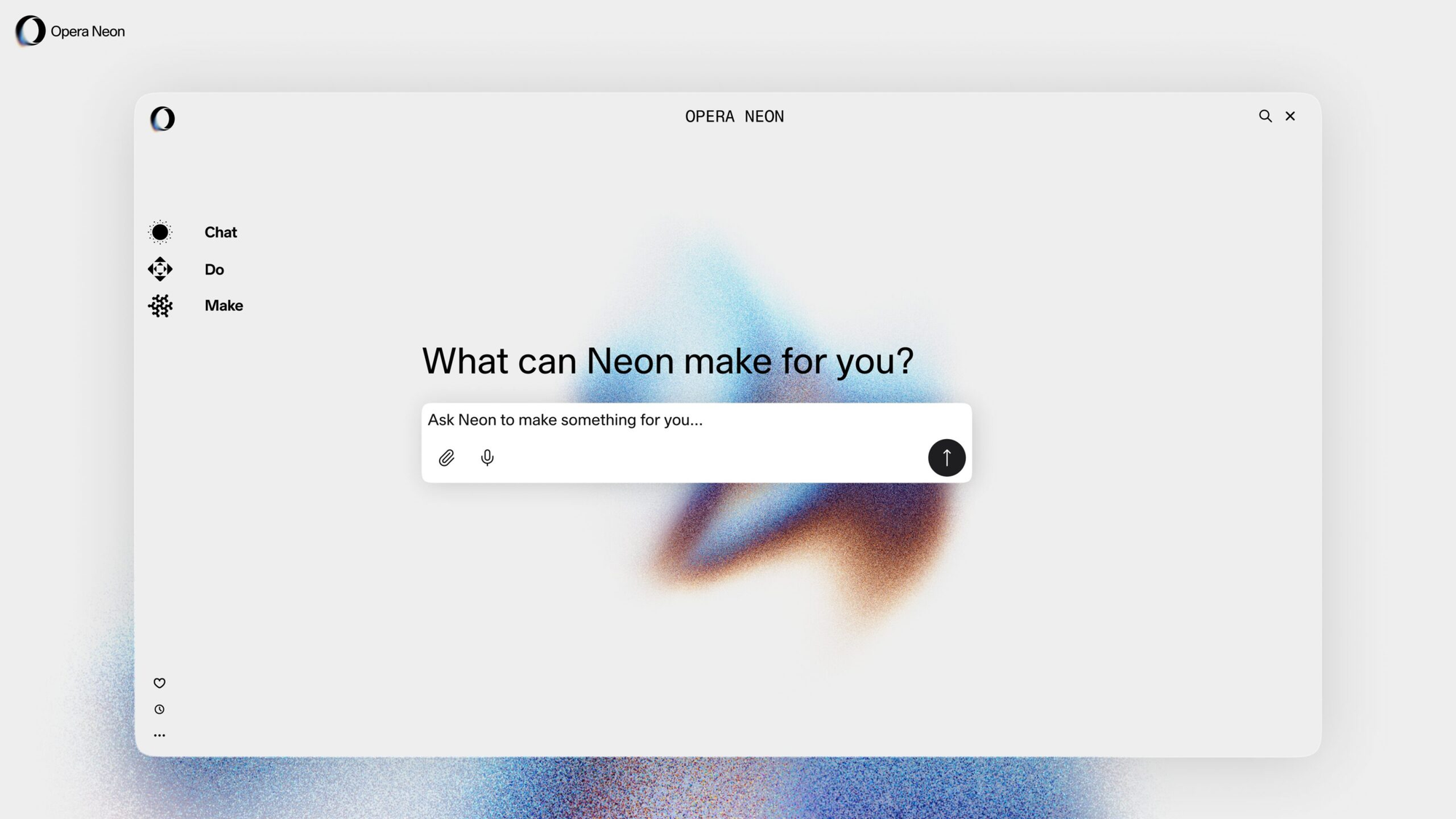
Opera's revamped AI browser follows a "Chat-Do-Make" model with real-time answers, web searches, image generation, and task automation across 50+ languages. It includes features like one-minute Deep Research mode for rapid information gathering.
What sets Disco apart is its fundamental philosophy: instead of helping you navigate existing websites more efficiently, it generates entirely new interfaces tailored to your specific needs. It's the difference between having a great assistant help you through a maze versus having that assistant rebuild the maze into a straight path.
Why Google Is Taking This Approach
Google's decision to launch Disco as a separate experimental product rather than integrating these features directly into Chrome is strategic. Chrome commands nearly two-thirds of the global desktop browser market and generates approximately three-quarters of Alphabet's total revenue through advertising. Radical changes to Chrome risk destabilizing this massive revenue engine.
By launching Disco through Google Labs, the company creates a sandbox for testing high-risk, high-reward interface changes. As Parisa Tabriz, VP of Chrome at Google, explained, Disco isn't meant to be a "general-purpose browser" — at least not yet.
This approach allows Google to:
- Test radical new concepts without impacting billions of existing Chrome users
- Gather feedback from enthusiastic early adopters who understand they're using experimental software
- Iterate quickly based on real-world usage patterns
- Potentially identify features that could eventually migrate to Chrome
The competitive pressure is real. OpenAI's Atlas browser represents a significant threat to Chrome's dominance, and Perplexity's Comet has gained substantial traction among power users. By experimenting with GenTabs in Disco, Google can develop and refine next-generation browsing concepts while maintaining Chrome's stability and market position.
The Gemini 3 Advantage
Powering Disco is Gemini 3, Google's most intelligent AI model to date. Released in November 2025, Gemini 3 represents a significant leap forward in AI capabilities:
- State-of-the-Art Reasoning: Gemini 3 tops the LMArena Leaderboard with an unprecedented 1501 Elo score. It demonstrates PhD-level reasoning on Humanity's Last Exam and achieves breakthrough performance on mathematical benchmarks.
- Multimodal Understanding: The model excels at processing text, images, video, audio, and code simultaneously. It achieves state-of-the-art scores on multimodal reasoning benchmarks, enabling it to understand complex visual and textual inputs when generating GenTabs.
- Agentic Coding Capabilities: Perhaps most relevant to Disco, Gemini 3 introduces what Google calls "vibe coding" — the ability to create applications from natural language prompts without requiring traditional programming knowledge. This is exactly what enables GenTabs to build interactive applications on demand.
- Context Awareness: Gemini 3 is significantly better at understanding the intent behind requests. It can grasp nuance and depth that previous models missed, making it ideal for interpreting complex browsing contexts and generating appropriate tools.
- Generative Interfaces: The model can dynamically create visual layouts featuring interactive tools and simulations tailored to specific queries. This capability forms the technical foundation of GenTabs.
How to Get Access: The Waitlist Process
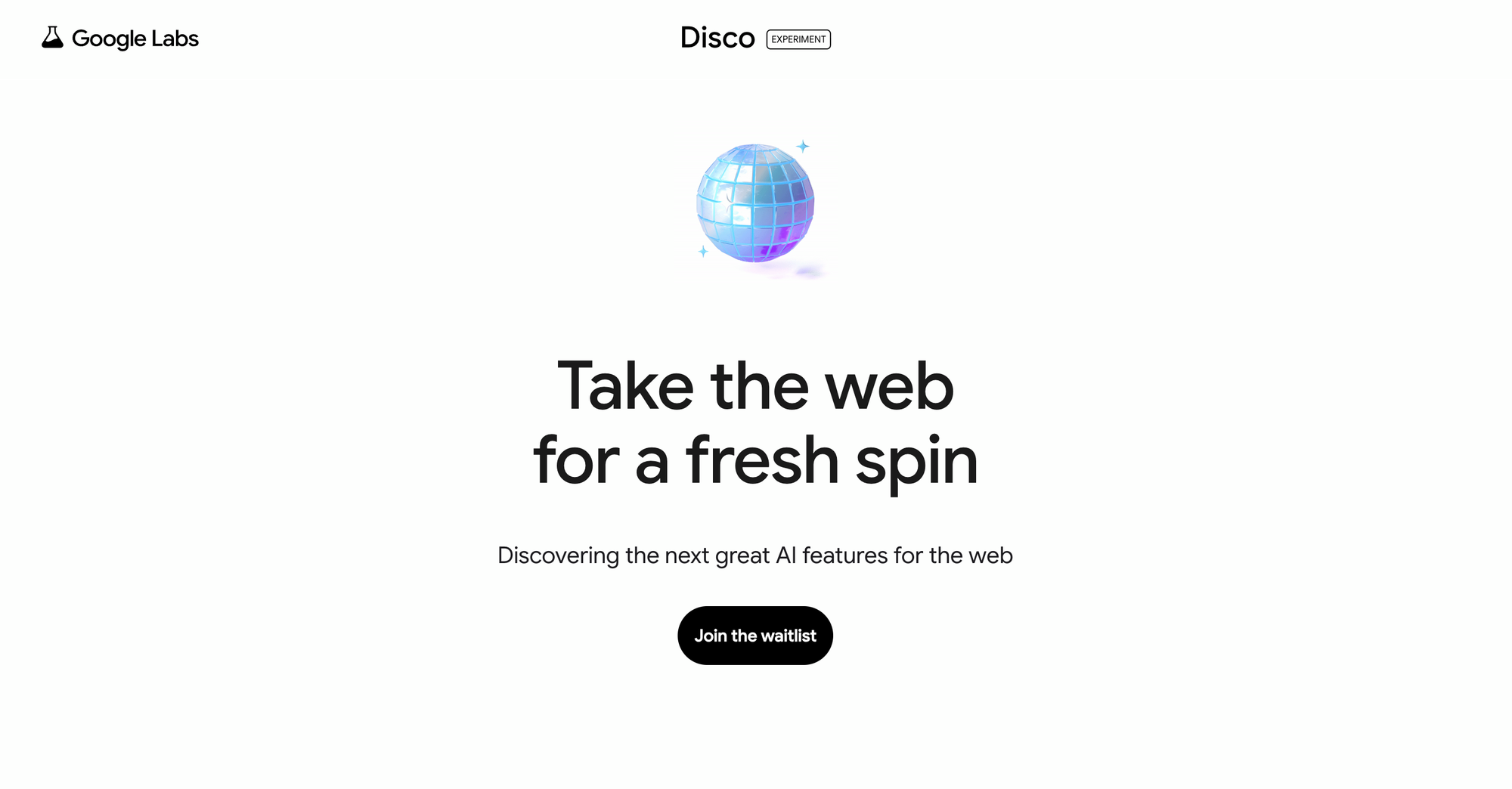
Disco is currently available only through a waitlist, and access is limited to macOS users in the United States. Here's what you need to know:
You can join the waitlist at https://labs.google/disco
Consider these requirements:
- MacOS computer (no Windows or ChromeOS support currently)
- U.S. residency
- Personal Google account (not a Workspace account)
The signup sheet is quite extensive. Google wants to understand how you've previously used AI tools creatively to better judge your fit as an early tester. Be prepared to describe your use cases and explain why you're interested in experimental AI browsing.
Google is clear that Disco is an early experiment. Things won't always work perfectly, and early testers should be prepared for bugs and limitations. The company emphasizes that feedback from this cohort will directly shape what features move forward and what gets refined.
There's currently no timeline for when Disco might expand to Windows, ChromeOS, or mobile platforms. Given that it's a Google Labs experiment, broader availability will likely depend on how successful the initial testing proves.
What This Means for the Future of Browsing
Disco represents more than just a new product — it signals a fundamental shift in how we might interact with the web. The traditional browser model, essentially unchanged since the era of tabs and URL bars, treats the internet as a vast library where humans do the work of finding, organizing, and synthesizing information.
The AI browser model that Disco embodies flips this paradigm. Instead of you adapting to how websites present information, the browser adapts to present exactly what you need. The web becomes less of a place you go to and more of a raw material from which custom tools are built.
This shift has profound implications:
Browsing could become dramatically more efficient. Complex research tasks that currently require hours of tab-juggling might be accomplished in minutes. The barrier between having an idea and having a working tool to execute that idea could effectively disappear.
The rise of AI browsers raises questions about traditional web development. If users increasingly interact with AI-generated interfaces rather than visiting websites directly, how does that change how sites should be built? Some experts predict a new category of "Agentic Web Interfaces" designed specifically for AI agents to access and act upon.
Content creators may need to rethink their strategies. If AI browsers like Disco can generate custom experiences from web content, the traditional pageview-based model of online publishing faces additional pressure beyond what AI chatbots already created.
Success with Disco could eventually reshape Chrome itself. Google has explicitly stated that "the most compelling ideas from Disco may one day make their way into larger Google products." Chrome with GenTabs-like capabilities would be a fundamentally different browser than what exists today.
Should You Try Disco?
If you're someone who spends significant time researching online, planning complex tasks, or juggling multiple tabs to accomplish goals, Disco could genuinely change how you work. The promise of having custom tools generated on demand is compelling, especially if your work involves synthesizing information across multiple sources.
However, prospective users should consider:
- It's experimental: Expect bugs, limitations, and occasional frustration. This is beta software from a research lab, not a polished consumer product.
- Privacy tradeoffs: The extensive data collection required for GenTabs to work effectively may not suit everyone's comfort level.
- Platform limitations: macOS-only availability excludes many potential users. If you're on Windows or ChromeOS, you'll need to wait.
- Learning curve: Maximizing Disco's potential requires learning to think differently about browsing. You'll need to articulate goals clearly and adjust to a more conversational workflow.
For early adopters and AI enthusiasts, Disco represents a fascinating glimpse into browsing's possible future. For everyone else, watching how the experiment unfolds may be wiser than diving in immediately.
The Technical Architecture Behind GenTabs
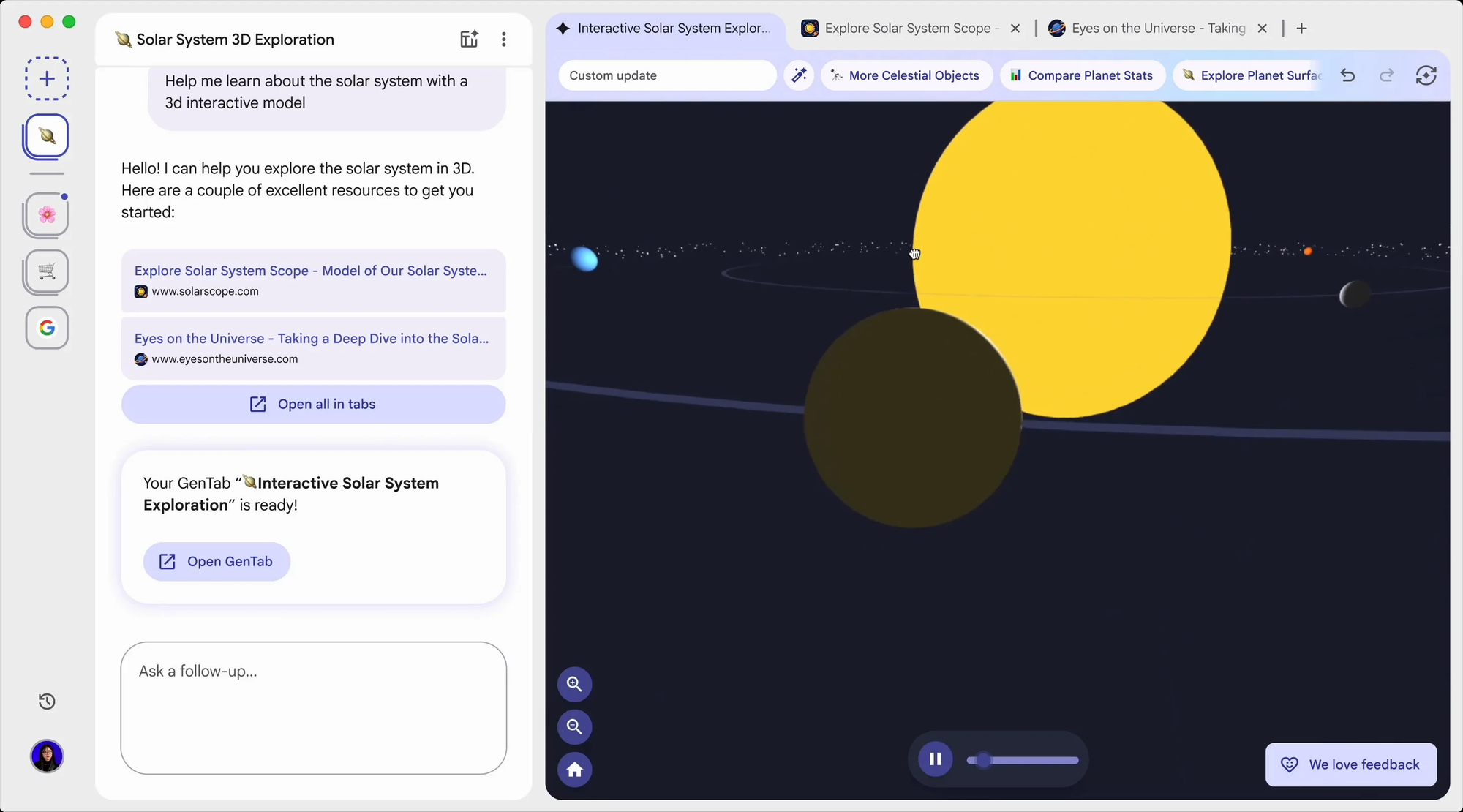
The Chromium Foundation: Disco is built on Chromium, the same open-source foundation that powers Chrome, Edge, and many other browsers. This ensures compatibility with virtually all websites and browser extensions while providing a familiar experience for users transitioning from existing browsers. The key innovation isn't in the browser shell itself but in how AI is integrated into the core browsing experience.
Natural Language Processing Pipeline: When you describe what you need to Disco, your request passes through Gemini 3's advanced natural language understanding system. The model doesn't just parse keywords — it interprets intent, context, and implicit requirements. Ask for help planning a birthday party, and the AI understands you'll need venue options, guest management, budget tracking, and timeline coordination, even if you didn't explicitly mention all these elements.
Code Generation Engine: Once Gemini 3 understands your goal, its agentic coding capabilities kick in. The model generates functional web application code in real-time, creating HTML, CSS, and JavaScript that renders as an interactive interface. This "vibe coding" approach means the AI handles all technical implementation while you focus on describing what you want.
Tab Context Integration: What makes GenTabs particularly powerful is how they incorporate information from your other open tabs. The AI continuously analyzes content across your browsing session, identifying relevant data points that should inform your generated application. This creates a feedback loop where traditional browsing enriches AI-generated tools, and those tools help you browse more effectively.
Source Attribution System: Every piece of information in a GenTab maintains connections to its original source. This isn't just a citation footnote — it's built into the architecture. Click on any data point, and you can trace it back to the website that provided it. This design choice reflects Google's commitment to keeping GenTabs grounded in the actual web rather than creating an abstraction layer that disconnects users from original content.
User Experience Design: How Disco Feels Different
The moment you open Disco, you notice it isn't trying to be Chrome with AI sprinkled on top. The entire interface philosophy differs from traditional browsers.
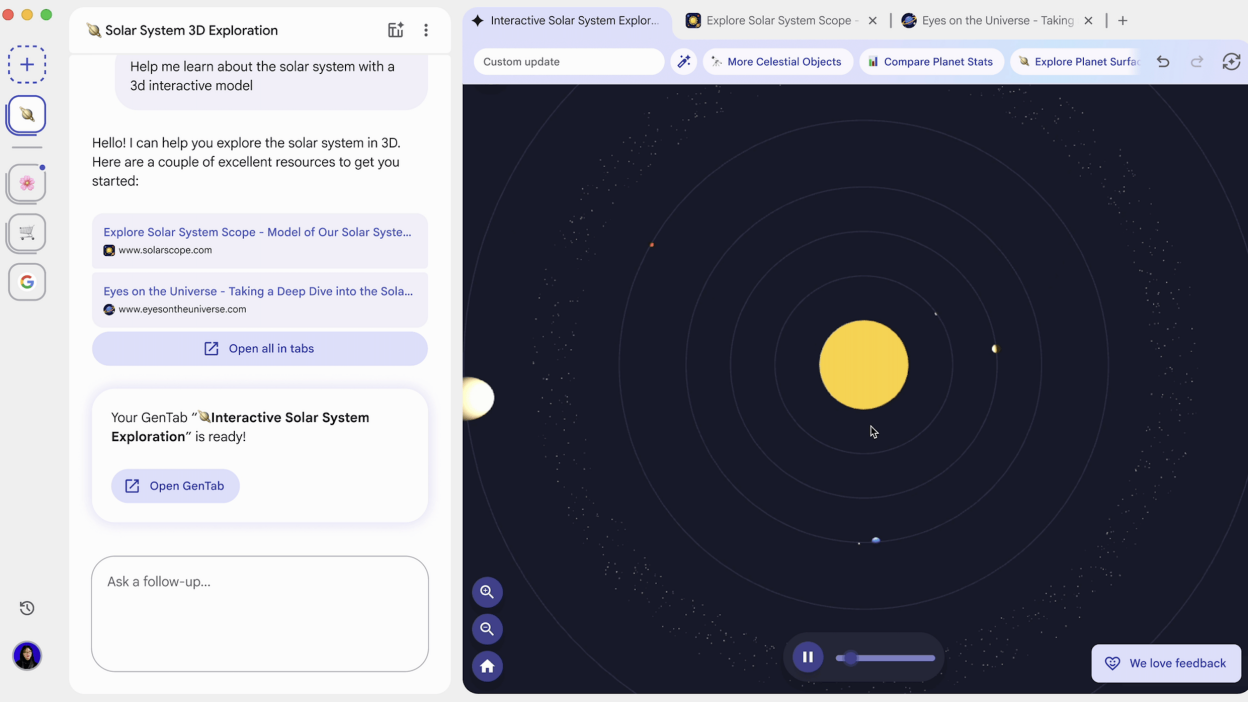
- The Dual-Pane Layout: Disco's signature visual element is its side-by-side arrangement of conversation and browsing windows. This acknowledges that AI-assisted browsing involves ongoing dialogue rather than one-shot queries. You might ask for a trip planner, receive a GenTab, browse some hotel options in traditional tabs, then ask Disco to incorporate those hotels into your planner. The continuous visibility of both modes makes this fluid back-and-forth natural.
- Conversational Address Bar: The chat box that dominates Disco's interface doubles as an address bar. Type a URL, and you'll navigate there conventionally. Type a question or request, and you'll engage with Gemini 3. This hybrid approach means you never need to context-switch between "browsing mode" and "AI mode" — the browser interprets your intent and responds appropriately.
- GenTab Favicon Indicators: GenTabs are visually distinguished from regular tabs through a Gemini spark icon in place of a standard favicon. This subtle design choice helps users immediately understand which tabs contain AI-generated content versus traditional web pages.
- Progressive Refinement: Unlike static search results, GenTabs are designed to evolve. You can refine them through continued conversation, asking Disco to add features, change layouts, or incorporate new information. The AI remembers context from your previous requests, making iterative improvement feel conversational rather than requiring you to re-explain your goals.
The Roadmap and Future Possibilities
Google has been deliberately vague about Disco's long-term roadmap, which is appropriate for an experimental product. However, several future directions seem plausible:
- Chrome Integration: The most likely outcome for successful Disco features is eventual integration into Chrome. Google has explicitly stated this possibility, and it aligns with how the company has historically used Labs experiments to test features before broader rollout.
- Platform Expansion: Windows and ChromeOS support seems inevitable if Disco proves successful. Mobile applications would be more complex given interface constraints, but touch-optimized GenTabs aren't impossible to imagine.
- Aluminium OS Connection: Google is reportedly developing "Aluminium OS," an Android-based successor to ChromeOS that's being built "from the ground up" with AI at its core. Some analysts speculate that GenTabs technology could be central to this new operating system, potentially making AI-generated interfaces a fundamental part of how future Chromebooks work.
- Enterprise Features: Business-focused capabilities like team sharing, integration with productivity suites, and compliance controls could extend Disco's appeal beyond individual consumers.
- Offline GenTabs: Advances in on-device AI processing could eventually enable GenTabs that work without constant cloud connectivity, though this remains technically challenging given current model sizes.
FAQ
What is Google Disco?
Google Disco is an experimental AI-powered browser from Google Labs that uses Gemini 3 to generate interactive mini-applications called GenTabs based on your browsing activity and requests. Unlike traditional browsers that display static web pages, Disco creates custom tools tailored to your specific tasks in real-time. It's designed as a "discovery vehicle" to test new concepts for the future of web browsing.
What are GenTabs and how do they work?
GenTabs are AI-generated interactive web applications that Disco creates on the fly. Powered by Gemini 3, they analyze your open tabs, chat history, and stated goals to build custom interfaces — like trip planners with maps, meal schedulers, or comparison dashboards — without requiring you to write any code. You simply describe what you need in natural language, and Disco builds it. Every element links back to original web sources for verification.
How can I get access to Google Disco?
You can join the waitlist at labs.google/disco. Currently, Disco is only available for macOS users in the United States. You'll need a personal Google account (not a Workspace account) and will be asked to describe your experience with AI tools. Access is being granted gradually to a small cohort of testers, so be prepared for a waiting period.
Is Google Disco replacing Chrome?
No, Disco is not meant to replace Chrome. Google's VP of Chrome, Parisa Tabriz, has explicitly stated that Disco isn't intended as a "general-purpose browser." It's an experimental product from Google Labs designed to test new AI browsing concepts without disrupting Chrome's 3 billion users. However, Google has indicated that successful features from Disco may eventually be integrated into larger Google products, including Chrome.
What AI model powers Google Disco?
Disco is powered by Gemini 3, Google's most advanced AI model released in November 2025. Gemini 3 features state-of-the-art reasoning capabilities (topping the LMArena Leaderboard at 1501 Elo), multimodal understanding across text, images, video, audio, and code, plus advanced "vibe coding" abilities that enable it to generate functional web applications from natural language descriptions.
How is Google Disco different from ChatGPT Atlas or Perplexity Comet?
Each AI browser has a distinct approach:
- ChatGPT Atlas focuses on conversational assistance and "agent mode" that executes tasks within existing websites
- Perplexity Comet excels at agentic automation like booking reservations, sending emails, and completing multi-step workflows
- Google Disco uniquely generates entirely new, custom interactive applications (GenTabs) based on your browsing context, rather than just navigating or automating existing web interfaces
Disco's philosophy is about creating new tools, not just using existing ones more efficiently.
Is Google Disco free to use?
Yes, Disco is currently free for users who gain access through the waitlist. As an experimental Google Labs product, there are no subscription fees during the testing phase. However, pricing structures may change if Disco features are eventually integrated into commercial Google products or if Disco becomes a standalone released product.
What can I create with GenTabs in Disco?
GenTabs can create virtually any interactive tool based on your needs, including:
- Trip planners with interactive maps, timelines, and booking links
- Meal planning apps with nutrition tracking and recipe integration
- Product comparison dashboards sortable by any criteria
- Study aids, flashcards, and interactive educational models
- Garden planning grids with planting schedules
- Investment research tools with financial metrics
- Custom calculators for mortgages, budgets, or any analysis
Google says "there is no end to what you can make."
Does Google Disco collect my browsing data?
Yes, according to Google's disclosure, your activity while using Disco — including AI chats and the contents of pages you visit — will be sent to Google and logged. This data collection is necessary for GenTabs to understand your context and generate relevant applications. Information provided during registration may be retained for up to two years. Users concerned about privacy should review Google's terms before joining the waitlist.
When will Google Disco be available on Windows or mobile?
There is currently no official timeline for Windows, ChromeOS, iOS, or Android versions of Disco. As an early Google Labs experiment, the initial release is limited to macOS users in the United States. Platform expansion will likely depend on the success of the current testing phase, user feedback, and Google's product roadmap. Some analysts speculate Disco technology could eventually appear in "Aluminium OS," Google's rumored AI-first successor to ChromeOS.
Wrap up: The Browser Revolution Is Just Beginning
Google's Disco represents something we haven't seen since the original browser wars of the 1990s: a genuine attempt to fundamentally reinvent how humans access and interact with digital information. GenTabs isn't just an incremental improvement — it's an entirely new category of functionality that blurs the line between browsing, searching, and building.
Whether Disco itself becomes a mainstream product or serves primarily as a proving ground for features that eventually reach Chrome, the concepts it introduces feel inevitable. The question isn't whether browsers will become more intelligent and generative, but how quickly and in what form.
For Google, Disco demonstrates a willingness to experiment boldly while protecting its core Chrome business. For the broader tech industry, it raises the stakes in an already intense competition to define the next generation of web interaction.
And for users? Disco offers an early preview of a future where the browser doesn't just show you the internet — it rebuilds the internet around your specific needs, one GenTab at a time.
The web is evolving. With Disco, Google is betting that you'll want a browser that evolves right alongside it.
Want to be among the first to experience this new era of browsing? Join the Disco waitlist and help shape the future of how we interact with the web.
Related Articles
 Dani
Dani
 Mark
Mark
 Mark
Mark