Google just announced that advertising is officially coming to its AI experiences, and the company is simultaneously rolling out the ability to purchase products without ever leaving the chat. If you've been wondering how tech giants plan to make money from AI assistants, you now have your answer: the same way they've always made money, but with a conversational twist.
In a letter to the advertising community this week, Google's VP of Advertising and Commerce Vidhya Srinivasan laid out the company's vision for 2026. The headline: "We aren't just bringing ads to AI experiences in Search; we are reinventing what an ad is."
That's corporate speak for a fundamental shift in how we'll discover and buy products online. Sponsored listings will now appear alongside AI-generated recommendations in AI Mode. A new feature called Direct Offers will let brands present exclusive discounts to shoppers at the moment they're ready to buy. And through a new protocol called UCP, US shoppers can already purchase items from Etsy and Wayfair directly within Google's AI interfaces, with Shopify, Target, and Walmart coming soon.
What's Actually Changing in AI Mode
Let's start with what Google is testing right now in AI Mode, its AI-powered search experience that launched in March 2025.
When you search for products in AI Mode, you'll increasingly see sponsored listings integrated into the AI-generated responses. These will be clearly marked with a "Sponsored" label to distinguish them from organic recommendations. Google emphasizes that anything without that label comes organically from the AI model.
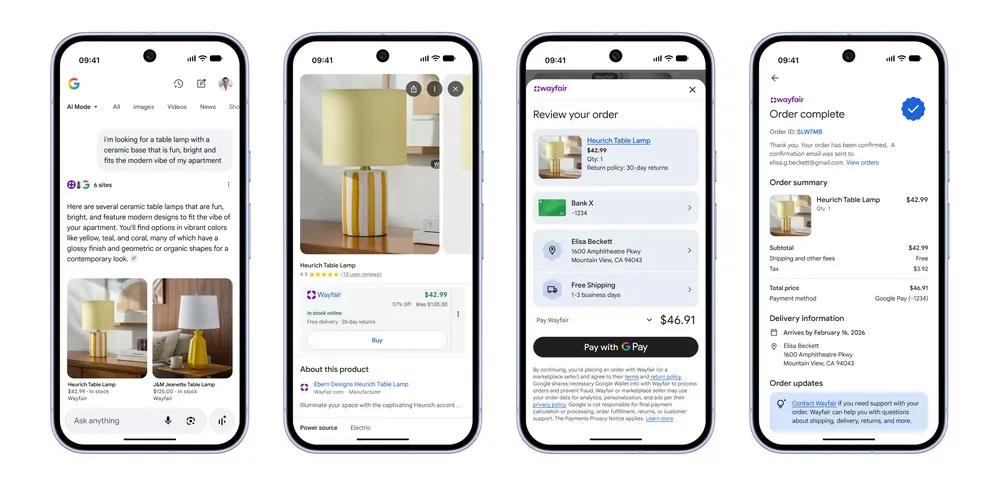
The company's research suggests that AI Mode provides a more helpful shopping experience when users can easily compare multiple brands and stores. The AI already surfaces organic shopping recommendations based on what's most relevant to a query. Now, retailers can pay to ensure their products appear in those conversations.
A Google spokesperson clarified the approach: "All ads in AI Mode will be marked as 'sponsored content'; anything that doesn't have that label is going to be organic from the model."
The new ad formats appear below the AI response, keeping the conversational answer itself uncluttered while still giving advertisers prominent placement. Early testing focuses on product searches where commercial intent is clear.
Direct Offers represents an even more targeted monetization approach. This feature allows businesses to present tailored promotions to shoppers who are actively ready to buy. Instead of showing the same offer to everyone, retailers can present exclusive discounts at the moment of highest intent, helping close sales without changing what they offer the general public.
Google plans to expand Direct Offers beyond simple price discounts to include value propositions like loyalty benefits and product bundles. The goal is matching the right offer from a retailer to the right user at precisely the right moment.
Shopping Without Leaving the Chat
The advertising changes are significant, but the bigger transformation is what's happening with checkout.
Google has launched the Universal Commerce Protocol (UCP), an open standard that allows AI agents to complete entire shopping transactions from discovery through purchase. Right now, US shoppers can buy items from Etsy and Wayfair directly within AI Mode in Search and the Gemini app. You find a product through conversation, add it to a cart, and complete checkout using Google Pay, all without opening a new tab or visiting a retailer's website.
Shopify, Target, and Walmart integrations are coming soon, dramatically expanding the range of products available for in-chat purchase. The protocol was co-developed with these retail giants along with endorsements from over 20 partners including Adyen, American Express, Best Buy, Flipkart, Macy's, Mastercard, Stripe, The Home Depot, Visa, and Zalando.
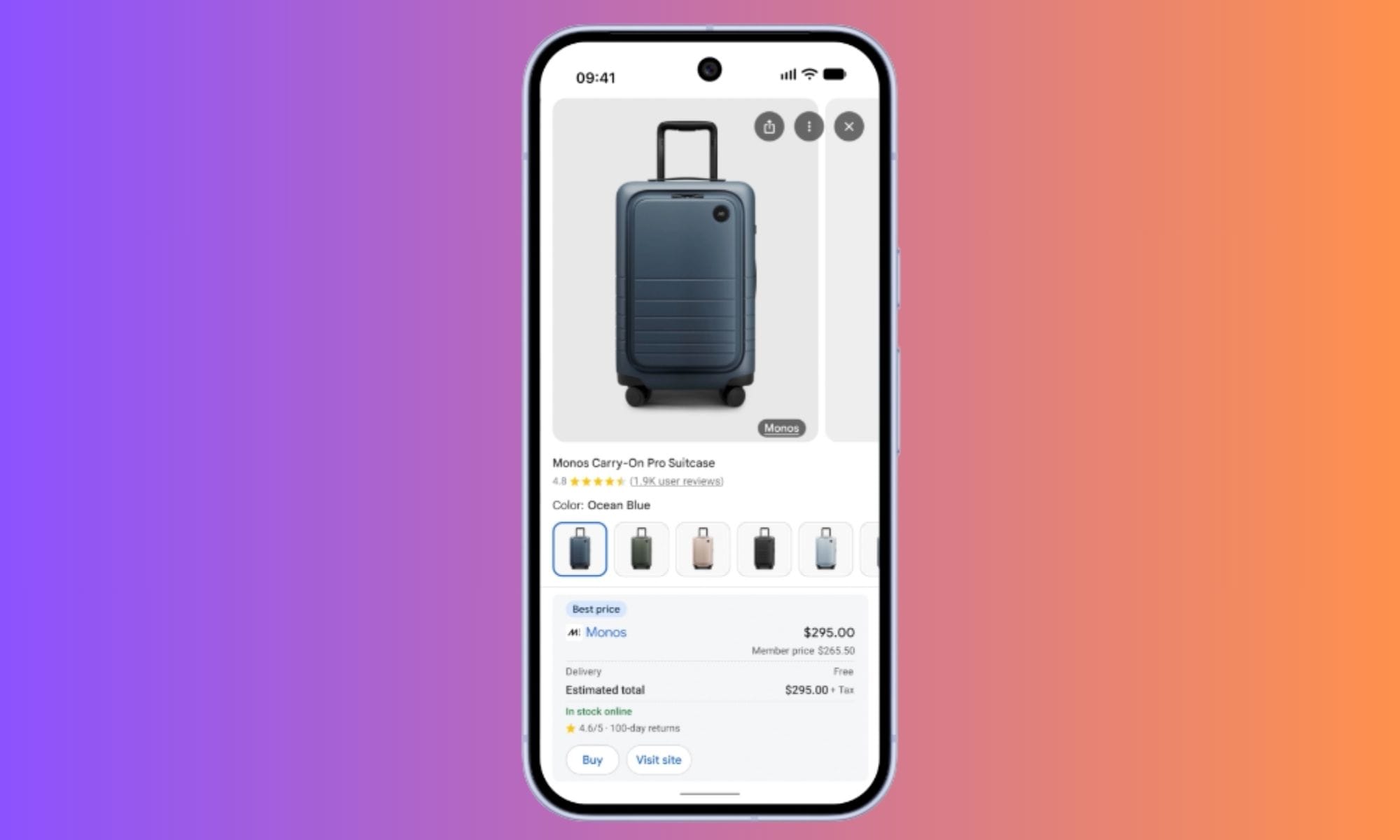
Here's how it works from a shopper's perspective. You're searching for a suitcase in AI Mode. The AI shows you options based on your query. You find one you like from a participating retailer. Instead of clicking through to their website, you tap to purchase. Google Pay uses your saved payment and shipping information. A few taps later, the order is placed. The retailer remains the merchant of record, handling fulfillment and customer service. You just skipped five to ten steps in the traditional shopping journey.
Target's Chief Information and Product Officer Prat Vemana described the vision:
"We're excited to co-develop a new standard for the future of commerce with Google and others. Universal Commerce Protocol will help us bring Target's curation and value into AI Mode and the Gemini app, making it easier for consumers to discover and purchase on-trend, design-forward products, all with an experience that feels natural, helpful and built around their needs."
The Universal Commerce Protocol Explained
UCP is the infrastructure making all of this possible, and understanding it helps explain where commerce is heading.
Traditional online shopping requires each retailer to build and maintain their own checkout experience. When you buy from different stores, you encounter different interfaces, enter payment information multiple times, and navigate separate accounts. The friction adds up, and cart abandonment rates remain stubbornly high.
UCP creates a common language that allows AI agents to interact with any participating retailer's backend systems. Instead of requiring unique connections for every individual store, the protocol enables all agents to communicate using the same standards. This dramatically simplifies integration for retailers while creating consistent experiences for shoppers.
The protocol separates different aspects of commerce into modular components. Discovery lets agents find products. Cart management handles adding and removing items. Checkout processes payments. Post-purchase support manages returns and questions. Each piece can work independently while connecting seamlessly through the protocol.
Security architecture keeps sensitive information protected. Credential providers tokenize payment and identity information. Payment service providers handle actual transaction processing. Agents operate without ever accessing raw payment or personal data. The system creates what Google calls a "transparent accountability trail" between merchants, credential providers, and payment services.
Retailers maintain significant control. They remain the merchant of record, own customer relationships, and can customize the integration to match their brand and technical requirements. UCP offers both a native integration path and an embedded option for businesses with highly customized checkout flows that require more control.
The protocol is designed to be transport agnostic, meaning it works across standard APIs, conversational interfaces, AI assistants, and automated workflows. It's also compatible with other emerging standards including Agent Payments Protocol (AP2), Agent2Agent (A2A), and Model Context Protocol (MCP).
What This Means for Retailers
For businesses selling products online, Google's announcement creates both opportunities and pressures.
- The opportunities are obvious. AI Mode is becoming a high-intent shopping surface. Users searching conversationally often have clearer purchase intent than traditional keyword searches. Being visible in these conversations, whether through organic recommendations or sponsored placements, puts products in front of ready buyers.
- UCP integration reduces checkout friction dramatically. Cart abandonment has plagued ecommerce since its beginning. When shoppers can complete purchases without leaving their current context, conversion rates should improve. Early adopters get first-mover advantage as consumers develop new shopping habits.
- The new Direct Offers feature lets brands compete on value rather than just visibility. Presenting exclusive promotions to high-intent shoppers helps close sales without publicly advertising discounts that erode margins.
But there are pressures too. As AI surfaces become primary shopping destinations, retailers who aren't integrated risk invisibility. The traditional path of driving traffic to your own website becomes less relevant when purchases happen inside Google's interfaces. Businesses must adapt to a world where they may never see shoppers on their own properties.
The good news is that UCP is designed as an open standard. Google has emphasized that retailers maintain control of customer relationships and remain merchants of record. The protocol works with existing retail infrastructure rather than requiring wholesale changes. But participating requires investment, and the learning curve is real.
The Advertising Industry Reacts
Media buyers and advertisers are watching these developments with intense interest.
Google generated $82.3 billion in ad revenue last quarter alone. The company's advertising business remains the engine driving Alphabet's growth, and maintaining that revenue stream as user behavior shifts toward AI interactions is an existential priority.
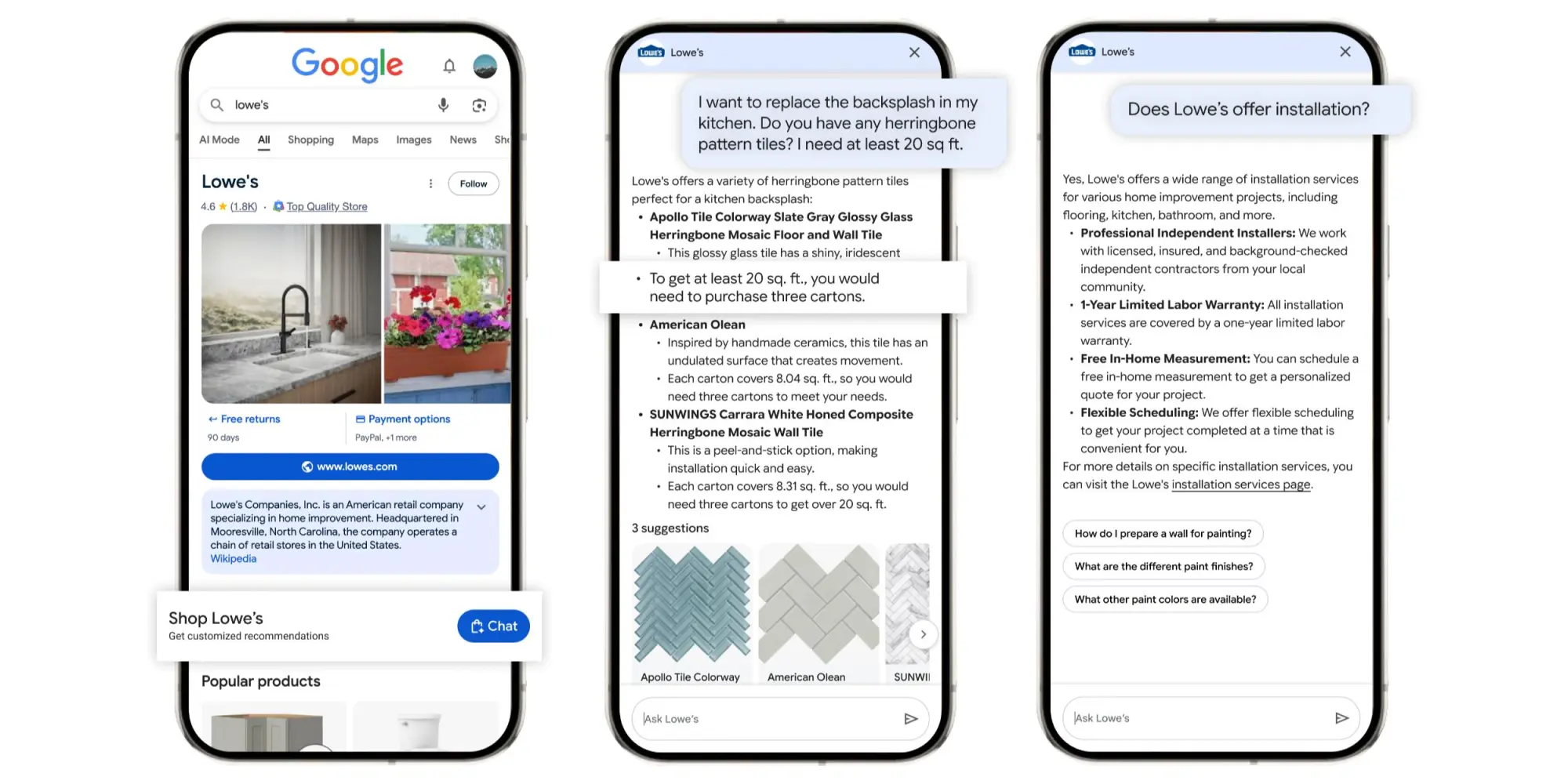
The announcement that ads would appear in AI Mode wasn't surprising. Google had been testing these formats since late 2025. What's notable is the scale and ambition of the current rollout, along with the tight integration between advertising and commerce.
The conversational nature of AI interactions provides richer signals about user intent than traditional keyword searches. When someone asks an AI assistant to help them find running shoes for flat feet under $150 that work well on concrete, the targeting opportunities are far more precise than optimizing for "running shoes."
Gartner predicts that by the end of 2026, up to 25% of traditional search volume will shift to AI chatbots and virtual agents. For advertisers, preparing for AI-integrated campaigns is becoming essential.
Some observers note tensions in Google's approach. The company publicly denied reports that it planned to bring ads to the Gemini app itself, with VP of Global Ads Dan Taylor stating on X: "There are no ads in the Gemini app and there are no current plans to change that." Yet the same week, Google announced commerce integrations that allow purchases within Gemini, blurring the line between advertising and transactions.
The distinction may be that current Gemini shopping features are organic, appearing only when users actively search for products. Paid advertising in the Gemini app remains officially off the table, even as the groundwork for monetization is clearly being laid.
Competition Heats Up
Google isn't operating in a vacuum. The race to monetize AI assistants is intensifying across the industry.
OpenAI launched ads in ChatGPT for its lower-tier users in February, drawing immediate criticism from competitor Anthropic. The company ran Super Bowl ads depicting humorous scenarios of AI advertising gone wrong, positioning itself as the anti-ad alternative.
Microsoft is developing its own commerce integrations for Copilot, including embedded checkout experiences for Shopify merchants. Amazon has unified its advertising consoles and launched AI agents for campaign management. The IAB Tech Lab introduced an Agentic RTB Framework establishing standards for autonomous buying systems.
The competition reflects a fundamental economic reality. Running large language models requires enormous computational resources costing hundreds of millions of dollars annually. The major AI companies all face the same question: how do you pay for infrastructure that expensive while keeping products accessible to consumers?
Subscriptions work for some users but limit reach. Enterprise licensing generates revenue but doesn't monetize consumer usage. Advertising remains the proven model for scaling consumer products, even as it raises questions about trust and user experience.
Forrester analyst Dipanjan Chatterjee notes the tension: "Answer engines have earned high trust among consumers partly because of the conversational fluidity of the experiences and partly because of their prescriptive and often authoritative personality. Throwing advertising into the mix muddies the waters and detracts from the credibility of the experience."
Google is betting that clear labeling and genuinely helpful commercial integrations can thread this needle. Users want product recommendations. They want to buy things. If AI can make those experiences better while being transparent about what's sponsored, perhaps the trust erosion can be minimized.
Wrap up
What Google announced this week isn't just about ads in search results or buying furniture through a chatbot. It's about the fundamental restructuring of how commerce works online.
For two decades, the dominant model has been: search for something, click through to a website, navigate that site's interface, enter your information, complete a purchase. Every retailer built their own checkout. Every transaction required leaving one context and entering another.
AI assistants are collapsing this journey. Discovery, evaluation, and purchase happen in a single conversation. The retailer's website becomes optional, even invisible. The AI becomes the primary interface for commerce.
Google is positioning itself to be the infrastructure layer connecting all the pieces. UCP provides the protocol. Gemini provides the intelligence. Google Pay provides the payment rails. Merchant Center provides the product data. Advertisers provide the revenue. Retailers provide the goods. Everyone plugs into Google's system.
This is both a massive opportunity and a significant concentration of power. Retailers gain access to high-intent shoppers and reduced friction. Shoppers get faster, more convenient transactions. Google gets transaction data, advertising revenue, and deeper integration into the commercial fabric of the internet.
The tradeoffs are real. As more commerce flows through AI intermediaries, the parties controlling those intermediaries gain leverage. Retailers who don't participate risk irrelevance. Competitors face an incumbent with unmatched scale and integration. Consumers gain convenience but cede more data and more decisions to AI systems they don't fully control.
None of this is settled. UCP is explicitly open source, inviting participation from across the industry. Competing protocols and platforms will emerge. Regulatory scrutiny will follow the money. Consumer preferences will evolve as the novelty wears off and the tradeoffs become clearer.
But the direction is unmistakable. AI is becoming the primary interface for commerce, and the race to define how that works is happening right now. Google just made its move.
FAQ
Are there ads in Google Gemini app?
Currently, there are no ads in the Gemini app itself. Google's VP of Global Ads Dan Taylor explicitly stated: "There are no ads in the Gemini app and there are no current plans to change that." However, Google is testing ad formats in AI Mode within Search, and commerce features allowing purchases from Etsy and Wayfair are now available in both AI Mode and the Gemini app.
How will Google ads work in AI Mode?
Sponsored listings will appear alongside AI-generated product recommendations in AI Mode, clearly marked with a "Sponsored" label. Ads appear below the AI response, keeping the conversational answer uncluttered. A new Direct Offers feature allows brands to present exclusive promotions to shoppers who are ready to buy, matching the right offer to the right user at the moment of purchase intent.
Can you buy products directly in Google Gemini?
Yes. US shoppers can now purchase items from Etsy and Wayfair directly within the Gemini app and AI Mode in Search using Google Pay. Shopify, Target, and Walmart integrations are coming soon. The Universal Commerce Protocol (UCP) enables these transactions while keeping retailers as the merchant of record.
What is Google's Universal Commerce Protocol (UCP)?
UCP is an open standard co-developed by Google with Shopify, Etsy, Wayfair, Target, and Walmart, endorsed by over 20 partners including Visa, Mastercard, and American Express. It creates a common language for AI agents to handle shopping transactions from discovery through checkout. UCP enables purchases within AI interfaces while maintaining security and letting retailers control customer relationships.
Which retailers support Google AI Mode shopping?
Currently, Etsy and Wayfair support direct checkout in AI Mode and Gemini for US shoppers. Shopify, Target, and Walmart integrations are coming soon. Over 20 additional partners have endorsed UCP, including Best Buy, Macy's, The Home Depot, and Zalando, suggesting broader retail availability is planned.
How does Google separate ads from organic AI results?
All sponsored content in AI Mode will be clearly marked with a "Sponsored" label. Google states that anything without that label comes organically from the AI model. The company emphasizes transparency, with ads appearing in designated areas below the AI response rather than mixed into the conversational answer itself.
What are Direct Offers in Google AI Mode?
Direct Offers is a new Google Ads feature that allows businesses to present tailored promotions to shoppers ready to buy, directly within AI Mode. Unlike traditional ads shown to everyone, Direct Offers let retailers share exclusive discounts with high-intent users at the moment of purchase decision. Future versions may include loyalty benefits and product bundles beyond simple price discounts.
Is Google's AI shopping available outside the US?
Currently, UCP-powered checkout is rolling out for US shoppers only. Google plans global expansion with rollouts to India, Indonesia, Latin America, and other markets. The timeline for international availability hasn't been specified, but the protocol is designed for global scale.
How does Google AI shopping protect payment information?
UCP uses a security architecture where credential providers tokenize payment and identity information, and payment service providers handle transaction processing separately. AI agents operate without accessing raw payment or personal data. Shoppers use Google Pay with saved payment and shipping details, with PayPal support coming soon. Retailers remain merchants of record.
Will AI shopping replace traditional ecommerce websites?
It's too early to say definitively, but the shift is significant. Google's AI shopping features let users complete purchases without visiting retailer websites. As more consumers adopt conversational shopping, traffic to traditional ecommerce sites may decline. However, retailers maintain control through UCP, and complex purchases may still require full website experiences. The transition will likely be gradual.
Related Articles
 Mark
Mark
 Dani
Dani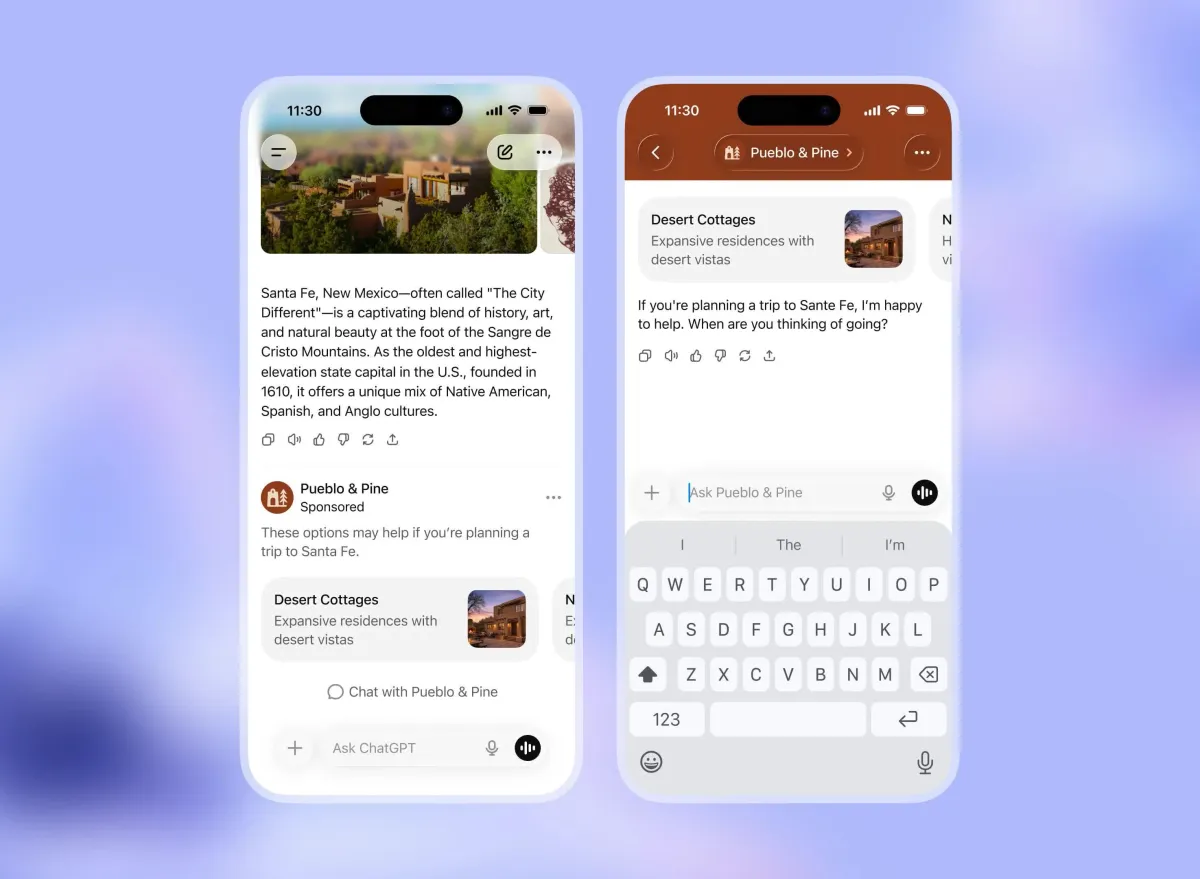
 Dani
Dani