


Generative AI reached global majority adoption faster than any technology in recorded history. That is not a projection or a forecast. It is a finding in Stanford's 2026 AI Index, released April 13, which documents 53% of the world's population now using generative AI, a threshold crossed in roughly three years from mainstream availability.
The personal computer took more than a decade to reach comparable penetration. The internet took longer. The smartphone required years of infrastructure buildout before adoption reached the same scale. Generative AI, delivered primarily through browser interfaces and mobile apps that required no new hardware, cleared the same bar faster.
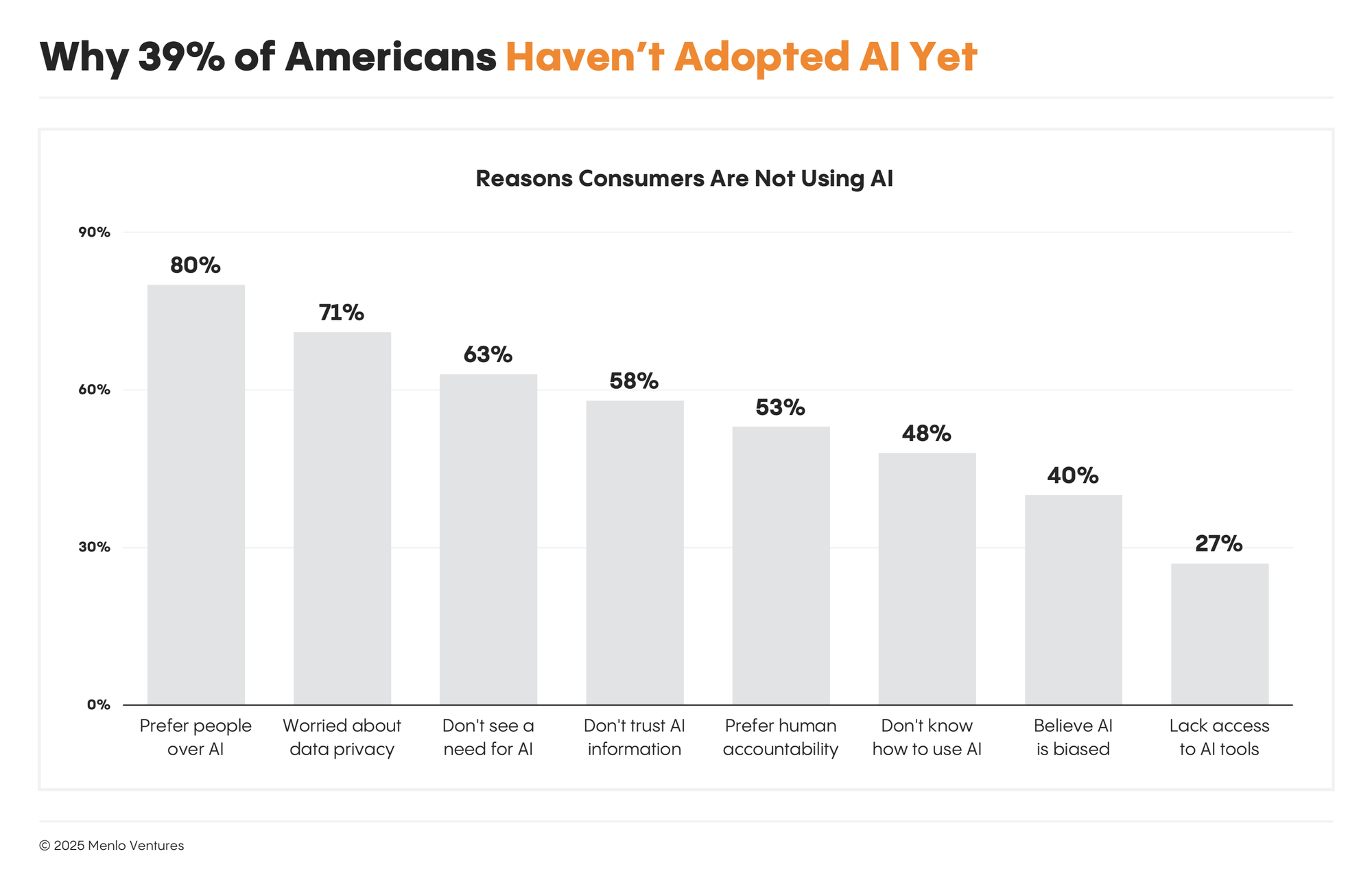
The country that built most of the technology ranks 24th in adoption. Only 28.3% of Americans use generative AI regularly, below Singapore at 61%, the United Arab Emirates at 54%, and dozens of other countries that did not produce the underlying models.
The gap between where AI is being made and where it is being used is one of the more counterintuitive findings in a report full of them.
What 53% Global Adoption Actually Means
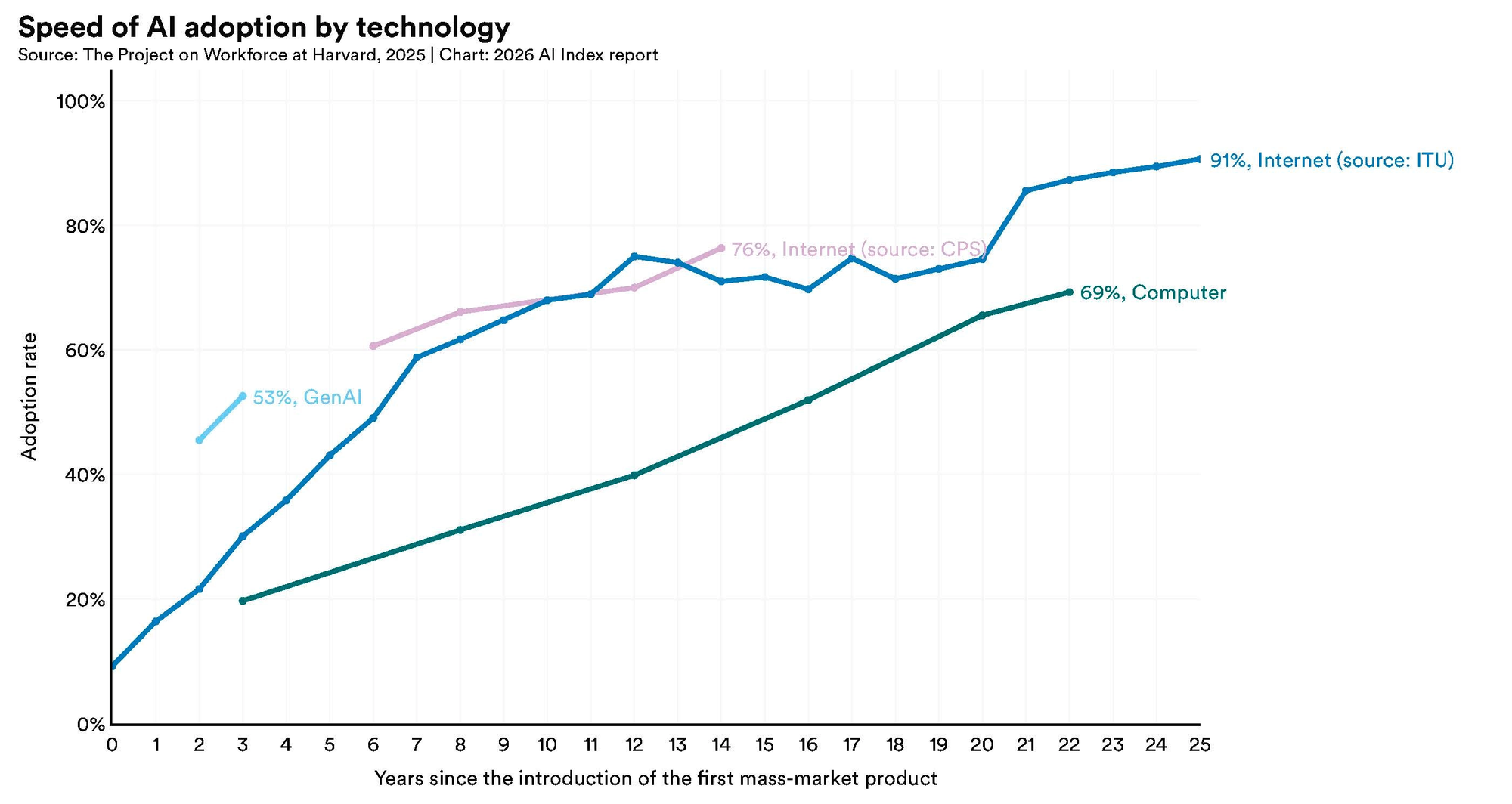
The Stanford report is precise about the framing: adoption "correlates strongly with GDP per capita," meaning higher-income countries tend to show higher usage rates. But even within that pattern, there are meaningful exceptions in both directions.
Countries showing higher-than-expected adoption given their income levels include Singapore at 61%, the UAE at 54%, and several Southeast Asian economies. Countries showing lower-than-expected adoption include the US and several Western European nations.
The 53% figure represents global population, which includes large lower-income populations where penetration is substantially lower. The adoption story is therefore not uniform: it is driven disproportionately by uptake in Asia, the Middle East, and parts of Latin America that have moved faster than their income levels would predict.
Generative AI also crossed the 53% threshold at a time when most users are accessing it for free or near-free. The consumer tools driving adoption, including ChatGPT, Gemini, and their equivalents, are available at no cost at the tier most users access. The report explicitly frames this as a technology where "consumers are deriving substantial value from tools they often access for free."
The $172 Billion American Paradox
American consumers may use AI less than most of the world, but they extract significant economic value from the tools they do use.
The Stanford report estimates the value of generative AI tools to US consumers reached $172 billion annually by early 2026. The median value per US user has tripled between 2025 and 2026, suggesting that while adoption breadth is limited, depth and intensity of use among adopters is increasing sharply.
That consumer surplus figure is striking for what it implies about non-users. If 28.3% of Americans generate $172 billion in estimated annual value, the potential value left on the table from the 71.7% who are not regular users is substantially larger.
The report does not explain why US adoption is comparatively low for a country that leads in AI investment, model production, and talent concentration. The correlation between GDP per capita and adoption would predict the US to rank near the top, not 24th.
Several factors may contribute. AI skepticism runs higher in the US than in most comparable economies. Only 39% of Americans believe AI-powered products and services offer more benefits than drawbacks, compared to 83% in China and 77% in Thailand. Americans are among the countries most likely to expect AI to eliminate jobs rather than create them. Public trust in government to regulate AI is also lower in the US than in any country surveyed, at 31%.
The technology is being built here. The anxiety about it is concentrated here too.
The Education Gap
One of the clearest mismatches in the Stanford report is between where students are and where their schools are.
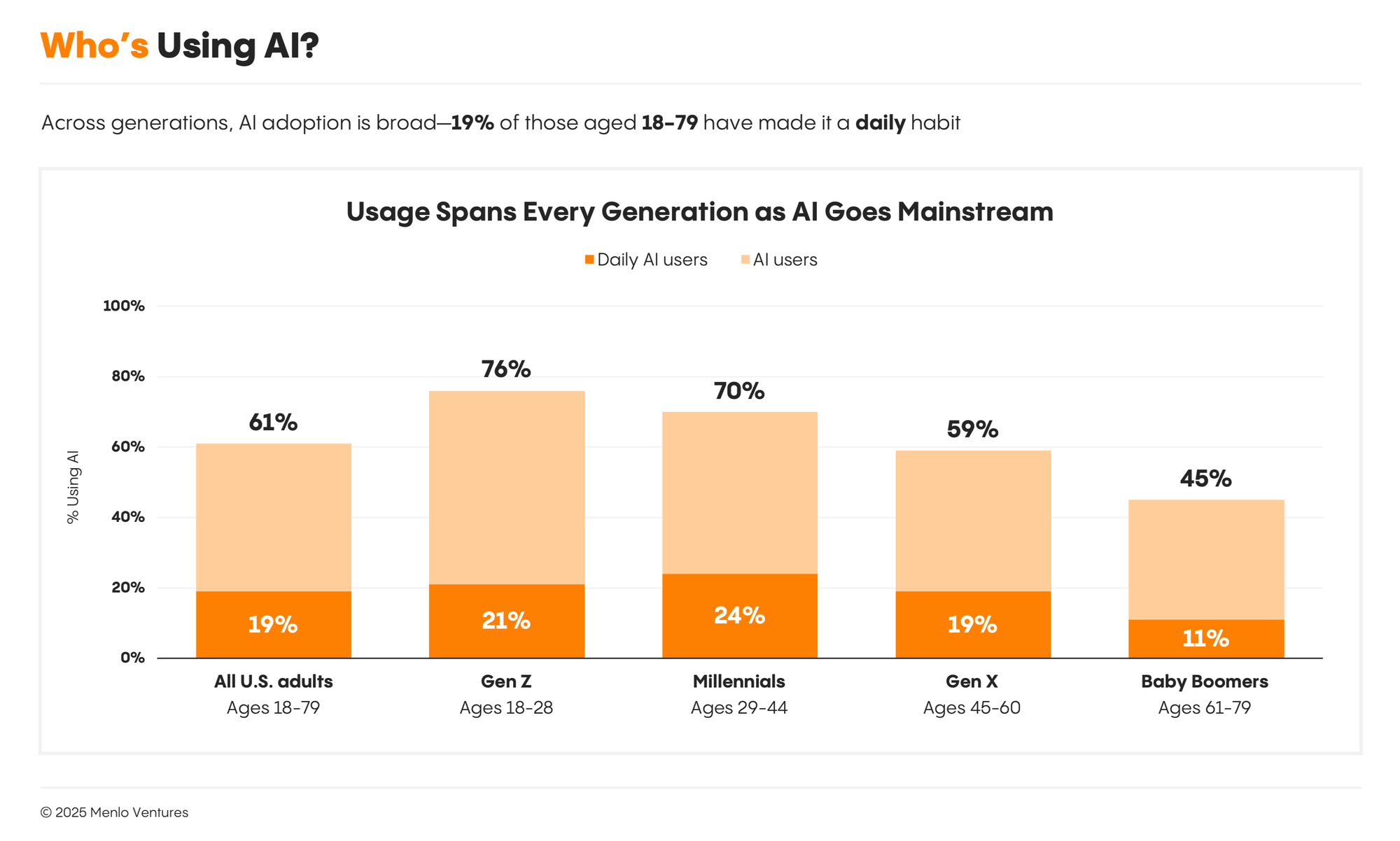
Four out of five US high school and college students now use AI for school-related tasks. The behavior is widespread, prevalent, and continuing to increase.
The institutional response has not kept pace. Only half of middle and high schools have AI policies in place. Of teachers who work at schools with a policy, just 6% say those policies are clear.
This creates a structural situation where the majority of students are using a tool their teachers cannot clearly explain their school's position on, in a policy environment that has not caught up to the behavior. The report frames this as institutions lagging behind use rather than use running ahead of institutions, which is a meaningful distinction for how policymakers should interpret it.
Outside formal education, the picture is different. AI engineering skills are accelerating fastest in the UAE, Chile, and South Africa, countries not typically associated with leading technical workforce development. The number of new AI PhDs in the US and Canada increased 22% from 2022 to 2024, but those additional graduates took jobs in academia rather than in industry, which is where most AI development is happening.
Organizational adoption has reached 88%, meaning nearly nine in ten organizations now use AI in at least one business function. That figure represents a near-complete saturation of enterprise adoption in the countries where the survey was conducted.
Public Sentiment: The Expert-Public Divide
One of the more striking findings in the 2026 report is how sharply expert and public opinion on AI diverge.
Among AI experts, 73% are optimistic about the technology's impact on jobs. Among the general public, only 23% share that belief. The gap is 50 percentage points, and it is not narrowing.
The report frames this as a "vibe shift" between those who work closely with AI systems and those who encounter the technology primarily through media coverage, AI-generated content, and the early effects on employment. Both groups are looking at the same technology and reaching opposite conclusions about what it means.
The public may not be wrong. The Stanford data also confirms that employment among younger workers in AI-exposed fields has already started to decline. Entry-level jobs in software development and customer support have been reduced. The report notes that a Stanford study found employment for software developers aged 22 to 25 has fallen nearly 20% since 2022. Whether AI is the primary cause or a contributing factor in a broader pattern of post-pandemic employment normalization, the trend is real and it is hitting the workers who are most likely to have recently entered the workforce.
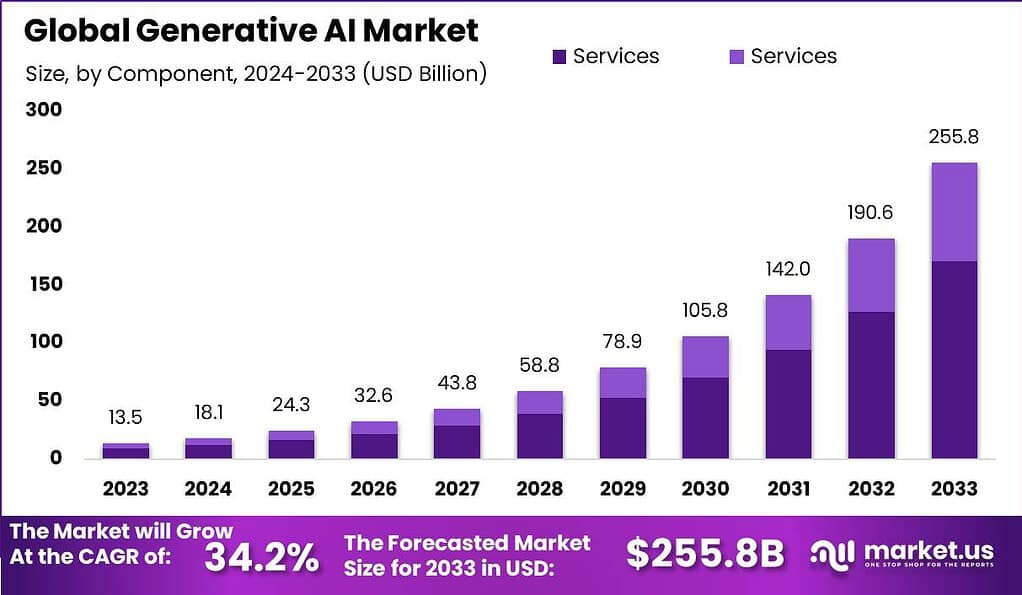
The expert optimism may also not be wrong. Global corporate AI investment hit $581.7 billion in 2025, up 130% from the prior year. The tools are improving faster than benchmarks can measure them. On SWE-bench Verified, the key software engineering benchmark, performance rose from 60% to near 100% in a single year.
The divergence between expert and public sentiment is not primarily a knowledge gap. It is a consequence gap. Experts see the productivity and capability gains. The public is experiencing the workforce effects first.
Where AI Adoption Is Accelerating Beyond Expectations
The countries showing the highest generative AI adoption relative to income level tell a different story about why people adopt technology quickly.
In the UAE, Singapore, Malaysia, Thailand, and Indonesia, more than 80% of people expect AI to have a profound impact on their lives within the next three to five years. That expectation correlates with willingness to adopt, and it stands in contrast to the US, where expectations are more skeptical and adoption rates are correspondingly lower.
The relationship between expectation and adoption suggests that the US ranking of 24th is not primarily a problem of access or affordability. Americans have both. The constraint appears to be appetite, shaped in part by the same job displacement anxieties that drive the expert-public sentiment gap.
Outside the Southeast Asian and Middle Eastern leaders, AI engineering skill development is fastest in Chile and South Africa. The UAE leads globally in AI skills growth, according to the LinkedIn data cited in the Stanford report. These are not the countries most people associate with frontier AI capability, but they are building the applied workforce that will deploy the tools being created elsewhere.
Conclusion
The 53% global adoption figure is genuinely remarkable as a technology diffusion story. No comparable tool has ever spread this quickly at this scale to this many users.
The US ranking of 24th in that story is equally notable for a different reason. The country that produced most of the technology, invested the most capital, and trained most of the researchers that made it possible is not leading in using it. The reasons are embedded in the public sentiment data: Americans are more skeptical about AI's workforce implications than citizens of almost any other surveyed country, and that skepticism is reflected in adoption rates that lag the global curve.
The economic value data suggests this is leaving money on the table. If the 28.3% of Americans who are regular users generate $172 billion in annual consumer surplus, closing the adoption gap meaningfully would represent one of the largest productivity unlocks available to the US economy without requiring any further model development.
The tools exist. The value is documented. What the Stanford data shows is that between building AI and benefiting from AI sits a layer of trust, policy clarity, and institutional readiness that the US, despite leading on the supply side, has not yet adequately built.
Frequently Asked Questions
How quickly did generative AI reach 53% global adoption?
According to Stanford's 2026 AI Index, generative AI reached 53% population adoption within approximately three years of mainstream availability, outpacing the personal computer, the internet, and the smartphone. The adoption correlates strongly with GDP per capita but shows meaningful exceptions in both directions, with several middle-income Asian and Middle Eastern countries exceeding what their income levels would predict.
Why does the US rank 24th in generative AI adoption?
Only 28.3% of Americans use generative AI regularly. Stanford's report does not provide a definitive explanation, but the data points toward skepticism rather than lack of access: only 39% of Americans believe AI offers more benefits than drawbacks, the US has the lowest public trust in government to regulate AI of any surveyed country at 31%, and Americans are among the most likely to expect AI to eliminate jobs. Higher-income countries where expectations about AI's impact are more positive, such as Singapore and UAE, show substantially higher adoption rates.
What is the $172 billion consumer value figure?
Stanford estimates the value of generative AI tools to US consumers reached $172 billion annually by early 2026, with the median value per user tripling between 2025 and 2026. This figure represents the economic surplus generated by 28.3% of the US population using these tools, suggesting the potential value from broader adoption is substantially larger.
How are US students using AI compared to institutional policy?
Four out of five US high school and college students use AI for school-related tasks, but only half of middle and high schools have AI policies, and just 6% of teachers say those policies are clear. The behavior has substantially outpaced institutional governance.
What explains the gap between expert and public sentiment on AI?
73% of AI experts are optimistic about AI's impact on jobs, compared to 23% of the public, a 50-point gap. The Stanford report frames this as a "vibe shift" between those who work closely with AI systems and those who experience it primarily through media coverage and early workforce effects. The public's concern is grounded in real data: entry-level employment in AI-exposed fields has already started to decline.
Where is AI adoption growing fastest?
Countries showing the highest adoption relative to their income levels include Singapore (61%), UAE (54%), and several Southeast Asian economies. More than 80% of people in China, Malaysia, Thailand, Indonesia, and Singapore expect AI to profoundly impact their lives within five years. AI engineering skill growth is fastest in the UAE, Chile, and South Africa.
Related Articles
 Dani
Dani Dani
Dani


