The edge AI hardware market is experiencing explosive growth that's reshaping how businesses and developers approach artificial intelligence. According to recent industry analysis, this market is projected to surge from $26.1 billion in 2025 to nearly $69 billion by 2031, growing at a compound annual growth rate exceeding 17%. This isn't just another tech trend – it's a fundamental shift in how AI applications are deployed, moving intelligence from distant cloud servers directly to the devices we use every day.
Whether you're building a smart security camera for your home, developing an industrial quality inspection system, or prototyping the next generation of autonomous vehicles, the edge AI chip you choose will determine your project's success. Make the wrong choice, and you're looking at compatibility nightmares, inadequate performance, or blown budgets. Make the right choice, and you'll have a solution that scales with your needs for years to come.
This guide cuts through the marketing noise to give you a clear, practical understanding of the edge AI landscape in 2026. We'll examine the leading chipmakers, compare real-world performance metrics, and help you match the right hardware to your specific use case.
Understanding Edge AI: Why Processing Locally Matters
Before diving into specific hardware, let's establish why edge AI has become so critical. Traditional cloud-based AI requires sending data to remote servers for processing, which creates three significant problems: latency, bandwidth costs, and privacy concerns.
Edge AI eliminates these issues by processing data directly on the device where it's generated. A security camera with edge AI can identify a potential intruder and trigger an alert in milliseconds, rather than waiting for round-trip communication with a cloud server. A factory robot can detect defects on a production line in real-time, preventing faulty products from moving further down the assembly process.
The privacy implications are equally important. When your smart doorbell processes video locally using edge AI, that footage of your family never leaves your home network. For healthcare applications, keeping patient data on-device helps maintain HIPAA compliance while still enabling AI-powered diagnostics.
Power consumption represents another crucial advantage of dedicated edge AI hardware. Running inference on a general-purpose CPU might consume 50 watts or more, while purpose-built AI accelerators can deliver superior performance while sipping just 2-3 watts. For battery-powered devices or always-on systems, this efficiency difference isn't just nice to have – it's essential.
The Major Players in Edge AI Hardware
The edge AI chip market has evolved significantly, with several companies establishing themselves as leaders in different market segments. Understanding who makes what, and who they're targeting, is essential for making informed purchasing decisions.
Hailo Technologies: The Power Efficiency Champion
Hailo has emerged as a dominant force in edge AI, particularly for vision applications. Based in Israel, the company has built a reputation for delivering exceptional performance per watt, making their chips ideal for thermally constrained and power-sensitive applications.
The Hailo-8 remains the company's workhorse product. Delivering 26 TOPS (tera-operations per second) while consuming just 2.5 watts typical power, it achieves roughly 10 TOPS per watt – a benchmark that competitors struggle to match. The chip doesn't require external memory, which simplifies integration and reduces system costs. It's available in multiple form factors including M.2 modules, mini PCIe cards, and a high-performance Century PCIe card suitable for multi-camera systems.
For cost-sensitive applications, Hailo offers the Hailo-8L, delivering 13 TOPS at an even lower power envelope. This chip powers the popular Raspberry Pi AI HAT+, which has become the go-to entry point for makers and developers exploring edge AI.
The newest addition to Hailo's lineup is the Hailo-10H, which represents the company's push into generative AI at the edge. Featuring 40 TOPS of INT4 performance and 8GB of dedicated LPDDR4 memory, the Hailo-10H can run large language models and vision-language models entirely on-device. In benchmarks, it achieves first-token latency under one second and generates more than 10 tokens per second on 2B parameter models. The chip is automotive-qualified to AEC-Q100 Grade 2 standards, targeting vehicles with 2026 production starts.
The Raspberry Pi AI HAT+ 2, launched in January 2026, brings the Hailo-10H to the maker community at a $130 price point. It enables local LLM execution without any cloud dependency, though the 8GB of dedicated memory does limit model sizes compared to more powerful systems.
NXP Semiconductors: Industrial Strength and Automotive Focus
NXP approaches edge AI from a position of strength in automotive and industrial markets, where long product lifecycles, functional safety certification, and supply chain reliability matter as much as raw performance numbers.
The company's recent $307 million acquisition of Kinara in early 2025 significantly expanded its AI capabilities. Kinara's Ara-2 processor delivers up to 128 TOPS while consuming less than 5 watts, and more importantly, it's optimized for transformer-based generative AI workloads—not just the convolutional neural networks that dominated previous edge AI generations.
NXP is integrating Kinara's technology with its existing i.MX application processor family, creating what the company hopes will become an AI ecosystem for automotive similar to what NVIDIA's CUDA achieved in data centers. The initial targets include in-vehicle cabin monitoring and infotainment copilots that can answer questions about vehicle manuals or monitor driver alertness.
The i.MX 95 family represents NXP's latest integrated application processor with AI capabilities. It combines up to six Arm Cortex-A55 cores with the company's proprietary eIQ Neutron NPU, delivering 2 TOPS of AI acceleration alongside general-purpose computing, graphics processing, and advanced image signal processing. While 2 TOPS sounds modest compared to dedicated accelerators, NXP's architecture achieves roughly three times faster real-world inference than the previous i.MX 8M Plus despite similar TOPS ratings – demonstrating why raw specifications don't tell the whole story.
The i.MX 8M Plus continues serving applications where 2.3 TOPS of AI performance suffices. NXP emphasizes its 15-year longevity support, EdgeLock security features, and compliance with ISO 26262 and IEC 61508 functional safety standards—features that matter enormously for medical devices, industrial automation, and automotive applications but might be overkill for consumer projects.
NVIDIA: Still the Heavyweight Champion
While this guide focuses on emerging alternatives, ignoring NVIDIA would be like discussing smartphones without mentioning Apple. The Jetson platform remains the benchmark against which other edge AI solutions are measured.
The Jetson AGX Orin delivers up to 275 TOPS, dwarfing everything else on this list. It runs full Ubuntu Linux, supports the entire CUDA ecosystem, and allows developers to port cloud-trained models with minimal modification. For robotics applications requiring simultaneous localization, mapping, object detection, and path planning, nothing else comes close.
The tradeoffs are power consumption (10-60 watts depending on workload), thermal management requirements, and cost. Jetson devices also experienced significant supply shortages in recent years, causing headaches for companies depending on them for production deployments.
For many applications, Jetson is overkill. But when you need the computational horsepower, alternatives simply don't exist at comparable performance levels.
Google Coral: The TensorFlow Lite Specialist
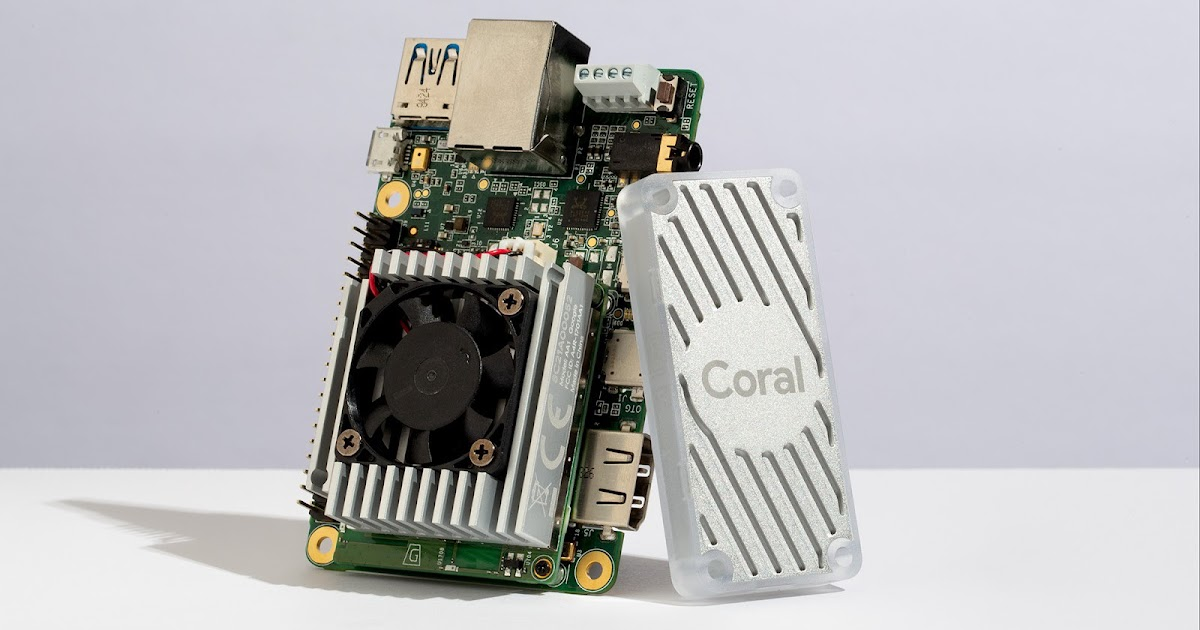
Google's Coral platform centers on the Edge TPU, delivering 4 TOPS at just 2 watts through an ASIC purpose-built for TensorFlow Lite models. This laser focus creates both strengths and limitations.
The Coral USB Accelerator remains popular for prototyping – plug it into any computer with USB and you've got hardware-accelerated inference within minutes. The Dev Board provides a complete development platform, while M.2 modules enable integration into custom hardware designs.
The catch is that Coral only supports TensorFlow Lite models quantized to INT8. If you're working in PyTorch, want to run larger models, or need floating-point precision, Coral isn't for you. But within its constraints, it delivers exceptional value and simplicity.
Rockchip: The Value Proposition
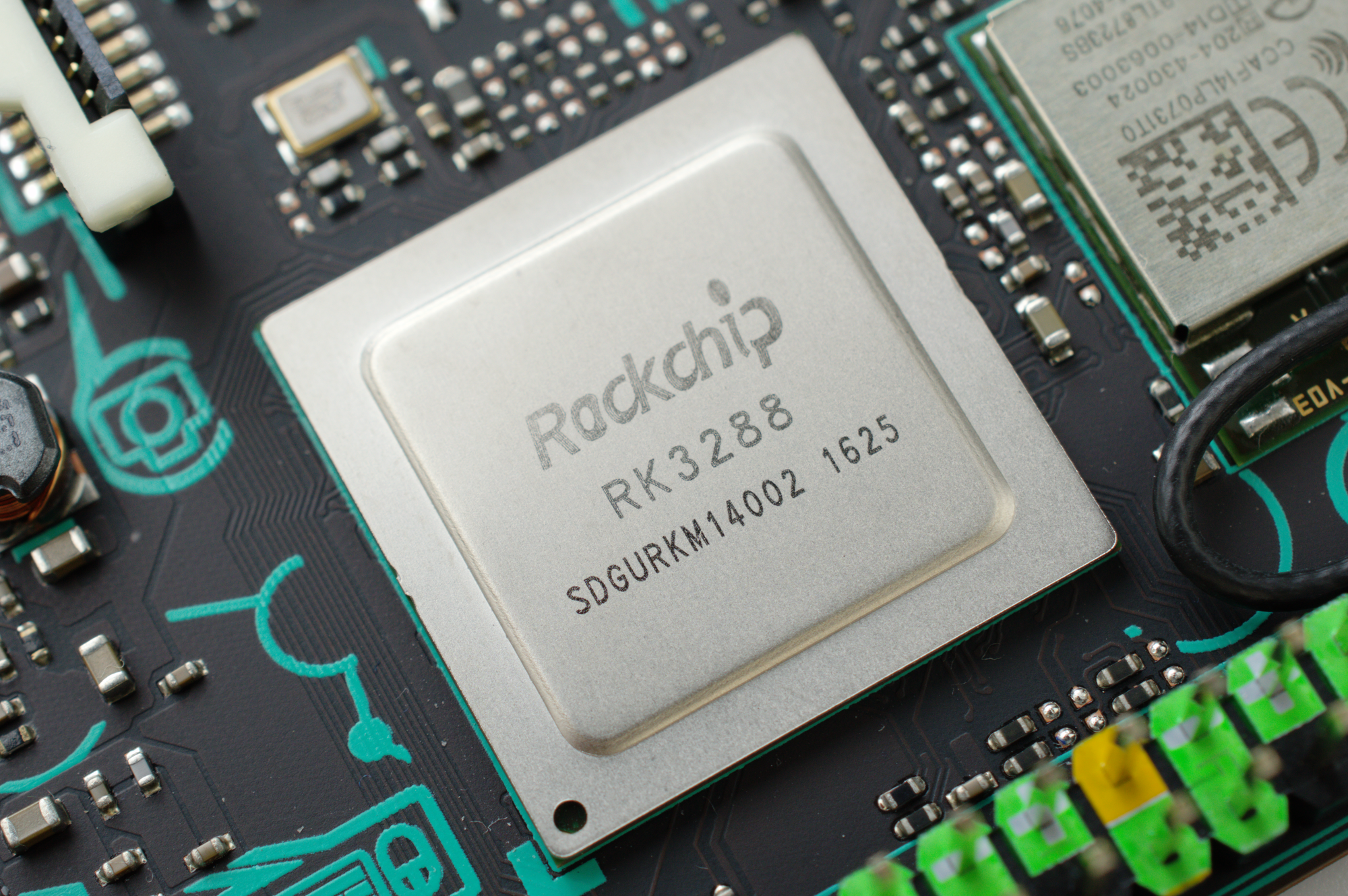
Rockchip's RK3588 has become ubiquitous in single-board computers targeting edge AI applications. This 8nm SoC combines an 8-core CPU configuration with a 6 TOPS neural processing unit, striking an interesting balance between AI capability and general-purpose computing.
The RK3588's appeal lies in its ecosystem. Dozens of boards from companies like Orange Pi, Radxa, and Khadas use this chip, creating competition that drives down prices and increases accessory availability. For applications combining AI inference with web servers, databases, or other software services, this integrated approach simplifies system architecture.
The limitation is that 6 TOPS won't satisfy demanding vision applications, and Rockchip's software stack doesn't match the polish of more established platforms.
Matching Hardware to Your Application
Understanding specifications matters, but matching them to your actual needs matters more. Let's examine common edge AI use cases and identify which hardware makes sense for each.
Smart Home Security Cameras
Home security represents one of the fastest-growing edge AI applications. Rather than streaming continuous video to cloud servers, modern smart cameras use on-device AI to distinguish between a prowling intruder and the family cat triggering motion detection.
For single-camera deployments, the Hailo-8 or Hailo-8L provides more than enough performance while maintaining the thermal profile suitable for compact enclosures. Integration with platforms like Snap One's Luma Insights demonstrates commercial viability. The Raspberry Pi AI HAT+ offers a development platform at consumer-friendly prices.
For network video recorders managing multiple cameras, systems with multiple Hailo-8 accelerators can scale to 104 TOPS, sufficient for real-time analysis across dozens of camera feeds simultaneously.
Power efficiency matters here because security cameras operate continuously. A chip consuming 10 watts adds $9-12 to annual electricity costs per camera—seemingly small, but it compounds across devices and years.
Industrial Quality Inspection
Factory floor applications demand reliability, determinism, and often functional safety certification. A quality inspection system that occasionally misses defects or produces false positives creates expensive problems.
NXP's i.MX 95 family makes sense here due to its compliance with IEC 61508 functional safety standards and 15-year longevity support. The integrated approach—CPU, NPU, ISP, and security in one package – simplifies system design and qualification.
For higher-performance requirements, AMD Xilinx's Kria K26 offers FPGA flexibility for custom processing pipelines with deterministic latency that fixed-function accelerators can't guarantee. The tradeoff is requiring FPGA development expertise.
Autonomous Mobile Robots
Robots navigating warehouse floors or manufacturing facilities need simultaneous localization and mapping, obstacle detection, path planning, and often manipulation – all with strict real-time requirements.
This workload typically exceeds what single-chip solutions can handle. NVIDIA's Jetson Orin family remains the default choice, though Qualcomm's RB5 platform offers an interesting alternative when 5G connectivity is required.
For simpler autonomous systems – think delivery robots following predetermined paths – lower-cost solutions become viable. The key is honestly assessing computational requirements before committing to hardware.
Generative AI at the Edge
The emergence of large language models and vision-language models has created new demand for edge AI capable of running transformer architectures, not just the convolutional neural networks that dominated earlier generations.
The Hailo-10H and Kinara Ara-2 both target this emerging market. Running a 2B parameter LLM locally enables use cases like document summarization, voice assistants, and interactive NPCs in gaming without cloud latency or subscription costs.
Memory becomes the primary constraint here. The Hailo-10H's 8GB dedicated RAM limits practical model sizes. For larger models, systems with more memory headroom or the patience to wait for next-generation hardware may be necessary.
Battery-Powered IoT Devices
When every milliwatt counts, Google's Edge TPU stands out. Consuming just 2 watts while delivering 4 TOPS enables AI inference in battery-powered sensors that need to operate for months between charges.
NXP's microcontroller-based solutions also target this segment, though with lower AI performance suitable for simpler models. The emerging TinyML movement pushes the boundaries of what's possible in severely resource-constrained environments.
Practical Buying Considerations
Specifications and use cases inform decisions, but practical considerations ultimately determine success or failure.
Software Ecosystem and Developer Experience
Hardware means nothing without software that lets you use it effectively. Evaluate the SDK quality, documentation completeness, community size, and model zoo availability before committing to any platform.
NVIDIA's CUDA ecosystem represents the gold standard – models trained on cloud GPUs typically port to Jetson with minimal modification. Hailo has built a comprehensive software suite with over 100,000 users and hundreds of deployed products providing proven reliability.
Google's Coral benefits from TensorFlow Lite's massive adoption, but the INT8 quantization requirement creates friction when working with models not originally designed for Coral.
Less established platforms may offer compelling specifications but frustrating development experiences. The Hailo-10H launch illustrated this when pre-release software packages broke compatibility with Raspberry Pi OS, forcing developers to compile from source using incomplete documentation.
Supply Chain and Availability
The semiconductor supply challenges of recent years taught painful lessons about hardware availability. A development platform that goes out of stock for six months kills project timelines.
NVIDIA Jetson modules experienced significant supply constraints. NXP's long-standing relationships with automotive and industrial customers typically ensure better availability for their parts. Raspberry Pi products, while popular, have also faced periodic shortages.
For production deployments, establish relationships with distributors, consider multiple sourcing options, and plan for longer lead times than you'd like.
Thermal Management
Edge AI chips generate heat, and thermal constraints often limit real-world performance more than specifications suggest.
Hailo's architecture runs cool enough for fanless operation in many scenarios – a significant advantage for reliability and acoustics. NVIDIA Jetson devices typically require active cooling, which adds noise and potential failure points.
Evaluate thermal requirements in the context of your actual deployment environment. A chip that performs beautifully on a bench might throttle in a sealed enclosure on a factory floor.
Future Roadmap Considerations
Edge AI hardware is evolving rapidly. The chip you buy today will likely be superseded within 18-24 months by something significantly better.
Consider whether your chosen platform has a clear upgrade path. Hailo's software compatibility across their product line means Hailo-8 applications generally port to Hailo-10H. NXP's integration of Kinara technology should eventually enable migration paths within their ecosystem.
Betting on platforms from financially stable companies with clear strategic commitment to edge AI reduces the risk of finding yourself stuck on abandoned hardware.
Pricing and Value Analysis
Edge AI pricing spans from hobbyist-accessible to enterprise-budget territory, and the best value depends entirely on your requirements.
At the entry level, the $70 Raspberry Pi AI HAT+ with Hailo-8L provides 13 TOPS, sufficient for many vision applications. Adding a Raspberry Pi 5 brings total system cost under $150 – remarkable for a complete edge AI development platform.
The $110 version with the full Hailo-8 doubles performance to 26 TOPS, worth the premium for applications needing higher throughput or running more complex models.
The new $130 Raspberry Pi AI HAT+ 2 with Hailo-10H adds generative AI capabilities but offers similar vision performance to the existing 26 TOPS model. The value proposition depends on whether you need local LLM execution.
Google Coral USB Accelerator at roughly $60 offers the lowest entry point, though with TensorFlow Lite constraints.
Professional-grade boards based on NXP i.MX 95 typically start around $200-400 for evaluation kits, with production modules priced based on volume commitments.
NVIDIA Jetson modules range from approximately $200 for Orin Nano to over $1,000 for AGX Orin, plus carrier board costs.
Remember that chip cost represents only part of total system cost. Factor in development time, power supply requirements, thermal solutions, and ongoing support when calculating true project costs.
Common Mistakes to Avoid
Years of observing edge AI projects—both successes and failures—reveal predictable pitfalls.
- Overbuying performance wastes money. A 275 TOPS Jetson AGX Orin running a MobileNet classifier is like driving a Formula 1 car to the grocery store. Match hardware to actual workload requirements.
- Underestimating software integration time burns schedules. Even with well-documented platforms, getting models optimized and deployed typically takes longer than expected. Build this into project timelines.
- Ignoring thermal constraints causes field failures. The prototype working on your desk may overheat in an enclosure or outdoor deployment. Test in realistic conditions early.
- Choosing hardware before finalizing models creates compatibility problems. Ensure your target models run well on candidate hardware before committing.
- Overlooking production scaling requirements leads to redesigns. The development platform that works perfectly for prototypes may not have the supply chain availability, certifications, or environmental ratings needed for production.
The Competitive Landscape Moving Forward
The edge AI market continues evolving rapidly. Several trends will shape the landscape through 2026 and beyond.
Integration is accelerating. Standalone AI accelerators give way to system-on-chips combining CPU, GPU, NPU, and ISP in single packages. This reduces system complexity and cost for many applications.
Generative AI at the edge is expanding. The Hailo-10H and Kinara Ara-2 represent early moves in this direction, but expect more capable solutions enabling larger local models.
Software ecosystems are consolidating. The advantage of established platforms with large user communities compounds over time, potentially creating barriers for new entrants.
Automotive qualification is becoming table stakes. As edge AI penetrates more vehicles, chips meeting AEC-Q100 and ISO 26262 requirements will capture growing market share.
Chinese manufacturers are advancing. While geopolitical factors complicate adoption in some markets, companies like Rockchip continue improving their offerings at aggressive price points.
Frequently Asked Questions
What is edge AI, and how does it differ from cloud AI?
Edge AI processes artificial intelligence workloads directly on local devices rather than sending data to remote cloud servers. This approach dramatically reduces latency—responses happen in milliseconds instead of seconds—eliminates bandwidth costs associated with uploading continuous data streams, and keeps sensitive information on-device rather than transmitting it over networks. Cloud AI remains valuable for training large models and applications where real-time response isn't critical, but edge AI has become essential for time-sensitive and privacy-conscious applications.
How do I know how many TOPS I need for my application?
TOPS (tera-operations per second) provides a rough performance comparison, but actual requirements depend heavily on your specific models and use cases. Simple image classification might run well with 2-4 TOPS. Object detection on real-time video typically needs 10-26 TOPS. Running multiple simultaneous models or processing several camera streams multiplies requirements proportionally. The best approach is benchmarking your actual workloads on evaluation hardware before committing to production designs.
Can I run ChatGPT or similar large language models on edge AI devices?
Full-scale models like GPT-4 require far more memory and compute than any current edge device can provide. However, smaller language models with 1-7 billion parameters can run on latest-generation edge AI hardware like the Hailo-10H. These models handle many practical tasks including document summarization, question answering, and conversational interactions, though they won't match the capability of their larger cloud-hosted counterparts.
Is Raspberry Pi AI HAT worth it for serious projects?
For development, prototyping, and learning, absolutely. The combination of accessible pricing, extensive documentation, and active community makes it ideal for getting started with edge AI. For production deployments, consider whether Raspberry Pi's form factor, environmental specifications, and supply availability meet your requirements. Many projects prototype on Raspberry Pi then migrate to custom hardware for production.
What's the difference between NPU, TPU, and GPU for AI inference?
These terms describe different architectural approaches to accelerating AI workloads. GPUs (Graphics Processing Units) like those in NVIDIA Jetson devices offer broad flexibility and work with most AI frameworks. TPUs (Tensor Processing Units) are Google's purpose-built accelerators optimized specifically for TensorFlow models. NPUs (Neural Processing Units) is a general term for specialized AI inference engines built by various manufacturers. Performance characteristics vary by architecture, but all serve the goal of accelerating neural network computation more efficiently than general-purpose CPUs.
How do I choose between Hailo-8 and Hailo-10H?
If your application focuses purely on computer vision tasks like object detection, pose estimation, or image segmentation, the Hailo-8 delivers excellent performance at lower cost. Choose the Hailo-10H when you need local generative AI capabilities like running language models, vision-language models, or Stable Diffusion, or when the 8GB dedicated memory provides headroom for larger models than the Hailo-8 supports.
Will edge AI devices work with my existing security cameras?
It depends on your setup. Edge AI accelerators integrated into NVRs (network video recorders) can add AI analytics to existing IP camera systems without replacing cameras themselves. Alternatively, AI-enabled cameras with built-in processing handle inference independently. The right approach depends on your existing infrastructure, budget, and whether you need AI processing on raw video streams or can work with compressed network video.
How long do edge AI chips typically remain available for purchase?
Consumer-focused products may have lifecycles as short as 2-3 years before being superseded by newer generations. Industrial and automotive-targeted chips from companies like NXP often have 10-15 year longevity commitments, ensuring supply availability for products with long service lives. Consider lifecycle requirements when selecting hardware for production deployments.
Can edge AI devices operate offline without internet connectivity?
Yes—this is one of edge AI's primary advantages. Because processing happens locally, edge AI devices function independently of network connectivity. This makes them suitable for remote locations, environments with unreliable connectivity, and applications where network dependencies create unacceptable reliability risks.
What programming languages and frameworks work with edge AI hardware?
Most edge AI platforms support Python, which has become the standard for AI development. C++ provides options when maximum performance matters. Framework support varies by platform: NVIDIA Jetson works with TensorFlow, PyTorch, and ONNX; Google Coral requires TensorFlow Lite; Hailo supports TensorFlow, PyTorch, ONNX, and Keras through their conversion tools. Check specific framework compatibility for your target platform before committing.
The edge AI landscape will continue evolving rapidly. The best hardware choice today depends on your specific requirements, budget, timeline, and tolerance for risk. Use this guide as a starting point, but verify current specifications, pricing, and availability before making purchasing decisions. What works perfectly for one application may be entirely wrong for another – there's no universal "best" edge AI device, only the best device for your particular needs.
Related Articles
 Dani
Dani
 Mark
Mark
 Dani
Dani