When OpenAI announced advertising in ChatGPT on January 16, 2026, most of the coverage focused on the revenue numbers and the industry drama. Less attention went to the specifics: which users see ads, how the targeting works, what actually changed in the privacy policy that went out to 800 million users on February 9, and what controls those users actually have.
The answers are more nuanced than either the critics or OpenAI's own marketing language suggest. Some of the privacy protections are stronger than comparable ad platforms. Some of the policy changes are less visible than they should be. And the options available to free users are more varied than most people realize.
Who Sees Ads and Who Doesn't
The tier structure is the starting point, and it is unambiguous.
The meaningful threshold is $20. The $8 Go plan is structured as an ad-supported product, not an ad-free one. Users who upgrade to Go to reduce usage limits while also expecting an ad-free experience should understand they are getting one without the other.
There is one option available to free users who want to reduce ad targeting without paying: turning off ad personalization in Settings. This does not remove ads, but it shifts targeting to the current conversation only, without incorporating past chats, ad interaction history, or stored preferences. Generic contextual ads rather than personalized ones.
How the Ad Targeting Actually Works
OpenAI's targeting model for ChatGPT ads is meaningfully different from how Meta and Google operate, and the distinction is worth understanding.
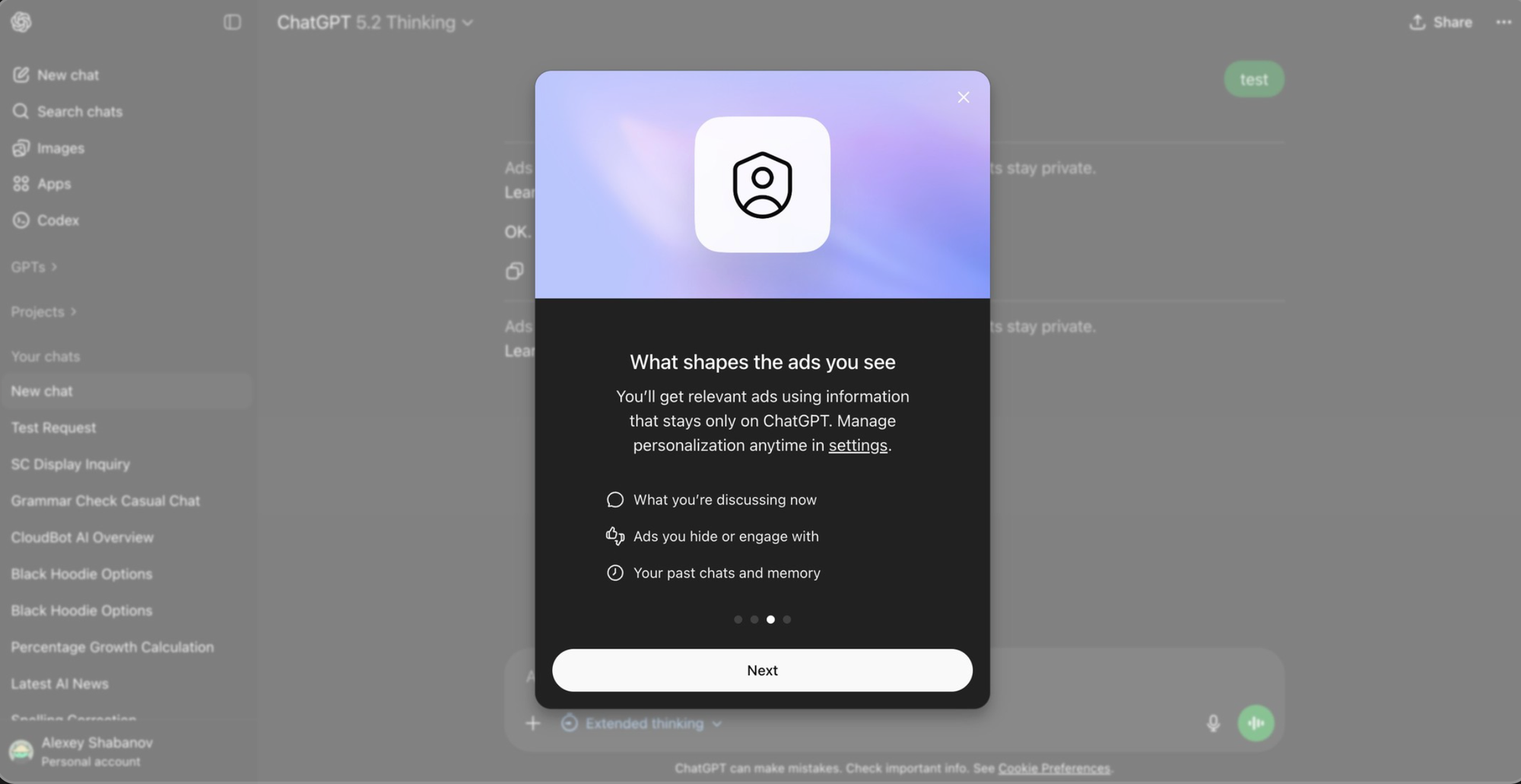
When personalized ads are enabled (the default), the system uses three signals:
- The content of your current conversation
- Your past chat topics
- Your history of ad interactions within ChatGPT
When personalized ads are turned off, only the first signal applies: the current conversation topic.
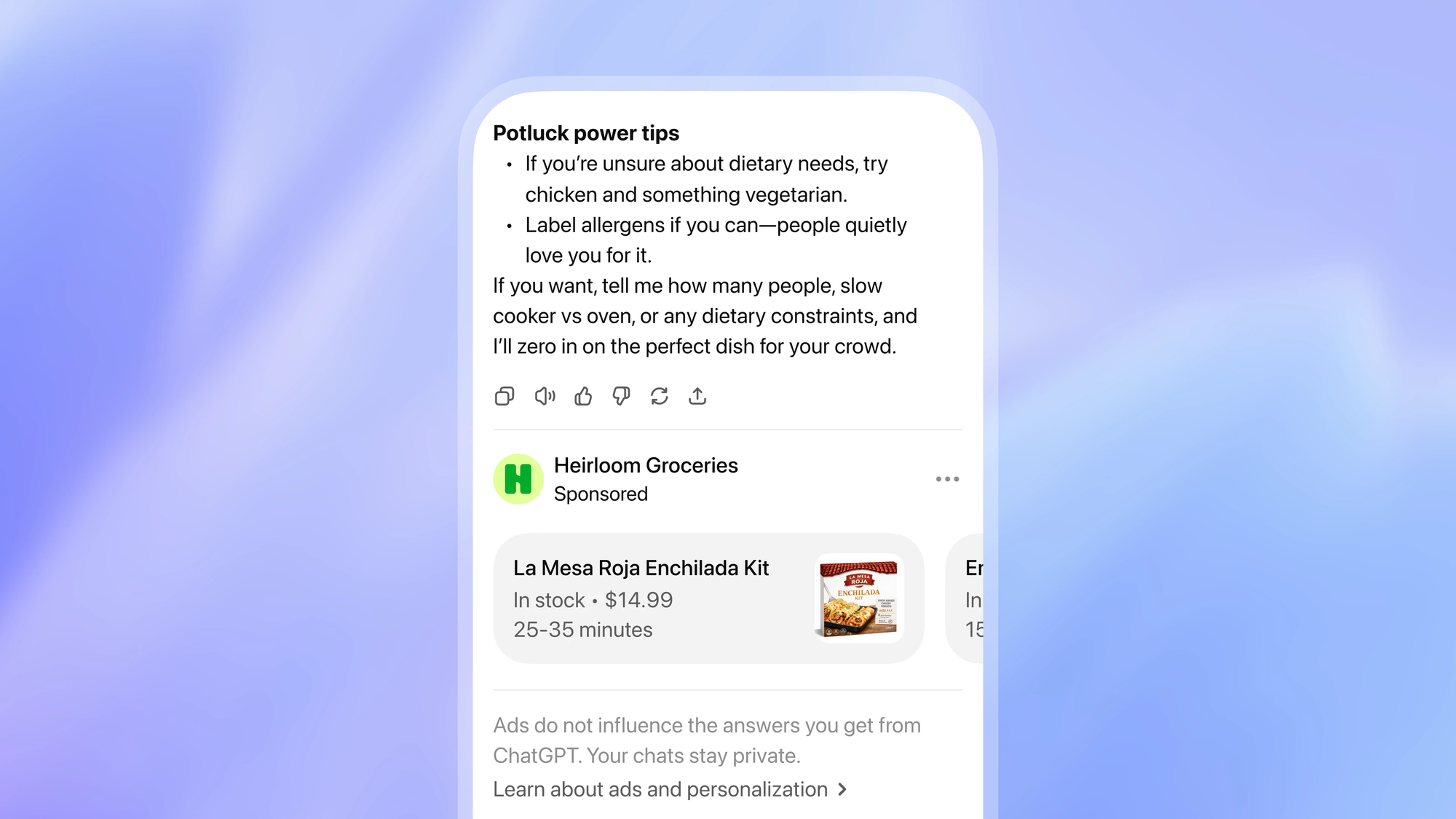
Advertisers do not choose who sees their ads by selecting audience segments or demographic profiles. They submit campaigns by category, and OpenAI's system matches those categories to conversations on its side. Advertisers receive only aggregate data: total impressions and total clicks. They do not receive individual conversation content, chat histories, memories, or any personally identifying information.
OpenAI's privacy policy states directly: "We don't 'sell' Personal Data or 'share' Personal Data for cross-contextual behavioral advertising, and we do not process Personal Data for 'targeted advertising' purposes (as those terms are defined under state privacy laws)."
The legal precision of that statement matters. "Sell" and "cross-contextual behavioral advertising" are terms of art in US privacy law under the California Consumer Privacy Act and similar statutes. OpenAI is not technically selling data or building profiles across external contexts. The targeting happens inside OpenAI's own infrastructure using signals from within the platform.
That said, the conversations themselves carry more inherently sensitive information than a search query does. When someone searches "symptoms of sleep disorder," they share topical intent. When someone has a multi-turn conversation about sleep problems with a conversational AI, they may share significantly more. Contextual matching on that conversation content is technically different from behavioral tracking, but the information being matched on is more detailed than what a keyword captures.
What the Privacy Policy Update Actually Changed
The February 9, 2026, privacy policy update is worth reading more carefully than most policy updates typically warrant, because it contains changes beyond the ad targeting disclosure.
OpenAI emailed the updated policy directly to users rather than simply updating the document in the footer of its website. The email summary identified several categories of change.
Ad targeting and data use
The policy now explicitly documents how ad signals work: the three-tier targeting structure (current conversation, past chats, ad interactions), the fact that advertisers receive only aggregate data, and the user controls available. This was not a reversal of a previous commitment but a formalization and detailed documentation of what the ad system actually does.
Data retention timelines
The updated policy added explicit statements about how long various categories of data are retained. Standard chat data carries a 30-day deletion window after a user requests deletion. Data associated with agent features carries a 90-day retention window, which is longer and which may include screenshot capture if agents are operating on a user's screen. Financial transaction data is retained for accounting, dispute resolution, and regulatory compliance purposes, with no fixed window.
The 90-day retention window for agent features is less prominent in OpenAI's communications than it deserves to be, particularly as the platform expands agentic functionality. Users who connect ChatGPT to external tools and data sources through the Model Context Protocol should be aware that this extends their data footprint to third-party services that OpenAI's policies do not directly govern.
Age prediction for teen accounts
The policy update introduced a disclosure that OpenAI uses behavioral signals to predict whether a user is likely to be under 18. If the system predicts a user is a minor, it adjusts ad exposure and certain data handling parameters automatically, without prompting the user to confirm their age.
This is presented as a child safety measure, and the intention is reasonable. But it introduces automated, opaque adjustment of privacy settings based on behavioral inference rather than self-reported information. Users who are adults should know the system may be making inferences about them, and users who are actually teenagers may have settings adjusted based on predicted rather than confirmed age status.
Contact syncing
A new optional feature allows users to sync contacts to help find friends on OpenAI services. The policy confirms this is optional, but the implications for non-users whose contact information gets uploaded are not detailed in the policy summary. Standard privacy concerns around contact graph sharing apply: contacts who have not agreed to OpenAI's terms may have their names and numbers uploaded as part of someone else's sync.
The Specific Ad Exclusions
OpenAI established a set of categories in which ads will not appear, and these are worth knowing explicitly.
Ads do not appear in:
- Conversations involving health or medical topics
- Mental health discussions
- Political topics
- Conversations where the user has indicated or OpenAI predicts the user is under 18
- Temporary Chats (where no history is saved)
- Logged-out sessions
- Image generation conversations
The health and mental health exclusions are the most consequential. ChatGPT is widely used for health-adjacent conversations, symptom checking, medication questions, and emotional support. The exclusion of these conversations from ad targeting addresses one of the most significant trust risks in the advertising model.
There is a boundary question the policy does not fully resolve: conversations that begin on a neutral topic and drift into health or mental territory. The policy describes using "overall context and user experience" for longer conversations, but the line between a recipe conversation that mentions allergies and a health conversation that should trigger the exclusion is not sharply defined in the public documentation.
What Free Users Can Actually Do
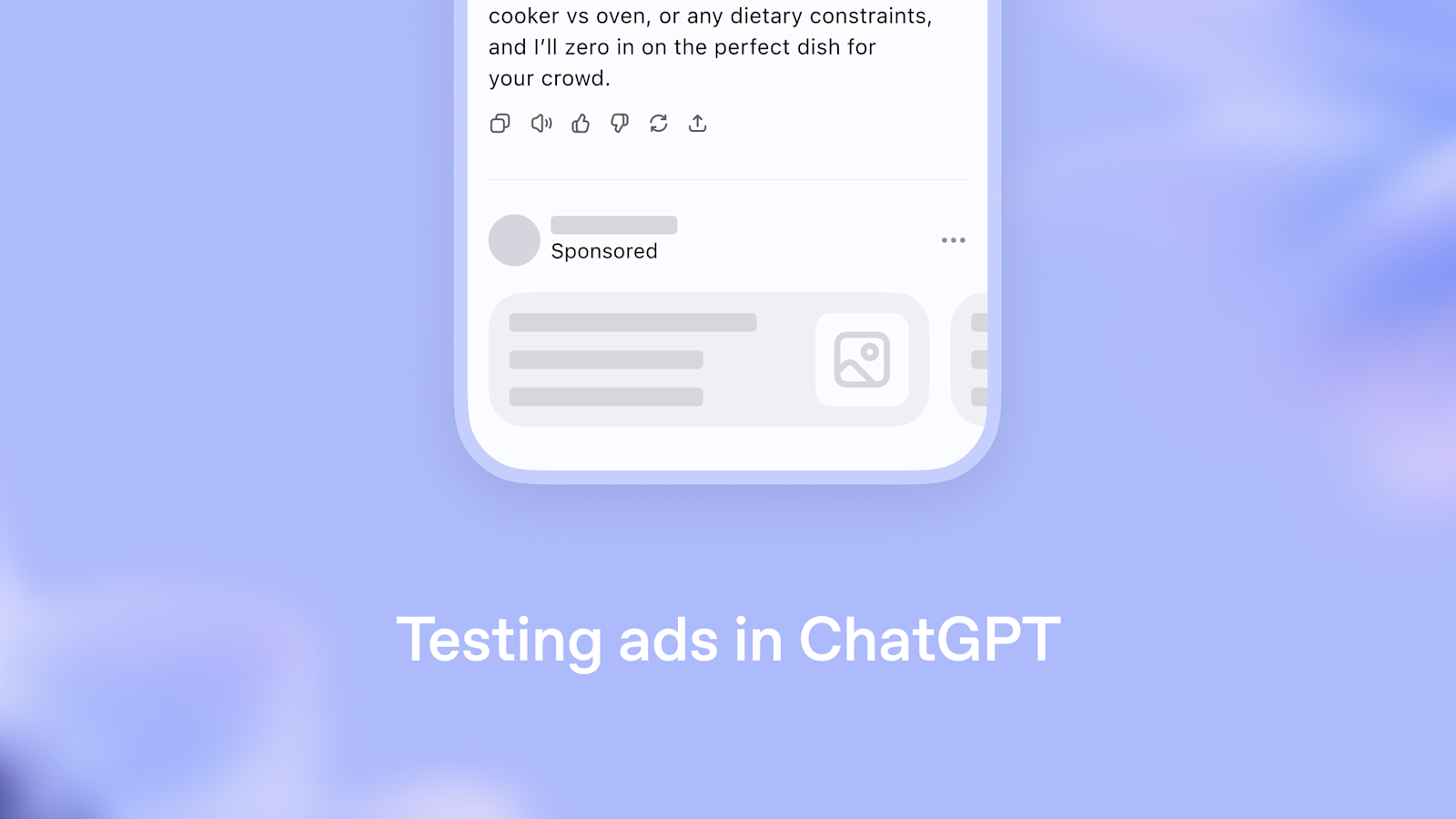
For users on the free plan who want to manage their ad experience, the available controls are:
- Turn off ad personalization. Go to Settings, then Ad Controls. This limits targeting to the current conversation topic only, removing past chat history and ad interaction history from the signal set. You will still see ads, but they will be less specifically matched to your usage patterns.
- Delete your ad data. A one-tap option in Ad Controls clears your complete ad history and interests profile. This does not affect your chat history or other ChatGPT settings.
- Dismiss individual ads. Each ad unit has a three-dot menu that lets you hide that specific ad, report it, or ask why you were shown it.
- Use Temporary Chat. Conversations started in Temporary Chat mode do not appear in your chat history and are excluded from ad targeting. The tradeoff is that the AI does not retain context from previous temporary conversations. Temporary Chats are also deleted automatically within 30 days.
- Upgrade to Plus at $20/month. The simplest and most complete solution. All ads disappear, and ad data is not collected or used for Plus accounts.
The free user experience is, by design, the ad-supported version of the product. The controls above reduce personalization but do not eliminate advertising entirely at the free tier.
The Unanswered Questions
Several elements of the advertising rollout remain less than fully transparent, and they are worth flagging for users making decisions about how to use the platform.
- Sensitive topic detection accuracy. The exclusion of health and mental health conversations from ad targeting is a commitment, but the accuracy of the system's ability to detect those conversations in real time is not disclosed. How reliably the system identifies a conversation as health-adjacent before serving an ad, and what happens when the system gets that wrong, is not addressed in the public documentation.
- Memory interaction with ad targeting. ChatGPT's Memory feature allows the AI to retain facts about users across conversations. The policy states that advertisers do not have access to memories. But the relationship between what is stored in Memory and what constitutes a "past chat" signal for ad targeting purposes is not explicitly addressed. Whether Memory-stored facts feed into ad personalization, or only raw chat history does, is unclear.
- Agent data and MCP connections. Users who have connected ChatGPT to third-party services through the Model Context Protocol should understand that data flowing through those connections is governed by the terms of those third-party services, not by OpenAI's privacy commitments. The 90-day retention window applies to agent activity within OpenAI's infrastructure, but what third-party tools retain is outside OpenAI's policy.
- Ad targeting as context expands. The current system targets ads based on conversation context and past chat topics. As OpenAI expands into agentic workflows where ChatGPT has persistent access to email, calendars, files, and other personal data, the question of whether and how those data sources interact with ad targeting is not yet addressed in the current policy.
The Honest Assessment
The ChatGPT advertising system, as currently implemented, compares favorably to many mainstream digital advertising platforms on privacy protection. Advertisers do not receive individual user data. Conversations are not sold. Targeting is contextual rather than cross-platform behavioral. Health and mental health conversations are excluded.
At the same time, contextual targeting based on AI conversations involves richer signal data than keyword-based search targeting, and several areas of the policy leave material questions open. The privacy update that accompanied the ad launch added meaningful transparency about the system, but it also quietly added other changes, including data retention clarifications, the age prediction system, and contact syncing, that deserve more attention than they received in the initial coverage.
For free users, the practical situation is this: ads are now part of the product, personalization is the default, the controls to reduce personalization exist and are accessible, and the only way to remove ads entirely is to pay $20 per month. Whether that tradeoff is acceptable depends on how much you use ChatGPT, for what kinds of conversations, and how much the presence of sponsored content affects the trust relationship you have with a tool you may use for consequential decisions.
Frequently Asked Questions
Do ChatGPT Go users ($8/month) see ads?
Yes. The Go tier was positioned as an affordable way to get expanded message limits and image generation, but it is an ad-supported tier. Ads do not disappear until the Plus plan at $20/month. This is one of the more common misunderstandings about the tier structure.
Does OpenAI sell user data to advertisers?
No. OpenAI's privacy policy states explicitly that it does not sell personal data or share it for cross-contextual behavioral advertising. Advertisers receive only aggregate performance metrics: total impressions and clicks. They do not receive individual conversation content, chat history, memories, or personally identifying information.
How does ChatGPT ad targeting work?
By default, targeting uses three signals: the current conversation topic, past chat topics, and ad interaction history. All of these signals stay within OpenAI's infrastructure. Advertisers submit campaigns by category, and OpenAI's system does the matching. If you turn off ad personalization in Settings, only the current conversation topic is used.
Can I remove ads from the free plan without paying?
Not entirely. You can turn off ad personalization (reducing targeting to current conversation only), use Temporary Chat mode (which excludes conversations from ad targeting), or delete your ad data profile. None of these eliminates ads from the free tier. The only way to use ChatGPT without any ads is to upgrade to Plus ($20/month) or a higher tier.
What conversations are excluded from ad targeting?
Ads do not appear in conversations involving health or medical topics, mental health, or politics. They are also excluded from conversations with users under 18, Temporary Chats, logged-out sessions, and image generation conversations. The accuracy of the sensitive topic detection system is not disclosed publicly.
What did the February 2026 privacy policy update actually change?
The update formalized ad targeting data practices, added explicit data retention timelines (30 days for standard chat deletions, 90 days for agent features), introduced disclosure of an age prediction system that adjusts settings for users predicted to be under 18, added documentation of new products including Atlas and Sora 2, and introduced an optional contact syncing feature. Several of these changes received limited coverage at the time of the ad launch announcement.
Related Articles
 Dani
Dani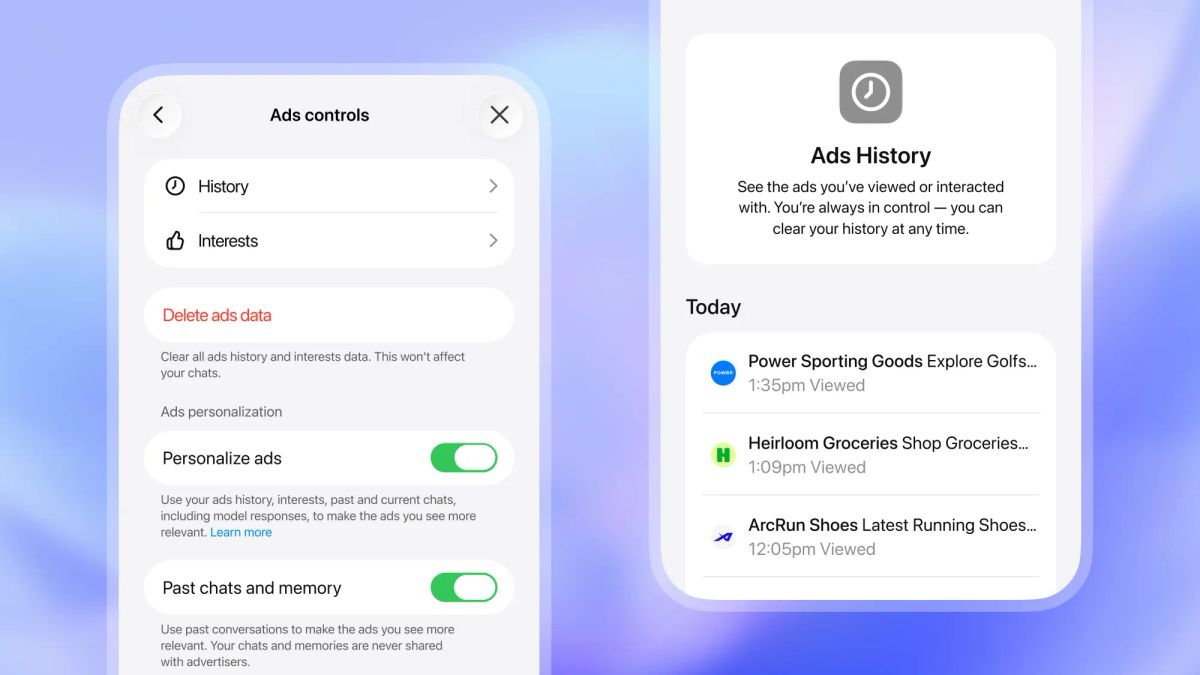 Mark
Mark Dani
Dani