Sam Altman spent years calling advertising a "last resort" for OpenAI. In January 2026, he announced ChatGPT would start running ads. Six weeks later, the pilot had crossed $100 million in annualized revenue. By April, self-serve ad tools were live. And according to Axios reporting from earlier this month, OpenAI is projecting that its advertising business will reach $100 billion in annual revenue by 2030.
The speed from reluctant pivot to nine-figure run rate to ten-figure projection is worth sitting with. It is also, in the context of what is actually happening inside ChatGPT and why OpenAI needs advertising to work, entirely legible.
How ChatGPT Ads Actually Work
The launch timeline
OpenAI confirmed advertising plans on January 16, 2026, ending months of internal speculation. The actual ad rollout began on February 9, targeting logged-in adult users on the free and Go tier ($8/month) in the United States. Plus, Pro, Business, Enterprise, and Education subscribers do not see ads.
The initial partner roster read like a Madison Avenue briefing: Target, Ford, Mrs. Meyer's, and Adobe as brand participants; WPP Media, Omnicom, and Dentsu as holding company launch partners; Criteo announced as the first formal ad tech partner on March 2; Smartly announced as a creative partner weeks later. The minimum spend to participate in the initial pilot was reported at $200,000 to $250,000, a figure that defined this as an enterprise product from the outset.
On March 26, OpenAI disclosed the $100 million annualized revenue milestone and announced expansion to Canada, Australia, and New Zealand. On April 10, Digiday reported that OpenAI had launched a self-serve ads manager, lowering the minimum spend threshold to $50,000, an operational shift that opens the platform to mid-market advertisers for the first time.
The ad formats
Two formats are currently running inside ChatGPT.
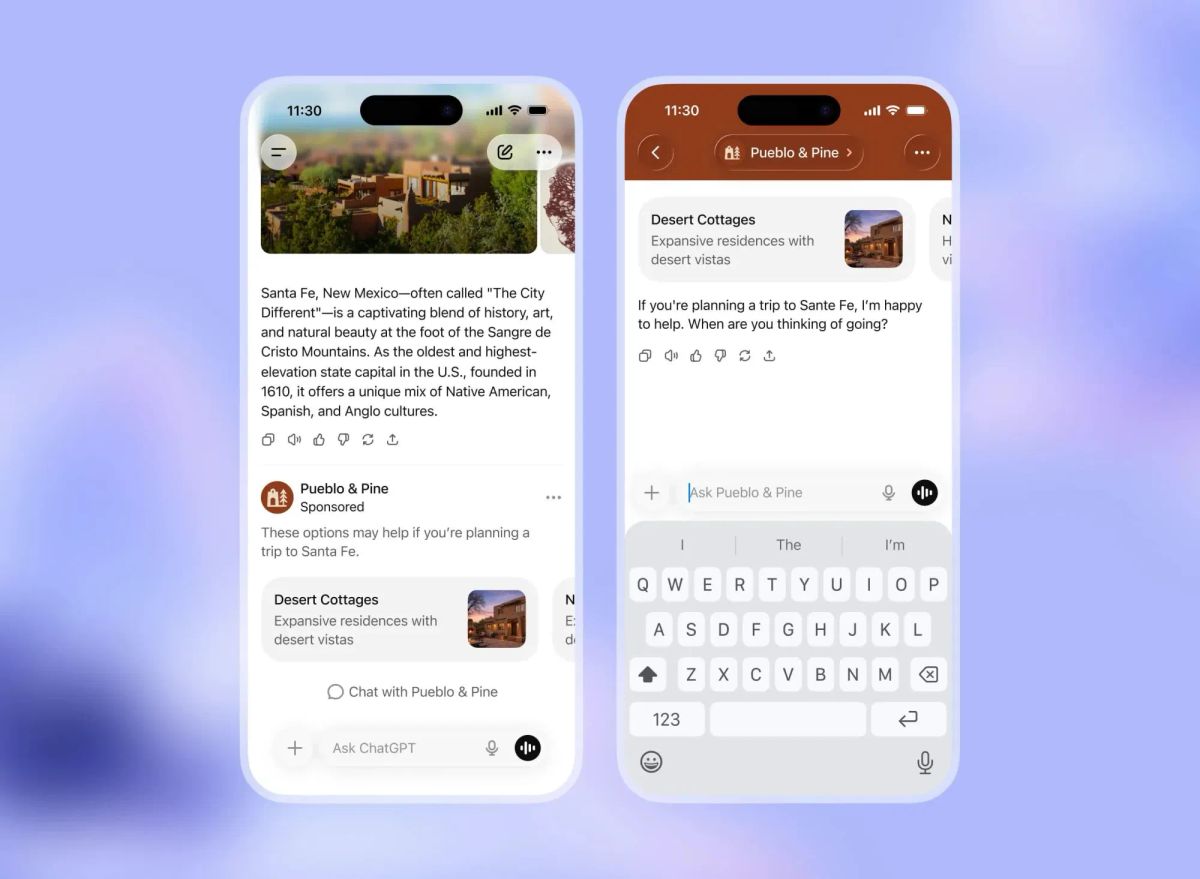
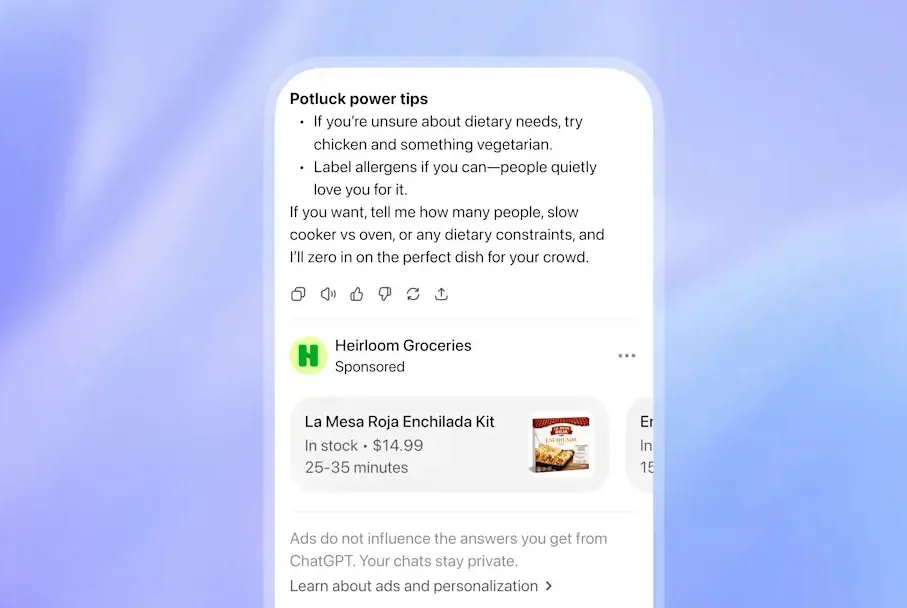
- Sponsored product cards appear beneath ChatGPT's organic response when the conversation topic aligns with an advertiser's category. A user asking about dinner recipes may see a card for a meal kit service. A user comparing laptops may see a brand placement from a tech retailer. The card shows a brand logo, a "Sponsored" label, product name, price, and delivery information. OpenAI has confirmed partnerships with Etsy and Shopify for product card inventory, making it a full purchase funnel rather than an awareness placement.
- Conversational banner ads are more experimental. They appear as labeled cards below responses with a button reading "Ask ChatGPT about this ad." Clicking it opens a new conversation thread powered by instructions the advertiser has pre-loaded, similar in structure to a custom GPT. The ad responds to the user's questions within that thread, creating a product conversation rather than a static impression.
Targeting works across three signals: the subject of the current conversation, the user's past chat topics, and previous ad interactions. Advertisers do not select keywords or audience segments directly. OpenAI handles matching on its side.
Ads are excluded from conversations involving health, mental health, and politics. Users under 18 are excluded from all ad targeting. Advertisers receive only aggregate data: impressions and clicks, without access to individual conversations, chat history, or personal information.
The pricing
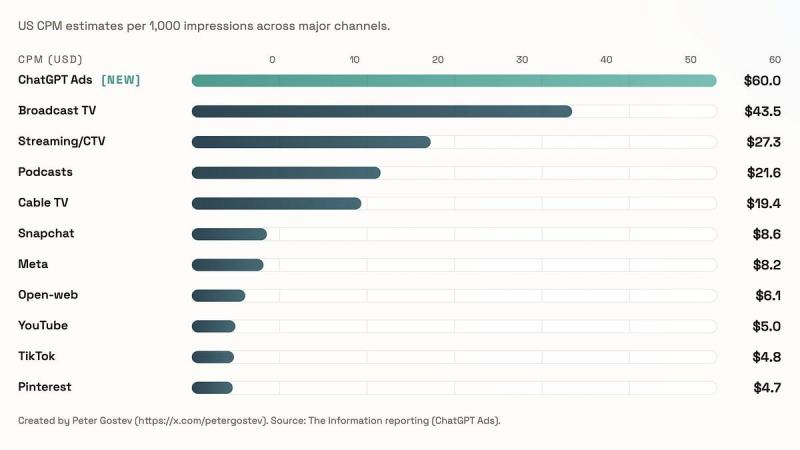
ChatGPT ads launched at approximately $60 per thousand impressions (CPM). That is roughly three times the typical Meta CPM and comparable to NFL broadcast inventory. OpenAI's justification for the premium rate rests on early conversion data: Criteo reported, based on a sample of 500 US retailers observed in February 2026, that users referred from large language model platforms like ChatGPT convert at approximately 1.5 times the rate of other referral channels.
The premium is partly structural. With roughly 85% of users eligible to see ads but fewer than 20% encountering them daily, the current inventory is scarce relative to demand, which supports higher pricing. As OpenAI scales ad density and opens self-serve access, pricing will likely compress.
The Revenue Math and the Projection Problem
The $100 million annualized figure is the product of six weeks of activity across 600 advertisers, reaching fewer than 20% of eligible users daily. The unit economics at that penetration level, if extrapolated, produce large numbers quickly.
OpenAI has shared projections with investors: $2.5 billion in ad revenue in 2026, $11 billion in 2027, $25 billion in 2028, $53 billion in 2029, and $100 billion by 2030. The 2030 figure assumes OpenAI reaches 2.75 billion weekly active users. As of February 2026, the platform reported 800 to 900 million weekly active users.
Truist analysts are more conservative. The firm estimated OpenAI will generate under $1 billion in ad revenue in 2026, with that figure growing to over $30 billion by 2030, roughly a third of OpenAI's own projection. A Truist analyst note called 2026 an "inflection year" for large language model-powered advertising and predicted LLM-powered ad channels would "become one of the most important pillars of the digital ad industry alongside Search, Social, and Retail Media."
The gap between OpenAI's projection and the Truist estimate reflects genuine uncertainty about how quickly ad load can scale, whether premium CPMs hold as inventory expands, and whether the conversion data from a small February sample sustains at scale. What both projections agree on is the direction: advertising inside conversational AI is a real market, it is growing, and it is growing quickly.
Why OpenAI Needs This to Work
The advertising pivot is driven by financial necessity as much as opportunity. OpenAI's operational costs are enormous. Training and serving frontier models at the scale of 800 million weekly users requires continuous infrastructure investment. According to financial projections reported in December 2025, OpenAI needs to grow revenue to approximately $200 billion to turn a profit by 2030.
Subscription revenue alone does not reach that number. Only about 5% of ChatGPT's weekly users pay for subscriptions. The ad-supported model monetizes the other 95%, a user base that represents the majority of the platform's engagement volume and the scale that makes ChatGPT's reach meaningful to brand advertisers.
OpenAI has told investors it expects ChatGPT consumer revenue to exceed $17 billion in 2026, with advertising representing a meaningful share from the non-paying user base. The company is building out a dedicated advertising organization at speed: Fidji Simo, former Facebook executive, serves as CEO of OpenAI's applications division; Denise Dresser, former Slack CEO, was appointed chief revenue officer in December 2025; and David Dugan, former Meta vice president who led the platform's global clients and agencies division for more than a decade, was hired to run OpenAI's global advertising solutions team in March 2026.
That is not the hiring profile of a company running a test. It is the hiring profile of a company building a permanent business.
What Happened at the Super Bowl
On February 9, 2026, the same day ChatGPT formally began serving ads, Anthropic aired two Super Bowl commercials mocking the ad launch.
The spots showed a chatbot character clearly meant to represent an ad-enabled ChatGPT. In one, a user asks for help getting a six-pack quickly. The chatbot begins answering, then pivots into promoting a fictional insole product with a discount code. The tagline: "Ads are coming to AI. But not to Claude."
Sam Altman responded publicly with a 420-word post calling the ads "clearly dishonest" and "deceptive." He wrote that OpenAI would "obviously never run ads in the way Anthropic depicts them," and added that "Anthropic serves an expensive product to rich people" while OpenAI needed to "bring AI to billions of people who can't pay for subscriptions." He also claimed that "more Texans use ChatGPT for free than total people use Claude in the U.S."
Marketing professor Scott Galloway, analyzing the exchange on his podcast, called Anthropic's Super Bowl campaign a "seminal moment" in the AI wars and compared it to Apple's 1984 ad positioning the Mac against IBM's Big Brother. He argued Altman's defensive response was itself a sign the attack had landed. Galloway predicted that within 12 months, Anthropic would be worth more than OpenAI, a projection he grounded in the intimacy of how people use AI and the risk advertising creates to that trust.
The tension between the two companies' business models is substantive. OpenAI's ad-supported architecture requires serving ads to conversations that may cover personal, emotional, or health-adjacent topics, even if ads are excluded from conversations explicitly flagged as sensitive. Anthropic's position is that the categories themselves are not always legible in advance, and that the commercial relationship between advertisers and a platform changes the nature of the product fundamentally.
The Competitive and Technical Questions
- Will the format hold? The two formats currently running, sponsored product cards and conversational banners, are early implementations. Smartly's involvement suggests OpenAI is working toward more dynamic, context-responsive formats. The Boots campaign Smartly cites on Meta, where a chatbot-style format drove sales nearly five times more effectively than standard placements, gives a directional sense of where conversational advertising could go if the format matures.
- What happens to measurement? The current ad reporting is aggregate-only: impressions and clicks, without conversion tracking, click-through rates, or demographic breakdowns. Clicks and conversions are listed in the ads manager as "coming soon." For performance advertisers accustomed to attribution modeling, the current data environment makes ROI calculation approximate. OpenAI has not committed to a timeline for expanding measurement.
- Does the conversion premium persist? Criteo's 1.5x conversion lift figure is preliminary, based on 500 retailers over one month. If it holds at scale, it meaningfully changes the ROI calculation at $60 CPM. If it regresses toward the mean as ad volume grows, the premium pricing becomes harder to sustain.
- What about Google and Meta? OpenAI is building a new advertising channel in a market where Google generates nearly $300 billion annually in ad revenue and Meta generates nearly $200 billion. Both operate at scales that would take OpenAI years to approach. The more precise competitive question is whether ChatGPT captures budget from search advertising, which operates on query intent and is structurally similar to how ChatGPT conversations generate ad signals. Truist's characterization of LLM advertising as a "fourth pillar" alongside Search, Social, and Retail Media implies meaningful market creation rather than pure cannibalization.
Conclusion
The story of ChatGPT advertising in 2026 is not primarily a story about $100 million. It is a story about architecture: a platform with 800 million weekly users, 95% of whom pay nothing, that has now demonstrated it can monetize that free user base at premium CPMs while maintaining user trust metrics, and that has built the organizational infrastructure to scale it.
Whether OpenAI's projections of $100 billion by 2030 are achievable depends on variables that no one can reliably forecast: user growth rate, advertiser adoption pace, format development, competitive pressure from Google and Meta, and whether the trust relationship between users and a conversational AI survives the commercial relationship becoming visible.
What is not speculative is the trajectory. The six weeks from launch to nine-figure annualized revenue is the fastest advertising ramp in platform history. The next six weeks will show whether that rate holds as ad density increases, CPMs adjust, and the experience becomes familiar rather than novel. The ad industry is watching closely, and so is everyone who uses AI to think.
Frequently Asked Questions
When did ChatGPT start showing ads?
ChatGPT began formally serving ads in the United States on February 9, 2026, targeting logged-in adult users on the free and Go ($8/month) subscription tiers. Plus, Pro, Business, Enterprise, and Education subscribers are excluded from ads. Ads do not appear in conversations involving health, mental health, or politics, and users under 18 are excluded.
How much revenue have ChatGPT ads generated?
OpenAI reported that the US advertising pilot crossed $100 million in annualized revenue within six weeks of launch, as of March 26, 2026. The company projects $2.5 billion in ad revenue for full-year 2026, growing to $53 billion by 2029 and $100 billion by 2030. Truist analysts project a more conservative $30 billion by 2030.
What do ChatGPT ads look like?
Two formats are currently running. Sponsored product cards appear below ChatGPT's organic response, showing a brand logo, product name, price, and delivery information. Conversational banner ads include an "Ask ChatGPT about this ad" button that opens an advertiser-pre-loaded conversation thread. All ads are clearly labeled as sponsored and visually separated from the chatbot's answer.
Do ChatGPT ads influence the chatbot's answers?
No. OpenAI has stated that ads do not influence ChatGPT's responses. Targeting is based on current and past conversation topics and ad interaction history. Advertisers receive only aggregate performance data: total impressions and total clicks. They do not receive access to individual conversations, chat history, memories, or personal information.
What is the Anthropic Super Bowl ad story?
On February 9, 2026, the same day ChatGPT began serving ads, Anthropic aired two Super Bowl commercials satirizing ad-enabled AI. The ads depicted a chatbot character pivoting from answering questions to promoting products, with the tagline "Ads are coming to AI. But not to Claude." OpenAI CEO Sam Altman publicly called the ads "clearly dishonest," and the exchange became the most visible public dispute between the two companies' competing business models.
How does ChatGPT advertising compare to Google and Meta?
ChatGPT ads are priced at approximately $60 CPM, compared to typical Meta CPMs under $20. Google generates approximately $295 billion annually in ad revenue; Meta generates approximately $196 billion. OpenAI's 2030 projection of $100 billion would represent roughly a third of Google's current annual ad revenue. Truist analysts describe LLM-powered advertising as a potential fourth pillar of digital advertising alongside Search, Social, and Retail Media.
Related Articles
 Mark
Mark Dani
Dani Dani
Dani