For most of the social media era, the logic was simple: get more followers, make more money. Build reach, attract brands, scale revenue. The audience was the asset, and a bigger audience was always a better one.
That logic still shapes how most people think about the creator economy. It no longer describes how the creator economy actually works.
"In 2025, the algorithm completely took over, and followings stopped mattering entirely." Amber Venz Box, CEO of LTK, speaking to TechCrunch, late 2025
Venz Box runs one of the largest creator commerce platforms in the world and monitors income data across thousands of creators. Her observation is not a prediction about a coming shift. It is a diagnosis of a shift that has already happened.
The data confirms it from multiple directions:
- Engagement rates fall as follower counts rise
- Revenue per follower is higher among small creators than large ones
- Platforms distribute content based on behavior signals, not social graphs
- The creators earning the most consistent income increasingly have smaller, more intentional audiences rather than the widest reach
Understanding why this happened requires looking honestly at three forces that converged to break the old model.
Force 1: The Algorithm Replaced the Social Graph
The most structural change in creator economics has nothing to do with audience behavior. It happened at the platform level, and most creators only noticed when their reach started declining without explanation.
How the old model worked
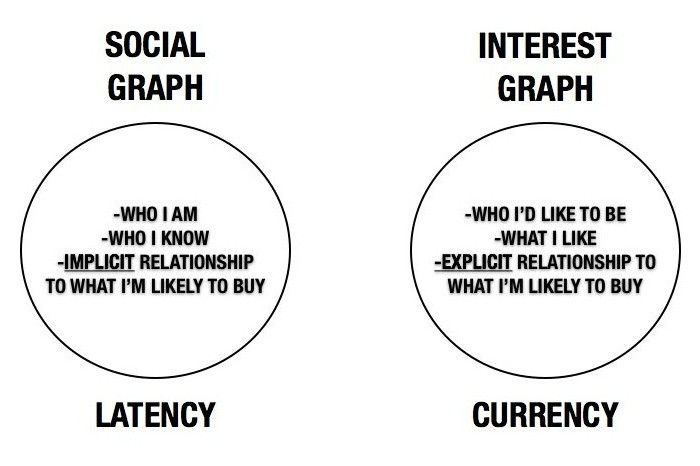
Social media platforms were originally built on a social graph: you follow people you know or want to follow, and you see their content. Reach was primarily a function of how many people had chosen to subscribe to your channel. Build a large enough subscriber base and distribution was predictable.
What replaced it
TikTok's For You Page changed that model fundamentally. TikTok uses an interest graph rather than a social graph, recommending content based on what users are likely to engage with rather than who they follow.
The implications are significant:
- A creator with zero followers can reach millions if the content performs well in the algorithm's testing pipeline
- A creator with five million followers can post a video that reaches almost no one if the algorithm's test audience does not respond with sufficient completion rate
- TikTok has officially confirmed that follower count is not a direct factor in its recommendation system
- By late 2025, the For You feed accounted for more than 70 percent of all video views on TikTok, while traffic from follower pages declined
Instagram and YouTube, watching TikTok's engagement numbers dwarf their own, moved in the same direction. Reels and Threads both now surface content to users who do not follow the creator. The platforms are increasingly in the business of matching content to interest, not distributing it to pre-committed audiences.
The practical consequence
Many large TikTok creators now report that 98 percent or more of their views come from non-followers through the For You Page. Follower count has become nearly irrelevant as a predictor of content performance.
For new creators, this is partly good news: a path to reach now exists without requiring years of audience-building first. But it also means that follower count, and all the brand deal pricing historically built around it, has become a deeply unreliable proxy for actual impact.
Force 2: Engagement Rates Fall as Audiences Scale
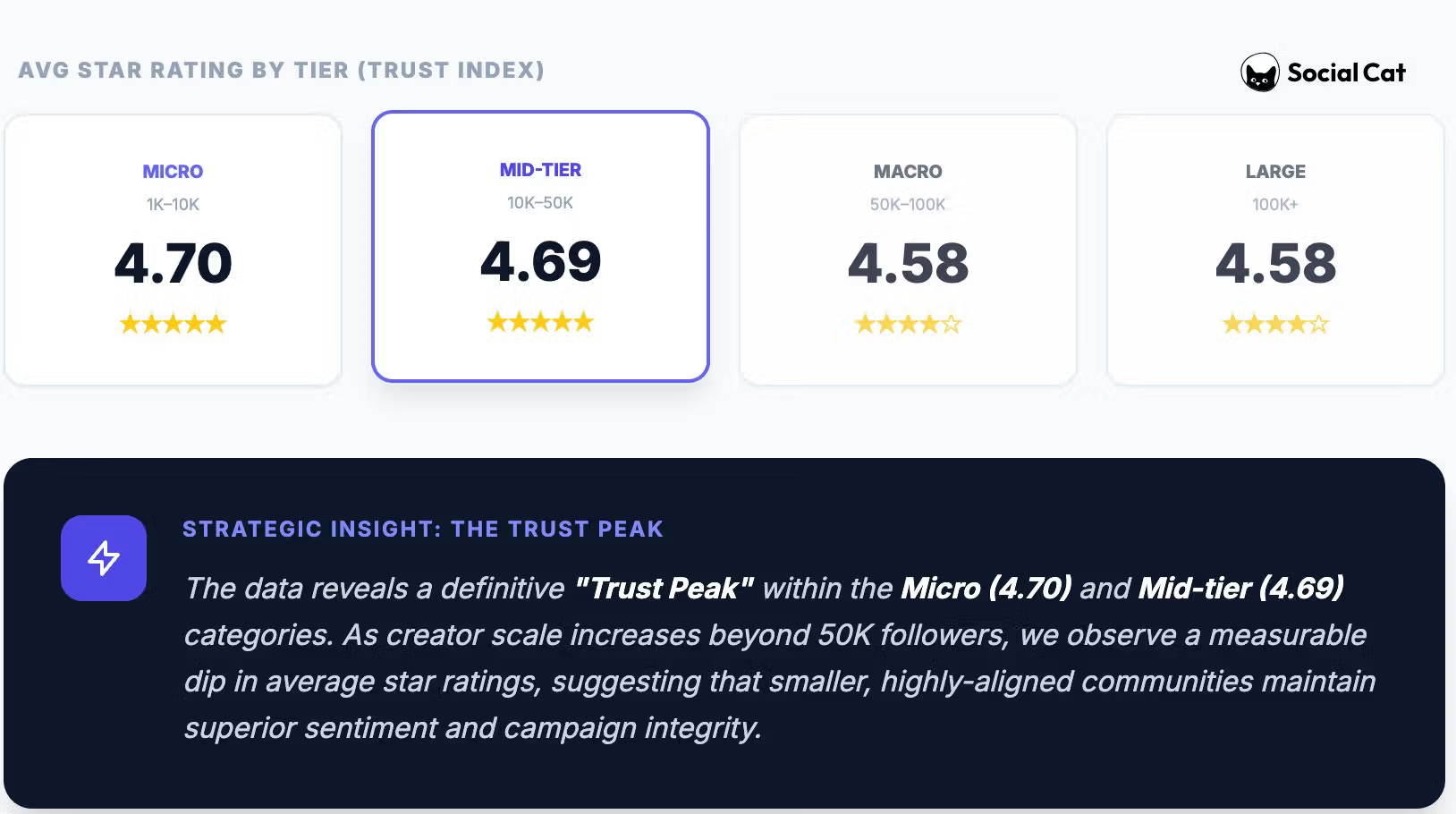
The algorithmic shift explains part of the decoupling between audience size and revenue. A separate and equally important dynamic is structural: as creator audiences grow, engagement rates decline, and with them the conversion rates that determine whether an audience actually generates commercial outcomes.
The engagement rate breakdown by tier
The data on this is consistent across studies and platforms. Source: Social Cat's 2025 Influencer Marketing Report, based on actual campaign performance across tens of thousands of creators.
| Influencer Tier | Follower Range | Avg. Engagement Rate |
|---|---|---|
| Nano | Under 10,000 | 2.71% |
| Micro | 10,000 to 50,000 | 1.81% |
| Mid-tier | 50,000 to 100,000 | 1.24% |
| Macro | 100,000 to 1 million | 0.61% to 0.87% |
| Mega | Above 1 million | 0.68% to 0.94% |
The conversion rate gap is even wider
- Nano-influencers convert at around 7 percent
- Macro-influencers convert at approximately 3 percent
- Micro-influencers achieve 20 percent higher conversion rates than macro-tier creators overall
Research from Baylor University's Keller Center for Marketing, which analyzed more than 1.8 million purchases across campaigns spanning nano to macro influencers, found that nano-influencers delivered higher revenue per follower across all tiers. Closer audience connections produced more authentic interactions, stronger trust, and better sales performance.
Why this happens
When an audience numbers in the hundreds of thousands or millions, the creator inevitably has less personal connection to each follower. The relationship becomes broadcast rather than conversational. Followers at that scale increasingly watch without interacting, forming the passive consumption pattern that is less useful for commercial outcomes than the active, trusting engagement found in smaller communities.
Micro-influencers feel like peers rather than distant celebrities. A 2025 study commissioned by LTK and conducted by Northwestern University found that consumer trust in creators increased 21 percent year-over-year, with the trust premium concentrated among creators perceived as genuine humans with real experiences rather than algorithmic content machines.
The brand marketing industry has already reacted
- 73% of brands now favor micro and mid-tier creators over celebrity and macro partnerships (2025 Influencer Marketing Hub Benchmark Report)
- Brands are working with 33% more micro-influencers each year on average
- Micro-influencers charge $100 to $1,000 per Instagram post versus $5,000 or more for macro-influencers
The preference shift reflects both cost efficiency and measurable performance advantages that the data now makes difficult to argue against.
Force 3: Revenue Is Concentrating in Owned Channels

The third force breaking the old model operates at the business architecture level. Large social media audiences generate leverage primarily through brand partnerships and platform payouts. Both of those revenue streams carry structural vulnerabilities that owned-channel revenue does not.
Platform payouts: the exposed position
Each major platform's creator payout structure depends on algorithmic cooperation and policy stability:
- TikTok Creator Rewards Program: $0.40 to $1.00 per 1,000 views, up significantly from the old Creator Fund's $0.02 to $0.04, but still contingent on consistent algorithmic reach
- YouTube: Revenue share requires consistent viewership above threshold levels
- Meta: Does not pay most creators for organic content at all
TikTok's US operations changed ownership structure in January 2026 and its algorithm is currently being retrained on American user data under Oracle's management. Creators who built their businesses around TikTok's specific algorithmic behavior now face a period of distribution uncertainty. Facebook views dipped 17 percent in the most recent measurement period. Social media's share of total brand advertising spend fell from 18 to 17 percent in 2025, the first meaningful decline in years.
Brand deals: also shifting
Brands that once paid premium rates for access to large audiences are increasingly measuring performance rather than reach. Performance-based compensation now leads as the most frequently used influencer payment model at 53 percent of campaigns, according to the 2025 Influencer Marketing Hub report.
When payment is tied to actual conversion outcomes rather than reach, large audiences with low conversion rates produce lower effective payouts than small audiences with high conversion rates.
What is actually growing
Circle's 2026 creator economy data points clearly toward owned-channel, community-led revenue:
- 32.9% of creator communities charge $26 to $50 per month for membership access
- 56% of creators launched their communities in the past two years
- 44% of those communities have between 1 and 100 members, showing that much of the growth is intentionally small-scale
Social platforms still dominate discovery, with 67 percent of creators saying new members find them through social apps. But the transaction increasingly happens somewhere the creator controls, not somewhere the algorithm controls.
The Audience Quality Problem
There is a version of this argument that concludes large audiences are worthless. That conclusion overcorrects.

Large audiences genuinely help with brand awareness campaigns where reach is the explicit goal. A creator with five million followers can put a brand in front of more people in a single post than most other distribution channels achieve. The influencer marketing industry is projecting $34 billion in global spend in 2026. A meaningful portion of that budget flows to large accounts for legitimate awareness work.
The problem is that awareness and conversion are different jobs, and confusing them has led to systematically mispriced creator partnerships. Brands that paid for conversion based on reach metrics were buying the wrong thing. Creators who priced partnerships on follower count were selling a number that did not predict the outcome the brand actually needed.
The Blueland case study
Brands building micro-influencer programs at scale are consistently outperforming single large-creator partnerships on conversion-focused campaigns.
Blueland's program ran 211 Instagram creators simultaneously and produced:
- A 13-to-1 return on investment
- A 4.7-fold increase in monthly Amazon sales
The math of that outcome does not work with one creator who has equivalent aggregate reach. It works because smaller audiences convert at higher rates, and because the diversity of 211 creators reaching 211 slightly different communities produces broader coverage than one creator reaching one homogenous mass.
For individual creators, the relevant question has shifted from "how do I grow my audience?" to "how do I deepen my relationship with the audience I already have?" The creators earning consistent, predictable income in 2026 have typically stopped optimizing for reach and started optimizing for retention, trust, and the commercial outcomes that arise from genuine relationships.
What This Means: A Breakdown by Audience Type
The decoupling of attention from revenue creates different problems and different opportunities depending on where a creator or brand sits in the market.
Creators with large audiences and declining engagement
The most common response is diversifying revenue away from platform dependency. Direct-to-community products, paid newsletters, cohort-based courses, and membership platforms all represent revenue streams that do not require algorithmic cooperation. The large audience still has value as an initial customer base for those products, even if its ongoing social media reach is less reliable than it once was.
Emerging creators
The algorithmic shift paradoxically lowers some barriers to entry. Reaching an audience no longer requires years of follower accumulation: a single well-executed video can reach millions on TikTok's For You Page without a pre-existing subscriber base. The challenge is that this reach is borrowed and non-accumulative. Showing up in someone's feed does not create the same durable relationship as having them choose to follow you, and the path from viral reach to durable monetizable community requires intentional conversion work.
Brands
The shift toward performance-based measurement is already underway, and the data supports continuing it. Shifting budget from a small number of large accounts to a larger number of smaller, higher-trust creators produces better conversion outcomes in most campaign categories where conversion is the goal. The operational complexity of managing more creator relationships is real but addressable with the right systems.
The Conclusion the Data Keeps Reaching
"A smaller number of people who genuinely trust you is worth more than a large number who barely notice you." Jack Conte, CEO of Patreon
Conte articulated this before the data bore it out. The creator economy built its first decade around the wrong variable, and it is now, somewhat painfully, correcting toward the right one.
Trust does not appear in follower count. It does not show up in impressions. It shows up in whether someone buys what you recommend, subscribes to what you build, and keeps paying month after month because they believe the relationship delivers value.
Those are the metrics the creator economy of 2026 is actually being built around, and they look very different from the ones that drove the previous decade.
Frequently Asked Questions
Why do large social media audiences no longer guarantee revenue for creators?
Three structural changes converged to break the old model. Platforms shifted from social graphs to interest graphs, meaning follower count no longer predicts distribution. Engagement rates decline as audiences scale, so large accounts convert at lower rates than smaller ones. And brand measurement moved from reach-based to performance-based pricing, exposing the gap between audience size and actual commercial outcome. Together, these changes made follower count a poor predictor of creator income.
What does the data show about micro-influencers versus large influencers?
The engagement rate gap is substantial. Nano-influencers below 10,000 followers achieve around 2.71 percent engagement on Instagram. Mega-influencers above one million followers average 0.68 to 0.94 percent. On conversion, micro-influencers achieve 20 percent higher rates than macro-tier creators, and nano-influencers convert at approximately 7 percent compared to 3 percent for macro accounts. Research analyzing 1.8 million purchases found that nano-influencers deliver higher revenue per follower than any larger tier.
How did the algorithm change the value of having a large social media following?
TikTok pioneered the interest graph model in which content is distributed based on predicted engagement rather than follower relationships. The platform has confirmed that follower count is not a direct input into its recommendation system. Instagram and other platforms have adopted similar logic. Reach is now determined post-by-post based on algorithmic behavior signals rather than being a predictable function of accumulated followers. Many large creators report that the vast majority of their views come from non-followers through recommendation feeds.
What revenue model works best for creators in 2026?
The most stable models are those that do not depend on platform algorithms or brand deal markets for revenue generation. Paid communities, membership subscriptions, and direct digital products generate recurring revenue tied to audience trust and retention rather than algorithmic reach. Circle's 2026 data shows that community-led revenue is growing rapidly, with most successful communities intentionally small. The social platform presence remains valuable for discovery and top-of-funnel awareness, but the commercial transaction is increasingly happening in channels the creator controls.
What should brands change about how they work with creators?
The primary shift is from reach-based selection to engagement and conversion-based selection. Running programs with larger numbers of smaller creators typically produces better conversion outcomes than single large-creator partnerships when the campaign goal involves actual commercial action. Performance-based payment models, where creators earn based on measured outcomes rather than flat fees, better align incentives with results. The operational complexity of managing more relationships is real but manageable and produces measurably better returns in most conversion-focused campaign categories.
Is the creator economy in decline?
The creator economy is growing, not declining. Global creator economy revenue was valued at approximately $200 billion in 2025 and is projected to grow at a 22.7 percent compound annual growth rate. What is declining is a specific subset of creator revenue, specifically platform-dependent income generated through reach metrics. Community-led and product-driven revenue is growing. The industry is redistributing rather than contracting, shifting money away from large passive audiences and toward smaller, higher-trust communities and direct-to-audience products.
Related Articles
 Dani
Dani
 Dani
Dani
 Dani
Dani