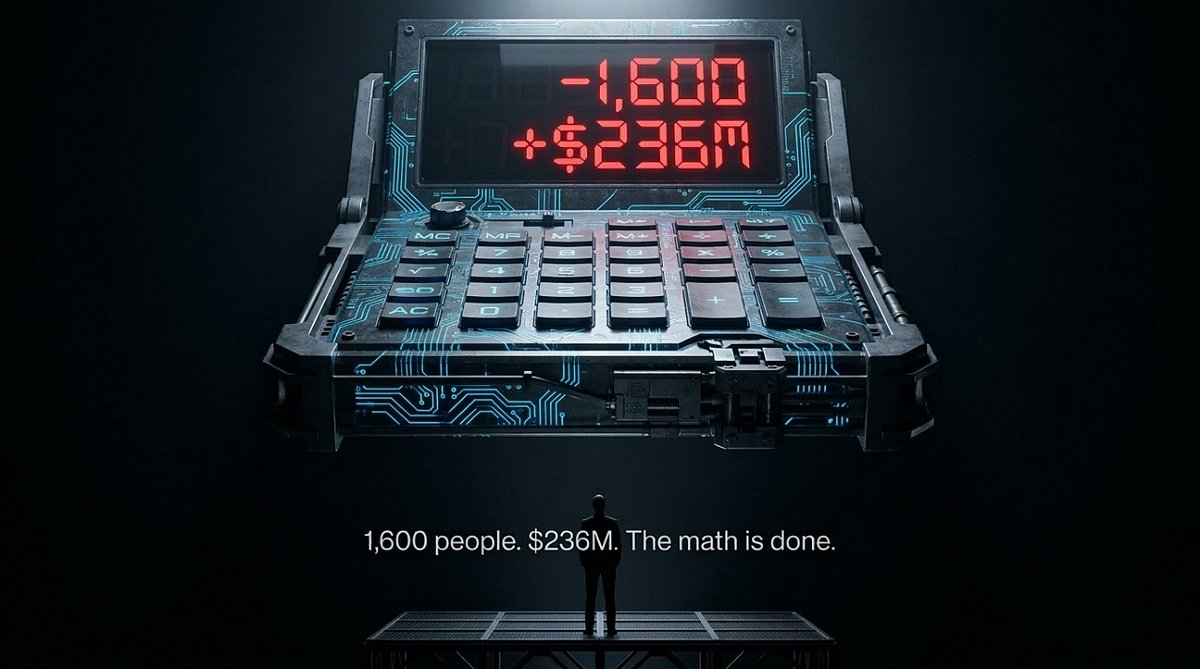
On March 11, 2026, Atlassian CEO Mike Cannon-Brookes sent an internal memo announcing 1,600 redundancies, roughly 10% of the company's global workforce. Buried inside the same announcement was a leadership change that, in some ways, tells a more interesting story than the headcount cut.
Rajeev Rajan, who had served as Chief Technology Officer for nearly four years, would step down on March 31. His responsibilities would not pass to a single successor. Instead, Atlassian split the role in two: Taroon Mandhana, formerly head of engineering for AI and products, became CTO of Teamwork; Vikram Rao, previously chief trust officer, became CTO of Enterprise and Chief Trust Officer.
One CTO became two, and both are explicitly scoped to the AI era.
What Actually Happened at Atlassian
The layoffs and the leadership change were announced together, and they belong together analytically.
Atlassian is not a struggling company by conventional measures. In the quarter before the announcement, cloud revenue grew more than 25% year over year. The company has more than 600 enterprise customers each generating over $1 million in annual recurring revenue. Rovo, its AI assistant, had crossed five million monthly active users. Remaining performance obligations grew at more than 40%.
And yet the stock had lost more than half its value since January 2026, caught in what traders have taken to calling the "SaaSpocalypse": a broad selloff in enterprise software shares driven by investor anxiety that AI agents could make conventional SaaS tools like Jira and Confluence obsolete. Atlassian, which has been unprofitable since 2017 and whose shares had already fallen roughly 33% in 2025 before the broader rout, was particularly exposed to that narrative.
The restructuring was framed as a self-funded pivot. Cannon-Brookes wrote that the cuts would allow Atlassian to "self-fund further investment in AI and enterprise sales, while strengthening our financial profile." More than 900 of the 1,600 positions eliminated came from software research and development, the engineering heart of the company.
The uncomfortable context: five months before the announcement, in October 2025, Cannon-Brookes appeared on the 20VC podcast and said explicitly that Atlassian would employ more engineers in five years, not fewer. Technology creation, he argued, is "not output-bound." The company hired 95 graduates in February 2025 and had planned 108 more for the February 2026 intake.
What changed between the podcast and the memo was not the technology. It was the stock price.
Why Split the CTO Role
The dual-CTO structure is the more consequential long-term signal.
Taroon Mandhana, CTO of Teamwork: Mandhana spent years leading Atlassian's engineering for AI and products, including Rovo. His mandate now covers the company's collaboration and productivity suite, the products that made Atlassian famous and that are most directly challenged by AI-native competitors. The "Teamwork" title is significant: it is explicitly positioned as Atlassian's response to the question of what human collaboration software looks like when AI agents are participants, not just tools.
Vikram Rao, CTO of Enterprise and Chief Trust Officer: Rao's background in trust and security shapes the second mandate. Enterprise customers deploying AI at scale face a set of governance, compliance, and risk questions that barely existed three years ago. Who owns the outputs of an AI agent? How does an AI-assisted system satisfy a regulatory audit trail? What does data residency mean when an AI model processes documents across jurisdictions? Rao's dual title, engineering authority combined with explicit trust responsibility, reflects an institutional recognition that these questions are not adjacent to technical leadership. They are central to it.
Together, the structure acknowledges that no single person is likely to do both jobs well simultaneously. The speed and product-market sensitivity required to ship competitive AI features is genuinely different from the careful, systematic thinking required to operate those features inside regulated enterprise environments. Atlassian decided to stop pretending those mandates fit comfortably in one role.
The Traditional CTO Role is Under Real Pressure
Atlassian's split is part of a broader pattern of C-suite restructuring as AI reshapes what technical leadership actually means.
For most of the past two decades, the CTO role was defined by three core responsibilities: setting technical direction, managing engineering organization, and communicating technical strategy to the board and investors. A CTO needed deep software architecture knowledge, credibility with engineering teams, and enough business acumen to speak the language of the CEO.
AI is putting pressure on all three simultaneously.
Technical direction is now a much faster-moving target. The relevant architectural decisions in 2026 include which foundation models to build on, how to manage prompt engineering at scale, when to fine-tune versus when to use retrieval-augmented generation, and how to design systems where AI agents operate alongside human workflows. A CTO who was excellent at distributed systems architecture in 2022 is not automatically well-positioned to make those calls in 2026.
Engineering management has become more complex because AI tools are changing how engineers work faster than management frameworks can adapt. GitHub Copilot and its successors have already shifted what a senior engineer does day to day. By 2026, leading research groups expect that engineers will increasingly function as orchestrators of AI agents rather than writers of code directly. The skill mix required of an engineering organization is genuinely different, and the organizational design questions that follow, which roles do you need, how do you evaluate performance, what does seniority mean when AI handles most implementation, are not questions that prior CTO playbooks address well.
Trust, governance, and compliance have become first-order technical concerns rather than second-order operational ones. The EU AI Act's high-risk AI provisions, effective 2025, imposed compliance requirements that demand technical responses. Data sovereignty regulations across multiple jurisdictions create architectural constraints. Customers running sensitive workloads in AI-assisted systems increasingly want technical guarantees, not just contractual ones, about how their data is handled. Managing those guarantees is engineering work that requires dedicated leadership attention.
Gartner's 2026 strategic technology trends explicitly identify AI governance, digital provenance, and what they call "geopatriation" (regional data sovereignty) as board-level concerns that must be operationalized by technical leadership. The IMD Business School's 2026 AI leadership forecast argues that as AI embeds more deeply into organizations, the COO may overtake the CTO as AI's most influential C-suite champion, precisely because AI operations are becoming as much about process and governance as about technology.
The Broader Leadership Restructuring Trend
Atlassian is not alone in rethinking what technical leadership looks like in the AI era.
The pattern visible across enterprise software is a disaggregation of technical authority. Companies are adding CAIO (Chief AI Officer) titles at one end of the spectrum and splitting existing CTO mandates into product-technology and infrastructure-security tracks at the other. Some are giving the CTO role explicit AI accountability while creating separate VP-level positions for platform engineering and developer experience.
The common thread is a recognition that the job has become too wide. A 2025 LeadDev survey of CTOs found that most were already using AI tools themselves for everything from codebase review to strategic planning, and that the cognitive demands of the role had expanded significantly. Broadridge CTO Jason Birmingham described the modern CTO as "the chief problem solver," arguing that AI fluency is now a precondition for effective technical leadership, not an optional specialization.
The "two CTOs" model Atlassian adopted carries its own risks. Coordination overhead between two executives with overlapping stakeholders can slow decisions. Accountability for cross-cutting issues can blur. The boundary between "Teamwork" and "Enterprise" is not always clean: an enterprise customer using Jira has expectations about both product capability and trust compliance simultaneously. Atlassian will need clear governance mechanisms to prevent the split from creating coordination problems that offset the specialization benefits.
Still, the alternative, asking one person to be simultaneously the best possible product AI technologist and the best possible enterprise trust and compliance architect, is arguably the less realistic ask.
The "AI Washing" Question
The Atlassian announcement arrived in a moment when the tech industry's use of AI as a justification for layoffs was receiving serious scrutiny.
OpenAI CEO Sam Altman said in February 2026 that fewer than 1% of 2025 job losses could actually be attributed to AI, and used the phrase "AI washing" to describe companies claiming AI as the rationale for cuts driven primarily by other pressures. A survey of 1,000 hiring managers by Metaintro found that 59% acknowledged exaggerating AI's role in layoffs because it "plays better" with investors and the press. Only 9% said AI had fully replaced roles.
Atlassian's own numbers make the AI justification difficult to evaluate cleanly. The company cut more than 900 R&D engineers while simultaneously reporting cloud revenue growth above 25% and reaffirming its full-year financial guidance. That is not the financial profile of a company in distress. It is the financial profile of a company responding to investor pressure to demonstrate a credible path to profitability, and using AI as the narrative that makes those cost reductions sound strategic rather than defensive.
The PwC 2026 Global CEO Survey found that 42% of CEOs now cite the pace of AI transformation as their top concern, and that CEO confidence in 12-month revenue growth had dropped to 30%, down from 56% in 2022. In that environment, announcing a pivot to "AI-first" simultaneously with a 10% headcount reduction produces a predictable investor response: Atlassian's stock rose about 2% in after-hours trading. Block saw a similar jump when Jack Dorsey announced his 40% workforce reduction in the same timeframe.
Whether Atlassian's cuts are genuinely AI-driven, financially-driven, or both simultaneously is a question that the company's public communications do not cleanly resolve. What is clearer is that the dual-CTO structure is a real organizational change with real logic behind it, and that its implications extend well beyond Atlassian's specific situation.
What the Atlassian Model Signals
The decision to split the CTO role into two AI-specialized mandates is a concrete organizational hypothesis: that the demands of building AI-native products and the demands of governing AI at enterprise scale are different enough to warrant different leadership, and similar enough that both should report into an integrated technical organization rather than being siloed off into separate functions.
That hypothesis will be tested operationally over the next 18 to 24 months, and the results will be watched by every large enterprise software company facing the same underlying problem.
For technical leaders watching from the outside, the Atlassian move raises a practical question: what does specialization in technical leadership actually look like, and how do you build an executive career in an era when the CTO title may mean something different at every company that uses it?
The answer emerging across the industry is that technical leadership in the AI era requires explicit choices about where to specialize, product-oriented AI development, infrastructure and platform, or trust and governance, rather than the generalist model that defined the CTO role in earlier eras of enterprise software.
Atlassian has, intentionally or not, made that argument visible by structuring it in public.
Timeline
| Date | Event |
|---|---|
| Oct 2025 | CEO Mike Cannon-Brookes says on 20VC podcast that Atlassian will employ more engineers in five years, not fewer |
| Feb 2025 | Atlassian hires 95 graduates; plans 108 more for Feb 2026 intake |
| Jan–Mar 2026 | Atlassian shares lose more than half their value in the "SaaSpocalypse" selloff |
| Mar 11, 2026 | Cannon-Brookes announces 1,600 redundancies (10% of workforce) and CTO transition |
| Mar 11, 2026 | Taroon Mandhana promoted to CTO Teamwork; Vikram Rao becomes CTO Enterprise and Chief Trust Officer |
| Mar 31, 2026 | Rajeev Rajan steps down as CTO after nearly four years |
| Jun 2026 | Restructuring expected to be largely complete |
Frequently Asked Questions
Why did Atlassian replace its CTO with two people?
Atlassian's stated rationale was a "generational transition" to promote AI leadership. The practical logic is that the traditional CTO role was trying to hold two distinct mandates simultaneously: leading AI product development for collaboration tools (Teamwork), and managing enterprise trust, compliance, and governance at scale (Enterprise). Taroon Mandhana's background is in AI and product engineering; Vikram Rao's is in trust and security. Splitting the role aligns leadership profiles with the actual demands of each domain.
Who are Taroon Mandhana and Vikram Rao?
Taroon Mandhana was previously Atlassian's head of engineering for AI and products, including Rovo, the company's AI assistant. He now holds the title CTO of Teamwork. Vikram Rao was previously Atlassian's chief trust officer. He now holds the title CTO of Enterprise and Chief Trust Officer, combining technical and trust leadership in a single mandate.
What happened to former CTO Rajeev Rajan?
Rajeev Rajan stepped down effective March 31, 2026, after nearly four years as CTO. Before joining Atlassian, he was a VP of engineering at Meta and a two-decade veteran of Microsoft. He has not publicly commented on the departure.
Are other tech companies splitting the CTO role?
Formally splitting the title into two is still unusual, but the underlying trend is broad. Many enterprise software companies are adding dedicated Chief AI Officer roles, separating product-technology and platform-infrastructure responsibilities, and giving trust and compliance functions explicit C-level representation. The common driver is that the AI era has expanded the technical leadership mandate faster than any single executive can absorb it effectively.
Is this move about AI or about cutting costs?
Both are likely true. Atlassian cut more than 900 R&D engineers while reporting cloud revenue growth above 25% and reaffirming its full-year guidance, which is not the financial profile of a company in distress. The dual-CTO structure is a genuine organizational change, but the broader restructuring appears driven at least partly by investor pressure around profitability. OpenAI's Sam Altman coined the term "AI washing" for precisely this dynamic: using AI as the narrative frame for cost reductions driven by other pressures.
What does this mean for the future of the CTO role?
The Atlassian move is one data point in a broader reconfiguration. Technical leadership in the AI era increasingly requires choices about specialization: product-oriented AI development, infrastructure and platform engineering, or trust and governance. The generalist CTO model that dominated enterprise software for two decades is under pressure from a role that has expanded faster than any single executive profile can realistically cover. Whether the answer is splitting titles, adding new C-level roles, or redefining what one CTO does will vary by company, but the underlying pressure is real and structural.
Related Articles
 Dani
Dani
 Dani
Dani