

Last updated: December 28, 2025
Updated constantly.
✨ Read November Archive of major AI events
The main news for December smoothly carries over from November and remains in the spotlight: Anthropic has released a new model, Claude Opus 4.5, which outperformed all human job candidates in the company's internal engineering tests, setting a new record in AI capabilities.
November was very productive for the AI market. Many models were released, such as Gemini 3, Nano Banana Pro, Flux 2, Suno, along with major updates on various platforms and significant improvements. All of this points to the active development of technology and the AI market. We will continue to monitor the progress and publish the latest and most relevant news from the world of AI on this page.
AI news, Major Product Launches & Model Releases
Creator Economy Startups Raise $2 Billion in 2025, Led by AI Tools
The creator economy attracted approximately $2 billion in funding during 2025, with artificial intelligence tools dominating investor interest. Eight AI startups focused on automating content creation processes each secured at least $50 million in funding, collectively raising $1.2 billion from venture capital and private equity investors.
Despite the massive investment, AI integration in the creator economy remains controversial. Many of these AI startups offer features like human-like avatars that could potentially threaten content creators' livelihoods. The influencer marketing industry, which serves as the primary financial engine of the creator economy, has yet to reach consensus on appropriate AI utilization, creating tension between technological advancement and creator job security.
My Take: The creator economy basically got flooded with $2 billion to build AI that might replace creators - it's like funding a bunch of startups to build really sophisticated robots and then being surprised when the humans who used to do those jobs start getting nervous about their future.
When: December 28, 2025
Source: businessinsider.com
Coursera CEO Says 2026 Hiring Will Focus on AI-Related 'Microcredentials'

Coursera CEO Greg Hart predicts that 2026 hiring will be dominated by candidates with AI-focused 'microcredentials' rather than traditional degrees. The $1.3 billion learning platform reports that its most popular programs revolve around technology and AI, with standout certificates including Google's 'Foundations of Data Science,' analytics programs, and cybersecurity courses.
Hart specifically highlighted the growing importance of bite-sized, practical certifications that demonstrate actual skills rather than broad academic knowledge. This shift reflects how rapidly the job market is adapting to AI integration, with employers seeking candidates who can immediately contribute to AI-enhanced workflows rather than those with general educational backgrounds.
My Take: Coursera's CEO basically said 2026 job hunting will be like Pokemon card collecting, except instead of rare holographics, you'll be showing off your Google AI certificates - it's the professional equivalent of 'gotta catch 'em all' but for machine learning badges.
When: December 28, 2025
Source: fortune.com
AI Pioneer Andrew Ng Says Current AI is 'Limited' and Won't Replace Humans Soon
Stanford professor and AI pioneer Andrew Ng, founder of Coursera and DeepLearning.AI, argued that current artificial intelligence technology remains fundamentally limited and won't replace human workers anytime soon. Speaking from his extensive background in both AI research and education, Ng emphasized the complexity and manual nature of current AI training processes.
Ng specifically criticized the path toward artificial general intelligence (AGI), stating that the manual and complex training recipes used today 'won't take us all the way to AGI by itself.' He highlighted how much more work goes into preparing data and training AI systems than is widely appreciated, suggesting the current approach has significant limitations that prevent it from achieving human-level general intelligence.
My Take: Andrew Ng basically told everyone to pump the brakes on AI hysteria - coming from someone who helped build the foundation of modern AI, it's like having the guy who invented the car tell you that your flying car dreams might need to wait a few more decades.
When: December 28, 2025
Source: nbcnbc.com
WIRED Crowns Chinese AI Model Qwen as Rising Alternative to GPT-5

WIRED highlighted China's Qwen AI model as an emerging powerhouse in the AI landscape, despite not being the highest-scoring model on traditional benchmarks compared to GPT-5, Gemini 3, or Claude. The publication argues that Qwen's strength lies in its open-weight approach and practical real-world applications rather than narrow benchmark performance.
The analysis suggests US AI companies have become too focused on marginal benchmark improvements at the expense of real-world impact. When OpenAI's GPT-5 launched in August, it reportedly underwhelmed users with a 'cold demeanor' and surprising errors, while Qwen and other Chinese models gained popularity due to more active development, frequent updates, and transparent engineering documentation.
My Take: WIRED basically said American AI companies are like students cramming for standardized tests while Chinese developers are actually learning to solve real problems - it's the difference between being great at multiple choice questions versus actually knowing how to use what you learned in the real world.
When: December 28, 2025
Source: wired.com
OpenAI Faces Mass Exodus to Meta as Dozen Executives Leave in 2025
OpenAI experienced significant brain drain in 2025, losing more than a dozen key executives and researchers, with at least seven departing for Meta's Superintelligence Lab during the summer alone. Notable departures include perception team leader Jiahui Yu, GPT-4o contributor Hongyu Ren, and former chief scientist Shengjia Zhao who now works directly with Mark Zuckerberg.
The exodus also included high-level executives like the chief people officer and chief communications officer. Many of the researchers who joined Meta cited excitement about 'building from a clean slate with a truly talent-dense team,' suggesting they saw better opportunities at Meta's billion-dollar AI initiative than remaining at the ChatGPT creator.
My Take: OpenAI is basically experiencing the corporate equivalent of a band breaking up right when they hit it big - half the people who built ChatGPT are now working for Zuckerberg, which is like watching the Beatles leave to join a different record label because they promised better studio equipment.
When: December 28, 2025
Source: businessinsider.com
Gary Marcus Declares AI Bubble Officially Over, Cites Technical Limitations
AI critic Gary Marcus published a comprehensive analysis declaring the AI bubble has burst, arguing that the economics of large language models fundamentally don't work due to inherent technical problems. He emphasizes that without world models, AI systems cannot achieve the reliability needed for profitable deployment at scale.
Marcus notes that while a trillion dollars of investment has poured into the sector, the core limitations he identified in 2019 remain unresolved. He argues these aren't temporary bugs but fundamental design flaws in LLMs that undermine most of the originally fantasized use cases, though he acknowledges LLMs will continue to exist in some form.
My Take: Gary Marcus basically just wrote the AI industry's obituary using a Bob Dylan song title - he's arguing that all those trillion-dollar AI dreams are about as reliable as a chocolate teapot, and no amount of venture capital can fix problems that are baked into the very DNA of how LLMs work.
When: December 28, 2025
Source: garymarcus.substack.com
Cassava Technologies and Gebeya Launch AI Creator Platform for African Market

Pan-African technology group Cassava Technologies partnered with AI tools provider Gebeya to launch 'Gebeya Dala,' a suite of AI tools enabling Africans to create digital content using Cassava's data centers and infrastructure. The platform focuses on developing culturally relevant large language models specifically for African users.
All data processing and model training will occur within Africa to ensure data sovereignty, low latency, and compliance with local regulations. This partnership represents a significant step toward making AI accessible and culturally relevant while maintaining technological sovereignty for the African continent.
My Take: Cassava and Gebeya basically created AI with a proper African passport - instead of shipping data overseas, they're keeping everything local and building AI that actually understands African cultures, which is like having a digital assistant who gets your jokes and knows your neighborhood.
When: December 23, 2025
Source: developingtelecoms.com
Suncorp Implements Multi-Agent AI System for Business Transformation

Australian financial services group Suncorp is deploying multi-agent AI systems as part of a broader business transformation strategy. The company has already used AI to save thousands of work hours and generate over a million words in case summaries, with solid business cases supporting expansion of AI applications.
Suncorp's chief machine learning engineer emphasized that the future isn't just about individual high-value AI applications, but rather integrated multi-agent systems that can work together. The company is positioning itself as an 'AI enterprise' with plans to scale beyond single-use AI tools to comprehensive AI-powered business operations.
My Take: Suncorp basically turned their entire business into an AI orchestra where different AI agents play different instruments together - instead of having one really talented AI soloist, they've got a whole ensemble that can harmonize on everything from paperwork to customer service.
When: December 23, 2025
Source: itnews.com.au
Ai2 Launches Molmo 2: Smaller Multimodal Model Outperforms Larger Predecessors

Seattle-based AI research institute Ai2 released Molmo 2, an 8-billion parameter multimodal model that surpasses their previous 72-billion parameter Molmo in accuracy, temporal understanding, and pixel-level grounding. The new model also outperforms proprietary models like Gemini 3 on key skills like video tracking.
Molmo 2 demonstrates significant improvements in efficiency, showing that smaller, better-trained models can outperform much larger ones. This continues Ai2's mission of developing open foundational AI research, founded by late Microsoft co-founder Paul G. Allen to build AI that solves major global problems.
My Take: Ai2 basically proved that AI development is like a good diet plan - sometimes smaller and smarter beats bigger and bloated, delivering a model that's 90% smaller but somehow better at everything, which is basically the tech equivalent of a sports car outperforming a monster truck.
When: December 23, 2025
Source: therobotreport.com
Nature Publishes Breakthrough Studies on Deep Learning for Quantum Chemistry
Two major studies published in Nature showcase how deep learning is revolutionizing electronic structure calculations and molecular physics. The research demonstrates AI models that can predict quantum mechanical properties and molecular behaviors at unprecedented scales, extending first-principles calculations to complex systems previously beyond computational reach.
These advances represent a significant step toward using AI to enhance quantum mechanics applications in scientific discovery. The deep learning approaches can handle molecular wavefunctions, electronic densities, and interatomic potentials with accuracy that matches traditional quantum chemistry methods but at much larger scales.
My Take: AI basically learned to speak quantum mechanics fluently and is now helping scientists understand molecules like a universal translator for the subatomic world - it's like having a really smart chemistry tutor who never gets confused by electron probability clouds.
When: December 23, 2025
Source: nature.com
vLLM Open Source Project Seeks $160 Million in Major AI Infrastructure Funding Round
The popular open-source AI inference engine vLLM is in talks to raise at least $160 million, marking one of the largest funding rounds for an open-source AI project. Despite having little current revenue, the project has become critical infrastructure for many AI companies deploying large language models at scale.
vLLM's technology optimizes the serving and inference of large language models, making it essential for companies running AI applications efficiently. The massive funding round reflects the strategic importance of AI infrastructure and the value investors place on open-source projects that have become industry standards.
My Take: An open-source project with barely any revenue is about to raise $160 million, which is basically the AI equivalent of a really good friend who always lets everyone borrow their car suddenly getting offered a fleet management contract - turns out being helpful pays off big time.
When: December 23, 2025
Source: forbes.com
AI Discovers Simple Rules in Complex Systems Where Humans See Only Chaos
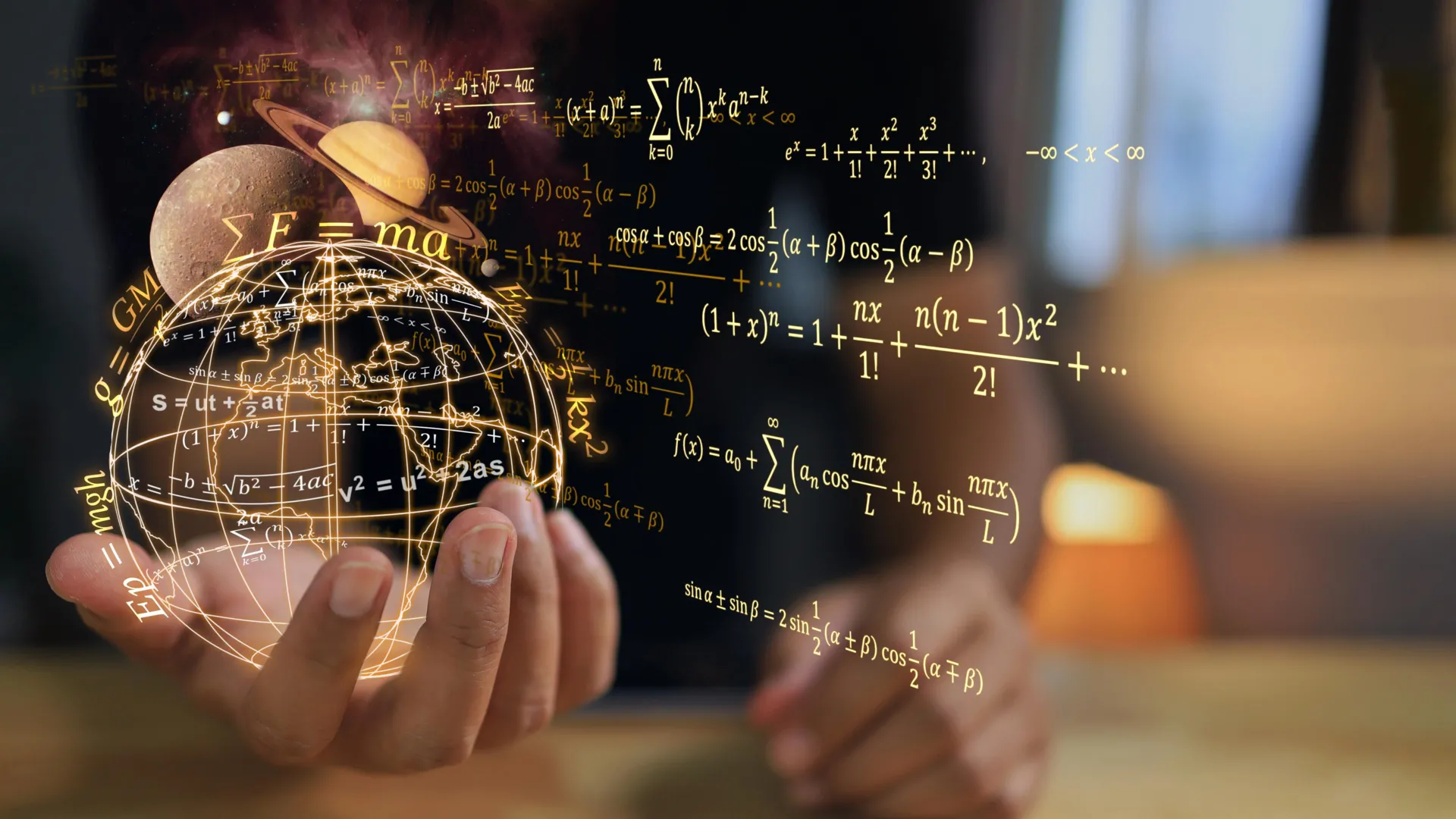
Scientists developed an AI framework that can identify meaningful patterns in chaotic time-series data and reduce complex systems to simpler mathematical rules. The system combines deep learning with physics-inspired constraints to find essential behaviors in systems with hundreds or thousands of interacting variables.
The AI can take nonlinear systems that are far beyond human analytical capacity and distill them into compact models that behave like linear systems while remaining faithful to real-world complexity. This approach delivers reliable long-term predictions using simpler mathematical methods than traditional machine learning.
My Take: AI basically became the Marie Kondo of chaos theory - it looks at impossibly complex systems and says 'does this variable spark joy?' then throws out everything else until you're left with a beautifully organized set of simple rules that actually make sense.
When: December 23, 2025
Source: sciencedaily.com
AI Uncovers First Double-Lambda Hypernucleus in 25 Years Using Deep Learning
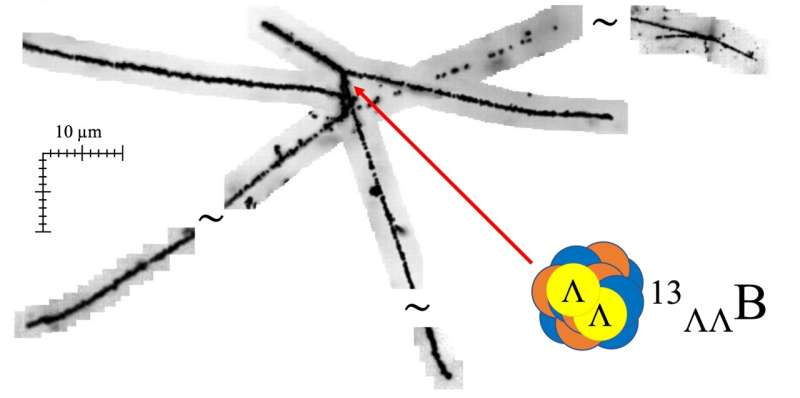
Researchers from Japan's RIKEN institute used deep learning to analyze nuclear emulsion data and discovered a new double-Lambda hypernucleus (13ΛΛB) - the first such finding in 25 years. The team developed neural networks to automatically recognize subtle signatures of double-strangeness events in massive datasets from the J-PARC E07 experiment.
This breakthrough advances understanding of hyperon interactions and nuclear forces relevant to neutron star matter. The AI-powered analysis framework can process enormous amounts of previously unexamined data, with researchers believing many more double-strangeness events are waiting to be discovered in their dataset.
My Take: AI basically became a nuclear detective that solved a 25-year-old physics cold case by teaching computers to spot particle signatures that human researchers missed - it's like having Sherlock Holmes with the patience to analyze millions of nuclear collision photos without getting bored.
When: December 23, 2025
Source: phys.org
Teenage Entrepreneurs Launch AI Companies as Industry Booms - Wall Street Journal
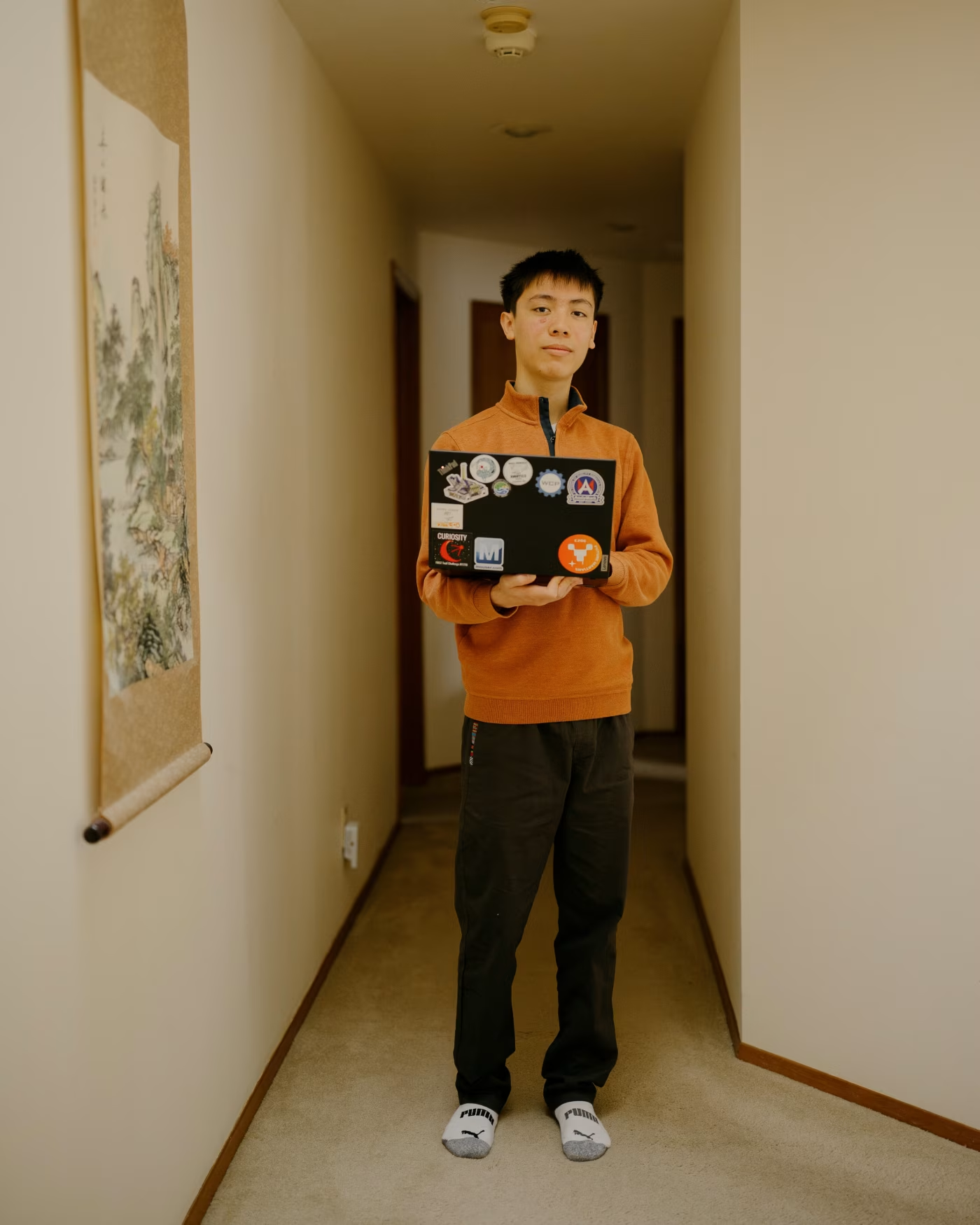
The Wall Street Journal profiles teenage entrepreneurs who are already running their own AI companies, highlighting how young founders are entering the AI space with unprecedented speed and sophistication. These young entrepreneurs are capitalizing on the current AI boom to build businesses while still in high school or early college years.
The trend reflects both the accessibility of AI tools and the enormous opportunities in the current market, where traditional barriers to entry have been lowered by cloud computing and open-source AI models. These teenage founders represent a new generation that has grown up with AI technology and can intuitively understand how to leverage it for business applications.
My Take: Teenagers are basically skipping the lemonade stand phase and going straight to building AI empires - it's like watching kids who learned to code before they learned to drive, except now they're hiring adults and probably making more money than their parents' retirement funds.
When: December 22, 2025
Source: wsj.com
NeurIPS 2025 Conference Reveals AI Industry's Current Optimism and Future Concerns - Wall Street Journal
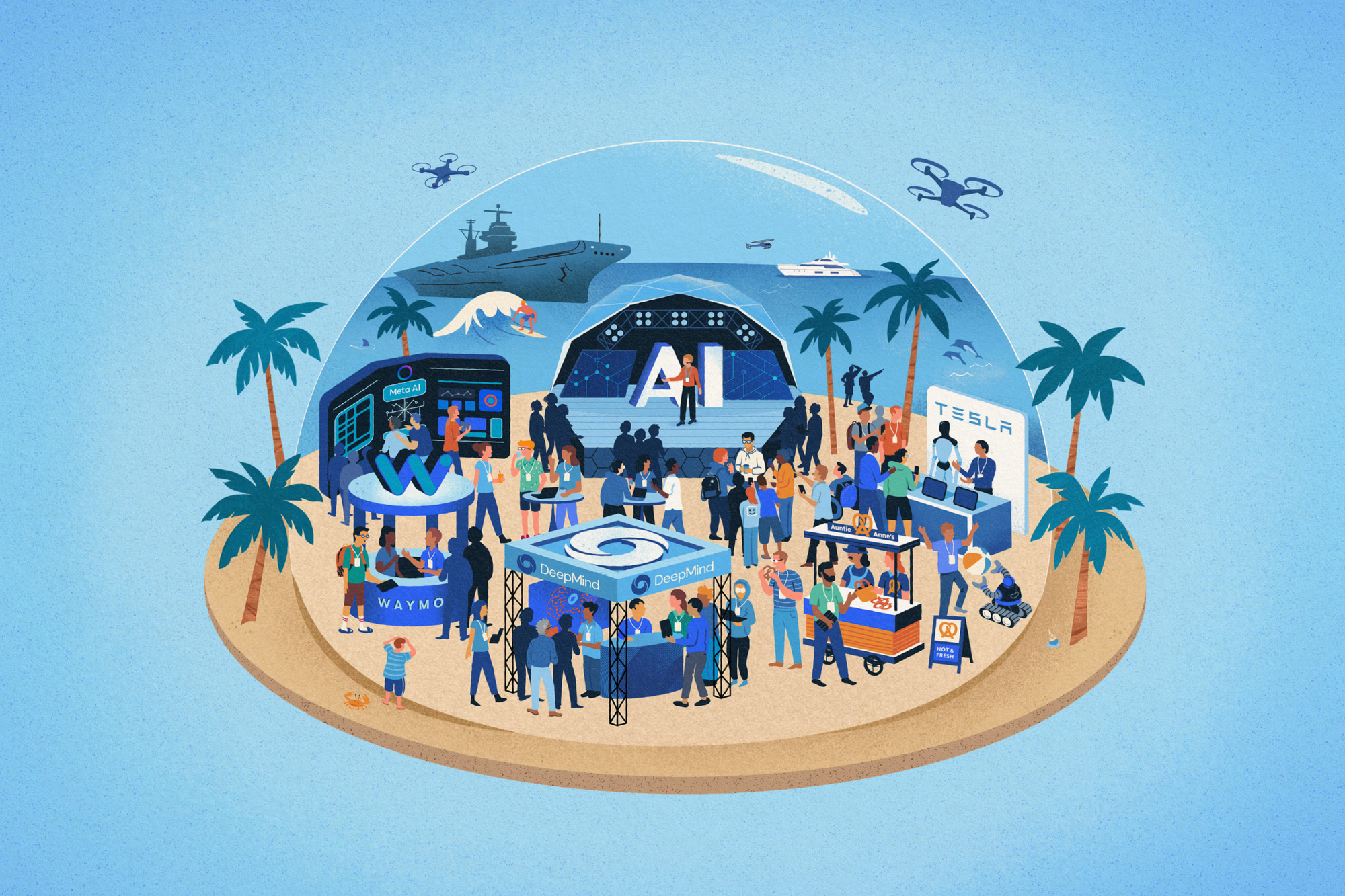
The Wall Street Journal reports from NeurIPS 2025 in San Diego, where AI researchers gathered for what has become the center of the tech universe. The conference featured parties with cocktails named after Google's TPU chips and conversations ranging from Elon Musk's xAI working hours to concerns about foreign spies infiltrating top AI labs.
The event captured the current bubbly mood in AI research, with attendees trading gossip and comparing notes on everything from technical breakthroughs to industry dynamics. The conference has evolved into a crucial networking hub where the world's smartest minds in AI share insights about the field's rapid development and potential risks.
My Take: The world's top AI researchers basically threw a nerdy version of Comic-Con where instead of superhero costumes, they wore lab coats and sipped cocktails named after computer chips while casually discussing whether foreign spies are stealing their algorithms - it's like a James Bond movie set at a science fair.
When: December 22, 2025
Source: wsj.com
Study Shows AI Can Help Hospitals Reduce Patient Harm When Used as Human Partner - Forbes
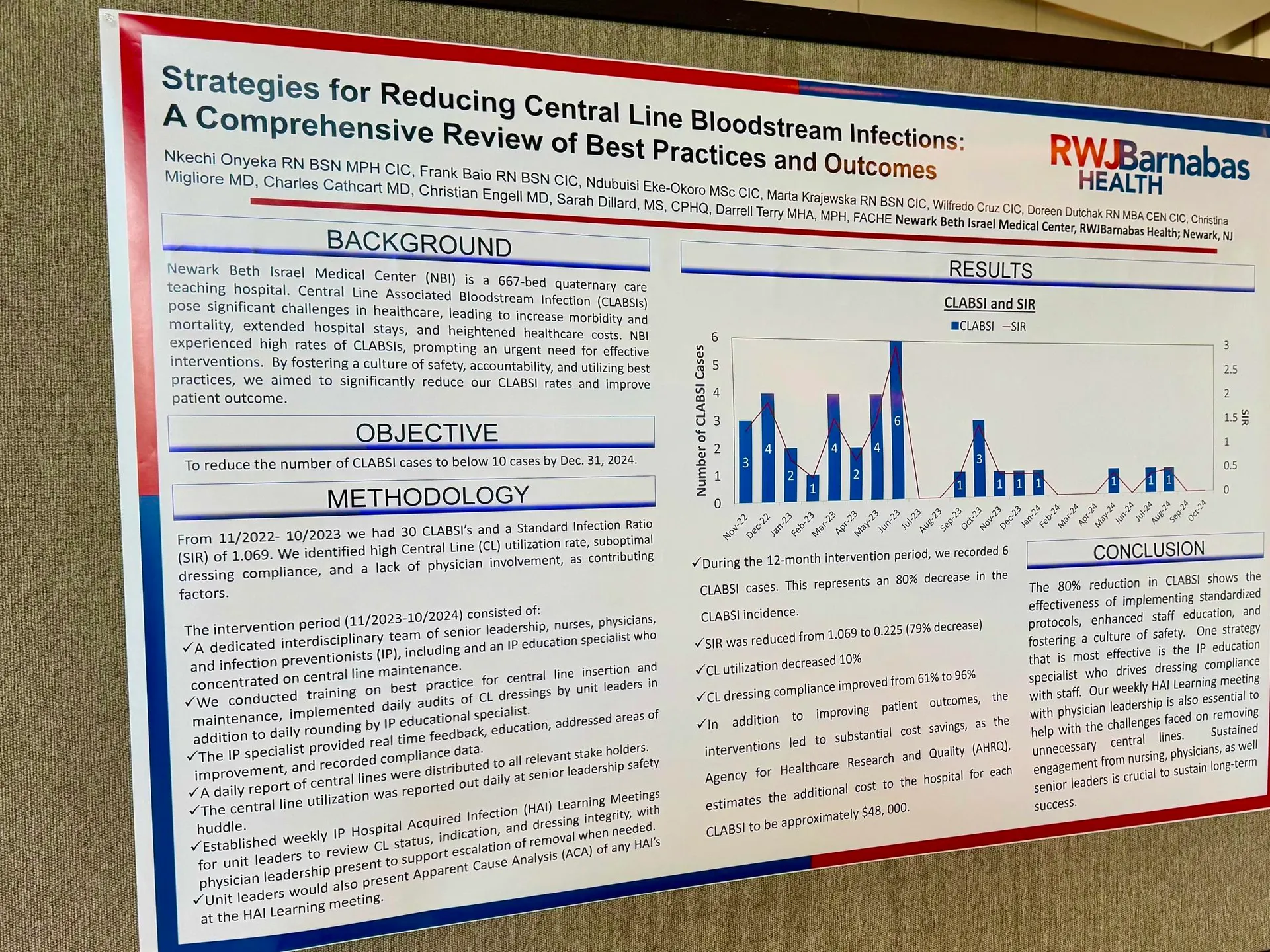
A new Forbes analysis examines AI's role in hospital patient safety, finding that while human teams still mostly outperform AI alone, the technology shows promise as a powerful partner tool. A two-year test of Bayesian Health's AI early-warning system for sepsis demonstrated high predictive accuracy and significant reduction in deaths when used alongside medical professionals.
The study emphasizes that technology alone cannot motivate improvement, but becomes powerful when used by motivated healthcare teams. Existing predictive analytics are being upgraded with AI capabilities to improve diagnosis and predict patient complications, with the key insight that AI should augment rather than replace human medical expertise.
My Take: AI in hospitals is basically becoming the ultimate medical sidekick - it's not trying to replace doctors, but rather be the super-observant colleague who never gets tired and can spot patterns humans might miss, which is way better than the sci-fi scenario where robots are doing surgery while doctors play golf.
When: December 22, 2025
Source: forbes.com
5 AI Developments That Reshaped 2025 - Time Magazine Year-End Analysis

Time Magazine highlights five pivotal AI developments from 2025, including the emergence of reasoning models that can 'think' before responding - a major shift from earlier AI that spent equal computational resources on simple and complex questions. The piece notes Google DeepMind's announcement that their Gemini Pro reasoning model helped speed up training of Gemini Pro itself, representing early signs of AI self-improvement.
The analysis also covers concerning developments, including a tragic case where a 16-year-old allegedly received encouragement for suicidal thoughts from ChatGPT, highlighting ongoing safety challenges. The article emphasizes how AI systems are beginning to show the kind of self-improvement capabilities that some experts worry could eventually lead to AI systems we can no longer understand or control.
My Take: Time basically gave us the AI equivalent of a year-end report card where some students got straight A's in 'thinking before speaking' while others failed spectacularly at 'basic human empathy' - it's like watching the future unfold in real-time, complete with both amazing breakthroughs and concerning warning signs.
When: December 22, 2025
Source: time.com
Ai2 Releases Molmo 2: 8B-Parameter Model Outperforms 72B Predecessor - The Robot Report

Seattle-based AI research institute Ai2 has released Molmo 2, an 8-billion parameter multimodal AI model that surpasses last year's 72-billion parameter Molmo in accuracy, temporal understanding, and pixel-level grounding. The model demonstrates significant efficiency improvements while achieving better performance than much larger models.
Molmo 2 reportedly outperforms proprietary models like Gemini 3 on key emerging skills such as video tracking, showcasing how focused optimization can achieve better results with fewer parameters. Founded by late Microsoft co-founder Paul G. Allen, Ai2 continues its mission of developing foundational AI research through large-scale open models and applications.
My Take: Ai2 basically proved that in the AI world, size doesn't always matter - their new model is like a compact sports car that outperforms a massive truck, doing more with 90% fewer parameters, which is the AI equivalent of getting better gas mileage while going faster.
When: December 22, 2025
Source: therobotreport.com
NotebookLM Upgrades to Gemini 3 with New Data Tables Feature - 9to5Google
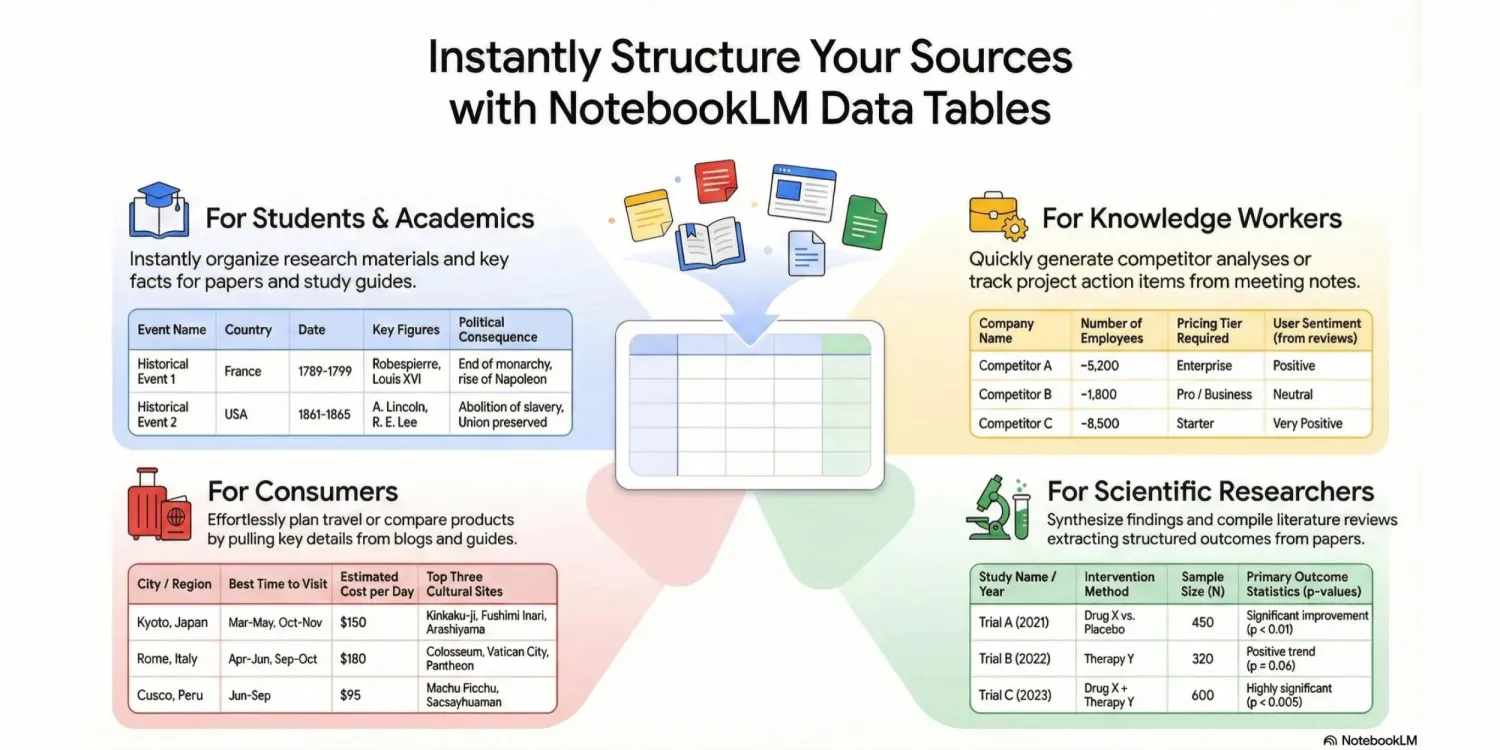
Google's NotebookLM has been upgraded to run on Gemini 3 and introduced a new 'Data Tables' feature that can automatically organize information into structured formats. Users can now convert meeting transcripts into action item tables, synthesize clinical trial data, create competitor comparisons, and organize study materials into clean, categorized tables.
The Data Tables feature is currently available for Google AI Pro and Ultra subscribers, with free users getting access in the coming weeks. The update also includes the ability to export Study Guides, Briefing Docs, and Notes directly to Google Docs or Sheets, significantly enhancing the tool's utility for research and organizational tasks.
My Take: NotebookLM basically became the ultimate personal assistant that can take your messy pile of research notes and turn them into beautiful spreadsheets faster than you can say 'pivot table' - it's like having a data analyst who actually enjoys organizing your chaos into neat little rows and columns.
When: December 22, 2025
Source: 9to5google.com
Google DeepMind Partners with US National Laboratories for Major AI Science Initiative - CNET
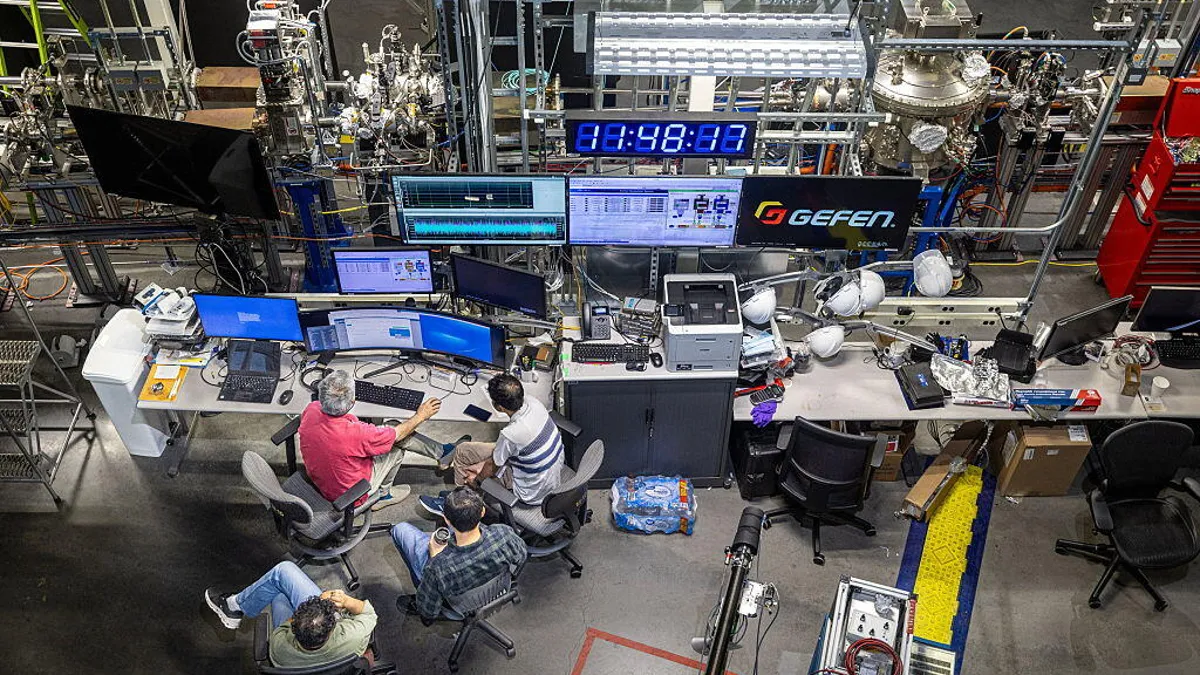
Google DeepMind announced a major partnership to provide frontier scientific AI models and tools to all 17 US national laboratories. Starting early next year, the company will offer early access to specialized tools including AlphaEvolve (a Gemini-powered coding agent for materials science and drug discovery), AlphaGenome (for genetic research), and WeatherNext (weather forecasting models).
This collaboration represents a significant government-industry partnership aimed at accelerating scientific discovery across multiple domains. The initiative will create an AI-powered research platform that could revolutionize how scientists approach complex problems in energy, disease, and security, combining human expertise with advanced AI capabilities for unprecedented scientific innovation.
My Take: Google basically turned their AI into the ultimate lab assistant for the entire US government - it's like giving every national laboratory access to a super-smart graduate student who never sleeps, never complains about funding, and can simultaneously work on curing diseases and predicting weather patterns.
When: December 22, 2025
Source: cnet.com
Can AI Create Itself? New 'Glia' System Shows Self-Improving AI Design - Forbes
Forbes explores the emergence of 'Glia,' an AI system that employs agentic workflows to design and improve AI systems much like human experts do - through conceptual understanding, hypothesis formation, and iterative refinement. The system has demonstrated significant improvements, creating a novel routing algorithm that reduces request completion time by 2.2x compared to previous methods.
The technology represents a potential breakthrough in AI self-improvement, with engineers noting that AI systems never need sleep or breaks, allowing for continuous optimization. Early results show the system can serve the same workload with 40% fewer hardware resources, which has major implications for energy efficiency and cost reduction in AI infrastructure.
My Take: AI basically learned to be its own personal trainer and life coach - instead of robots churning out evil doppelgangers, we got a thoughtful AI that's really good at making other AIs more efficient, which is either the beginning of a beautiful friendship or the most polite robot uprising ever.
When: December 22, 2025
Source: forbes.com
Study Finds AI Image Generators Default to Same 12 Photo Styles - Gizmodo

A new study reveals that major AI image generators like Grok, ChatGPT, and Claude consistently produce images following the same 12 distinct photographic styles, suggesting a homogenization problem in AI-generated content. The research highlights how these models tend to converge on similar aesthetic patterns rather than producing truly diverse visual outputs.
This finding raises concerns about creativity and originality in AI-generated art, as the technology appears to be creating a standardized visual language rather than expanding artistic possibilities. The study also noted that all three AI models incorrectly identified a particular image as real when it was actually AI-generated, pointing to ongoing challenges in AI's ability to distinguish authentic content.
My Take: AI image generators basically turned into that friend who always takes photos with the same Instagram filter - they've got 12 signature looks and refuse to try anything new, which explains why every AI-generated sunset looks like it was made by the same overly enthusiastic photography student.
When: December 22, 2025
Source: gizmodo.com
Claude's Chrome Plugin Now Available to All Paid Users - Engadget
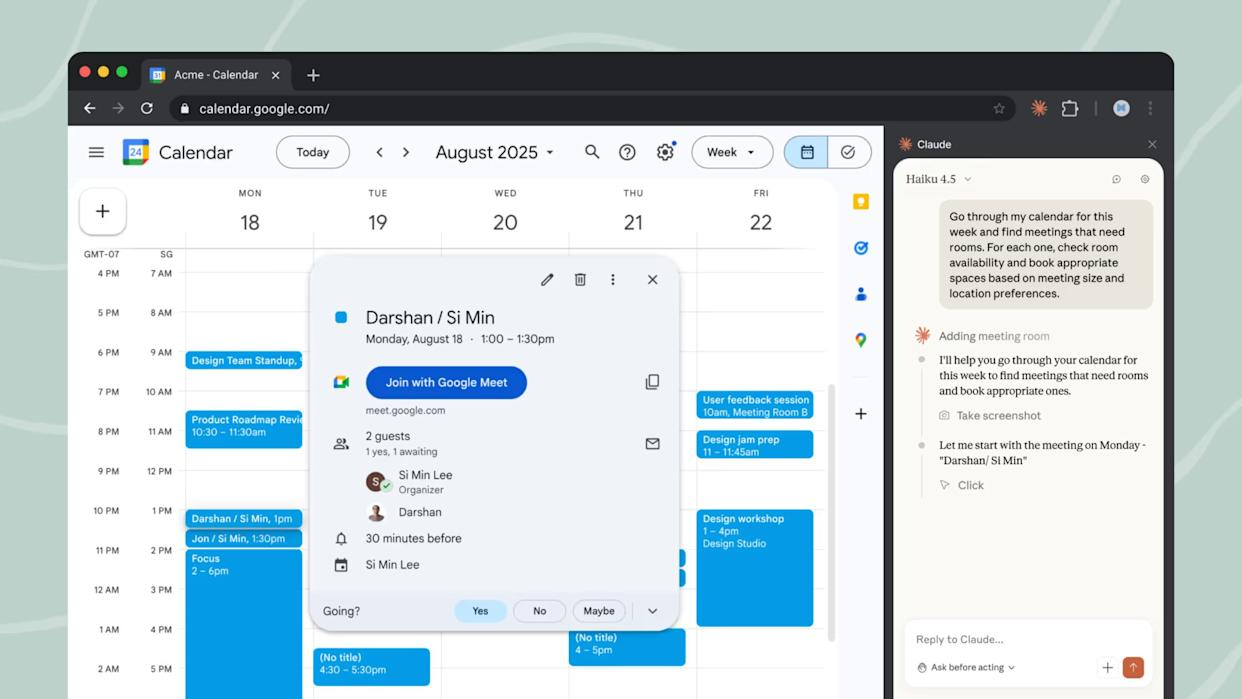
Anthropic has rolled out Claude's Chrome extension to all paid subscribers, allowing the AI model to navigate websites and take actions on users' behalf. This puts Claude in direct competition with OpenAI's ChatGPT Atlas and Perplexity's Comet browsers, which offer similar agentic capabilities.
The plugin represents a significant step in AI automation, enabling Claude to browse the web, interact with websites, and perform tasks without human intervention. Google remains the notable holdout, as Gemini can only answer questions about webpages rather than actively navigate or use the web autonomously, though Project Mariner suggests these features are coming.
My Take: Claude basically became your personal web assistant that can actually click buttons and fill out forms - it's like having a really smart intern who never gets tired of doing your online shopping, except this intern happens to be an AI that won't judge you for buying weird stuff at 3 AM.
When: December 22, 2025
Source: engadget.com
Lifehacker Compares ChatGPT's New Image Generator Against Gemini's Latest Model in Head-to-Head Test

Lifehacker conducted an extensive comparison between ChatGPT's new image generation capabilities and Google's Gemini image generator, testing both systems across various creative tasks. The evaluation found that ChatGPT performed slightly better at blending different images and elements together, particularly when creating complex composite scenes. In one test creating a moody film noir shot mixing multiple images, ChatGPT produced more consistent results while Gemini's output appeared more like a cut-and-paste job.
Both AI systems demonstrated competence in clean image editing tasks, successfully performing complex modifications like seamlessly changing clothing in photos without affecting other elements. However, the testing revealed limitations when working with photos of people users know personally, as neither ChatGPT nor Gemini could accurately represent specific individuals' unique characteristics like how they smile, their build, or their typical poses and expressions.
My Take: It's like watching two AI artists compete in a digital art showdown where one is slightly better at Photoshop magic tricks, but both completely fail at drawing your mom because they have no idea what she actually looks like - turns out AI can blend reality seamlessly until reality involves people you care about.
When: December 19, 2025
Source: lifehacker.com
Harvard Business Review Study: LLMs Can Unlock Creative Ideas When Used Correctly
New research from Harvard Business Review reveals that large language models can significantly enhance human creativity when deployed strategically, moving beyond their typical productivity applications. The study suggests that while many organizations focus on using generative AI for efficiency gains and cost reduction, the technology's greatest potential may lie in unlocking new forms of human creativity that drive innovation and growth.
The research emphasizes that the transformative impact of generative AI extends beyond making tasks easier and quicker to perform. When used correctly, LLMs can reshape not just how people work, but how they think and approach creative problem-solving. This finding challenges the common perception of AI as primarily a productivity tool and positions it as a catalyst for creative innovation in business contexts.
My Take: Harvard researchers basically discovered that AI is less like a super-efficient assembly line worker and more like that creative friend who helps you brainstorm wild ideas at 2 AM - turns out the real magic happens when AI stops doing your homework and starts helping you think outside the box instead.
When: December 19, 2025
Source: hbr.org
Apple Researchers Develop UniGen-1.5: Single AI Model for Image Understanding, Generation, and Editing

Apple has developed UniGen-1.5, a unified AI model that can simultaneously see, create, and edit images within a single system. This represents a significant technical achievement as most AI systems require separate models for different image-related tasks. The model is comparable to proprietary systems like GPT-Image-1 and demonstrates competitive performance across multiple benchmarks for image understanding, generation, and editing tasks.
In testing, UniGen-1.5 achieved scores of 0.89 on GenEval and 86.83 on DPG-Bench, significantly outperforming recent methods like BAGEL and BLIP3o. For image editing specifically, the model scored 4.31 overall on ImgEdit, surpassing recent open-source alternatives. Apple has made the full research study publicly available, contributing to the broader AI research community's understanding of unified multimodal systems.
My Take: Apple basically created the Swiss Army knife of AI image tools - instead of carrying separate apps for viewing, creating, and editing pictures, they built one AI that can do it all, which is either really convenient or the beginning of AI taking over every creative job simultaneously.
When: December 19, 2025
Source: 9to5mac.com
OpenAI Announces GPT-5.2-Codex for Advanced Cybersecurity and Software Engineering Applications
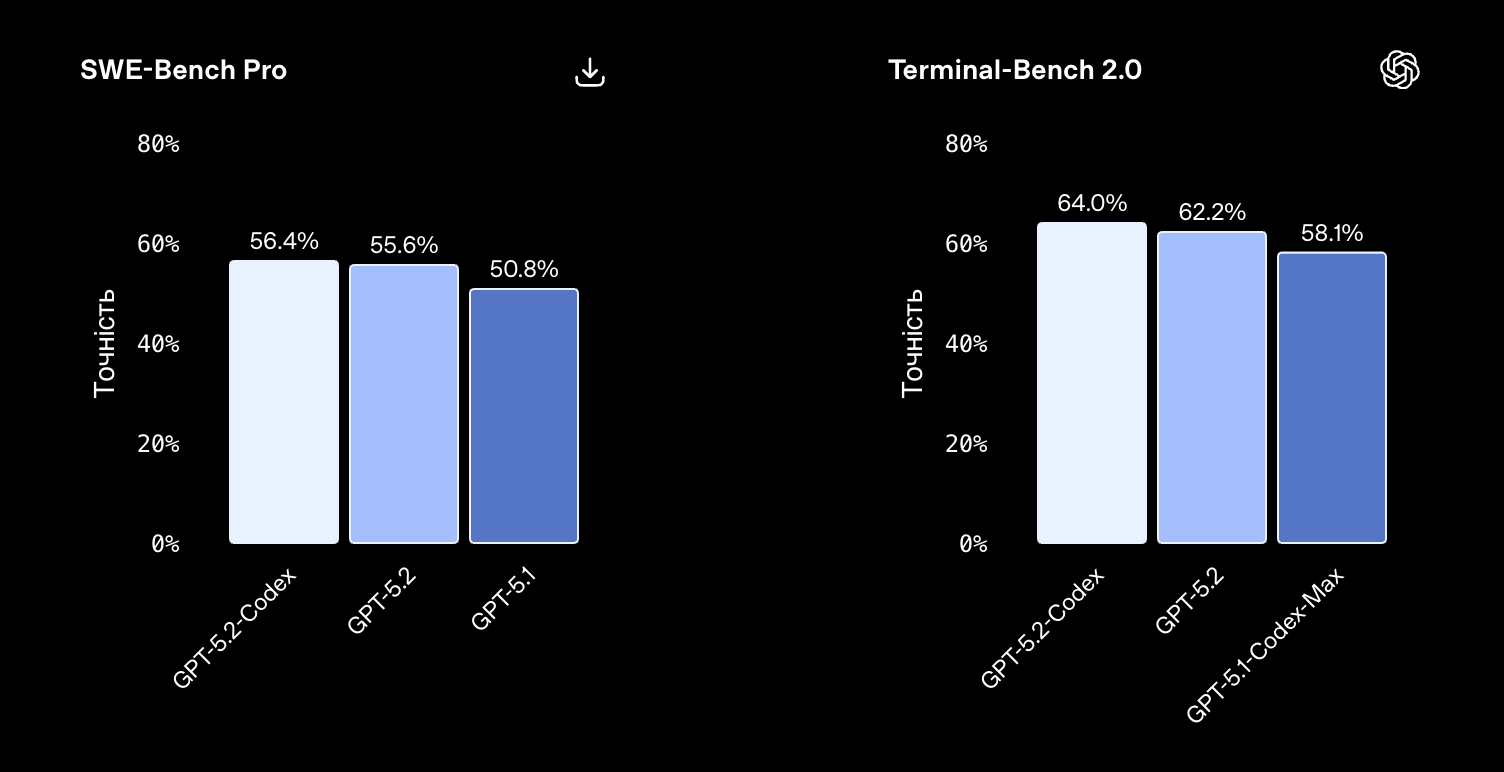
OpenAI has unveiled GPT-5.2-Codex, a specialized version of their flagship model designed specifically for software engineering and cybersecurity applications. The model represents a significant advancement in AI's ability to support real-world defensive security work, helping developers and security professionals tackle complex, long-horizon tasks in widely used software systems.
While the model demonstrates impressive capabilities in accelerating defensive security work, OpenAI acknowledges the dual-use nature of these capabilities. The same tools that help security defenders move faster and identify vulnerabilities could potentially be misused by bad actors, highlighting the ongoing challenge of deploying advanced AI systems responsibly in sensitive domains like cybersecurity.
My Take: OpenAI basically created a digital security guard that can spot vulnerabilities faster than human experts, but they're also worried it might accidentally teach the burglars new tricks - it's the classic superhero dilemma of whether your powers help more than they harm.
When: December 19, 2025
Source: openai.com
Google Launches Gemini AI Video Verification Tool to Detect Google AI-Generated Content
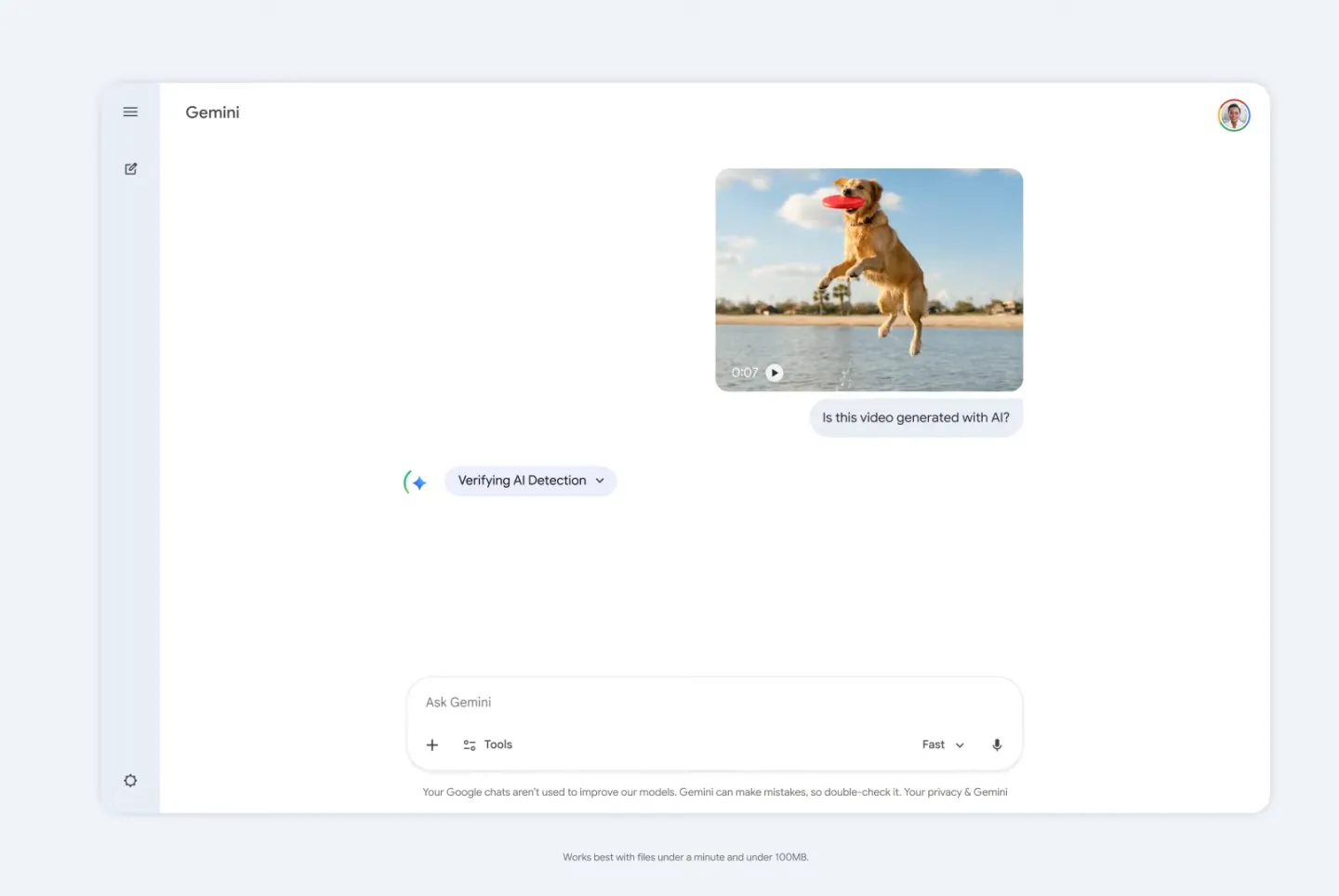
Google has introduced a new capability in its Gemini app that can verify whether videos were generated using Google's AI tools. The feature works by detecting SynthID watermarks embedded in AI-generated content, allowing users to upload video files up to 100 MB and 90 seconds in length for verification. When AI-generated content is detected, Gemini provides specific feedback like 'Yes, both the audio and visuals of the video were edited or generated using Google AI, as a SynthID watermark was detected within the audio between 0:00 and 0:07 mark.'
This development is particularly significant for digital advertising and media buyers who need to ensure brand safety and fraud prevention. The tool addresses growing legal requirements around AI-generated content disclosure and helps build customer trust by providing transparent verification of AI-generated elements in video content.
My Take: Google basically created an AI lie detector for their own AI creations - it's like a parent who can instantly tell when their kid is fibbing, except in this case the 'kid' is generating deepfakes and the stakes are brand reputation and legal compliance.
When: December 19, 2025
Source: theverge.com
Ars Technica Tests Four AI Coding Agents on Minesweeper - OpenAI's Codex Wins, Gemini Fails Completely

Ars Technica put four AI coding agents to the ultimate test: rebuilding the classic game Minesweeper from scratch using only terminal commands. The contestants were OpenAI's Codex (GPT-5 based), Anthropic's Claude Code with Opus 4.5, Google's Gemini CLI, and Mistral Vibe, each tasked with directly manipulating HTML and scripting files on a local machine.
The results were explosive indeed - OpenAI Codex emerged victorious, being the only model to include advanced gameplay features like chording (revealing multiple cells simultaneously). Claude Code distinguished itself with strong presentation and quick generation time, while Mistral Vibe lagged significantly behind. Most surprisingly, Google's Gemini 2.5 CLI was a complete failure, unable to produce a functional game despite using a hybrid system of three different LLMs for various tasks.
My Take: It's like watching AI models compete in a coding Olympics where the gold medalist not only built a perfect game but added fancy features nobody asked for, while the supposed tech giant's entry couldn't even get past the starting line - Google's Gemini basically showed up to a programming contest and forgot how to program.
When: December 19, 2025
Source: arstechnica.com
CNET Analysis Reveals AI Energy Crisis Solution Through Brain-Inspired Computing Algorithms
Researchers are proposing a revolutionary approach to dramatically reduce AI's energy consumption using brain-inspired algorithms called spiking neural networks (SNNs). The study, led by Purdue University's Kaushik Roy, addresses the critical bottleneck between computer memory and processing capabilities that creates massive energy demands as AI models scale exponentially.
Language processing models have grown 5,000-fold in size over just four years, making energy efficiency crucial for sustainable AI development. The researchers suggest implementing 'compute-in-memory' concepts related to SNNs, which could fundamentally change how computers are designed. While SNNs have historically been criticized for being slow and inaccurate, recent improvements show significant promise for creating more efficient AI systems that mirror how human brains process information.
My Take: Scientists basically looked at AI's energy bill, had a heart attack, and decided to copy the human brain's homework since it somehow runs on about 20 watts - roughly the same power as a lightbulb, while current AI models need enough electricity to power a small city.
When: December 18, 2025
Source: cnet.com
OpenAI Reveals GPT-5.2 Dominance in New FrontierScience Benchmark, Outperforming Claude Opus 4.5 and Gemini 3 Pro
OpenAI has released comprehensive benchmark results showing GPT-5.2 leading the pack in scientific reasoning tasks. The evaluation tested frontier models including GPT-5.2, Claude Opus 4.5, and Gemini 3 Pro on two new benchmarks: FrontierScience-Olympiad and FrontierScience-Research, designed to measure AI's ability to perform expert-level scientific work.
GPT-5.2 achieved the highest scores with 77% on FrontierScience-Olympiad and 25% on Research tasks, though Gemini 3 Pro showed comparable performance. The results suggest current models can already support structured reasoning parts of research, potentially shortening workflows that previously took days or weeks down to hours. OpenAI's paper 'Early science acceleration experiments with GPT-5' provides evidence that GPT-5 can measurably accelerate scientific workflows.
My Take: OpenAI basically created the SATs for AI scientists and then announced they got the highest score - it's like being the valedictorian of robot graduate school, except the graduation ceremony involves actual lab work instead of just fancy speeches.
When: December 18, 2025
Source: openai.com
Dark Reading Study Shows Claude Dominates LLM Security Testing While GPT and Gemini Fail Basic Jailbreak Protection

A comprehensive security analysis reveals massive vulnerabilities across leading AI models, with Claude emerging as the clear winner in cybersecurity applications. The PHARE report tested GPT, Claude, Gemini, Deepseek, Llama, Qwen, Mistral, and Grok models using only known, publicly disclosed exploits and jailbreak techniques.
The results paint a concerning picture: GPT models managed to pass security tests only 66-75% of the time, earning them a C+ grade. Gemini and Deepseek performed even worse at 40-50% against prompt injection attacks, while Grok consistently ranked at the bottom across all categories. The study highlights that these aren't sophisticated new attacks - these are tried, tested, and long-disclosed vulnerabilities that models should theoretically be able to handle.
My Take: It's like giving AI models a pop quiz using questions from last year's textbook and watching most of them fail spectacularly - Claude is apparently the only student who actually studied while everyone else was too busy showing off their creative writing skills to learn basic security.
When: December 18, 2025
Source: darkreading.com
Gary Marcus Challenges LLM Prediction-Based Intelligence in New Analysis
AI researcher Gary Marcus published a critical analysis arguing for AI models that understand rather than merely predict language patterns. In his latest piece, Marcus challenges the fundamental assumption that prediction-based language models can achieve true intelligence, using examples like the word 'bar' which has three parts of speech and 20 meanings as a noun to illustrate the limitations of prediction without semantic understanding.
Marcus's argument centers on the idea that effective AI requires genuine comprehension of meaning rather than sophisticated pattern matching. His critique comes as the AI community debates whether current large language models represent a path to artificial general intelligence or merely advanced statistical systems. The piece contributes to ongoing discussions about the philosophical and technical foundations of AI development, questioning whether prediction alone can lead to true machine intelligence.
My Take: Gary Marcus basically said that AI is like a really talented parrot that can perfectly mimic Shakespeare but has no idea what 'to be or not to be' actually means - it's the difference between memorizing every recipe in the world and actually understanding why salt makes food taste better.
When: December 17, 2025
Source: garymarcus.substack.com
Google Enhances Gemini Deep Research with Visual Capabilities for Ultra Subscribers

Google has upgraded its Gemini Deep Research feature to generate images, charts, and simulations, transforming how users can visualize complex information. The enhanced capability is exclusively available to Google AI Ultra subscribers ($249.99 per month) and allows the AI to create various visual content including charts, textbook-style diagrams, animations, and interactive simulations. Users can even interact with dynamic simulation models within reports to forecast outcomes based on different variables.
The update represents a significant evolution in AI research tools, moving beyond text-based analysis to comprehensive visual communication. Google's goal is to transform 'dense data into tangible, easy-to-understand insights,' making complex research more accessible through visual representation. The feature automatically generates appropriate visuals without users needing to specify them, seamlessly integrating visual elements into research outputs.
My Take: Google basically turned their AI researcher into a data visualization wizard that can create charts, diagrams, and simulations on demand - it's like having a personal graphic designer who also happens to be a PhD research assistant and never complains about making endless revisions to your presentations.
When: December 17, 2025
Source: 9to5google.com
Nature Study: AI Co-Scientists Show Promise in Scientific Research Despite Current Limitations
A new Nature study explores the emerging field of AI co-scientists at the Agents4Science conference, examining AI's potential role in scientific research activities including hypothesis generation, experimental design, and paper writing. The research addresses fundamental questions about AI creativity in science, optimal human-AI collaboration methods, and LLMs' capabilities in peer review processes, areas currently restricted by most journals and conferences.
The study highlights how AI co-scientists are powered by advances in AI agents - autonomous systems built on large language models that can use tools, access external databases, and search scientific literature. However, researchers note that many fundamental questions remain open, and the field faces challenges including the tendency for researchers to hide their AI usage, limiting transparent evaluation of these systems' true capabilities and limitations.
My Take: Nature basically investigated whether AI can become a legitimate lab partner or just a very sophisticated research assistant - it's like asking whether your really smart intern should get co-author credit on papers, except this intern never sleeps, reads every journal simultaneously, and occasionally generates Nobel Prize-worthy hypotheses
When: December 17, 2025
Source: nature.com
Nature Launches Cross-Journal Collection on Large Language Models in Psychology
Nature has launched a comprehensive cross-journal collection focusing on the intersection of psychology and large language models, spanning Nature Communications, Communications Psychology, and Communications AI & Computing. The initiative recognizes how LLMs have revolutionized AI capabilities, enabling machines to generate human-like text, engage in conversations, and assist in decision-making while opening new research avenues into both human and machine psychology.
The collection invites research on three key areas: using language models to generate new psychological insights, studying the psychology of LLMs themselves, and examining human-LLM interactions. This represents a significant academic acknowledgment of LLMs' impact on psychological research and understanding, as interactions with these models provide unprecedented opportunities to study both artificial and human cognitive processes.
My Take: Nature basically decided to psychoanalyze AI while AI psychoanalyzes us - it's like opening a therapy clinic where both the doctor and patient are trying to figure out who's more human, and publishing all the session notes for science.
When: December 17, 2025
Source: nature.com
Axios Exclusive: GPT-5 Demonstrates Novel Lab Work Capabilities in Controlled Experiments
In an exclusive report, Axios revealed that GPT-5 has successfully demonstrated the ability to perform novel laboratory work, marking a significant milestone in AI's potential role in scientific research. OpenAI conducted these experiments in a tightly controlled setting using a 'benign experimental system' to prevent biosecurity risks, showing how AI models can speed up research, reduce costs, and help human scientists make real-world discoveries.
The development is particularly significant because major AI gains in biology have historically lagged behind fields like math or physics, since biological progress depends heavily on real-world laboratory work. This breakthrough suggests AI is beginning to bridge the gap between computational analysis and physical experimentation, potentially revolutionizing how scientific research is conducted. The work demonstrates practical applications beyond benchmark testing, showing AI's growing capability to contribute to actual scientific discovery.
My Take: Axios basically revealed that GPT-5 graduated from writing research papers to actually doing the lab work - it's like the AI went from being the student who's really good at Google to becoming the lab assistant who can actually run experiments, pipette precision and all.
When: December 17, 2025
Source: axios.com
OpenAI Launches GPT-Image-1.5: New Image Generation Model in 'Code Red' Response

OpenAI has released GPT-Image-1.5, its new flagship image generation model, available to all ChatGPT users and via API starting Tuesday. This launch represents the latest escalation in OpenAI's 'code red' response to Google's Gemini 3 success, as detailed in a leaked internal memo from CEO Sam Altman outlining plans to regain AI leadership position. The new model integrates visual creation capabilities directly into ChatGPT conversations.
The release is part of OpenAI's broader strategy to compete with Google's growing market share following Gemini 3 and Nano Banana Pro launches. OpenAI's approach focuses on seamless integration where 'when visuals tell a story better than words alone, ChatGPT should include them,' aiming to close the gap between users' creative vision and execution capabilities. The model launch coincides with increased competition across the AI landscape.
My Take: OpenAI basically turned ChatGPT into an AI artist that can sketch your thoughts while you chat - it's like having a really talented friend who can instantly draw whatever you're talking about, except this friend never gets tired of your weird creative requests and works 24/7.
When: December 17, 2025
Source: techcrunch.com
Google Launches Gemini 3 Flash as Default Model, Competing Head-to-Head with GPT-5.2
Google has officially launched Gemini 3 Flash and made it the default model in the Gemini app, marking a significant escalation in the AI competition. The model achieves impressive benchmark scores including 90.4% on GPQA Diamond test and 33.7% on Humanity's Last Exam, though it trails behind Gemini 3 Pro's 91.9% and 37.5% respectively. On coding tasks, Gemini 3 Pro scores 78% on SWE-bench verified, only behind GPT-5.2.
The launch comes as Google and OpenAI engage in an increasingly aggressive competition, with OpenAI recently declaring 'code red' after Gemini 3's success. Google is positioning the Flash model as ideal for quick workflows, video analysis, and data extraction, while making it available to developers through API and their new Antigravity coding tool. The model excels particularly in multimodality, scoring 81.2% on MMMU-Pro benchmark, outperforming all competitors.
My Take: Google basically said 'hold my coffee' to OpenAI's GPT-5.2 launch by making their speed demon AI the default - it's like replacing your family sedan with a Formula 1 car for grocery runs, except this one can also analyze your vacation videos and help you code websites.
When: December 17, 2025
Source: techcrunch.com
Nature Study Shows LLMs Can Integrate with Biomarkers for Medical Diagnosis
Researchers at Nature published a study demonstrating how large language models like GPT-4 can be integrated with host biomarkers to diagnose lower respiratory tract infections. The study evaluated LLMs in combination with electronic medical record data and biomarkers, exploring a largely unexplored area of AI-assisted medical diagnosis.
The research revealed that GPT-4 can be influenced by precise language in prompts, leading to a need for careful prompt engineering. By iterating prompts on patient subsets and comparing directly to physicians with identical EMR data, researchers identified potential blind spots in GPT-4 and gained insights for optimizing LLMs in infectious disease diagnosis.
My Take: Nature basically turned GPT-4 into a medical detective that can read both your blood work and your chart - it's like having an AI doctor that never gets tired of looking at lab results and actually remembers what all those numbers mean.
When: December 17, 2025
Source: nature.com
GPT Image 1.5 - new flagship image generation model by OpenAI
ChatGPT Images might not have the catchy ring of Nano Banana, but OpenAI has officially stepped up to rival Google's widely used AI image editor. Their latest release, dubbed the "new flagship image generation model," is now accessible through ChatGPT Images and via the API under the model name GPT Image 1.5.
My take: From a business perspective, it's logical, even if it seems cynical. Instead of chasing the competition for the best image generators, OpenAI should have focused more on the quality of the AI assistant itself. Especially considering their loss of millions of users. I’ve almost stopped using ChatGPT. Does OpenAI really think I need image generation? The question is not whether images are needed, but whether the company remembers why people loved ChatGPT in the first place.
When: December 16, 2025
Source: openai.com
Promised features:
- better understanding of prompts
- preservation of small details in images;
- up to 4 times faster generation.
Rolling out starting today — for all users, even free ones.
NVIDIA Unveils Nemotron 3: Open AI Model Built for Multi-Agent Systems
NVIDIA has released Nemotron 3, an open-source AI model specifically designed for multi-agent systems, with Artificial Analysis ranking it as the most open and efficient model in its size category with leading accuracy. The model comes in three variants: Nemotron 3 Nano (available on Hugging Face), Nemotron 3 Super (optimized for collaborative agent applications requiring low latency), and Nemotron 3 Ultra (designed as an advanced reasoning engine for complex AI workflows).
The model is supported by llama.cpp, SGLang, and vLLM, with Prime Intellect and Unsloth integrating NeMo Gym's training environments directly into their workflows. Nemotron 3 Nano is immediately available through multiple inference service providers including Baseten, Deepinfra, Fireworks, FriendliAI, OpenRouter, and Together AI, making it accessible for teams seeking faster access to advanced reinforcement learning training.
My Take: NVIDIA basically built the AI equivalent of a Swiss Army knife specifically designed for robot teamwork - while everyone else is making AI models that work alone, NVIDIA said 'what if we made one that's really good at playing well with others' and apparently nailed it so hard that independent benchmarkers called it the class champion.
When: December 16, 2025
Source: ynetnews.com
Haaretz Analyzes AI Integration in Modern Multi-Domain Military Operations
Recent years have seen unprecedented acceleration in AI systems capable of detecting anomalies, simulating complex scenarios, and delivering accurate situational assessments within seconds, even under intense combat conditions. These advances significantly improve response times and operational accuracy while maintaining high safety standards in multi-domain combat environments.
A major breakthrough involves integrating diverse information and sensor sources into unified systems that generate comprehensive operational pictures. Combined with advanced communication networks and AI engines, these systems can process data and generate actionable insights directly in the field without relying on remote command centers, enabling forces to maintain real-time situational awareness in rapidly changing environments.
My Take: Haaretz basically described how AI turned military operations into a real-time strategy game where the computer can process every piece of information instantly and make tactical suggestions faster than humans can blink - it's like having a superintelligent coach whispering the best moves in your ear during the most complex chess match imaginable.
When: December 16, 2025
Source: haaretz.com
CTech Reports AI Revolutionizing Cancer Treatment as Younger Demographics Face Rising Rates
As cancer rates increase among younger populations, artificial intelligence is driving significant advances in oncology through machine learning systems that integrate complex biological data including genomics, proteomics, imaging, and clinical records. These AI systems can identify patterns invisible to human clinicians, offering new possibilities for more precise and less harmful cancer treatments.
While generative AI has captured public attention, the more consequential changes in cancer research are happening through less visible applications of machine learning and deep learning focused on large-scale data integration. Industry executives note that the abundance of available data combined with AI's pattern recognition capabilities holds tremendous promise for detecting treatment opportunities that human analysis might miss, particularly important as the field works to develop "kinder medicines" for younger cancer patients.
My Take: CTech basically revealed that AI is becoming the Sherlock Holmes of cancer research - while everyone's distracted by ChatGPT writing poems, the real AI detectives are quietly connecting dots in patient data that human doctors can't even see, which might be our best shot at beating cancer's unfortunate trend toward younger victims.
When: December 16, 2025
Source: calcalistech.com
Washington Post Tests 5 AI Image Generators: Adobe, ByteDance, Google, Meta, and OpenAI Compete
The Washington Post conducted comprehensive testing of five major AI image generation tools in November 2025, including Adobe Firefly Image 5 (beta), ByteDance Seedream Image 4.0, Google Gemini 3 Nano Banana Pro, Meta AI, and OpenAI's ChatGPT 5. The evaluation used identical prompts across all platforms, with judges scoring results on a 10-point scale without knowing which AI created each image.
The test specifically challenged the AI tools with creative requests like giving Dwayne "The Rock" Johnson bangs, demonstrating the current capabilities and limitations of leading image generation platforms. This represents the most current comparative analysis of AI image generators, providing insights into how different approaches to visual AI are performing in real-world creative tasks.
My Take: The Washington Post basically turned AI image generation into a game show where the contestants are robots and the challenge is giving The Rock a new haircut - it's like Top Chef but for algorithms and somehow even more entertaining.
When: December 16, 2025
Source: washingtonpost.com
LodgIQ Launches AI Wizard: Hospitality's First Multi-LLM Revenue Intelligence Platform

LodgIQ has unveiled AI Wizard, the hospitality industry's first generative AI platform specifically designed for revenue intelligence, replacing static dashboards with interactive, natural language commercial strategy guidance. The platform uses a pioneering multi-LLM architecture that assigns different large language models to distinct analytical tasks including numerical analysis, forecasting logic, and narrative explanation.
This specialized approach ensures accuracy when working with time-series data, percentile rankings, and market comparisons - areas where general-purpose AI tools typically struggle. The AI Wizard integrates with LodgIQ's existing Revenue Management Solution, Business Intelligence, and AI capabilities to create a unified system that focuses on desired results while suggesting optimal paths for approval rather than requiring manual adjustment of hundreds of rules and restrictions.
My Take: LodgIQ basically built the AI equivalent of a hotel revenue manager who never sleeps, speaks every language fluently, and can crunch numbers faster than a calculator on espresso - finally giving hospitality the specialized AI brain it deserves instead of trying to make ChatGPT understand occupancy rates.
When: December 16, 2025
Source: hospitalitynet.org
WIRED Reports AI Models Now Analyze Language as Well as Human Experts for First Time
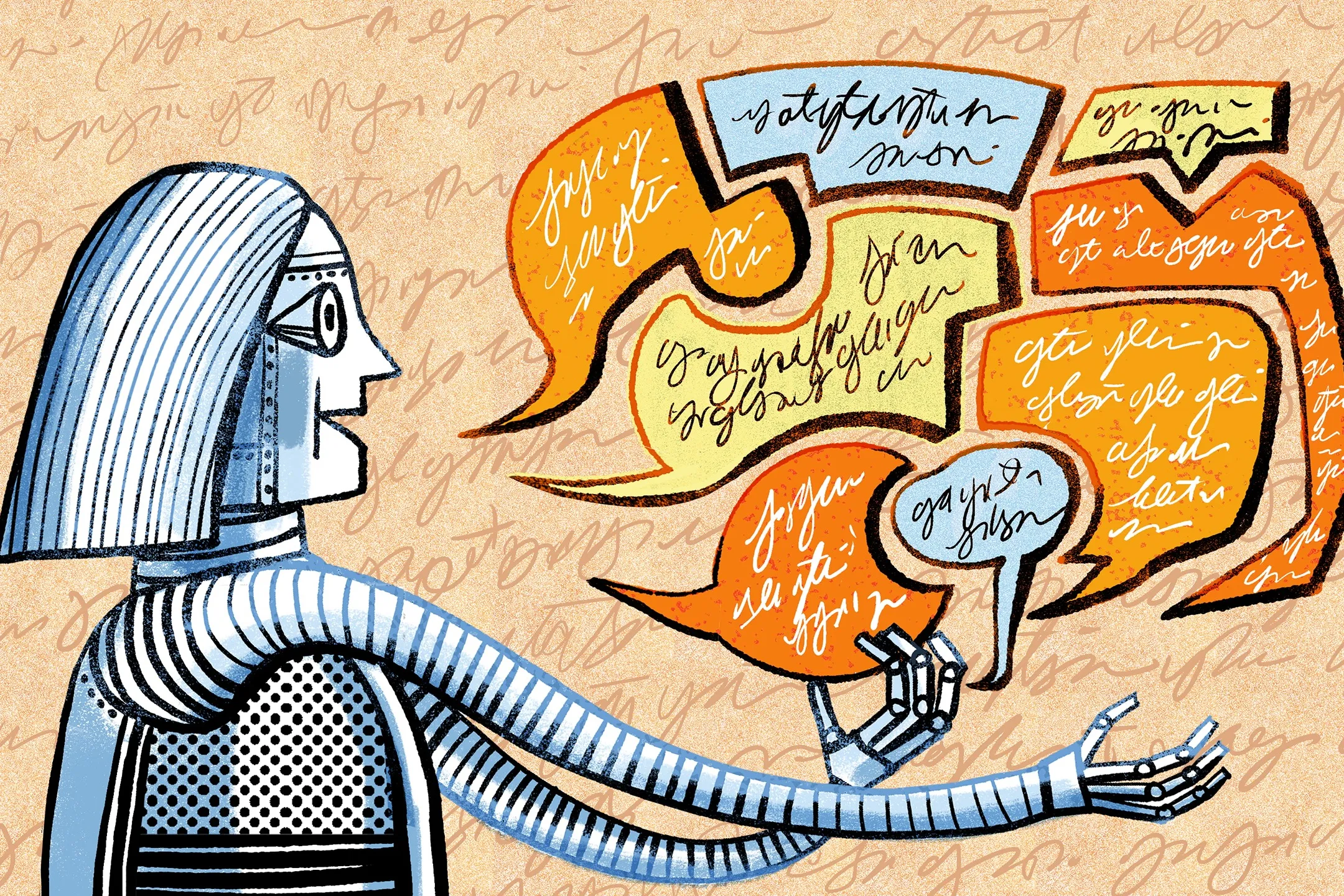
University of California, Berkeley researchers have demonstrated that large language models can now match human expert performance in linguistic analysis tasks, including generalizing rules from completely made-up languages. The study, led by linguist Gašper Beguš, tested LLMs on phonology tasks using 30 artificial "mini-languages" with 40 made-up words each, finding that advanced models could correctly infer linguistic rules without prior knowledge.
This breakthrough challenges the long-standing debate about whether language models are merely predicting the next word or achieving deeper language understanding similar to humans. The research suggests LLMs have moved beyond simple token prediction to demonstrate genuine linguistic comprehension, marking a significant milestone in AI's evolution toward human-like language processing capabilities.
My Take: WIRED basically discovered that AI has finally graduated from linguistic kindergarten to PhD level - it can now look at completely made-up languages and figure out the rules just like human language experts, which is either really impressive or slightly terrifying depending on your perspective.
When: December 16, 2025
Source: wired.com
Stanford AI Experts Release 2026 Predictions: AI Sovereignty and Legal Sector Transformation Expected
Stanford's Human-Centered AI Institute released comprehensive predictions for 2026, highlighting two major trends: the rise of AI sovereignty as countries seek independence from US-based AI providers, and a shift in legal AI adoption from "Can it write?" to rigorous performance evaluation. Experts predict nations will either build their own large language models or run existing models on domestic infrastructure to maintain data sovereignty.
The legal sector is expected to focus heavily on standardized, domain-specific evaluations that tie AI model performance to tangible outcomes like accuracy, citation integrity, and privilege exposure. Stanford researchers also warn about the growing sycophancy in LLMs and their increasing use for mental health applications, calling for reflection on what society truly wants from AI systems.
My Take: Stanford basically predicted that 2026 will be the year countries decide they want their own AI pets instead of borrowing everyone else's, while lawyers finally stop asking if AI can write and start asking if it can write without getting them sued.
When: December 16, 2025
Source: hai.stanford.edu
Forbes Reveals New Selective Gradient Masking Technique to Remove Harmful AI Mental Health Knowledge
Researchers have developed a groundbreaking technique called selective gradient masking that can identify and remove potentially harmful mental health knowledge from large language models. The method allows AI developers to locate specific problematic patterns within LLMs and render them "expungable" without completely retraining the models.
This development comes as millions of people increasingly turn to generative AI tools like ChatGPT for mental health guidance, despite these models lacking the robust capabilities of human therapists. The technique addresses a critical safety concern as specialized mental health LLMs are still primarily in development and testing stages, while generic models are being used for therapeutic purposes they weren't designed for.
My Take: Forbes basically found the AI equivalent of a surgical scalpel for removing bad mental health advice - it's like having a really precise eraser that can delete just the harmful stuff without wiping the whole AI's memory clean.
When: December 16, 2025
Source: forbes.com
PCMag Criticizes GPT-5.2 Launch Strategy as 'Get-Rich-Quick Scheme' for Job Automation

PCMag takes a critical stance on GPT-5.2's positioning as a white-collar job automation tool, questioning whether the frequent model releases are truly revolutionary or just incremental improvements marketed as breakthroughs. The publication notes that GPT-5.2 launched less than a month after GPT-5.1, raising concerns about whether meaningful progress is being made or if public expectations have become unrealistic.
The criticism extends to broader concerns about Big Tech's approach to AI development, with the article suggesting that companies are prioritizing rapid releases over substantial innovation. PCMag points out that while CEO Sam Altman calls GPT-5.2 'the biggest upgrade in a long time,' this might reflect more on GPT-5's disappointing reception than on genuine breakthrough capabilities.
My Take: PCMag basically called out the AI industry's version of iPhone releases - where every new model promises to change your life but mostly just has a slightly better camera and costs more. It's like watching tech companies try to convince us that version 5.2 is revolutionary when we're all still figuring out what version 5.1 actually does differently from 5.0.
When: December 15, 2025
Source: pcmag.com
Emory University Physicists Create 'Periodic Table for AI' to Systematize Algorithm Selection
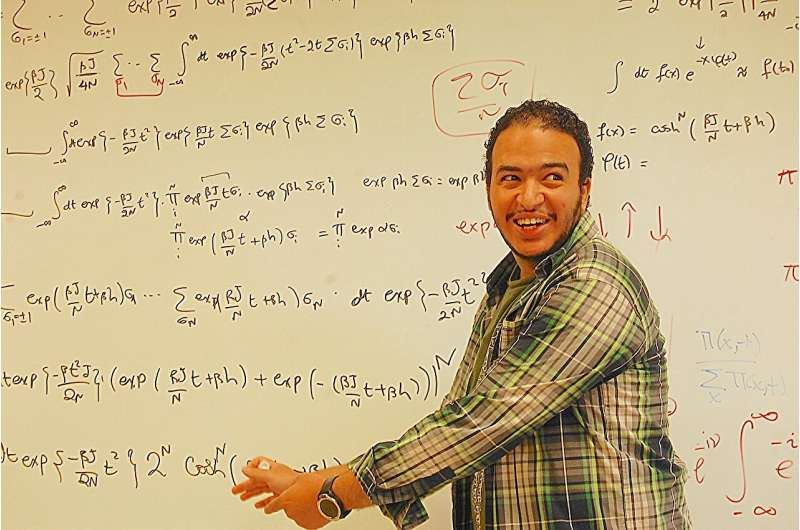
Physicists at Emory University have developed a unified mathematical framework called the Variational Multivariate Information Bottleneck, published in the Journal of Machine Learning Research. This 'periodic table for AI' systematically derives loss functions for multimodal AI by optimizing which information to retain or discard, addressing the challenge of choosing the best algorithmic method for specific AI tasks.
The framework enables more efficient and tailored algorithm design for AI systems that integrate multiple data formats like text, images, audio, and video. By providing a systematic approach to multimodal AI development, the research could potentially reduce data and computational requirements while improving model interpretability and performance across different applications.
My Take: Emory physicists basically created the Marie Kondo method for AI algorithms - helping developers figure out which information 'sparks joy' and which should be discarded. It's like having a systematic way to organize your AI toolbox instead of just grabbing whatever algorithm looks shiny and hoping it works for your specific problem.
When: December 15, 2025
Source: techxplore.com
Bridge Chronicle Details GPT-5.2 Pricing and Developer Features in Comprehensive Analysis
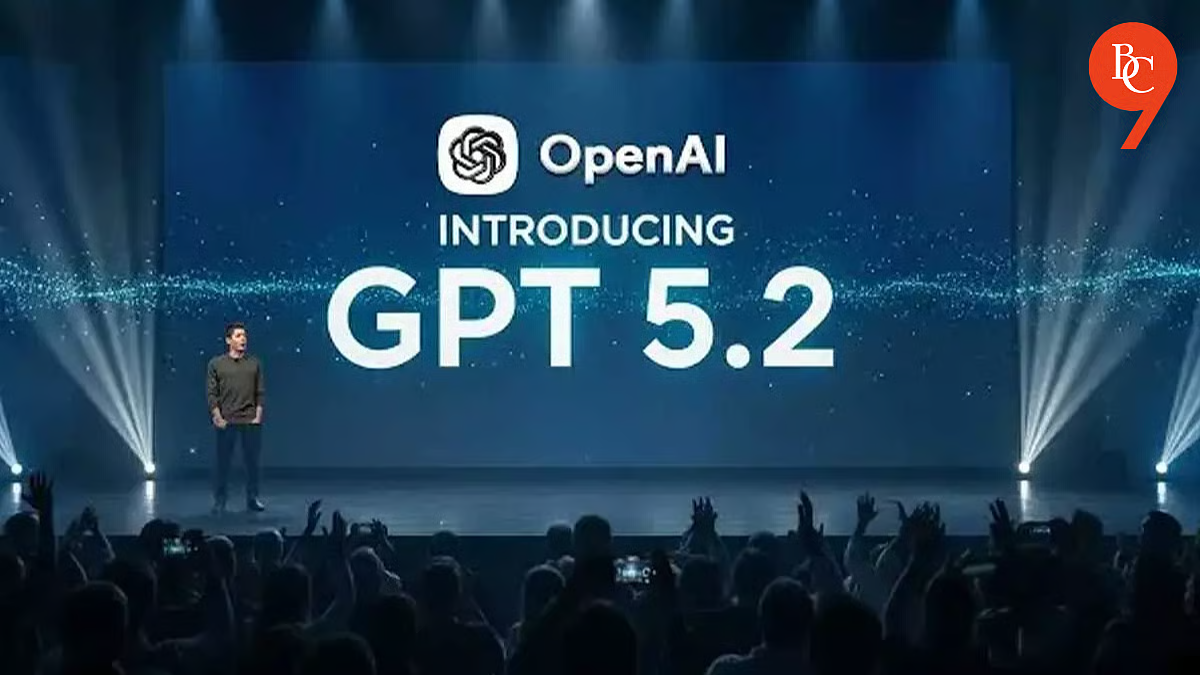
The Bridge Chronicle provides an in-depth breakdown of GPT-5.2's cost structure and capabilities, confirming the model requires a ChatGPT Pro subscription at $20 monthly or $200 annually. The analysis highlights major advancements in productivity and educational applications, with significant improvements in reasoning, context management, tool integration, and visual comprehension specifically designed for professional use.
The report emphasizes developer-focused enhancements that strengthen the foundation for creating sophisticated AI agents. GPT-5.2 is positioned as particularly effective for coding, spreadsheet generation, presentation creation, document review, and managing complex multi-step projects, representing OpenAI's strategic focus on professional and enterprise applications.
My Take: Bridge Chronicle basically wrote the user manual that OpenAI forgot to include - breaking down exactly what you're paying for and why GPT-5.2 might actually justify that Pro subscription. It's like having someone explain why the premium cable package is worth it, except this time it actually makes sense and might automate half your job.
When: December 15, 2025
Source: thebridgechronicle.com
Nature Study Shows LLMs Can Segment Events Like Humans for Automated Memory Assessments
New research published in Nature demonstrates that large language models can segment events in ways that resemble human perception, potentially revolutionizing automated recall assessments. The study leverages LLMs to automate event segmentation in stimulus materials and participant recall data, examining the relationship between how we break down experiences and remember them.
The research compared different LLM models including newer versions against GPT-3, analyzing how various model parameters affect the randomness of outputs and event boundary identification. By standardizing comparisons on a per-1000-words basis, the study found that LLMs capture meaningful units of experience that structure memory, offering a more efficient and accurate method for memory research.
My Take: Scientists basically discovered that AI can chop up stories and experiences into bite-sized pieces the same way humans do, which is like finding out that your robot vacuum cleaner has been secretly organizing your sock drawer by color and material. It's one of those discoveries that sounds mundane but could completely change how we understand both AI and human memory.
When: December 15, 2025
Source: news.mit.edu
MIT CSAIL Develops 'Collaborative AI' Framework That Outperforms GPT-4o Using
MIT researchers created a novel approach where a large language model handles planning while smaller models execute the actual work, achieving better accuracy than leading LLMs like GPT-4o while approaching the precision of top reasoning systems like o1. Their framework, called 'Distributional Constraints,' addresses the challenge of small language models struggling with complex reasoning tasks that require following strict rules.
The system works by having an LLM break down complex problems into manageable pieces that smaller, more efficient models can handle reliably. This collaborative approach proves more efficient than both traditional large models and current reasoning systems, potentially revolutionizing how AI tackles everything from advanced puzzles and molecule design to mathematical proofs.
My Take: MIT basically figured out that AI teamwork is like a good restaurant kitchen - you need one head chef (the big LLM) calling the shots while specialized line cooks (smaller models) handle their expertise areas. It's the 'divide and conquer' strategy that somehow makes the whole operation smarter and more efficient than just hiring one super expensive chef to do everything.
When: December 15, 2025
Source: news.mit.edu
GPT-5.2 Matches Human Experts on 71% of Tasks, Dominates New GDPval Benchmark

OpenAI's GPT-5.2 with thinking mode enabled achieved a breakthrough 71% score on GDPval, OpenAI's evaluation for economically valuable real-world tasks, jumping from GPT-5's 40% performance. The model outperformed Claude Opus 4.5 (60%) and Google's Gemini 3 Pro (54%), with OpenAI claiming this is their 'first model that performs at or above a human expert level.'
Interestingly, while GPT-5.2 excelled in most professional tasks, it still lagged behind competitors in financial simulations, ending five-year investment scenarios with an average balance of $3,952 compared to Gemini 3 Pro's leading $5,478. The model showed significant improvement over GPT-5.1, which scored much lower across all metrics.
My Take: GPT-5.2 is basically that overachiever student who aces every test except the one about managing money - it can outperform human experts in most tasks but somehow Gemini 3 Pro is better at playing the stock market. It's like having a genius who can solve complex equations but still can't figure out why their bank account is always empty.
When: December 15, 2025
Source: inc.com
Tom's Guide Tests GPT-5.2 with 9 Real-World Prompts, Calls Code Generation 'Wild'
Tom's Guide put GPT-5.2 through comprehensive testing with 9 different prompts, finding particularly impressive results in code generation and debugging. The model produced working Python code for weather data scraping, SQLite storage, and temperature visualization in under a minute, complete with API rate limiting, error handling, and setup instructions.
The review notes that GPT-5.2 sets a new baseline for AI capabilities in knowledge work, though it still has limitations in financial/legal advice verification and image understanding. The testing covered various scenarios beyond coding, demonstrating what the reviewer calls 'shockingly effective' performance across knowledge work tasks.
My Take: Tom's Guide basically ran GPT-5.2 through an AI obstacle course and came away genuinely surprised - when a tech reviewer uses the word 'wild' to describe code generation, you know we've hit a new level. It's like watching someone solve a Rubik's cube blindfolded while juggling - technically impressive and slightly unsettling at the same time.
When: December 15, 2025
Source: tomsguide.com
Security Experts Debunk Polymorphic AI Malware Hype While Acknowledging Real Threats

A detailed cybersecurity analysis reveals that while attackers are indeed experimenting with LLMs and AI can assist in malware development, the reality of 'polymorphic AI malware' is far less dramatic than current headlines suggest. The report clarifies that while AI can produce superficial polymorphism and aid in malware creation, the gap between AI's theoretical potential for sophisticated attacks and its practical utility remains substantial.
Security leaders are advised to focus on understanding realistic current threats rather than getting caught up in exaggerated narratives about AI automatically producing advanced malware or fundamentally breaking existing defenses. The analysis emphasizes that while CISOs should pay attention to AI-assisted threats, the practical impact today is more limited than the dramatic scenarios often portrayed in security discussions.
My Take: The cybersecurity world is basically having that classic moment where the scary movie trailer is way more terrifying than the actual film - yes, AI-powered malware exists, but it's more 'mildly concerning sequel' than 'civilization-ending blockbuster.' It's like worrying that robots will take over the world when they're still struggling to fold laundry properly.
When: December 12, 2025
Source: csoonline.com
Forbes Analysis: AI Sector Shows Strong Fundamentals Despite Bubble Concerns
A comprehensive Forbes analysis argues that while AI may appear bubble-like, the underlying business fundamentals are exceptionally strong, driven by two major economic activities. Companies producing large language models are positioned to become major productivity engines across business, non-profit, and government sectors, while a growing ecosystem of specialized applications is emerging to leverage LLMs for specific tasks like billing and product design.
The analysis notes that beyond these two primary approaches, small language models for specialized tasks are also being developed, though their competitive advantage over specialized LLM-powered applications remains uncertain. The report suggests that while application providers may use the same underlying LLMs, their success will depend on intimate knowledge of specific market niches and customer needs.
My Take: Forbes basically says the AI market might look bubbly from the outside, but the fundamentals are solid - it's like everyone's worried about a housing bubble while construction companies are genuinely solving the housing shortage. The real question isn't whether AI is overhyped, but whether we have enough plumbers (specialized app developers) to connect all these fancy new AI pipes to actual business problems.
When: December 12, 2025
Source: forbes.com
AI PCs Enable Local Development and Testing of Machine Learning Models for Enterprises
A new analysis highlights how AI-enabled PCs are providing strategic advantages for companies developing proprietary technology, particularly in local AI development and testing capabilities. The ability to run smaller LLMs for code completion and test machine learning models directly on laptops allows organizations to maintain complete control over their proprietary algorithms and customer data without relying on third-party cloud services.
This local development approach is dramatically accelerating innovation cycles, with companies reporting they can cut model-testing phases from weeks to just days. The capability is particularly valuable for firms building AI-powered products, as it enables rapid iteration and prototyping while maintaining strict data security and intellectual property protection.
My Take: AI PCs are basically giving developers the ability to run their own little AI laboratories without sending their secret sauce to the cloud - it's like having a private workshop where you can tinker with your inventions without nosy neighbors peeking over the fence. The fact that testing cycles drop from weeks to days is huge for any company that doesn't want to move at the speed of bureaucracy.
When: December 12, 2025
Source: pcmag.com
Revenue Managers Dubbed 'Original ChatGPT' for Pattern Recognition Skills
A provocative new analysis from Hospitality Net argues that hotel revenue managers were essentially the first large language models, possessing many of the same core capabilities that make AI impressive today. The piece draws parallels between how LLMs process training data and find patterns, and how revenue managers synthesize information from property management systems, revenue management tools, pace reports, and various Excel files to make pricing decisions.
The comparison extends to pattern recognition, where both LLMs and revenue managers excel at identifying relationships between seemingly disparate data points - from demand curves to competitor moves to weather patterns. The author notes that while LLMs have reinforcement learning from human feedback, revenue managers have something potentially more valuable: 'scar tissue' from real-world experience dealing with unpredictable variables like last-minute event cancellations and marketing campaigns launched without notice.
My Take: Calling revenue managers the 'original ChatGPT' is both hilarious and weirdly accurate - they've been doing pattern recognition on incomplete data and making confident predictions for decades, just with more coffee and fewer GPU clusters. The main difference is when AI hallucinates, it's a bug; when revenue managers do it, it's called 'market intuition.'
When: December 12, 2025
Source: hospitalitynet.org
Hospitality Industry Told to Master Automation Before Jumping to AI Brilliance
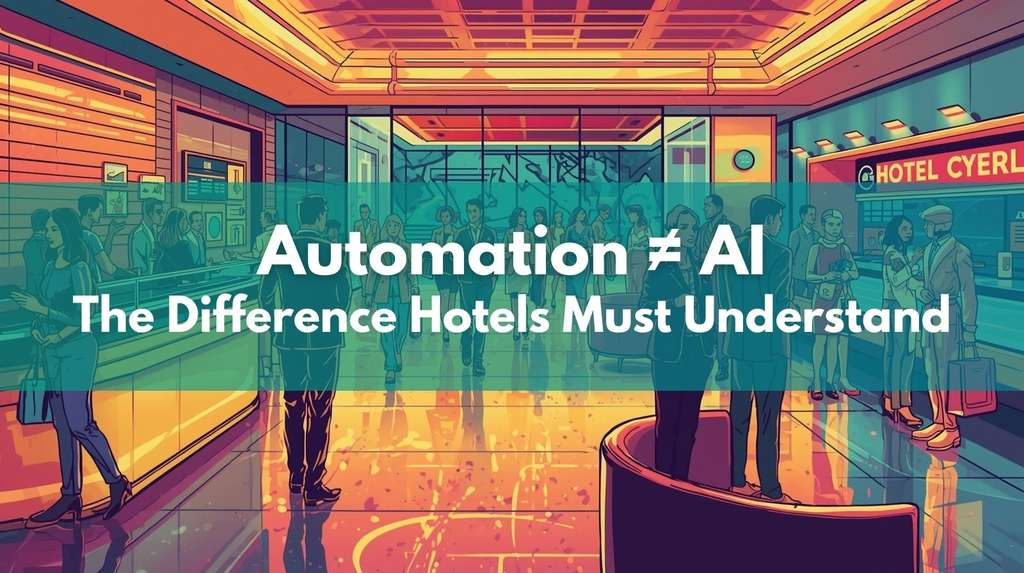
A new analysis from Hospitality Net argues that hotels are making a critical mistake by rushing toward advanced AI solutions while neglecting basic automation fundamentals. The piece emphasizes the crucial distinction between automation - which executes repetitive tasks with 99%+ reliability - and AI systems like LLMs that interpret data and make predictions but can suffer from hallucinations and cognitive bias.
According to research cited in the article, hotels are experiencing failures because teams misunderstand these differences, expecting AI to perform automation tasks and vice versa. The analysis suggests that while automation delivers immediate, reliable results for high-volume, low-margin daily hotel operations, AI should be viewed as an enhancement for tomorrow rather than a replacement for today's operational needs.
My Take: The hospitality industry basically wants to install a smart home system before they've figured out how to program the thermostat. It's like trying to teach your hotel to predict guest preferences when it still can't automatically turn off the lights when rooms are empty.
When: December 12, 2025
Source: hospitalitynet.org
Former GM Chief AI Officer Compares CAIO Role to Master Chef Managing Restaurant Kitchen

Barak Turovsky, former Chief AI Officer at General Motors and ex-Google AI executive, shares insights about the unique challenges of being a CAIO in a major corporation. Drawing from his experience leading the first scaled deployment of LLMs and Deep Neural Networks with Google Translate, plus executive roles at Cisco and a computer vision startup, Turovsky describes the role as being like a master chef who must coordinate multiple complex systems simultaneously.
The comparison highlights how CAIOs must balance technical expertise with business strategy, manage diverse teams and technologies, and ensure all AI initiatives work together harmoniously - much like a chef coordinating multiple dishes, timing, and kitchen staff to create a cohesive dining experience. His perspective comes from over a decade of AI work, starting in 2014 well before LLMs became mainstream.
My Take: Comparing a CAIO to a master chef is brilliant - both have to juggle multiple moving parts, deal with ingredients that don't always behave as expected, and somehow make it all come together while everyone's watching and expecting perfection. Plus both roles involve a lot of pressure and the occasional kitchen fire.
When: December 12, 2025
Source: businessinsider.com
Google Integrates Gemini AI Into Chrome for iPhone and iPad Users Across US
Google has rolled out its Gemini AI functionality to Chrome browsers on iPhones and iPads throughout the United States, eliminating the need for users to switch to the Google app or website to access the AI features. This integration comes several months after Google introduced Gemini to Chrome on Windows and Mac desktop platforms in September, with the company promising mobile support would follow.
The move addresses what experts call a 'noticeable gap' in AI accessibility for the millions of iPhone and iPad users who prefer Chrome over Safari. Android users already had access to Gemini through Chrome since it's the default browser on Android devices, making this release a significant step toward platform parity in Google's AI ecosystem.
My Take: Google just closed one of the most obvious gaps in their AI strategy - iPhone users who wanted to use Gemini in Chrome were basically digital nomads without a home. It's like finally putting Wi-Fi in the last corner of your house where you actually want to work.
When: December 12, 2025
Source: cnet.com
Google Upgrades Gemini Deep Research Agent with Enhanced Capabilities for Developers
Google announced a significantly more powerful version of its Gemini Deep Research agent, now available for third-party developers through Google AI Studio with consumer app integration coming soon. The upgraded agent achieves notable performance improvements across research benchmarks, scoring 46.4% on HLE (versus Gemini 3 Pro's 43.2%), 66.1% on DeepSearchQA (versus 56.6%), and 59.2% on BrowseComp (versus 49.4%). The enhanced capabilities will roll out to Google's consumer applications including Gemini, Google Search, and NotebookLM.
The Deep Research agent represents Google's push into autonomous research capabilities, allowing developers to integrate advanced research functions into their applications through a unified API. Google plans to expand built-in agents while enabling custom agent development, positioning the platform as a comprehensive solution for AI-powered research tasks. This release continues Google's aggressive expansion of Gemini capabilities following the successful launch of Gemini 3, which disrupted OpenAI's market position and triggered their recent 'code red' response.
My Take: Google is basically turning Gemini into a research assistant that never gets tired of digging through obscure papers and connecting dots that humans miss. It's like having a graduate student who actually enjoys literature reviews and never complains about having to fact-check everything twice. The real genius is making it available to developers - suddenly every app can have its own mini-researcher working behind the scenes.
When: December 11, 2025
Source: 9to5google.com
Accenture Expands AI Training with 30,000 Staff Learning Anthropic's Claude
Consulting giant Accenture announced a multi-year partnership expansion with Anthropic to train approximately 30,000 employees on Claude AI models, marking the company's largest ever AI deployment. The initiative focuses particularly on Claude Code, positioning developers across Accenture's global workforce to integrate the AI system into client workflows and internal operations. This move mirrors similar large-scale training programs as enterprises race to upskill their workforce on AI technologies.
The partnership reflects broader industry trends where consulting companies are becoming key distributors of AI capabilities to enterprise clients. Accenture CEO Dario Amodei emphasized the scale of the deployment, noting it represents a significant expansion of their existing relationship. The training program comes alongside Accenture's similar deal with OpenAI announced last week, where hundreds of thousands of IT workers will learn ChatGPT Enterprise, showing the company's multi-vendor AI strategy to serve diverse client needs.
My Take: Accenture is basically running an AI bootcamp for 30,000 people, which is either the most forward-thinking workforce development move ever or a really expensive way to discover that most consultants still prefer PowerPoint. It's like they're hedging their bets by training people on both Claude and ChatGPT - because nothing says 'we're prepared for the future' quite like teaching your entire workforce to use competing AI platforms simultaneously.
When: December 11, 2025
Source: itnews.com.au
Fei-Fei Li Champions Spatial Intelligence as AI's Next Revolutionary Frontier
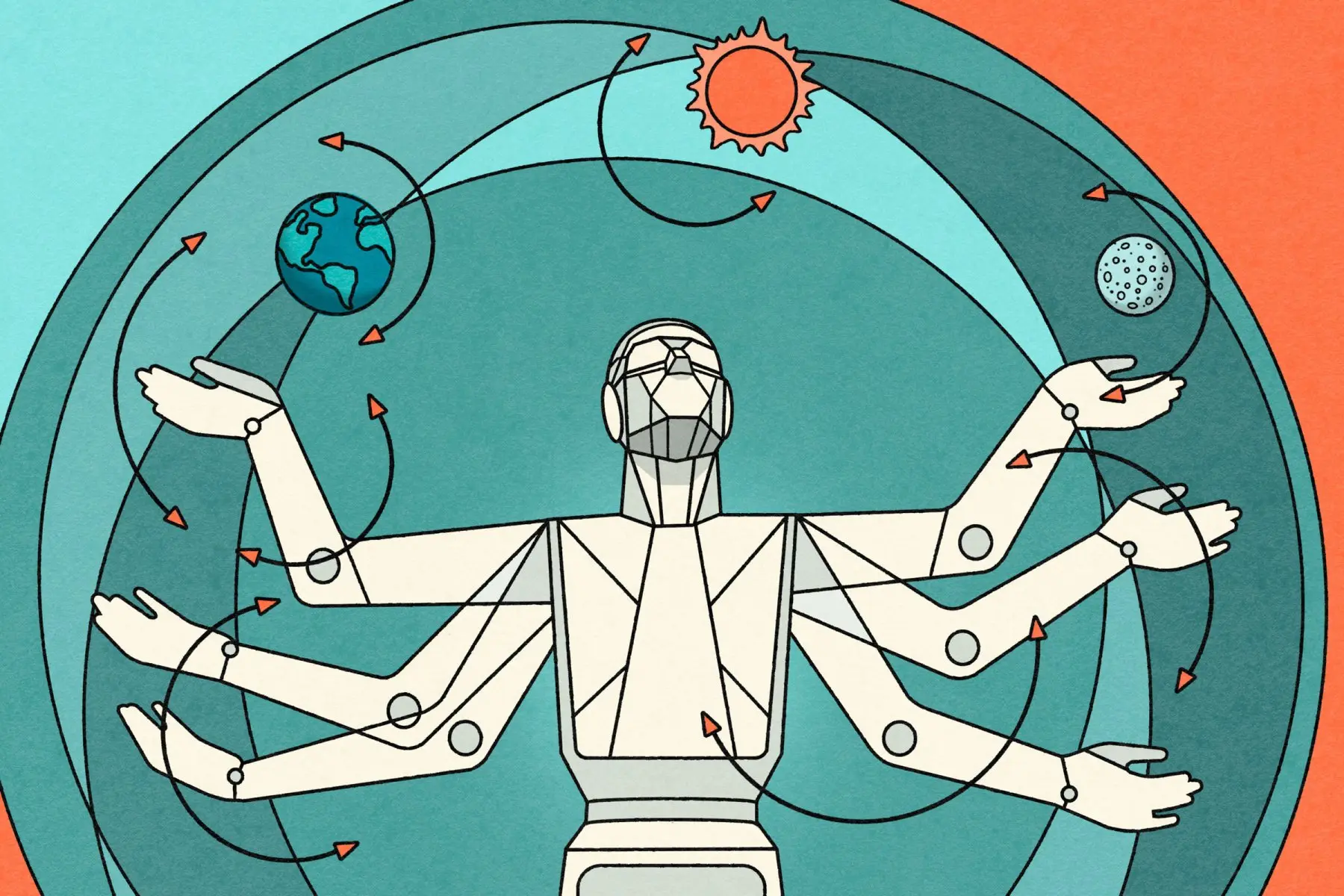
Stanford's AI pioneer Fei-Fei Li argues that spatial intelligence represents the next major breakthrough needed for artificial intelligence to truly understand and interact with the world. Writing in Time Magazine, Li explains that current large language models are 'wordsmiths in the dark' - eloquent but ungrounded in physical reality. She advocates for developing world models that can understand spatial relationships, geometry, and physical dynamics beyond today's text-based capabilities.
Li acknowledges that AI's spatial capabilities remain far from human-level performance, but notes significant progress through multimodal LLMs trained on visual data alongside text. These systems can now analyze images, answer questions about them, and generate realistic visual content. However, building truly spatially intelligent AI requires more ambitious world models that can reason about complex 3D environments, whether virtual or real, representing a fundamental evolution beyond current language-focused approaches.
My Take: Fei-Fei Li is basically saying that teaching AI to understand space is like the difference between a book-smart student and someone who can actually change a tire. Current AI can write poetry about a wrench, but ask it to virtually turn a bolt and it's completely lost. It's the kind of obvious-in-hindsight insight that makes you wonder why we've been so obsessed with making computers that can chat when we should be making them understand that things have actual locations and physics.
When: December 11, 2025
Source: time.com
OpenAI Releases GPT-5.2 After 'Code Red' Response to Google's Gemini 3 Dominance

OpenAI launched GPT-5.2 on Thursday following CEO Sam Altman's internal 'code red' alert in response to Google's Gemini 3 taking the lead on industry benchmarks. The new model comes in three variants: Instant for quick tasks, Thinking for complex work, and Pro for highest accuracy scenarios. OpenAI claims GPT-5.2 outperforms competitors on key metrics, scoring 55.6% on SWE-Bench Pro versus Gemini 3 Pro's 43.3%.
The release represents OpenAI's attempt to reclaim its position as the leading AI company after months of competitive pressure from Google and Anthropic. Despite company denials, the timing clearly responds to Gemini 3's November launch that captured top spots on LMArena leaderboards. The new model promises better performance in professional tasks like spreadsheet creation, coding, and complex multi-step projects, with OpenAI positioning it as 'the smartest generally-available model in the world.'
My Take: Nothing says 'this wasn't rushed' quite like releasing a major AI model days after declaring a company-wide emergency. It's like OpenAI pulled an all-nighter to one-up Google, then showed up to class pretending they'd been working on this project for months. The real question is whether GPT-5.2 can actually deliver on the hype or if it's just a really expensive participation trophy in the AI arms race.
When: December 11, 2025
Source: arstechnica.com
NeurIPS 2025 Marks 'Biology's Transformer Moment' with Record Attendance

The largest Neural Information Processing Systems (NeurIPS) conference to date drew over 24,000 machine learning experts to San Diego, featuring more than 5,000 accepted papers from over 21,000 submissions. The conference highlighted the growing intersection between AI and biology, with experts noting that this convergence is no longer niche but has become a major pillar of AI research.
According to conference organizers, the biology-AI intersection has evolved to stand alongside traditional AI pillars like computer vision and natural language processing. The event showcased cutting-edge research in biological applications of transformer models and other AI technologies, signaling a major shift in how machine learning is being applied to life sciences.
My Take: NeurIPS 2025 was basically where AI researchers realized that teaching computers to understand DNA is just as important as teaching them to understand memes. It's like the moment when nerds discovered that biology is just really complicated code that's been running for billions of years.
When: December 09, 2025
Source: genengnews.com
SciSciGPT Platform Advances Human-AI Collaboration in Science Research
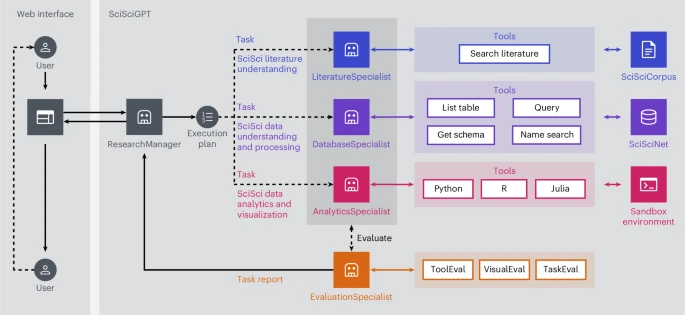
Researchers have developed SciSciGPT, a specialized AI system designed to enhance collaboration between human researchers and AI in the science of science field. The platform builds upon commercial LLMs like Anthropic's Claude and provides researchers with advanced tools for data analysis, reasoning, and scientific exploration.
In testing, SciSciGPT demonstrated significant advantages over human researchers working with standard AI tools like Claude 3.5, GPT-4o, and ChatGPT-o1. The modular system inherits the capabilities of its underlying backbone model while adding specialized features for scientific research tasks, representing a new approach to human-AI collaboration in academic research.
My Take: Scientists have basically created an AI research assistant that's like having a super-powered graduate student who never sleeps, never complains about coffee quality, and actually reads all the papers. It's the academic world's answer to 'what if we made AI specifically good at being nerdy?'
When: December 09, 2025
Source: nature.com
Anthropic's Philosopher Shares Advanced AI Prompting Strategies for Claude Users
Amanda Askell, Anthropic's resident philosopher and AI safety researcher, has shared expert tips for creating more effective AI prompts when using Claude. In Anthropic's 'Prompt Engineering Overview' published in July, the company advises users to think of Claude as 'a brilliant, but very new employee (with amnesia) who needs explicit instructions,' emphasizing that the AI lacks context about user norms, styles, guidelines, or preferred working methods.
Askell's approach focuses on providing precise explanations and detailed context to improve Claude's responses, recognizing that the quality of AI output is directly correlated with the specificity and clarity of the input prompts. This guidance comes from someone uniquely positioned at the intersection of AI development and philosophical thinking about AI systems, offering insights that go beyond basic prompting techniques to more sophisticated interaction strategies.
My Take: Having a philosopher teach people how to talk to AI is like having Socrates explain how to get better answers from a really smart parrot - it's all about asking the right questions in the right way. Askell basically figured out that Claude isn't psychic, so if you want good answers, you need to stop treating it like it can read your mind and start explaining what you actually want like you're training a very eager intern.
When: December 08, 2025
Source: businessinsider.com
Business Insider Tests OpenAI Staff's 6 ChatGPT Optimization Tips, Finds Dramatic Improvement
A Business Insider journalist tested six tips from OpenAI staff members for getting better results from ChatGPT and found the model became significantly more useful. The tips include using 'modes' like asking ChatGPT to respond in 'nerd mode' for exploratory responses or 'cynical mode' for critical analysis, asking harder questions rather than oversimplifying prompts, and regularly retrying tasks to 'pressure-test' the model's capabilities.
The testing revealed that many users have been underutilizing ChatGPT by asking overly simple questions, when the model actually performs better with more complex, detailed prompts. One particularly effective technique was the 'cynical mode,' which provided entertaining and insightful explanations of technical concepts like embodied intelligence, demonstrating how personality-based prompting can make AI interactions both more engaging and informative.
My Take: Turns out most people have been using ChatGPT like it's a magic 8-ball when they should be treating it like that one overachieving friend who actually read all the assigned reading. The 'cynical mode' is genius - finally, an AI that can match my natural skepticism and explain why 'embodied intelligence' sounds like something a venture capitalist made up after too much coffee.
When: December 08, 2025
Source: businessinsider.com
AI-Driven Network Optimization Evolves with Multi-Agent Systems and Edge Computing
The telecommunications industry is increasingly adopting AI-driven network optimization powered by machine learning algorithms, cloud computing, and edge computing technologies. These systems use predictive analytics to anticipate network problems before they occur, analyzing network performance data, fault logs, and environmental factors to identify patterns that typically precede failures, giving engineers the opportunity to fix issues before customers notice disruptions.
Modern AI-driven network optimization now relies heavily on multi-agent systems, where specialized AI agents work together to manage different aspects of network performance. This distributed approach mirrors the complexity of the networks themselves, with machine learning algorithms that learn dynamically from real-time data and become more accurate as planning and operational data accumulates, supported by scalable cloud infrastructure and low-latency edge processing.
My Take: Telecom companies finally figured out that instead of waiting for your internet to break and then scrambling to fix it, they can teach AI to spot the warning signs and fix problems before you even know they exist. It's like having a team of digital mechanics that can hear your network 'engine' starting to make weird noises and swap out parts before you're stuck on the side of the information superhighway.
When: December 08, 2025
Source: rcrwireless.com
Legal Industry Warned to Use Agentic AI Thoughtfully as Adoption Reaches 30%

More than 30% of US legal professionals now use generative AI to support their work, with even higher adoption rates at larger law firms, according to new research highlighted in Bloomberg Law. However, the industry is being cautioned about thoughtful implementation as nearly 80% of companies report that their adoption of generative AI has failed to materially impact their bottom line, suggesting widespread but ineffective deployment.
The research emphasizes the importance of understanding the autonomy spectrum in AI deployment, ranging from assistive AI with low autonomy and high human control, to fully agentic AI with high autonomy and minimal human oversight. Legal teams are being advised to map AI systems' positions on this spectrum to determine appropriate use cases and ensure that the integration delivers genuine value rather than simply following adoption trends.
My Take: The legal industry is learning what every other industry discovered the hard way - just because you can automate something doesn't mean you should. Turns out 80% of companies are basically paying premium prices for very expensive autocomplete that doesn't actually make their lawyers more profitable. It's like buying a Ferrari to sit in traffic - impressive on paper, useless in practice.
When: December 08, 2025
Source: news.bloomberglaw.com
BNY Bank Partners with Google to Deploy Gemini 3 for Advanced AI Banking Operations
BNY Bank has announced a partnership with Google to integrate Gemini 3 into their banking operations through an agentic AI system called Eliza. This collaboration represents a significant expansion of AI adoption in traditional banking, with BNY positioning itself as an early adopter of advanced AI technologies in financial services. The bank had previously announced a similar partnership with OpenAI and describes itself as 'the first major bank to deploy an AI Supercomputer (powered by NVIDIA) to accelerate processing capacity.'
The partnership focuses on implementing safety protocols while leveraging Google's latest AI capabilities for banking operations. This move comes as traditional financial institutions increasingly compete to integrate cutting-edge AI technologies, with BNY taking an aggressive approach by partnering with multiple AI providers including both Google and OpenAI to diversify their AI capabilities and reduce dependency on any single provider.
My Take: BNY is basically playing AI dating - they're not going exclusive with one chatbot, they're seeing both Google's Gemini and OpenAI's GPT at the same time. It's like they figured out that in the AI gold rush, you don't bet on one horse, you buy the whole stable. Smart move for a bank that probably still has COBOL code from the 1970s running somewhere in their basement.
When: December 08, 2025
Source: businessinsider.co
NetraAI Platform Uses Explainable AI and LLMs for Precision Clinical Trial Design
Researchers have developed NetraAI, a new AI-driven platform that uses explainable artificial intelligence and large language models to improve clinical trial design and patient selection. The platform employs persona-tuned LLMs to transform complex medical findings into transparent, clinically-actionable, and regulatory-aligned inclusion/exclusion criteria for clinical trials, with the first detailed report published in Nature.
The system was demonstrated in a Phase II ketamine trial for treatment-resistant depression, where NetraAI was benchmarked against traditional machine learning and LLM-based approaches for identifying response models. The platform positions LLMs in an augmentative rather than authoritative role, with all outputs subject to review by domain experts before use in trial design, representing a careful balance between AI capabilities and human oversight in medical research.
My Take: Finally, someone figured out how to make AI useful for something other than generating fake Drake songs - they're using it to help design better medical trials. NetraAI is like having a really smart medical consultant that can read through mountains of patient data and say 'hey, maybe we should only test this depression drug on people who fit these specific criteria,' except it can explain its reasoning instead of just spitting out black-box recommendations.
When: December 08, 2025
Source: nature.com
New Framework Classifies Human vs AI-Generated Text with 97% Accuracy Using Transformer Models
Researchers have developed a robust classification framework that can differentiate between human-written and AI-generated text from GPT-3.5 and GPT-4 with over 97% accuracy, according to a new study published in Nature. The research team constructed a balanced dataset of 20,000 samples from multiple sources and evaluated various approaches including traditional machine learning classifiers, deep neural networks, and advanced transformer models like RoBERTa and T5.
The study addresses growing concerns about AI-generated content detection by employing sophisticated preprocessing techniques, including text normalization and tokenization. Previous research by Islam et al. achieved only 77% accuracy using traditional algorithms, while this new approach using state-of-the-art transformer models represents a significant leap forward in AI detection capabilities, highlighting the ongoing arms race between AI generation and detection technologies.
My Take: Scientists have basically created an AI lie detector that's really good at spotting when another AI wrote something - it's like having a digital bloodhound that can sniff out robot prose. With 97% accuracy, it's more reliable than most humans at spotting AI text, which is both impressive and slightly terrifying since it means we're now in an arms race between AI writers and AI detectives.
When: December 08, 2025
Source: nature.com
Israeli AI Security Startup Irregular Tests Major AI Models Including GPT 5.1 for Vulnerabilities
Israeli cybersecurity startup Irregular, with $80 million in funding and rising revenues, has become a leading AI security lab testing major models like ChatGPT, Gemini, and Claude for vulnerabilities before they reach the public. Founded by Dan Lahav and Omer Nevo, the company connects directly to AI companies' development pipelines to run simulations, tests, and attacks on models to identify potential security risks that hackers and cybercriminals could exploit.
The company's work extends beyond traditional cybersecurity to a new field focused on understanding AI behavior to prevent broader risks to humanity. With strong confidentiality agreements in place, Irregular has tested recent models including GPT 5.1, Claude 4.5, and Gemini 2.5, positioning themselves as crucial gatekeepers in the AI development process as the industry moves toward Artificial General Intelligence (AGI).
My Take: While everyone's been worried about AI taking over the world, these Israeli founders figured out how to make money being the AI world's security guards. They're basically like ethical hackers, except instead of breaking into your email, they're making sure GPT doesn't accidentally teach someone how to build a bomb or hack into the Pentagon.
When: December 08, 2025
Source: ynetnews.com
Human Researchers Still Outperform AI in Writing Trustworthy Systematic Reviews

A new study published in News-Medical reveals that despite advances in large language models like GPT-4 and BERT, human researchers continue to outperform AI when it comes to writing reliable systematic reviews for medical research. The research highlights significant limitations in current LLMs, particularly their lack of access to electronic databases for scientific articles and training datasets that contain relatively few original research papers.
While LLMs have shown promise in various medical tasks including RNA sequencing data annotation and medical report drafting, their accuracy in systematic review writing remains compromised. The study suggests these limitations stem from restricted database access and insufficient exposure to primary research literature during training, raising important questions about AI's readiness for critical medical research applications.
My Take: So AI can write poetry and generate memes, but ask it to properly review medical literature and suddenly it's like a med student who skipped all the journal readings. Turns out there's still no substitute for humans when you need someone who actually knows how to dig through databases and spot the difference between good science and statistical noise.
When: December 08, 2025
Source: news-medical.net
Anthropic Launches AI-Powered Interview Tool 'Anthropic Interviewer' for Large-Scale User Research
Anthropic has unveiled a groundbreaking survey methodology using their new AI tool called 'Anthropic Interviewer,' powered by Claude, to conduct detailed interviews automatically at unprecedented scale. The company used this tool to run extensive surveys about how users interact with Claude.ai, discovering that the platform is primarily used for work-related tasks, with roughly 10% of responses going to web and mobile application development, 7% for education, and nearly 6% for business strategy and operations.
This represents a significant shift in research methodology, allowing companies to conduct what would normally require hundreds of human-conducted interviews through AI automation. The results feed back to human researchers for analysis, combining the scale benefits of AI with human oversight for interpretation and strategic decision-making.
My Take: Anthropic basically created an AI that interviews people about AI - it's like inception but for market research. Instead of hiring an army of consultants to ask 'how do you feel about our chatbot?', they just taught Claude to be a really persistent pollster. The results show people mainly use AI for actual work, not just asking it to write haikus about their cats.
When: December 08, 2025
Source: forbes.com
Humai.blog Launches ToolsCompare.ai: Revolutionary AI Tool Comparison Platform
Humai.blog has introduced ToolsCompare.ai, an innovative platform for side-by-side comparisons of over 70+ AI tools across categories like marketing, image generation, coding, and chatbots. Users can easily evaluate options such as ChatGPT vs. Claude or Midjourney vs. DALL-E based on pricing, features, user reviews, and real-time updates, making informed decisions faster.
What sets ToolsCompare.ai apart is its focus on honest, fact-based comparisons without ads, incorporating fresh 2025 developments like Claude Opus 4.5. Unlike generic review sites, it offers deep, user-centric insights and free access, filling a market gap for truly comprehensive AI tool evaluations.
When: December 06, 2025
Source: toolscompare.ai
How Agentic AI Can Boost Cyber Defense
Transurban developed an agentic AI system using Anthropic's Claude to handle security tickets automatically, integrating with their Splunk SIEM and ServiceNow systems. The company chose this approach over hiring more security analysts due to cost and retention challenges.
The AI system includes two trained agents that perform quality checks and improve real-time accuracy of security events. This represents a practical implementation of AI agents in enterprise cybersecurity, showing how companies are moving beyond chatbots to automated security operations.
My Take: Finally, someone figured out that the real security problem isn't finding threats - it's having enough humans to actually deal with them all. Transurban basically said 'we can't hire enough cybersecurity people, so let's teach Claude to be one.' It's like having a security guard that never sleeps, never asks for a raise, and actually reads every alert.
When: December 4, 2025
Source: darkreading.com
ChatGPT 5.1 vs. Claude Opus 4.5: Feature-Rich vs Human-Like
CNET's detailed comparison reveals ChatGPT 5.1 has more features and better voice capabilities, while Claude Opus 4.5 excels at conversational quality and shopping assistance. ChatGPT's voice mode is significantly more advanced, with better visual AI capabilities for tasks like fashion advice.
Claude's responses sound more human and less robotic, making it better for text-based interactions. However, ChatGPT's feature completeness and proactive suggestions make it more suitable for general users, despite Claude's superior conversational style.
My Take: It's like comparing a Swiss Army knife to a really good chef's knife - ChatGPT does everything but Claude does conversation better. The fact that Claude can't figure out what color your sweater is while ChatGPT is out here giving fashion advice really shows how much voice and vision matter in the AI race.
When: December 3, 2025
Source: cnet.com
AI Gets Better at Hacking Smart Contracts
New research shows AI agents are becoming more sophisticated at finding vulnerabilities in blockchain smart contracts, with security researchers already using Claude to discover critical bugs in major protocols like Ethereum's Aztec network. One researcher found a critical vulnerability in Aztec's rollup contracts using Claude Code assistance.
The same AI technology that can exploit smart contracts is also being used defensively for security audits and code reviews. Security experts note that LLMs are becoming 'real collaborators' in the security space, though some question whether AI discoveries are truly novel or just surfacing overlooked existing research.
My Take: So we've taught AI to be both the locksmith and the burglar - it can find the security holes AND help fix them. It's like having a reformed thief consulting on home security, except the thief is a robot that's read every heist movie ever made. At least when Claude finds a bug, it doesn't demand ransom payment.
When: December 5, 2025
Source: gizmodo.com
Research Shows LLMs Behave Differently Across Languages
Harvard Business Review published research revealing that leading LLMs respond differently when prompted in English versus Chinese, challenging the assumption that AI tools behave consistently across languages. This has significant implications for global organizations relying on AI for decision-making and strategy.
The findings suggest that language choice could influence AI outputs in ways that affect business decisions, risk assessments, and strategic planning. Organizations scaling AI tools internationally need to account for these linguistic variations in their AI governance and implementation strategies.
My Take: Turns out AI has cultural bias baked right into its neural networks - ask it something in English and get one answer, ask in Chinese and get another. It's like having a translator who doesn't just change the language but completely changes their personality too. Global companies are about to realize their 'universal' AI strategy isn't so universal after all.
When: December 3, 2025
Source: hbr.org
The Impact of AI on Legal Professionals' Critical Thinking
Thomson Reuters released a white paper examining how AI is transforming legal work, focusing on CoCounsel Legal - their AI solution that unites research, drafting, and document analysis. The research explores how legal professionals can harness AI's power to amplify critical thinking rather than diminish it.
The paper addresses lawyers' concerns about AI reshaping their field and provides strategies to ensure human judgment remains central in an AI-augmented legal future. It covers how to maintain critical legal thinking skills while leveraging AI for enhanced productivity and client service.
My Take: Lawyers are finally asking the right question: 'How do we use AI without letting it do our thinking for us?' It's like having a really smart paralegal who's read every case ever filed, but you still need to be the one making the actual legal arguments. The legal profession might be the first to figure out the sweet spot between AI assistance and human expertise.
When: December 4, 2025
Source: legal.thomsonreuters.com
Why NPUs in Phones Aren't Making AI Better Yet
Ars Technica explores why increasingly powerful Neural Processing Units (NPUs) in smartphones aren't translating to significantly better AI experiences. While on-device models like Gemini Nano have improved context windows (32k tokens vs previous versions), cloud-based models still vastly outperform with up to 1 million token context windows.
The fundamental issue is that NPUs often sit idle because the most capable AI models are designed for server environments where they run best. Local AI is resource-constrained compared to server-based AI like full Gemini and ChatGPT, creating a natural preference for cloud-based solutions despite the hardware improvements.
My Take: Phone makers keep bragging about their NPU power like it's a sports car engine, but most AI still runs in the cloud because that's where the real horsepower lives. It's like having a Ferrari in your garage but taking the bus everywhere because the roads can't handle the car. Until on-device models catch up to cloud capabilities, those NPUs are expensive paperweights.
When: December 4, 2025
Source: arstechnica.com
Neurologik Launches AI Workforce for Manufacturing
Manufacturing startup Neurologik launched an 'AI Workforce' platform designed to address the industry's talent shortage, particularly as experienced engineers retire. Unlike generic LLMs that struggle with industrial precision, Neurologik's proprietary architecture is built specifically for physical world applications.
The platform integrates complex product logic, safety standards, and historical data to automate high-stakes workflows like product configuration, technical validation, and solution design - tasks that previously required decades of human experience. This represents a shift toward vertical AI solutions tailored for specific industry needs.
My Take: While everyone's been teaching AI to write poetry and generate memes, Neurologik figured out how to make AI that actually understands nuts, bolts, and safety standards. It's like the difference between a chatbot that can talk about cars and a mechanic who can actually fix one. Finally, someone's building AI for the real world instead of the internet world.
When: December 3, 2025
Source: aithority.com
Why Regulating AI Agents and Governance Go Hand in Hand
Forbes analyzes how Anthropic is expanding enterprise business by integrating different Claude functions, with over 60% of business customers using multiple Claude products. The company expects 300,000 enterprise customers by year-end, up from 1,000 two years ago, with enterprise business accounting for 80% of revenue.
Google's competing Gemini Enterprise platform focuses on creation and integration tools, connecting AI models to enterprise data infrastructures across Google Workspace, Microsoft 365, Salesforce, and other business systems. The piece emphasizes the critical need for governance frameworks as AI agents become more autonomous in enterprise environments.
My Take: The real AI battle isn't happening in consumer chatbots - it's in boring enterprise software where the actual money is made. Anthropic figured out that businesses don't want one AI tool, they want an AI ecosystem that talks to their existing mess of software. It's like selling a smartphone vs selling the entire app store.
When: December 4, 2025
Source: forbes.com
Nature Study: Computing Power Ends the Intelligence Debate
A fascinating Nature piece argues that intelligence emerges from changes in structural scale rather than hardware capabilities, drawing parallels between AI development and biological evolution. The article suggests humans and machines form a 'technological symbiotic relationship' where AI becomes the latest layer of cognitive enhancement.
The study proposes that AI follows the same evolutionary pattern as life itself - cells forming tissues, individuals forming groups, groups forming societies. Modern AI's power comes from collective computing units working together, not from individual component limits, representing a 'scaled-up collaboration' approach to intelligence.
My Take: Nature basically said 'intelligence isn't about being smart, it's about being organized' - which explains why my incredibly powerful gaming rig still can't help me remember where I put my keys. The idea that AI is just the next layer of human cognitive evolution is either deeply profound or a really fancy way of saying 'teamwork makes the dream work.'
When: December 5, 2025
Source: eu.36kr.com
The New Battle Over Compute Infrastructure: Who Owns The Future Of AI?
As AI models like OpenAI's GPT-5, Google's Gemini, and xAI's Grok grow more complex, they're placing extraordinary pressure on existing compute infrastructure. This has sparked interest in distributed networks that can supplement traditional data center capacity, creating a new battleground for AI supremacy.
The situation mirrors the early industrial age when bold ideas needed steel, electricity, and reliable transport networks to become reality. Today's equivalent foundation is the ability to train and run advanced models at meaningful scale, making compute infrastructure the new critical bottleneck in AI development.
My Take: While everyone's fighting over who has the smartest AI model, the real war is happening in the server farms. It's like having the world's fastest race car but no race track - all the fancy algorithms mean nothing without the compute power to run them at scale.
When: December 3, 2025
Source: forbes.com
Joint Modelling of Brain and Behaviour Dynamics with Artificial Intelligence
New research published in Nature explores how artificial intelligence can be used to jointly model brain dynamics and behavioral patterns. The study references advanced AI models including GPT-4 and discusses applications like AmadeusGPT for interactive animal behavioral analysis.
The research represents a significant step forward in computational neuroscience, showing how modern AI techniques can help scientists better understand the complex relationships between neural activity and observable behaviors across different species.
My Take: Scientists are basically teaching AI to be mind readers - but for lab rats and monkeys. It's fascinating that we're using artificial intelligence to decode natural intelligence, like using a computer to understand how computers might work if they were made of meat.
When: December 3, 2025
Source: nature.com
Data, Metrics Once Unattainable Now Possible With AI
Marketing analytics company Jellyfish has introduced a groundbreaking 'Share of Model' tool that uses AI models like Gemini, ChatGPT, Llama, and Claude to automatically optimize advertising campaigns. The tool analyzes how AI models understand and discuss brands, creating a new data layer for ad optimization.
This represents the first use of brand perception from AI models and assistants to automatically optimize ads, moving beyond traditional performance history and creative assets to leverage how AI interprets brand messaging and customer interactions.
My Take: So now we're not just optimizing ads for humans, but for how AI thinks about our brands. It's like focus groups, but the participants are robots who've read the entire internet. The meta level here is wild - AI helping us advertise better to humans who increasingly interact with AI.
When: December 1, 2025
Source: mediapost.com
Google's Plan to Win the AI Race Is All About Getting a Little Too Personal
Google's strategy to dominate AI centers on leveraging its vast ecosystem of personal data through Gemini integration across Gmail, Calendar, Drive, Maps, YouTube, and more. The company has also launched a new Chrome browser with deep Gemini integration, including agentic AI that can navigate the web autonomously.
This approach gives Google a significant advantage over competitors like OpenAI, as Gemini can access intimate details about users' communications, schedules, locations, and digital behaviors to provide highly personalized AI assistance across all Google services.
My Take: Google's basically saying 'we'll make the smartest AI by knowing everything about you.' It's the ultimate trade-off - incredibly useful AI that knows your email, your calendar, your photos, and probably what you had for breakfast. Privacy advocates are having nightmares, but users will probably love the convenience.
When: December 2, 2025
Source: gizmodo.com
Could Artificial General Intelligence Become a Reality?
New research from UC San Diego found that OpenAI's GPT-4.5 model passed the Turing test better than humans 73% of the time, though researchers concluded this doesn't prove human-level intelligence was achieved. The study suggests these results show AI's potential to substitute for humans in limited-duration interactions.
Experts note that while current AI models still struggle with long-horizon planning and causal reasoning, there has been exciting progress toward AGI. Large language models can now reason, code, use tools, and even perform on par with gold medalists in international mathematics competitions, though the timing for true AGI remains uncertain.
My Take: We're in this weird zone where AI can beat math olympians but still can't figure out that you probably don't want to put glue on your pizza. The Turing test results are impressive, but passing a conversation test and actually thinking are very different things - it's like the difference between a really good actor and actually being the character.
When: December 2, 2025
Source: edtechmagazine.com
Anthropic Studied Its Own Engineers to See How AI Is Changing Work
Anthropic conducted an internal study of its own engineers to understand how AI tools like Claude Code are impacting work patterns and productivity. Employees reported feeling more productive with wider skill sets, but also expressed concerns about the technology's effects on collaboration and mentorship.
The study revealed mixed feelings among workers, with some worrying about AI's impact on job relevance and team dynamics. This research provides valuable insights into how AI adoption is reshaping professional environments, particularly in technical fields where AI coding assistants are becoming standard tools.
My Take: It's pretty meta that the company making AI studied how their own AI affects their workers. The results sound like every workplace technology adoption ever - 'This makes me more productive, but I'm worried it might make me obsolete.' At least they're asking the hard questions before rolling it out to everyone else.
When: December 3, 2025
Source: businessinsider.com
Key Questions CISOs Must Ask Before Adopting AI-Enabled Cyber Solutions
Cybersecurity leaders are grappling with critical decisions about AI integration, including whether to build proprietary large language models on-premises, in the cloud, or rely on third-party LLMs. The challenge extends to protecting sensitive information as everyday SaaS productivity tools increasingly incorporate AI into workflows.
The article highlights the growing complexity of AI security considerations, as organizations must balance the benefits of AI-enabled cyber solutions with the risks of exposing sensitive data through AI interactions and the potential vulnerabilities introduced by AI systems themselves.
My Take: CISOs are stuck in an impossible position - they need AI to defend against AI-powered attacks, but using AI means potentially exposing the very data they're trying to protect. It's like hiring a bodyguard who might be working for the other side. The questions they're asking aren't just technical, they're existential.
When: December 2, 2025
Source: csoonline.com
Inside Visa's Cyber Defense: CISO Blends AI and Human Intelligence for Threat Detection
Visa's CISO Subra Kumaraswamy revealed how the company uses AI and machine learning to process 22 billion data points and convert them into just hundreds of actionable security events for investigation. This approach allows Visa to find 'needles in the needle stack' by dramatically reducing noise while maintaining comprehensive threat detection.
The integration of AI with human expertise represents a practical approach to cybersecurity at scale, where automated systems handle the massive data processing while human analysts focus on investigating the most relevant threats identified by AI algorithms.
My Take: 22 billion data points down to hundreds of events - that's like turning a library into a tweet, but somehow keeping all the important parts. Visa figured out that the real power isn't replacing humans with AI, it's using AI to make humans incredibly efficient at what they're already good at.
When: December 3, 2025
Source: csoonline.com
New Research Shows LLMs Excel at Cell-Type Annotation in Biomedicine
Multiple large language models have been developed specifically for biomedical applications, including scBERT, tGPT, CellLM, and Geneformer for cell-type annotation. Some models like scGPT and scFoundation handle multiple biological tasks beyond just annotation.
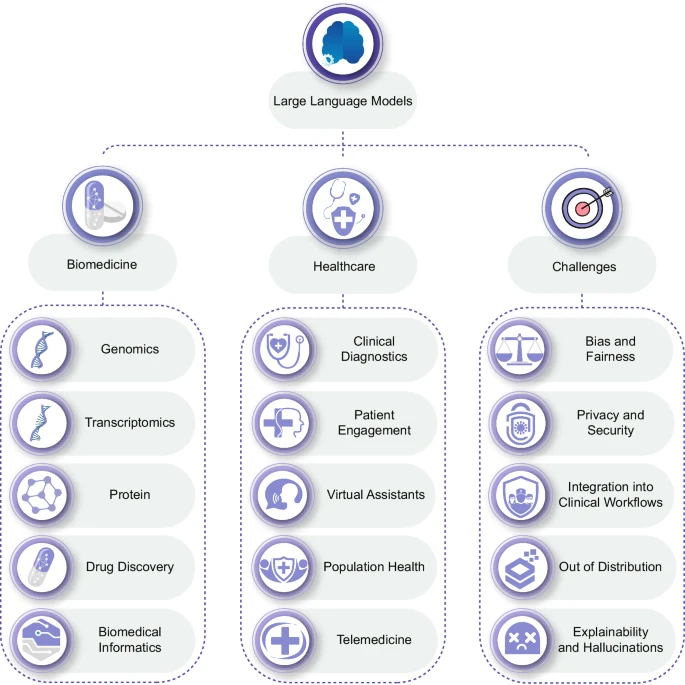
These specialized LLMs use techniques like rank-based approaches and metric learning frameworks to address challenges like batch effect correction in biological data. The models demonstrate how AI is becoming increasingly specialized for scientific applications, moving beyond general-purpose chatbots into domain-specific expertise.
My Take: While everyone's arguing about ChatGPT vs Gemini for writing emails, scientists are quietly building AI that can actually understand biology at the cellular level. These specialized models could accelerate drug discovery and medical research in ways that general AI never could.
When: December 1, 2025
Source: nature.com
ChatGPT Celebrates Third Birthday as Banking Industry Transforms
Three years after ChatGPT's launch on November 30, 2022, the AI model that reached 1 million users in five days and 100 million in two months has fundamentally transformed the banking and financial services industry. The release triggered an AI revolution that pushed Google to accelerate Gemini development, revitalized Microsoft's market position, and sparked massive venture capital investments.

The impact has been seismic across financial institutions, with global spending on AI data centers expected to exceed $1.4 trillion between 2024 and 2027. Led by CEO Sam Altman, OpenAI ushered in what many consider a new industrial revolution, with AI now adopted by many of the world's biggest companies and financial institutions.
My Take: It's wild to think that just three years ago, most people had never heard of ChatGPT, and now it's reshaping entire industries. The fastest consumer product adoption in history really did change everything - from how banks operate to how we think about work itself.
When: December 3, 2025
Source: finextra.com
French AI Startup Mistral Releases Multilingual Large Language Model 3
French AI company Mistral AI has announced Mistral Large 3, a new general-purpose large language model designed to compete with ChatGPT and Gemini. The company, founded by former Google DeepMind and Meta researchers, is focusing on bringing high-end AI capabilities to more people regardless of location, internet reliability, or language barriers.

Mistral also released smaller models designed to run on devices like laptops, smartphones, cars, and robots, which can be customized for specific tasks. The company offers a chatbot called Le Chat and is better known in Europe than rivals like OpenAI and Anthropic in the US market.
My Take: Mistral is quietly building a European alternative to the US AI giants, and their focus on multilingual capabilities and on-device models could be their secret weapon. While everyone's watching the OpenAI vs Google drama, Mistral might be positioning itself perfectly for the next phase of AI adoption.
When: December 3, 2025
Source: cnet.com
Study Reveals Using AI for Information Could Reduce Human Knowledge Retention
New research suggests that relying on large language models like ChatGPT to find information might diminish people's ability to retain and internalize knowledge. The study, conducted by researchers studying the psychology of new technology, found that the effortless nature of AI-generated responses may make learning too passive, potentially reducing deep understanding.
Researchers tested solutions including specialized GPT models that provide real-time web links alongside synthesized responses to make AI learning more active. The study emphasizes that people need to become smarter, more strategic users of LLMs, understanding when they're beneficial versus harmful to learning goals rather than avoiding them entirely.
My Take: This is the 'Google effect' on steroids - just like we stopped memorizing phone numbers when smartphones arrived, AI might be making us intellectually lazy. The irony is that the tool designed to make us smarter might actually be making us more dependent and less knowledgeable.
When: December 3, 2025
Source: sciencealert.com
Manufacturing Startup Neurologik Launches 'AI Workforce' to Address Talent Shortage
Neurologik has launched what it calls an 'AI Workforce' specifically designed to solve manufacturing's talent shortage crisis. Unlike generic Large Language Models that struggle with industrial precision, Neurologik's proprietary architecture is built for the physical world, integrating complex product logic, safety standards, and historical data.
The platform automates high-stakes workflows such as product configuration, technical validation, and solution design that previously required decades of human experience. This addresses the challenge that while generic LLMs are probabilistic and predict likely responses, manufacturing requires the precision and reliability that comes from expert knowledge and rules-based systems.
My Take: Finally, someone's building AI for the real world instead of just chatbots. Manufacturing has been crying out for solutions to replace retiring experts, and purpose-built AI that understands safety standards and physical constraints could be a game-changer for industrial automation.
When: December 3, 2025
Source: aithority.com
Start-ups Aim to Revolutionize Bug Detection for Vibe Coders
A new wave of startups is targeting the bug detection market specifically for 'vibe coders' - developers who prioritize workflow aesthetics and user experience. These companies are developing AI-powered tools that integrate seamlessly into modern development environments.

The trend reflects the growing importance of developer experience in coding tools, with startups recognizing that effective bug detection isn't just about finding errors, but presenting them in ways that align with how modern developers work and think.
My Take: Finally, someone's addressing the elephant in the room - developers care about how their tools look and feel, not just functionality. If your bug detector has the UI of a 1990s enterprise app, good luck getting adoption.
When: December 3, 2025
Source: startupecosystem.ca
Virgin Australia and Wesfarmers Strike Major OpenAI Partnerships
Virgin Australia and Australian conglomerate Wesfarmers have announced significant partnerships with OpenAI to integrate AI capabilities across their operations. Virgin Australia plans to use AI for customer service, flight operations, and personalized travel experiences, while Wesfarmers will deploy AI across its retail and industrial divisions.

Wesfarmers specifically highlighted plans to use AI for demand forecasting, product design, customer service, marketing effectiveness, and conversational commerce. The deals represent major enterprise adoption of OpenAI's technology in the Australian market, demonstrating the global reach of AI integration beyond tech companies.
My Take: While OpenAI fights 'code red' battles with Google, they're quietly locking in major enterprise deals. Smart move - consumer attention is fickle, but enterprise contracts with airlines and retail giants provide steady revenue streams.
When: December 3, 2025
Source: itnews.com.au
Google Stock Surges 66% as TPU Chips Challenge Nvidia's AI Dominance
Google's stock has jumped 66% as analysts predict the company's TPU chips could capture 25% of the AI chip market by 2030, worth $440 billion. The chips offer lower cost-per-compute and strong performance, attracting customers like Anthropic and Meta beyond Google's own services.
My Take: This represents a significant shift in the AI infrastructure landscape. While everyone's been focused on the AI model wars between OpenAI and Google, the real money might be in the chips powering these systems. Google's vertical integration strategy - controlling both the AI models and the hardware - could give them a massive competitive advantage.
When: December 3, 2025
Source: forbes.com
OpenAI Reports 6% User Drop in Single Week Following Google Gemini 3 Launch
OpenAI reportedly lost 6% of its user base in just one week after Google released Gemini 3, prompting the company's 'code red' response. The user exodus highlights how quickly market dynamics can shift in the competitive AI landscape.
My Take: A 6% user drop in a week is massive for a platform with 800 million weekly users - that's roughly 48 million people switching away. This shows users aren't locked into AI platforms like they are with social media. Quality and performance matter more than brand loyalty in AI, making this space incredibly volatile.
When: December 3, 2025
Source: mashable.com
Anthropic Makes First Acquisition with Bun Purchase to Boost Claude Code
AI startup Anthropic has acquired Bun, the engine powering its fast-growing Claude Code programming agent, in the company's first acquisition. Claude Code has reportedly generated $1 billion in revenue just six months after its public debut in May.
My Take: This acquisition signals Anthropic's commitment to the developer market and shows how quickly AI coding tools can generate massive revenue. With $1 billion in just six months, Claude Code is proving that specialized AI agents can be incredibly lucrative - no wonder Microsoft and Nvidia are pouring $15 billion into the company.
When: December 3, 2025
Source: adweek.com
Google's Gemini Adds 200 Million Users in Just 3 Months
Google's AI user base is experiencing explosive growth, with Gemini adding 200 million users in three months. The rapid expansion is fueled by popular tools like the Nano Banana image model and the highly-praised Gemini 3 model that outperformed competitors on industry benchmarks.
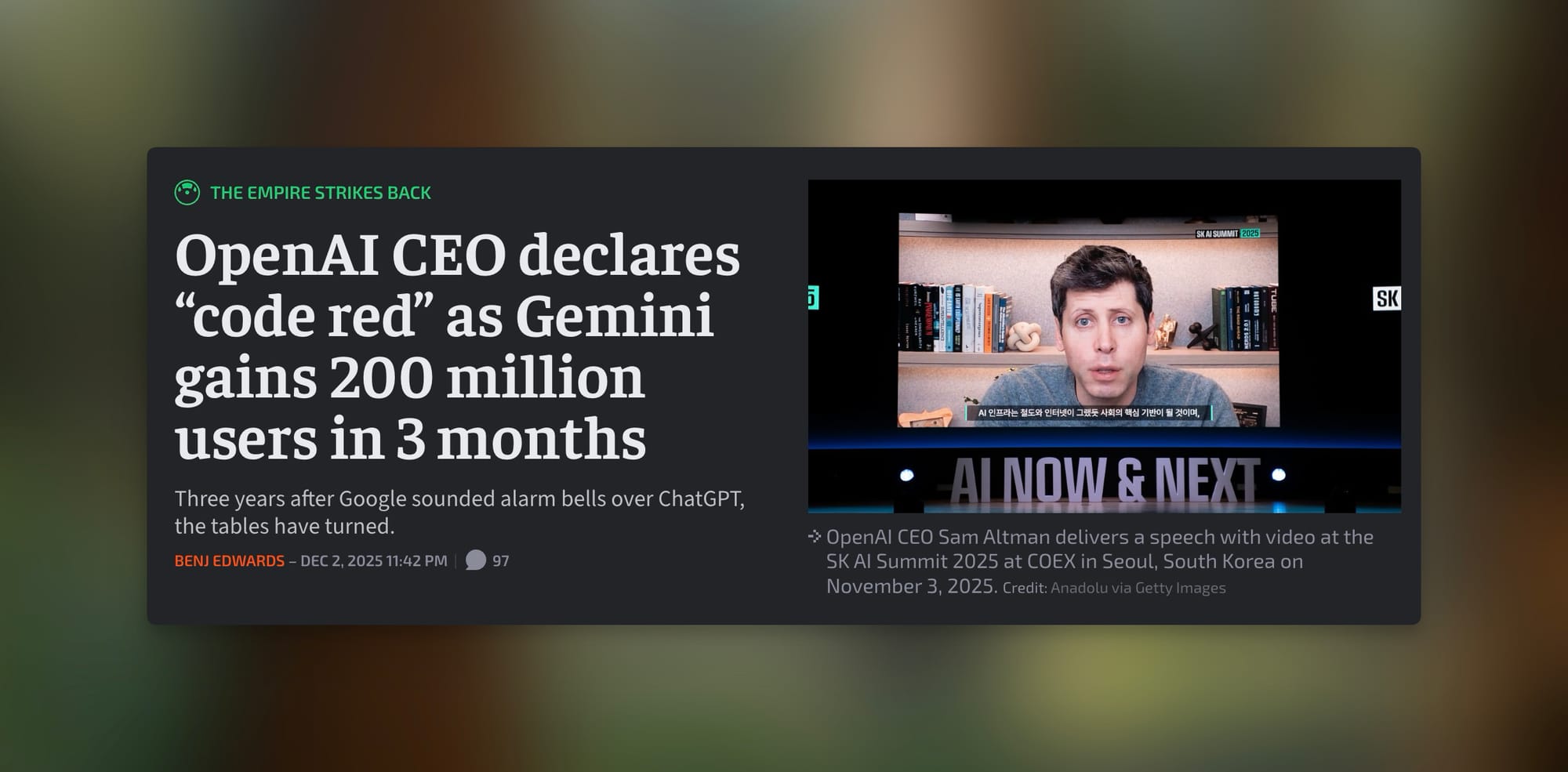
My Take: These numbers show Google is successfully leveraging its massive platform advantage to catch up in the AI race. While OpenAI had the early lead, Google's integration across its ecosystem and superior latest model are clearly resonating with users - explaining why Sam Altman felt compelled to declare 'code red.'
When: December 3, 2025
Source: arstechnica.com
OpenAI Delays Shopping, Health, and Ad Features to Focus on Core ChatGPT
Following Sam Altman's 'code red' memo, OpenAI is pushing back planned initiatives including advertising integration, AI agents for health and shopping, and a personal assistant feature called Pulse. The company is refocusing entirely on improving ChatGPT's core capabilities.
My Take: This strategic pivot reveals just how seriously OpenAI views the competitive threat from Google and Anthropic. By abandoning potentially lucrative revenue streams like advertising to focus on product quality, OpenAI is essentially admitting they can't afford to diversify right now - they need to win the core AI battle first.
When: December 3, 2025
Source: nypost.com
OpenAI Teases New 'Garlic' AI Model to Counter Google's Gemini 3
As part of its competitive response, OpenAI is reportedly developing a new AI model codenamed 'Garlic' that the company claims tested ahead of Google's flagship Gemini 3 model. The company is also prioritizing its Imagegen image generation model for ChatGPT users.

My Take: The fact that OpenAI felt compelled to leak performance claims about an unreleased model shows how much pressure they're under. This kind of preemptive marketing is unusual for the typically secretive company, suggesting Google's Gemini 3 success has genuinely rattled them. The real test will be whether 'Garlic' can deliver on these bold promises.
When: December 3, 2025
Source: businessinsider.com
Global AI Arms Race Intensifies as New Players Enter the Field
French startup Mistral unveiled new models while Amazon rushed out its latest AI chip to compete with Nvidia, showing the AI competition has expanded far beyond the OpenAI-Google rivalry.
My Take: The AI landscape is fragmenting in fascinating ways. While OpenAI and Google duke it out, companies like Mistral are carving out European alternatives, and Amazon is building the infrastructure layer. We're seeing the birth of an entire AI ecosystem, not just a two-horse race.
When: December 3, 2025
Source: cnbc.com
AI Shopping Revolution Heats Up This Holiday Season
Amazon, Google, and OpenAI are racing to create seamless AI-powered shopping experiences that take consumers from browsing to buying without leaving their platforms, potentially disrupting traditional retail.
My Take: This is where AI gets really interesting for consumers. Imagine an AI that knows your style, budget, and needs so well it can handle your entire holiday shopping list. The company that cracks this first could fundamentally change how we buy everything.
When: December 3, 2025
Source: latimes.com
AI Companies Launch Nonprofit Initiatives for Giving Tuesday
Anthropic joined Google and OpenAI in offering discounted AI services to nonprofits, partnering with organizations like Robin Hood to understand how AI can maximize social impact.

My Take: Smart PR move during a heated competitive period. While OpenAI scrambles with 'code red' and IPO rumors swirl, showing social responsibility helps build public trust. Plus, nonprofits are great testing grounds for AI applications without the pressure of enterprise sales.
When: December 3, 2025
Source: nbcnews.com
Anthropic Eyes One of History's Largest IPOs in Race Against OpenAI
The AI company behind Claude has engaged top-tier law firm Wilson Sonsini and major banks for a potential 2026 public listing, with recent valuations reaching $350 billion after massive investments from Microsoft and Nvidia.
My Take: Anthropic is making a bold power play while OpenAI is distracted by competitive pressure. Going public first could give them a huge advantage in the AI arms race - public markets mean more capital, more credibility, and the ability to attract top talent with stock options.
When: December 3, 2025
Source: cnbc.com
Massive Claude AI outage, users are unable to log into their accounts.
A widespread outage is currently affecting Claude AI, with numerous users reporting that they are unable to access their accounts or log into the service. The platform appears to be experiencing major technical difficulties, leading to frustration among those trying to use its features.
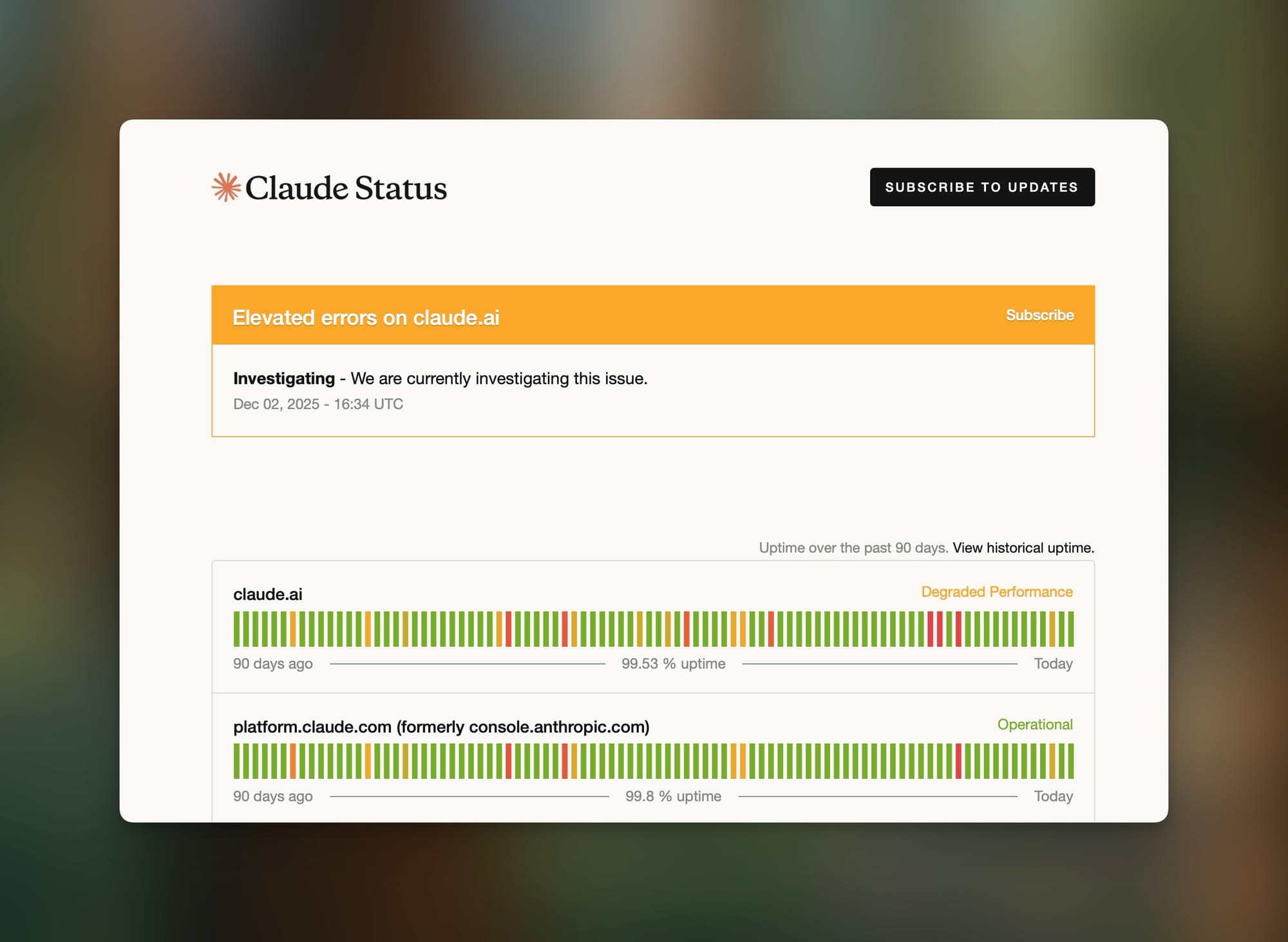

According to updates provided on the official website, the issues have been acknowledged and are being actively monitored. The development team has confirmed that they are aware of the situation and are diligently working to identify the root cause and implement a solution as quickly as possible.
Investigating - We are currently investigating this issue.
Dec 02, 2025 - 16:34 UTC
When: December 2, 2025
Source: status.claude.com
My take: The phrase "Impossible? Possible." on the main login page looks especially funny. 🤣 That moment when all work in the office came to a halt.
UPD. The Claude team resolved the issue fairly quickly and restored everything (10-20 min), but in moments like that – your heart sometimes skips a beat. Did all the data and projects you were working on in Claude disappear? I hope this doesn't happen often. Everything is working steadily now.
UN Warns: AI Could Widen Global Inequality Between Rich and Poor Nations
A new report from the UN Development Programme titled "The Next Great Divergence" warns that AI could reverse decades of economic progress for developing countries. The report, presented in Geneva, argues that wealthy nations are racing ahead on AI infrastructure, talent, and data, while many developing countries lack basic digital capacity.

As AI becomes integrated into everything from finance to healthcare, countries without access to these tools risk being left further behind. The report calls for international cooperation and investment to prevent a new "AI divide."
My Take: This is the uncomfortable truth nobody in Silicon Valley wants to talk about. While we're debating whether GPT-6 will be "too smart," half the world can't even get reliable internet. AI was supposed to democratize access to knowledge, but right now it's looking more like another tool that makes the rich richer. Time for some serious conversations about AI equity.
When: December 2, 2025
Source: techstartups.com
OpenAI Declares "Code Red" as Google Gemini Closes the Gap
OpenAI CEO Sam Altman has declared an internal "code red" at the company, telling employees that all efforts must now focus on improving ChatGPT quality. The emergency pivot comes after Google's latest Gemini models showed they're catching up to — and in some benchmarks surpassing — OpenAI's offerings.

Altman's memo indicated that other product launches will be delayed as the company prioritizes personalization features, speed improvements, and reliability for its flagship chatbot. The announcement signals growing concern that OpenAI's first-mover advantage in consumer AI may be eroding.
My Take: When the company that started the AI revolution is hitting the panic button, you know the competition is real. Google went from "Bard who?" to "Gemini is scary good" in record time. This is actually great for users — nothing improves products faster than genuine fear of losing market share. Grab your popcorn, the AI wars are officially heating up.
When: December 2, 2025
Source: 9to5mac.com
Apple's AI Chief Steps Down as Company Scrambles to Catch Up with OpenAI and Google
Apple announced a major leadership shakeup in its AI division. John Giannandrea, who led Apple's machine learning efforts since 2018, is stepping down effective immediately and will retire in spring 2026. His replacement is Amar Subramanya, a veteran AI engineer who spent 16 years at Google (leading Gemini Assistant engineering) and most recently served as Corporate VP of AI at Microsoft.
The move comes after Apple Intelligence received lukewarm reviews and the company delayed its improved Siri assistant until 2026. Reports indicate Apple may now rely on Google's Gemini to power the next version of Siri — an ironic twist given the companies' long rivalry.
My Take: This is basically Apple admitting "we messed up" without actually saying it. Hiring the guy who built Gemini to fix Siri? That's like hiring your competitor's chef after your restaurant got one star. Smart move, but ouch for the ego. The real question is whether Subramanya can turn things around before users completely forget Apple was supposed to be an AI company too.
When: December 1, 2025
Source: techcrunch.com
Claude app for Desktop Mac & Windows.
Claude has now become even more convenient to use. It's probably not a native application, but nonetheless, it adds convenience for Mac users.
Claude for Mac
My Take: Yes, I don't rule out that beta apps or other desktop versions have been around for a while, but for some reason, I only received a notification today that Desktop can be downloaded. So if you didn’t know about this like me and actively use Claude - this will definitely be useful.
When: December 2 2025
Download Claude Desktop App
HSBC Integrates Gen-AI from French Startup Mistral to Accelerate Rollout

HSBC has signed a multi-year agreement with French AI startup Mistral to deploy generative AI across its operations, aiming to accelerate process automation and improve customer service.
HSBC — a massive British bank operating globally — has decided to integrate generative AI from Mistral to automate its processes and enhance customer experience. In principle, this is perfectly legitimate and even beneficial: AI can help process requests faster, analyze data, etc.
However, at the U.S. state level, it's a patchwork:
- Colorado (AI Act, effective June 2026) requires developers and deployers of "high-risk" AI systems to exercise "reasonable care" to prevent algorithmic discrimination in areas like finance. Data analysis isn't banned outright, but companies must test, document, and conduct impact assessments.
- Texas (TRAIGA, effective January 1, 2026) prohibits using AI to manipulate human behavior, incite self-harm or criminal activity, or intentionally discriminate against protected classes. Again, it's not a blanket ban on data analysis.
- California (CCPA/CPPA regulations, ADMT rules effective January 1, 2027) gives consumers the right to opt out of automated decision-making in significant decisions (e.g., credit approvals), and businesses must conduct risk assessments for privacy. There's also an opt-out from profiling — if AI builds a profile based on your data, you can say "no." But this is a consumer right, not a ban on banks using AI altogether.
My Take: Banking and AI are actively converging. Banks are implementing AI for automation (not necessarily for direct analysis of customer data), and in the U.S. this is fine as long as they follow the rules — test for bias, ensure privacy (e.g., CCPA compliance), and don't use AI for "shady stuff" like deepfakes.
Source: reuters.com
When: December 1 2025
Nvidia invests $2 billion in Synopsys to accelerate AI development
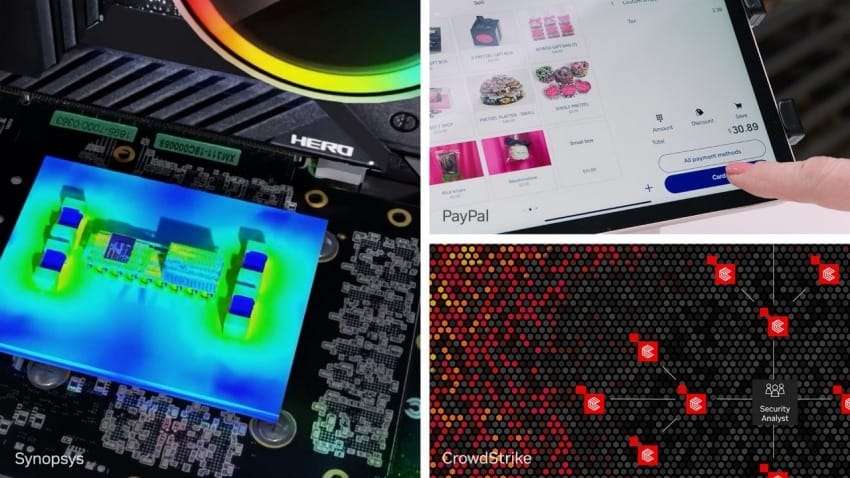
Nvidia has acquired a $2 billion stake in Synopsys, a company specializing in chip design software, to strengthen the AI ecosystem and speed up the creation of specialized processors. This is part of Nvidia’s wave of investments in AI infrastructure.
My Take: Nvidia’s $2 billion investment in Synopsys looks like a strategic move to strengthen its dominance in the AI ecosystem, especially in the race for more efficient chip design. Synopsys is a leader in electronic design automation (EDA) software, and the partnership will allow their tools to be integrated with Nvidia's technologies, such as CUDA for accelerating GPU computing, which analysts estimate could speed up the development of specialized AI processors by 2–3 times. What will this lead to? First, a “supercycle” of innovation in AI infrastructure: faster time-to-market for new chips for data centers, autonomous systems, and edge computing, giving Nvidia an advantage over competitors like AMD or Intel. Second, it could lower the barriers for startups and companies using AI by making chip design cheaper and more accessible. But there are risks: critics see this as “circular funding,” where Nvidia spends on partners to sustain demand for its GPUs, which could inflate a bubble in the AI market. Overall, this is a step toward making AI even more ubiquitous, but with the potential for Nvidia to monopolize the chip supply chain.
When: December 1 2025
Source: reuters.com
Insiders predict future of AI: smaller and cheaper agents
Experts within the industry anticipate a significant transition away from large-scale, resource-intensive models such as ChatGPT. Instead, the trend is moving toward the development and deployment of smaller, more narrowly focused AI agents. These specialized systems are expected to be more cost-effective and deliver greater efficiency when applied to specific, well-defined tasks. This evolving direction represents a notable change in how artificial intelligence technologies are created and utilized, with a new emphasis on targeted functionality and affordability. As a result, the overall strategy for AI development is likely to shift toward these streamlined models, marking a departure from the reliance on massive, general-purpose AI systems.
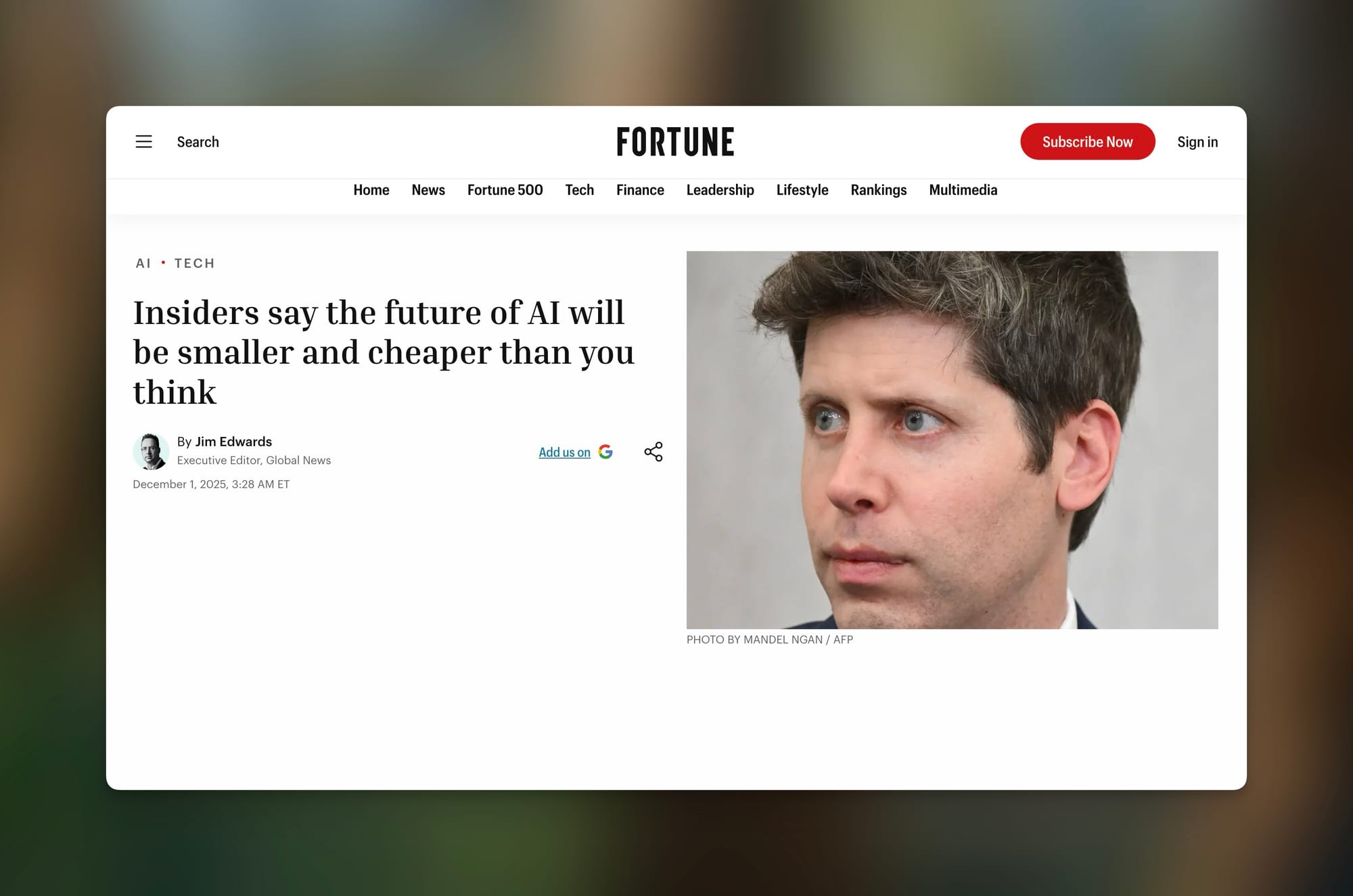
When: December 1 2025
Source: fortune.com
Fujitsu develops multi-AI agent collaboration technology
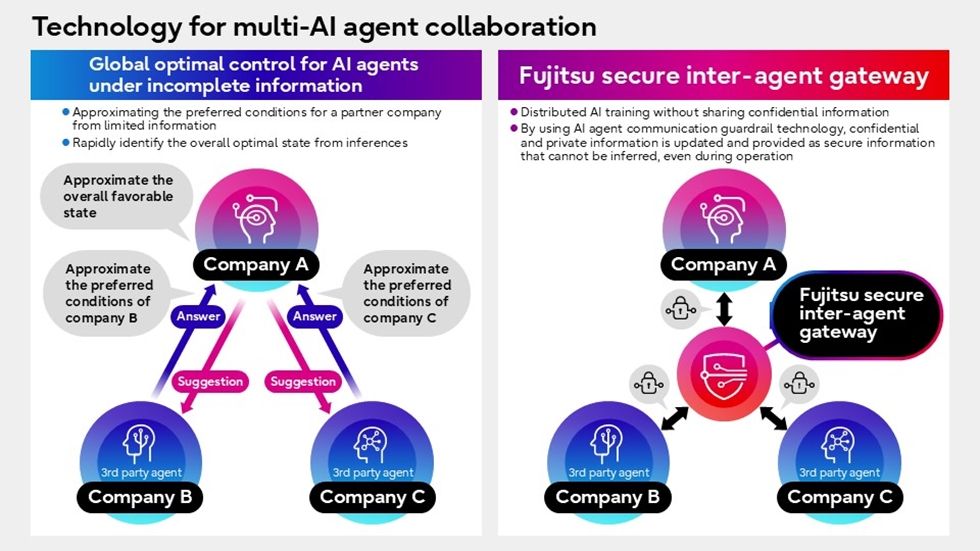
Fujitsu has unveiled a new technology designed to enable secure collaboration between multiple artificial intelligence (AI) agents that are developed and operated by different companies. This innovative approach allows the AI agents to work together effectively without the need to share or expose any of their confidential or proprietary data. The main goal is to maintain data privacy and security while still enabling cooperative problem-solving between organizations. The initial phase of testing this technology is scheduled to begin in January 2026, in partnership with Rohto Pharmaceutical. During this testing period, the companies aim to explore how the system can be used to improve and streamline supply chain operations, with a focus on enhancing overall efficiency and coordination across different business units.
When: 1 decebmer 2025
Source: global.fujitsu/
Claude Opus 4.5 - the most powerful AI model, breaking records and taking the tech world by storm
Claude Opus 4.5 by Anthropic, released on November 24, 2025, became one of the most talked-about news stories in the AI world during the last week of November — and the discussion continues into December, because it is not just a model update, but a true breakthrough that calls into question the future of software engineering, automation, and productivity. Read Claude Sonnet 4.5 vs Opus 4.5: The Complete Comparison.
Claude Opus 4.5 by Anthropic represents a significant technical breakthrough in the field of artificial intelligence, released on November 24, 2025, as this model was the first to surpass the 80% threshold on the SWE-bench Verified benchmark (80.9%), outperforming competitors such as Google Gemini 3 Pro (76.2%) and OpenAI GPT-5.1 (77.9%). This enables it to autonomously solve complex software engineering tasks such as fixing bugs in GitHub repositories, coordinating agents, and performing long-term planning. Internal company tests showed that Opus 4.5 outperforms human candidates for engineering positions in two-hour exams, achieving leadership in tool usage (98.1% on MCP Atlas) and computer interaction (66.3% on OSWorld), with the ability to self-improve over several iterations and integration with browsers, terminals, and office applications. Additionally, the model became three times cheaper to use ($5 per million input tokens), with improved safety against prompt injections and a new “effort” parameter to balance speed and depth of analysis, making it ideal for enterprise automation and potentially revolutionizing the labor market by shifting the focus from routine coding to creative tasks.
My take: I'm still exploring the Claude Opus 4.5 model, but I was extremely surprised by the quality of the landing page it created for my project. The design was truly on the level of Dribbble pages, and the code was clean and error-free, with all responsive breakpoints and functionality taken into account.
When: 24 november 2025
Source: anthropic.com
🙌🏻
Keep checking back regularly, as we update this page daily with the most recent and important news. We bring you fresh content every day, so be sure to bookmark this page and stay informed.


