The kitchen is one of the last rooms in the modern home to remain genuinely analog. The smartphone replaced the notepad and the alarm clock. The smart speaker replaced the radio. Streaming replaced the DVD player. But the act of cooking itself has stayed largely the same for generations: a person, a pan, some heat, and whatever judgment they happen to have accumulated.
That is changing, and the pace of change accelerated sharply between 2024 and 2026. Ovens that recognize food by camera and self-adjust. Refrigerators that track expiration dates and suggest what to make for dinner. All-in-one cookers that guide users step-by-step through 60,000 recipes while adjusting their own temperature in real time. Voice assistants that chain appliances together so that asking "what should I cook tonight?" can result in the oven preheating and a grocery order being placed before you have finished the question.
The smart kitchen appliance market is projected to reach $81 billion by 2034, growing at roughly 7.7 percent annually in North America alone. Over 60 percent of U.S. consumers already use connected home technology in some form. The question for most households has shifted from "is this real?" to "which of it is actually useful, and what does it cost to find out?"
What AI Is Actually Doing in Today's Kitchens
The Oven Has a Camera Now
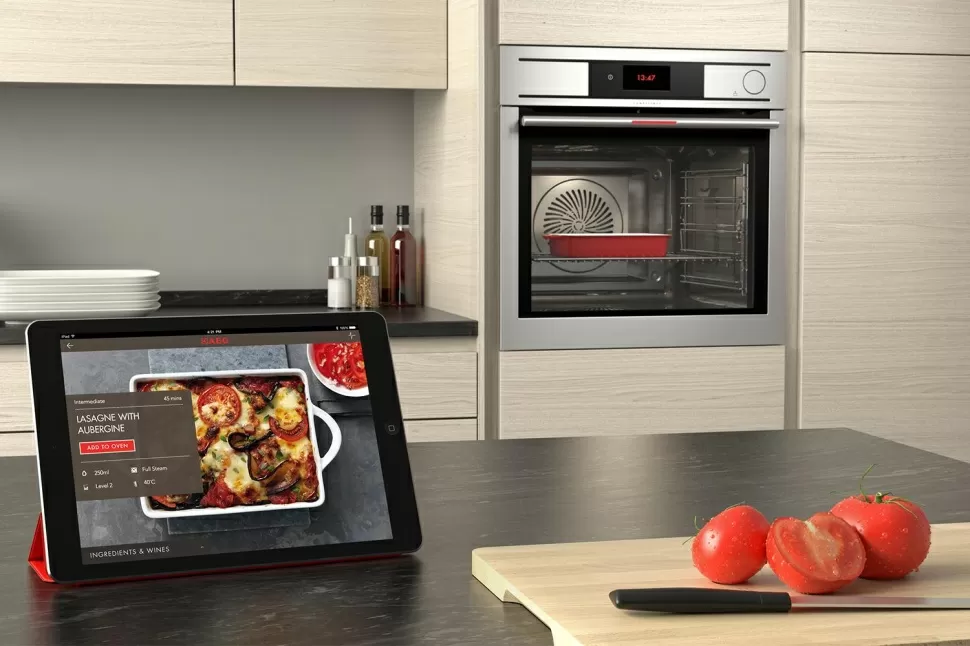
The most consequential AI integration in kitchen appliances is currently happening in ovens, and the mechanism is simpler than the marketing language suggests. A camera mounted inside the oven cavity captures an image of whatever has been placed on the rack. A computer vision model identifies the food, crossreferencing it against a database of thousands of items, and either suggests optimal cooking parameters or adjusts them automatically. The user confirms or overrides.
Samsung's Bespoke AI oven, one of the most widely reviewed implementations, uses this system to recognize up to 80 different food categories and suggest corresponding time and temperature settings. The camera also detects when food is done and, in some configurations, slightly opens the oven door to prevent overcooking. In testing, recognition accuracy improves with well-lit, uncovered food in the center of the rack and degrades with covered dishes or unusual preparations. The system learns from frequently used recipes over time, refining its suggestions based on the specific household's cooking patterns.
Miele's Smart Food ID system works similarly, with an added capability called Smart Browning Control that monitors the surface color of a pizza or similar item and adjusts cooking accordingly. Miele also offers CookAssist for stovetop cooking, which calculates ideal pan temperature using an algorithm rather than a simple thermometer, transmitting instructions to the smartphone so the user can manage the process without standing over the stove. The Dialog Oven, Miele's top-tier offering, goes considerably further: it uses electromagnetic waves that interact with the texture and density of food to cook multiple items simultaneously at different doneness levels, addressing the classic problem of achieving perfectly cooked fish and vegetables in the same oven at the same time.
The Agari Oven, which debuted at CES 2025, combines 3D scanning and remote temperature sensing to calculate a food item's exact dimensions and internal structure before determining cooking parameters. The June Oven, a smart countertop unit at approximately $999, uses an HD internal camera for food recognition while functioning as an air fryer, dehydrator, broiler, slow cooker, toaster, and warming drawer, consolidating several devices into one connected unit.
For consumers evaluating these products, the honest benchmark is not a head-to-head comparison against a professional chef. It is a comparison against the median home cook who regularly overcooks chicken, undercooks fish, and burns garlic. By that standard, adaptive AI cooking has already cleared a meaningful threshold of practical value.
The Refrigerator as Household Intelligence Hub
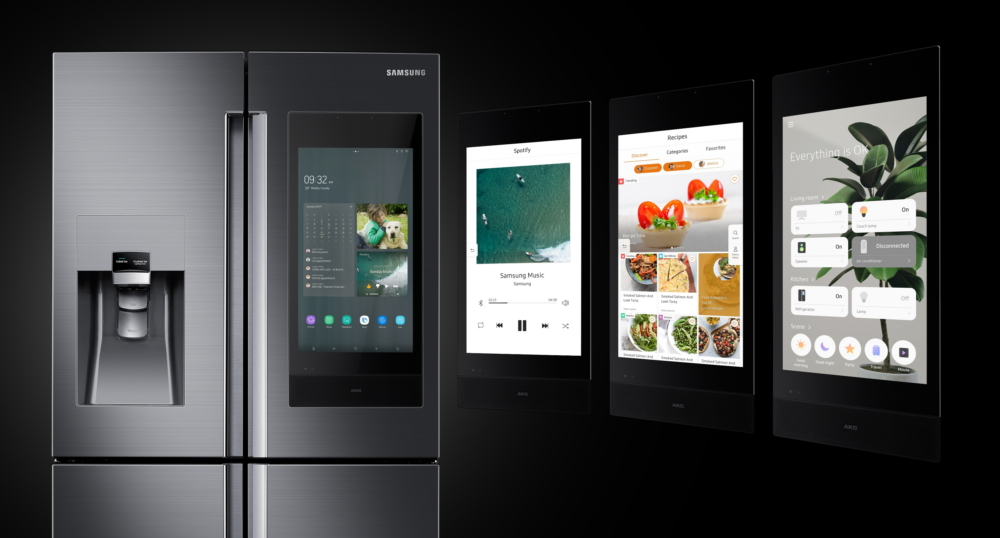
The smart refrigerator has been a running joke in consumer tech circles since at least 2014, when the vision of an internet-connected fridge that could order milk felt like the kind of feature that sounded useful until you realized you still had to put the groceries away. The current generation has earned more serious consideration.
Samsung's Bespoke AI Family Hub refrigerator, upgraded at CES 2026 with Google Gemini-powered AI Vision, now goes substantially beyond matching food items to a local database. The 2026 system reads food labels, identifies items by text extraction, tracks expiration dates, and automatically generates suggestions based on what is approaching the end of its useful life. Bixby, Samsung's voice assistant, coordinates the ecosystem: ask which ingredients are about to expire, and the fridge surfaces them on screen; ask for recipes that use those ingredients, and it suggests options; confirm one, and the system sends pre-heat instructions to the connected oven. The entire chain can unfold through a single voice conversation.
LG's ThinQ ecosystem operates on similar principles across its refrigerator and appliance lineup. GE Appliances has integrated Google Cloud's generative AI into its SmartHQ app, allowing users to photograph refrigerator contents and receive recipe suggestions based on what is visible. The Flavorly AI feature then converts selected recipes into shopping lists and connects to Instacart for delivery. The practical implication is a material reduction in the daily decision fatigue around meal planning, particularly for households managing dietary restrictions, multiple preferences, or time constraints.
A peer-reviewed systematic review published in ScienceDirect found that smart refrigerators can reduce food waste by up to 60 percent through advanced inventory management, expiration tracking, and recipe suggestions that direct attention toward items that would otherwise go unused. For a U.S. household that wastes an estimated $1,500 in food annually, that efficiency gain has direct financial relevance.
The All-in-One Cooking Platform
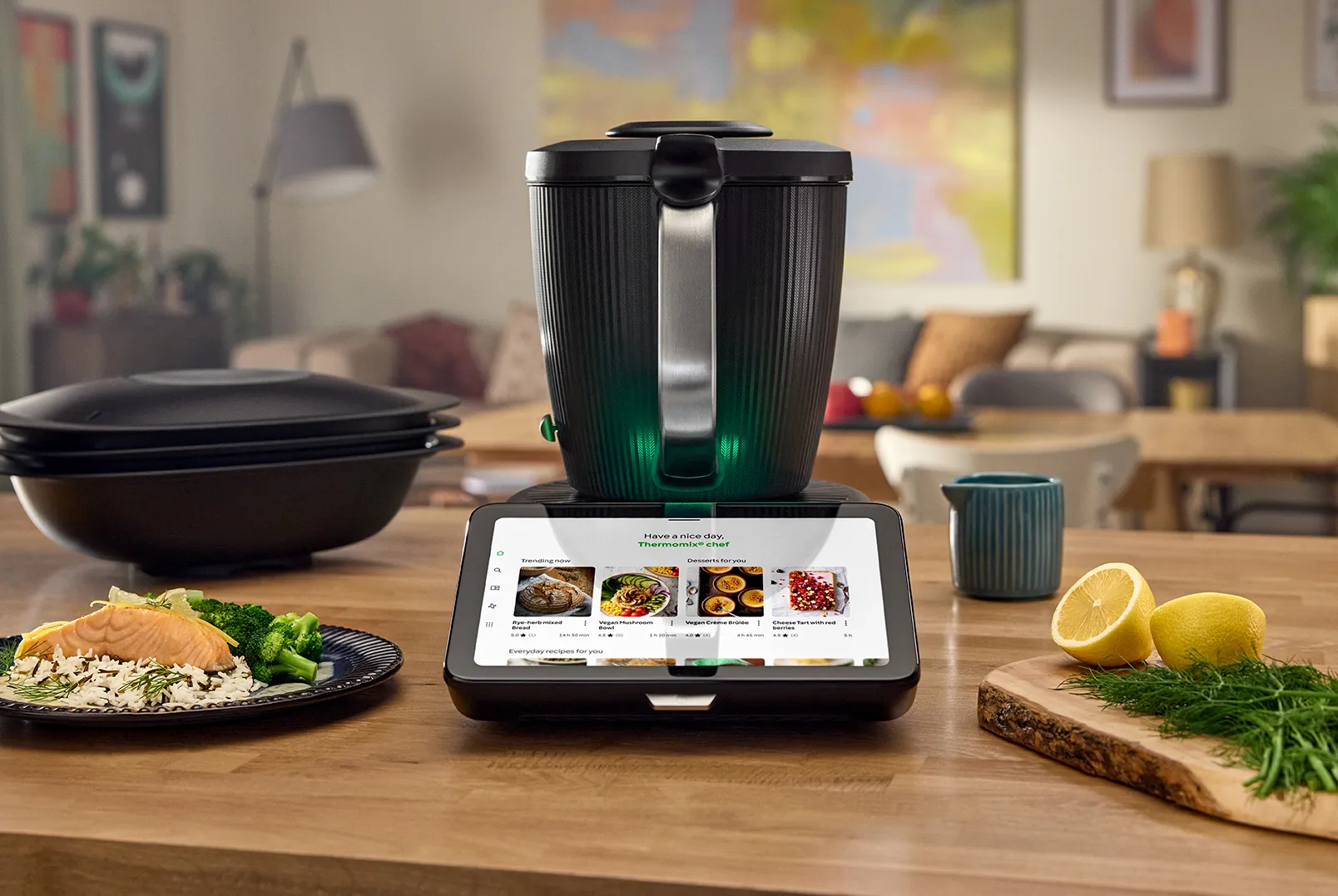
The Thermomix TM7, launched by Vorwerk in early 2025, represents a different approach to AI in the kitchen: rather than instrumenting individual appliances, it consolidates cooking functions into a single networked device and uses AI to guide the cooking process from start to finish.
The TM7 functions as a blender, food processor, steamer, slow cooker, mixer, and precision cooker simultaneously, while the Cookidoo AI assistant helps users navigate more than 60,000 recipes tailored to the device. The assistant identifies what is in the fridge and pantry, suggests recipes that match available ingredients and dietary preferences, and adjusts cooking parameters in real time as the dish progresses. Vorwerk describes the Cookidoo Assistant as a personal sous-chef that reduces time spent searching for recipes and helps ensure that available ingredients are used before they spoil.
The Hestan Cue system takes a narrower but technically elegant approach: a smart induction burner paired with a pan that has a temperature sensor embedded in its base, feeding real-time data back to an app that coaches the cook through each step of a recipe while automatically adjusting the burner's heat. The result is precise temperature management without requiring the user to develop an intuitive sense for heat levels, which is the skill that separates good cooks from frustrated ones on the stovetop.
Who This Is For, and Who It Is Not For
The Practical Value Proposition
The honest case for AI kitchen technology in 2025 and 2026 is not that it transforms amateur cooks into professionals. It is that it reduces the most common and predictable failures in everyday cooking.
Where AI kitchen tools deliver measurable value:
- Preventing overcooking and undercooking through real-time temperature monitoring and automatic adjustment
- Eliminating the daily decision cost of "what should I make?" by surfacing recipes based on available ingredients and time constraints
- Reducing food waste by tracking expiration dates and directing attention toward items that need to be used
- Guiding new or inexperienced cooks through unfamiliar recipes with step-by-step instruction calibrated to the specific equipment
- Coordinating multi-appliance workflows so that cooking dinner does not require managing four separate timers and two apps simultaneously
Where the current generation still falls short:
- Recognition accuracy degrades with unusual cuts of meat, non-standard preparations, or food that is covered or obscured
- Recipe databases, while large, do not yet adapt well to the improvised, fridge-clearing cooking that experienced home cooks do intuitively
- The ecosystem benefits require that most or all of your appliances come from the same manufacturer, which creates significant vendor lock-in
- The learning features that improve accuracy over time depend on cloud connectivity, which raises data handling questions that not all consumers will find comfortable
The technology is most valuable for specific user profiles: households where one person does most of the cooking and wants consistent results without deep technique, families managing multiple dietary restrictions, people new to cooking who benefit from guided instruction, and anyone who consistently wastes food due to poor inventory management. It is less compelling for experienced cooks who already have strong intuitions and prefer to work without digital prompts, and for anyone who uses a mix of appliances from different manufacturers and cannot invest in rebuilding the kitchen around a single ecosystem.
The Privacy Dimension
Cameras in the Oven, Cameras in the Fridge
A smart kitchen in 2026 may contain cameras in the refrigerator interior, in the oven cavity, potentially on the range hood, and certainly in any voice assistant device positioned on the counter. Each of those sensors is collecting data, and in most cases that data is being transmitted to cloud services for processing, improvement, and storage.
The privacy considerations are not theoretical. Miele's Smart Food ID system notes explicitly that photos taken by the oven camera are used, on an anonymous basis and with user consent, to improve the AI's food recognition capabilities. Samsung's AI Vision in the Bespoke refrigerator connects to cloud services to match food items, read labels, and update inventory lists in real time. GE Appliances' SmartHQ platform processes refrigerator photos through Google Cloud's generative AI infrastructure.
The questions consumers should ask before purchasing any smart kitchen device with a camera or persistent microphone are the same questions worth asking about any IoT device: Where is the data processed, and by whom? Can image processing be performed on-device rather than in the cloud? What data is retained, and for how long? Can features be disabled without losing core functionality?
Samsung addressed security concerns at CES 2025 by highlighting Samsung Knox, the company's IoT security framework, as the underlying protection for all WiFi-enabled appliances. Miele's terms of use provide an opt-in model for anonymized data sharing. These are meaningful commitments, but they also indicate that the data sharing is happening at scale and that consumers who want the full feature set are, in most cases, also enrolling in a continuous data relationship with the manufacturer.
For many users, that trade is reasonable and familiar. For households with higher privacy sensitivity, evaluating which features actually require cloud connectivity and which can operate locally is a worthwhile due diligence step before purchasing.
The Ecosystem Reality
Why the Platform Question Matters More Than the Device Question
The most important decision in smart kitchen technology is not which oven or refrigerator to buy. It is which ecosystem to adopt, because the compelling use cases, particularly the ones that chain appliances together through shared intelligence, require a common platform.
| Ecosystem | Anchor Device | AI Assistant | Key Strength |
|---|---|---|---|
| Samsung SmartThings | Bespoke AI Family Hub fridge | Bixby plus Google Gemini | Broadest appliance coverage, cross-device coordination |
| LG ThinQ | LG Signature refrigerator | LG AI | T-OLED transparency display, ThinQ ecosystem integration |
| GE SmartHQ | GE Profile wall oven | Google Cloud generative AI | Flavorly recipe AI, Instacart integration, smart probe |
| Miele Home | Dialog Oven, smart oven | Miele Smart Food ID | Precision cooking, electromagnetic cooking technology |
| Vorwerk Cookidoo | Thermomix TM7 | Cookidoo AI Assistant | 60,000 guided recipes, all-in-one cooking platform |
The scenario that best illustrates why the ecosystem question matters: Samsung's Bixby can ask the refrigerator which ingredients are expiring, suggest a recipe that uses them, and tell the oven to begin preheating, all in one voice command. That sequence only works because the refrigerator, the voice assistant, and the oven all run on SmartThings. A household with a Samsung fridge, a Miele oven, and a Google Nest speaker cannot assemble that workflow without building custom integrations that most consumers have neither the time nor the technical inclination to maintain.
This means that the decision to invest in one smart kitchen ecosystem is also a decision to stay within that ecosystem for the lifetime of those appliances. Ovens and refrigerators last 10 to 15 years. The platform commitment that comes with them lasts at least as long.
What Is Coming Next
The 2026 Trajectory
Several developments in 2025 and early 2026 signal the direction the category is moving beyond its current state.
The upgrade of Samsung's AI Vision to Google Gemini integration at CES 2026 represents a meaningful capability jump: moving from local database matching to cloud-powered language model processing means the system can now read arbitrary labels, identify unfamiliar items by text, and generate contextually appropriate suggestions rather than matching against a fixed catalogue. As similar upgrades propagate across refrigerator and oven platforms, the accuracy gap between recognized and unrecognized items will narrow significantly.
The Thermomix TM7's Cookidoo Assistant, launched in December 2025, points toward a different kind of AI integration: a conversational cooking interface that understands what you have, what you want, and what you are capable of, and that adapts its guidance accordingly. This is closer to the "assistant chef who is always nearby" framing in the article's title than any hardware innovation, and it represents the logical direction of AI in cooking: not smarter hardware alone, but smarter software that mediates between the cook's intentions and the cooking process.
The smart kitchen appliance market's projection toward $81 billion by 2034 reflects genuine consumer demand, not speculative hype. But the most important near-term question is not market size. It is whether the AI features in these appliances improve fast enough to stay ahead of the frustration they generate in their current state, where recognition accuracy, ecosystem compatibility, and privacy architecture are all still works in progress.
The kitchen is getting harder to fail in accidentally. That is the clearest way to describe what AI is currently accomplishing in home cooking, and it is a more honest measure of progress than the comparison to a sous-chef that manufacturers tend to reach for in their marketing.
Frequently Asked Questions
What does AI actually do in a smart oven?
AI in a smart oven primarily works through computer vision: a camera inside the oven identifies the food being cooked and either suggests appropriate time and temperature settings or adjusts them automatically. More advanced systems, like Miele's Smart Browning Control, monitor changes in the food's appearance over time and adjust cooking parameters in response. Some ovens also learn from usage patterns over time, refining their suggestions based on what a particular household cooks regularly. The practical effect for most users is fewer overcooked or undercooked meals without requiring manual temperature management.
Are smart kitchen appliances worth the higher price?
The answer depends heavily on which problem you are trying to solve. For households that frequently overcook food, waste groceries due to poor inventory management, or struggle with the decision fatigue of daily meal planning, the value case is meaningful. Smart refrigerators that track expiration dates and suggest recipes based on available ingredients can reduce annual food waste, which research estimates runs to approximately $1,500 per U.S. household. Smart ovens that prevent overcooked chicken or dry salmon are solving a real problem for many home cooks. The value case is weaker for experienced cooks who already have strong kitchen instincts, and for anyone who cannot invest in a single integrated ecosystem across multiple appliances.
What is the best smart kitchen ecosystem in 2026?
Samsung's SmartThings ecosystem, anchored by the Bespoke AI Family Hub refrigerator, currently offers the broadest appliance coverage and the most developed cross-device coordination, including the integration of Google Gemini for AI Vision in the 2026 model. LG's ThinQ ecosystem is competitive on refrigerator and appliance quality. GE SmartHQ offers strong recipe AI through the Flavorly platform and a useful smart probe system. Vorwerk's Thermomix TM7 with Cookidoo AI is the most complete solution for households that want guided, recipe-based cooking. The right ecosystem depends on which appliances you need to replace and whether you want a whole-kitchen solution or a single device that does not require platform commitment.
What are the privacy concerns with smart kitchen appliances?
Smart kitchen appliances with cameras, microphones, or sensors typically collect data that is transmitted to cloud services for processing, improvement, and storage. Refrigerator cameras identify food items and read labels; oven cameras photograph food at each cooking session; voice assistants record audio queries. Most manufacturers offer opt-in terms for data sharing and publish security frameworks, but the full feature set of these appliances generally requires an ongoing data relationship with the manufacturer. Consumers who want to minimize data exposure should evaluate which features require cloud connectivity versus which can operate locally, and should review the specific data retention and usage terms of any platform they adopt.
Can a smart kitchen work with appliances from different brands?
Partially. Voice control through Amazon Alexa, Google Assistant, or Apple HomeKit can connect appliances from different manufacturers for basic commands, such as preheating an oven or checking a refrigerator's temperature. However, the more sophisticated cross-appliance workflows, including chaining the refrigerator's ingredient suggestions to the oven's pre-heat and a grocery delivery order in a single voice command, typically require that the appliances run on the same manufacturer's platform. Households with Samsung refrigerators, Miele ovens, and a Google Home speaker will not have access to the same integrated intelligence as households where all three come from the same ecosystem.
What is the Thermomix TM7 and what does it do differently from other smart kitchen devices?
The Thermomix TM7, launched by Vorwerk in early 2025, is an all-in-one cooking platform that combines blending, food processing, steaming, slow cooking, mixing, and precision temperature cooking in a single connected device. Its distinguishing feature is the Cookidoo AI Assistant, which guides users through more than 60,000 recipes while automatically adjusting the device's cooking parameters in real time. The assistant can also suggest recipes based on available ingredients, helping to reduce food waste. Unlike smart ovens or refrigerators, the Thermomix does not require ecosystem commitment to multiple appliances because it handles most cooking functions itself.
How does food recognition work in smart ovens and refrigerators?
Food recognition in smart appliances uses computer vision, the same technology category that underlies facial recognition and self-driving car cameras. A camera captures an image of the food, and an AI model compares it against a training database of thousands of food items to identify what it is seeing. Earlier systems matched against local databases with limited scope. The 2026 generation, including Samsung's Gemini-powered AI Vision, connects to cloud services that can read text on labels, identify unfamiliar items, and generate more contextually appropriate suggestions. Accuracy is generally higher for common food items in standard presentations and lower for unusual cuts, covered dishes, or items with handwritten or non-standard packaging.
Related Articles
 Dani
Dani
 Dani
Dani
 Dani
Dani