There is a number that haunts every online course creator who has spent weeks building a curriculum, recorded hours of video, and launched a sales funnel that actually worked: somewhere between 10 and 15 percent.
That is the average completion rate for a typical self-paced online course. Even when people want to learn, even when they paid to enroll, most of them stop somewhere in the middle and never come back. The content may be excellent. The production value may be high. The problem, as it turns out, is not the content at all.
This is the crack in the foundation of the knowledge economy's dominant business model, and it is widening precisely at the moment when AI has made course content cheaper, faster, and more accessible than ever. When anyone can generate a structured curriculum in minutes, the value of a standalone course drops toward the value of the information it contains. And in 2026, information is nearly free.
What fills the gap is community, specifically AI-powered community: recurring membership spaces where people do not just consume content but stay, participate, get feedback, work alongside others, and return week after week. The economics, the retention, and the relationship between creator and member are all fundamentally different from the course model, and the data behind the shift is more compelling than the pitch suggests.
Why the Course Model Is Under Structural Pressure
The global e-learning market is large and still growing, projected to reach $370 to $400 billion in 2026, up from roughly $325 billion in 2025. The headline number makes the market look healthy. What it obscures is a quieter pattern: the standalone course model, specifically the "record once and sell forever" format that defined a decade of creator businesses, is increasingly struggling to justify its price point.
The issue is not demand for learning, which remains strong. The issue is a structural mismatch between what creators have been selling and what learners actually need.
For years, creators sold the same format in slightly shinier packaging: six modules, lifetime access, maybe a bonus mini-course. That model worked when information was scarce. In 2025, when AI can generate a strategy in seconds and YouTube has a free tutorial for nearly everything, selling knowledge alone is like selling bottled water next to a waterfall.
By 2026, the explosive growth of online courses is slowing, not collapsing or disappearing, but maturing and losing its blind momentum. Most foundational knowledge is now accessible for free or cheaply, and as a result, the perceived value of many courses has dropped.
What learners are actually searching for in 2026:
- Accountability
- Momentum
- The confidence that comes from doing the work alongside others who are trying to do the same thing
Those are not things AI can generate on demand, or that a pre-recorded video module can deliver. They require an ongoing, active environment, which is precisely what a community provides and what a course does not.
The Completion Rate Problem
The completion gap between courses and communities is not a minor inconvenience. It is the defining data point of this transition.
| Format | Average Completion Rate |
|---|---|
| Self-paced MOOC | 4 to 9% |
| Typical standalone course | 10 to 15% |
| Course with coaching and community | 70%+ |
| Circle community-integrated courses | 40 to 60% |
Peer engagement features alone can triple online course completion rates, from around 15 percent to 45 percent or more.
From a creator business perspective, that difference compounds significantly. A student who completes a course and gets a result becomes a testimonial, a case study, a referral source, and often a repeat buyer. A student who abandons a course at module two becomes none of those things. The community model does not just improve the learner's experience; it improves the creator's entire downstream economics.
How the Community Model Actually Works
The paid community model is structurally different from a course in ways that matter for both creator and member.
A course is a transaction. The learner pays once, gets access to content, and the exchange is largely complete.
A community is an ongoing relationship. The member pays monthly or annually for continued access to a space, to other members, to live sessions, to updated resources, and to accountability structures that require human presence to exist.
The financial implication of that difference is significant:
- Course income is front-loaded and depends on perpetual new sales to grow
- Community income is recurring and compounds as the membership base grows
A community with 200 members at $50 per month generates $10,000 in monthly recurring revenue regardless of whether the creator launches a new product that month.
Circle data reveals that recurring, community-based revenue now sits at the center of creator business models, while sponsorships and affiliate income play increasingly peripheral roles. For many creators, communities are no longer a side project or a nice-to-have extension of their brand, but the core of the whole business.
What AI Adds to the Community Layer
The recent integration of AI into community platforms is not cosmetic. It addresses the operational problems that historically made running a paid community far more demanding than running a course.
A course, once recorded, requires little ongoing attention. A community requires facilitation, onboarding, engagement prompts, content updates, and moderation, none of which scale naturally for a solo creator serving several hundred paying members.
AI changes the scaling equation in three concrete ways:
1. Member onboarding and matching New members joining an established community face the cold-start problem: they arrive, see threads they do not know how to enter, feel like outsiders, and quietly disengage within weeks. AI-driven onboarding matches new members with existing ones based on shared goals, experience levels, or complementary skills, creating the initial connection that makes a community feel welcoming rather than intimidating from day one.
2. Content and engagement automation Circle's AI agents can prompt discussions, surface relevant older content, send check-ins, and trigger automated sequences based on member behavior. A creator with 300 members can maintain active facilitation without manually engineering every single interaction.
3. Always-on support outside live sessions One of the consistent complaints from community members is the gap between live calls. AI agents trained on a creator's methodology and content library can answer questions in real time that would otherwise wait days for a response, keeping the community active between the moments when the creator is directly present.
The Platform Landscape in 2026
The market for community platforms has matured, and the leading options now reflect meaningfully different philosophies about what a paid community should look like.
Circle
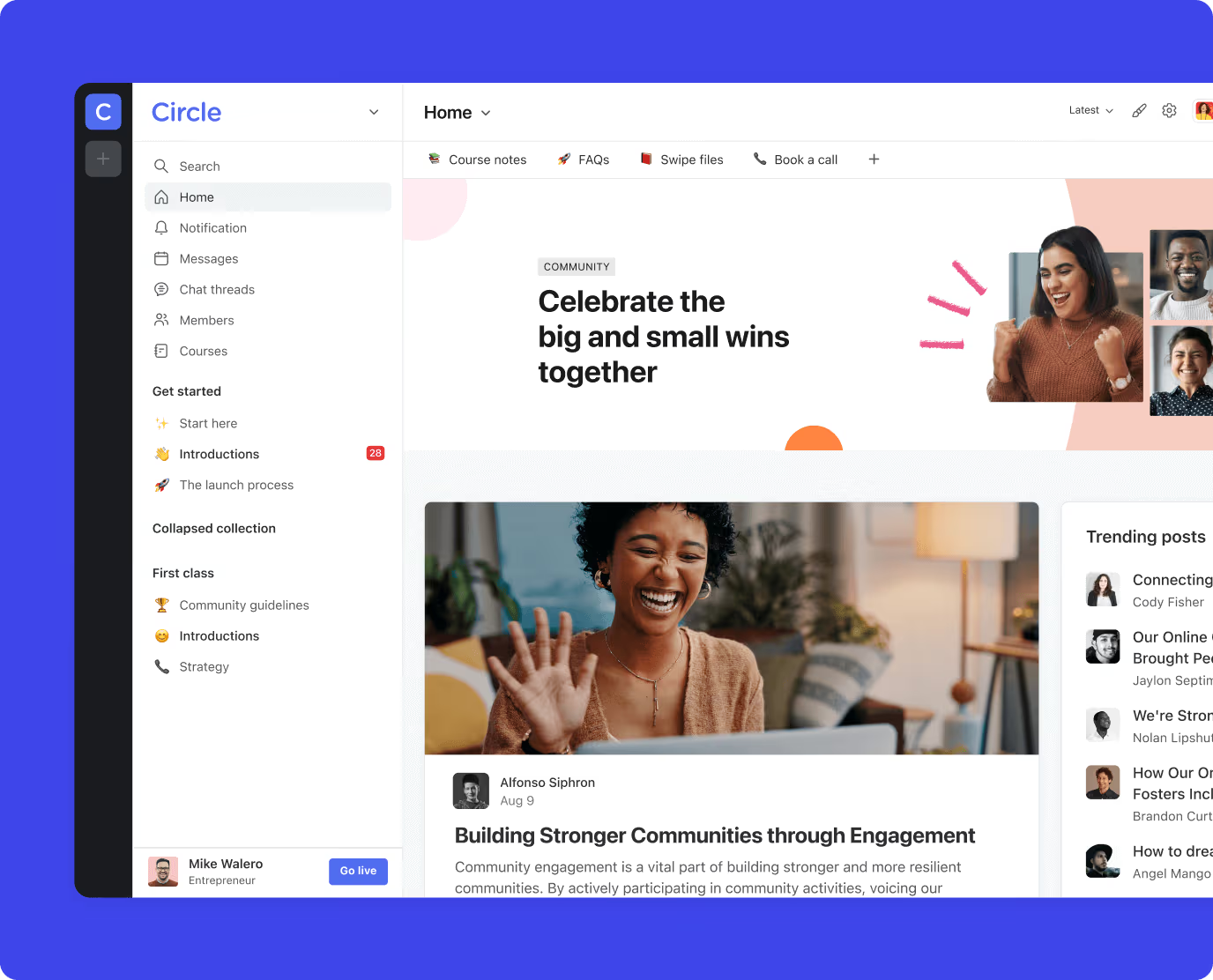
Best for: Feature-depth, AI automation, structured learning alongside open discussion
Circle now supports 18,000+ active communities, with 56 percent of creators having launched in the last two years. Its positioning is comprehensive, combining community spaces, courses, live events, email marketing, payment processing, and AI agents in a single platform.
| Plan | Monthly Price (Annual) | Transaction Fee |
|---|---|---|
| Professional | $89 | 0.5% |
| Business | $199 | 0.5% |
| Enterprise | $419 | 0% |
Notable communities on Circle include those run by Ali Abdaal, Jay Shetty, and Harvard's extended education programs.
Strength: Depth of features, AI agent customization, and suitability for structured learning communities. Limitation: Cost is meaningful for a new builder before revenue arrives.
Skool
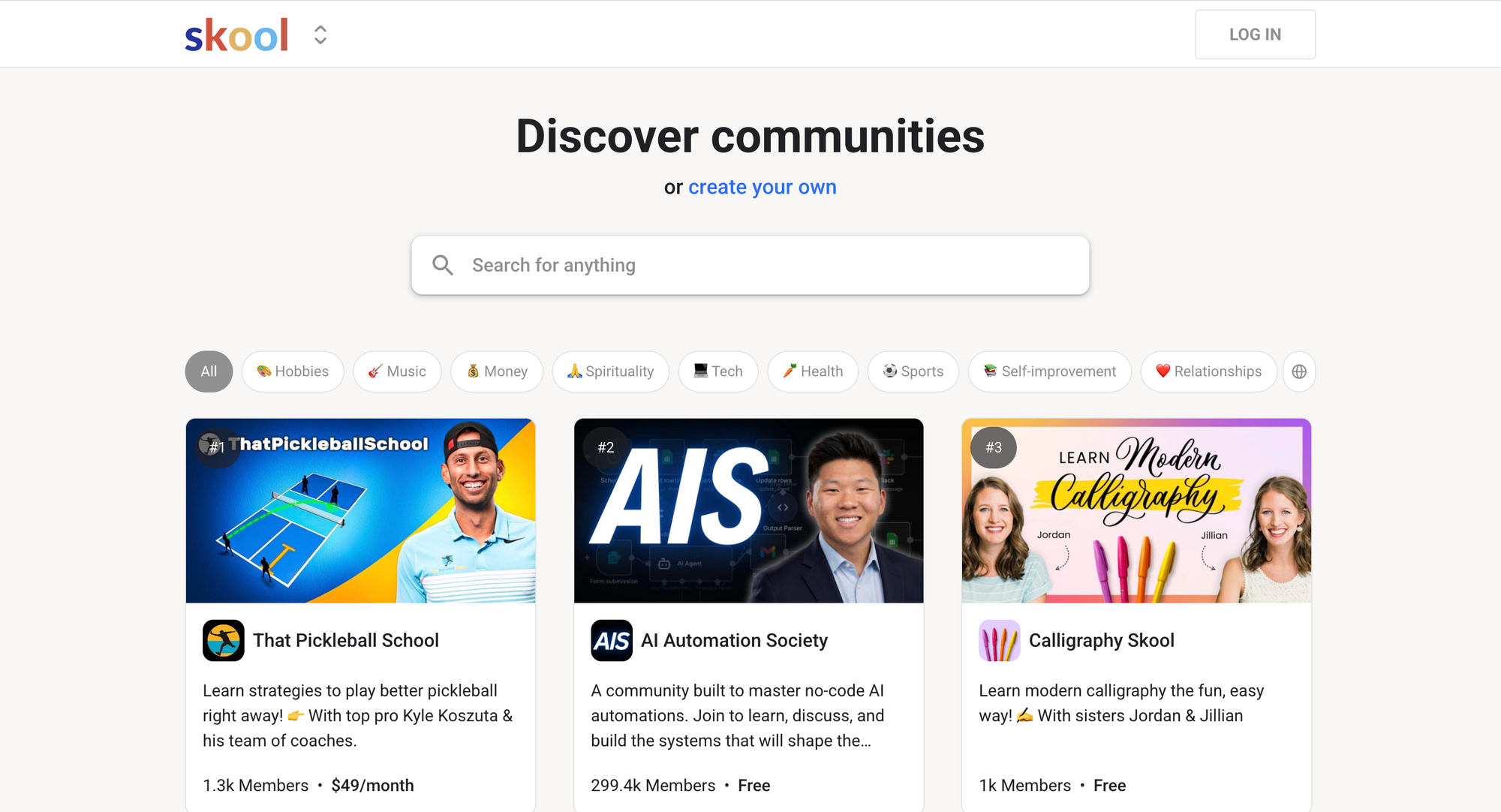
Best for: Simplicity, gamification-driven engagement, fastest path from idea to paying members
Skool occupies a different position in the market: simpler, cheaper, and more aggressively focused on gamification as an engagement driver. Founded by Sam Ovens and backed by Alex Hormozi, it had over 174,000 community creators by late 2024.
| Plan | Monthly Price | Transaction Fee |
|---|---|---|
| Hobby | $9 | 10% |
| Pro | $99 | 2.9% |
Skool's gamification mechanics, including points, leaderboard rankings, and content unlocked through participation, consistently generate higher day-to-day engagement than more passive community formats.
Strength: Frictionless setup, strong member engagement, and community discovery that drives organic growth. Limitation: Limited third-party integrations, basic analytics, and no advanced AI features.
Mighty Networks
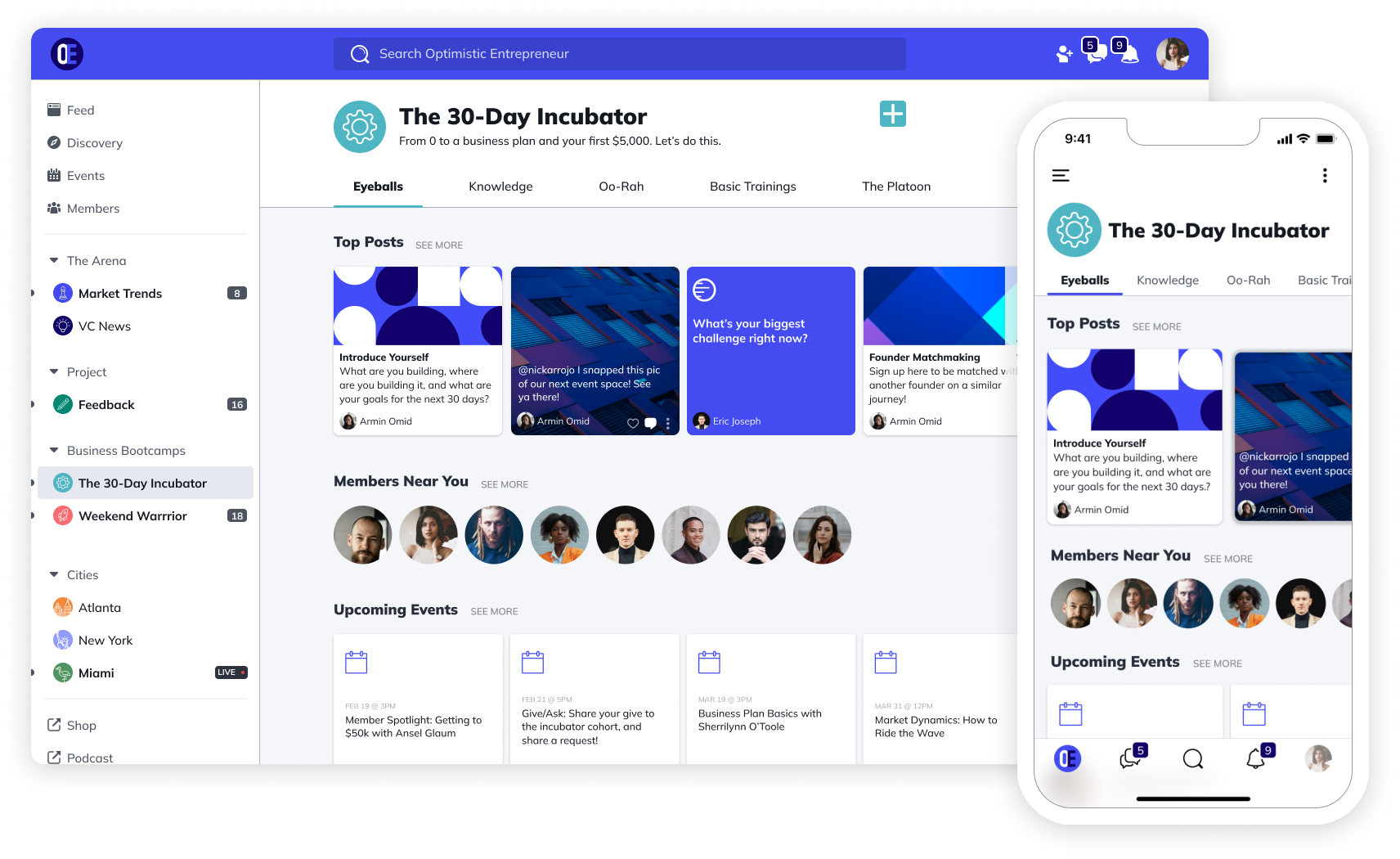
Best for: Branded mobile-first communities, large-format live event programs
Mighty Networks occupies the premium end of the branded community market. Starting at $119 per month, it targets creators who want the community to feel like a standalone branded product rather than an add-on to a content library. It has been slower to integrate AI functionality than Circle but has historically attracted creators building large-format communities around live events and cohort-based programs.
What "AI-Powered" Actually Means Here
The term AI gets applied broadly to community platforms in 2026, so it is worth being specific about what the technology is actually doing, because the honest picture is more nuanced than the marketing.
AI in community platforms currently does these things well:
- Automates onboarding sequences
- Powers search and content discovery
- Generates discussion prompts and engagement triggers
- Provides always-on responses to member questions within the scope of the creator's documented knowledge
What AI does not do well, and what remains the core value proposition of a paid community:
- Replicate the experience of being challenged by a peer
- Deliver group accountability that carries real social stakes
- Mentor someone with genuine knowledge of your specific situation
The AI layer extends and scales the human experience rather than substituting for it. The front-end value proposition, meaning the reason someone pays $50 or $100 per month to be in this specific space, still has to come from the creator's genuine expertise, the quality of the other members, and the tangible results the community produces. AI is the infrastructure; the community is the product.
The Economics: Course vs. Community
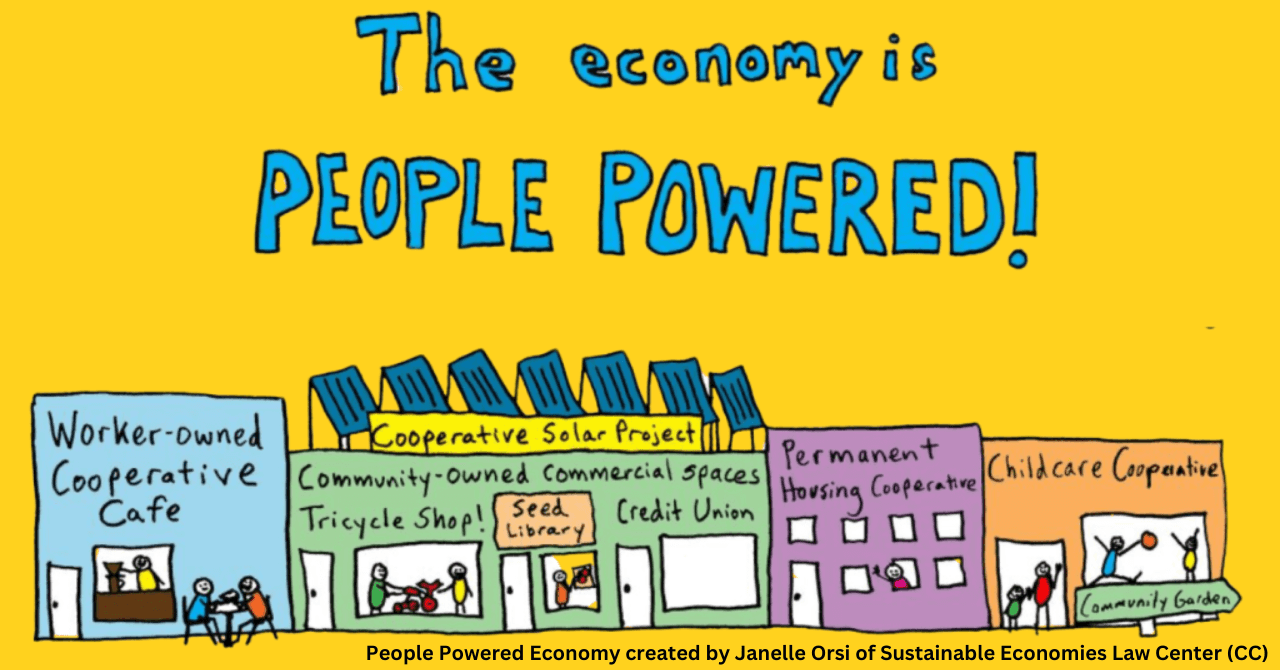
The financial comparison between these models rewards different behaviors and carries different risk profiles.
Courses generate larger one-time payments and can scale to significant revenue on a successful launch. A $500 course with 1,000 buyers in a launch week is $500,000 in revenue. The risk is that the same launch next quarter may produce very different results, and the structural trend toward commoditized information makes launch-over-launch growth harder to sustain.
Communities generate smaller per-member payments but compound over time. A community at $79 per month with 200 members produces $15,800 in monthly recurring revenue, and a creator with a high renewal rate grows that number by adding members rather than executing a new launch every quarter.
Two-Year Revenue Comparison
| Metric | Standalone Course | Paid Community |
|---|---|---|
| Price per member | $200 to $500 one-time | $29 to $99 per month |
| 100-member scenario (Year 1) | $20,000 to $50,000 | $34,800 to $118,800 |
| Revenue predictability | Launch-dependent | Monthly recurring |
| Growth requirement | Perpetual new sales | Retention |
| Member relationship | Transaction-complete | Ongoing |
| Repeat purchase probability | Low to moderate | Built into the model |
The community model is not always more profitable for every creator. A large-audience operator with genuine launch capability can still generate significant revenue from course launches. But for the majority of creators without a list of tens of thousands, the community model offers more predictable, compounding income at a fraction of the launch risk.
How AI Solves the Cold Start Problem
The most practical barrier to starting a paid community is not the platform or the pricing. It is the cold start problem: launching a community with few members is a poor experience for everyone, which makes it hard to grow, which keeps the experience poor.
AI addresses this directly. Automated discussion prompts, surfaced relevant content, and AI agents that respond to new member questions create the sensation of an active community even when the human member count is modest.
A community with 25 paying members and active AI engagement often feels more alive than a community with 200 members and no facilitation infrastructure.
How the leading platforms handle the cold start:
- Circle AI agents run onboarding sequences, check in with inactive members, and surface older discussions relevant to new questions
- Skool's gamification gives new members an immediate reason to participate that does not depend on whether anyone else responds
Neither approach replaces the need to build a genuinely valuable community. They reduce the threshold at which a community feels worth being in, which is the operational problem that causes most communities to fail in their first three months.
Practical Starting Points for Creators
The transition from course-first to community-first does not require abandoning courses. The most durable structure uses a course as an onramp: it delivers structured foundational content and graduates learners into a community where the ongoing work happens.
Four principles that consistently separate communities that compound from those that stall:
- Start with a clear outcome, not a topic. Communities built around vague subjects like "marketing," "wellness," or "entrepreneurship" struggle to retain members because people cannot clearly articulate why they are paying. Communities built around specific, recurring problems, such as "scale your freelance business past $10,000 per month" or "manage anxiety using evidence-based techniques," give members a reason to stay as long as the problem remains relevant.
- Price for commitment, not just accessibility. Communities priced below $15 per month tend to attract members who treat them as disposable. The low price reduces churn anxiety, but it also reduces perceived value. Most sustainable communities in the $50 to $150 per month range show better engagement and lower churn than those priced near the floor.
- Use AI to cover the gaps your calendar cannot. No creator can be actively present in a community at all hours. AI agents trained on your methodology handle the 11pm question that would otherwise go unanswered for 18 hours. They do not replace live presence; they maintain the community's active feeling between the moments when the creator is genuinely in the room.
- Track retention, not just sign-ups. The vanity metric for communities is total member count. The operational metric is monthly churn. A community with 300 members and 8 percent monthly churn is losing 24 members per month and requires constant new acquisition just to stay flat, while a community with 150 members and 2 percent monthly churn is genuinely compounding.
What This Means for the Broader Knowledge Economy
The creator economy is not shrinking so much as it is professionalizing. The era where growth alone guaranteed income is giving way to a system that rewards creators who understand demand, pricing, and performance.
The community shift is part of a larger reorientation away from attention as the primary asset. Attention is abundant and increasingly cheap to generate. What is scarce is trust, transformation, and belonging, and those things are produced by sustained relationships rather than content consumption.
The global creator economy was valued at approximately $200 billion in 2025, projected to grow at a 22.7 percent compound annual rate. The share of that value concentrated in community-led, owned platforms rather than platform-dependent content distribution is growing steadily, and that is not a coincidence.
Courses are not disappearing, but their role in the knowledge business is shifting from primary product to acquisition mechanism. The recurring revenue, the retention data, and the completion rates all point in the same direction: the knowledge business is becoming a membership business, and AI is making that transition viable at scales that previously required a full team to sustain.
Frequently Asked Questions
What is the difference between a paid community and an online course in 2026?
A course is a one-time transaction delivering structured content; completion happens independently. A paid community is a recurring membership in an active space that includes content, live interaction, peer connection, and ongoing accountability. The course model front-loads revenue from launches; the community model generates monthly recurring income that compounds as the member base grows.
Why are online course completion rates so low?
Self-paced courses average 10 to 15 percent completion because they lack accountability, deadlines, peer momentum, and an environment where not finishing has social consequences. Community-integrated courses consistently show 40 to 70 percent completion rates because those structural elements are present.
Which platform is best for starting a paid AI community in 2026?
It depends on the creator's priorities. Skool offers the simplest, most affordable path at $99/month Pro with strong gamification. Circle offers more depth, AI agent functionality, and flexibility at $89/month and above. Mighty Networks suits creators building large-format branded communities with strong mobile presence. Most new community builders start with Skool or Circle's lower tier and migrate as their needs grow.
How much should a paid community charge?
Most sustainable communities charge between $29 and $149 per month. The 32.9 percent of communities charging $26 to $50 per month represent the accessible professional tier. High-retention, high-touch communities typically sit in the $79 to $149 range. Pricing below $15 per month tends to reduce perceived value and attract lower-engagement members.
How does AI specifically help run a paid community?
AI in community platforms handles onboarding automation, member matching, discussion prompting, content surfacing, and always-on Q&A based on the creator's documented knowledge. It reduces the operational load that makes community management difficult for solo creators, particularly during early growth phases when engagement needs to feel active before the human member count justifies it.
Can a creator run both a course and a community?
Yes, and the most durable model combines them. A standalone course acts as an onramp that delivers foundational structured content, and graduates move into a recurring paid community where ongoing work, accountability, and live interaction happen. This structure extracts more lifetime value per student than either model alone.
How long does it take to build a profitable paid community?
Most communities begin generating meaningful recurring revenue between months three and six, assuming the creator has an existing audience or email list to launch into. Reaching $3,000 to $5,000 monthly recurring revenue typically requires 50 to 100 paying members, which is achievable within 6 to 12 months for a creator with genuine expertise and an established audience of several thousand.
Related Articles
 Dani
Dani
 Dani
Dani
 Dani
Dani