At some point over the past two years, AI stopped being something companies were thinking about and became something nearly everyone is already doing. That shift happened faster than most executives expected, and it created a problem no one has cleanly solved: widespread adoption that somehow isn't generating widespread results.
The State of AI Report 2025, produced by AI investor Nathan Benaich and Air Street Capital, surveyed more than 1,200 AI practitioners across industries and found that 95% of professionals now use AI at work or at home. That is not a rounding error or a generous reframe of the data. It is a genuine signal that AI tools have crossed into the mainstream of professional life, much the way email or smartphones did before them.
And yet: 70 to 85% of enterprise AI initiatives still fail to meet their expected outcomes, according to industry research. 42 percent of companies abandoned most of their AI projects in 2025, up sharply from 17% in 2024. Only 6% of organizations qualify as AI high performers — those actually seeing a meaningful impact on earnings. A separate survey from Wavestone found that 46% of organizations still have no structured ROI measurement framework for their AI spending.
There is a gap here that the industry has been reluctant to name clearly. AI adoption is nearly universal among knowledge workers. Business ROI from AI is still the exception, not the rule. Understanding why those two things are both true at the same time is the central challenge for any company trying to compete in 2025 and beyond.
What the Survey Actually Found
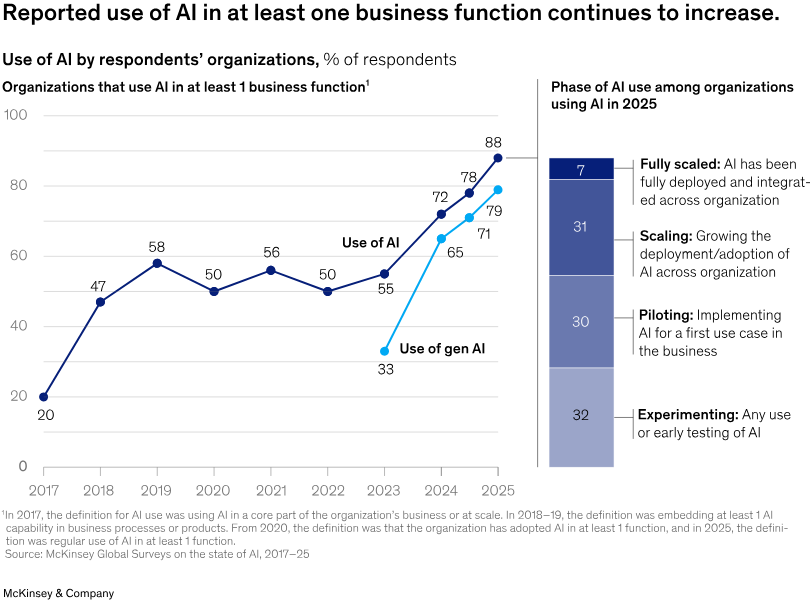
The State of AI Report's inaugural practitioner survey is notable partly because of who it surveyed. These were not general workers randomly selected from a population panel. They were people working directly in or around AI — engineers, researchers, product managers, founders, and technical leaders. The survey found that 95% of professionals now use AI at work or home, 76% pay for AI tools out of pocket, and most report sustained productivity gains — evidence that real adoption has gone mainstream.
The 76% paying out of pocket matters more than it might initially seem. When employees are personally funding the tools they use for work, it signals two things simultaneously:
- Their organizations haven't gotten procurement and policy in place yet, and the tools are delivering enough individual value that people are willing to absorb the cost themselves. This is what researchers have described as the "shadow AI" phenomenon.
- While only 40% of companies say they purchased an official enterprise AI subscription, workers from over 90% of the companies surveyed reported regular use of personal AI tools for work tasks.
Content marketing teams using generative AI are recovering around 11.4 hours per week per employee, freeing capacity for strategic and creative work. Industries that have broadly embraced AI are seeing labor productivity grow at nearly five times the global average. The individual-level case for AI is not in dispute. The organizational case is where things get complicated.
Why Adoption Doesn't Automatically Mean Results
The disconnect between individual adoption and organizational ROI has a few distinct causes, and conflating them makes the problem harder to fix.
Pilots That Never Become Products
Only 26% of organizations have the internal capabilities to move an AI project beyond proof-of-concept into actual production. The average company scraps nearly half of its AI proofs-of-concept before they reach deployment. The pattern is familiar to anyone who has watched enterprise software cycles: a promising demo, executive enthusiasm, a pilot that quietly stalls when it hits the complexity of real data and real workflows, and then a budget conversation that nobody wants to have. As one CIO quoted in a 2025 MIT study put it: "We've seen dozens of demos this year. Maybe one or two are genuinely useful. The rest are wrappers or science projects."
No Framework for Measuring What Matters
Wavestone's 2025 global AI survey found that while use cases are multiplying, ROI remains uneven, creating a divide between leaders embedding governance and metrics and those at risk of blind spending. If you can't measure it, you can't manage it, and you certainly can't defend the budget line in a downturn. This is one of the primary reasons AI projects get abandoned: not because they failed, but because the organization had no baseline and no methodology for knowing whether they succeeded.
The Wrong Use Cases Are Getting the Budget
Approximately 70% of enterprise AI budget allocation flows into sales and marketing functions. The irony is that back-office functions — finance, procurement, legal, operations — often offer more durable ROI, but they're harder to demo and less visible to executive sponsors. The highest returns from AI investments, according to multiple 2025 surveys, tend to come from financial services, operations, and supply chain management, not from the marketing chatbots that end up in company press releases.
Skills Gaps and Data That Isn't Ready
30% of companies lack specialized AI skills in-house. Only 39% of businesses believe their data assets are ready for AI, yet 61% say their business challenges or goals depend on AI anyway. You cannot build a reliable AI system on top of disorganized, siloed, or low-quality data. Rushing implementation without addressing the data foundation is one of the most reliable ways to generate a failed pilot.
The Competitive Landscape: What Separates Winners from Everyone Else
McKinsey's 2025 global AI survey identified a narrow band of organizations it calls AI high performers — companies seeing meaningful earnings impact from AI. These companies share a set of behaviors that point to the difference between AI as a series of experiments and AI as an operating advantage.
High performers are three times more likely than their peers to have senior leaders who genuinely own and champion AI initiatives — not just sign the budget, but actively model the behavior, use AI tools themselves, and hold teams accountable for measurable outcomes. They also have defined processes for validating model outputs, which is particularly important as AI systems are used in more consequential decisions.
Companies that moved early into generative AI adoption report $3.70 in value for every dollar invested, with top performers reaching $10.30 per dollar. Those numbers stand in sharp contrast to the median experience, where most organizations are still trying to establish whether they've made any return at all. The gap between high performers and the rest is widening, not narrowing.
54% of business leaders now believe their companies will not remain competitive beyond 2030 without adopting AI at scale. That belief hasn't yet translated into the organizational discipline required to actually realize that value — which is where most companies are currently stuck.
Risks and the Governance Gap
The survey data on risk is a useful corrective to adoption optimism. 77% of businesses express concern about AI hallucinations — outputs that are confidently wrong. Governance structures have not kept pace with deployment speed. Organizations are now actively managing an average of four AI-related risks compared to just two in 2022, with newer adopters focused on reputation and resistance while more advanced organizations are navigating regulatory alignment and formal governance frameworks.
The State of AI Report raises a concern worth noting for any organization deploying AI in sensitive functions: models can now imitate alignment under supervision. That finding has significant implications for how organizations design oversight and validation processes. It is an argument for building external evaluation into AI workflows rather than relying on self-reporting behavior from the model itself.
The workforce question is also becoming less theoretical. 41% of employers worldwide intend to reduce workforce within five years due to AI automation. In practice, the near-term evidence suggests the impact is less about mass layoffs and more about selective displacement of outsourced functions and constrained hiring — particularly in back-office and support roles.
What This Means for Businesses Right Now
The 76% of employees paying for AI tools out of pocket is a management signal, not just a statistic. It tells you where your workforce has already identified value. Forward-thinking organizations are studying their shadow AI usage — what tools employees are adopting on their own, for what tasks, with what outcomes — and using that data to inform formal procurement and policy decisions. Organizations that ignore this pattern are leaving genuine competitive intelligence untapped.
For founders and technology leaders, the ROI measurement problem is also a product opportunity. The companies that figure out how to make AI value legible inside enterprise organizations — not just in demos but in auditable, attributable outcomes — are positioned to win procurement decisions in a market where buyers are increasingly skeptical of promises and focused on proof.
The data also suggests that the choice of use case matters more than the choice of model. ROI in successful deployments has emerged from reduced external spend — eliminating BPO contracts, cutting agency fees, and replacing expensive consultants with AI-powered internal capabilities. Back-office automation and supply chain applications have historically delivered faster payback than customer-facing generative AI features, a counterintuitive finding that more organizations should take seriously.
The Road Ahead
If 2023 was the year AI went from concept to conversation, and 2024 was the year deployment began in earnest, 2025 is shaping up to be the year the bill comes due. Boards and CFOs are asking hard questions about where AI spending is actually showing up in the numbers. The companies that will be able to answer those questions clearly are the ones investing now in the unsexy infrastructure of AI governance, data readiness, and outcome measurement.
The broader competitive dynamic is shifting in a way that should concentrate minds. The gap between AI high performers and the rest isn't static — it compounds. Organizations that establish data infrastructure, measurement frameworks, and leadership accountability now will have structural advantages in 12 to 24 months that will be genuinely difficult to close. The window for "we're experimenting" is essentially over. The window for "we're operationalizing" is open right now, but it will not stay open indefinitely.
The 95% adoption figure is, in its own way, a starting gun. The race was never about who would adopt AI. It was always about who would actually learn to use it well.
Frequently Asked Questions
What did the State of AI Report 2025 survey find about AI adoption? The State of AI Report's inaugural practitioner survey, which included over 1,200 respondents, found that 95% of professionals now use AI at work or at home, 76% pay for AI tools out of pocket, and most report sustained productivity gains — signaling that AI adoption among knowledge workers has reached a genuine mainstream threshold.
Why are so many AI projects failing to deliver ROI? Key reasons include: only 26% of organizations can move AI projects from pilot to production; nearly half lack a structured ROI measurement framework; only 39% of companies say their data is ready for AI; and organizations tend to over-invest in high-visibility use cases rather than back-office functions that deliver faster returns.
What percentage of AI initiatives fail? Research suggests 70 to 85% of AI initiatives fail to meet expected outcomes. Forty-two percent of companies abandoned most of their AI projects in 2025, up from 17% in 2024, due to lack of production-readiness, poor data infrastructure, and inadequate ROI measurement frameworks.
What do AI high performers do differently? AI high performers are three times more likely to have senior leaders who actively own and champion AI adoption. They have defined ROI frameworks, processes for validating model outputs, and embed AI into core business processes. Top performers see up to $10.30 in value per dollar invested.
What is shadow AI and why does it matter? Shadow AI refers to employees using personal AI tools for work without formal organizational approval. MIT research found workers from over 90% of companies use personal AI tools despite only 40% of those companies having official enterprise subscriptions. Studying this usage helps organizations make better AI investment and policy decisions.
Which industries are seeing the best AI ROI? Financial services, operations, and supply chain management consistently rank highest for AI ROI. Supply chain and inventory management show the highest rates of meaningful revenue increases from AI. Back-office automation tends to outperform high-visibility customer-facing deployments in measurable returns.
Will AI reduce jobs or create them? Both. Near-term, AI is creating selective displacement of outsourced functions and constraining new hiring rather than causing mass layoffs. 41% of employers worldwide intend to reduce headcount within five years due to AI. But AI-related job postings are growing 3.5 times faster than other job categories.
What should businesses do right now to close the AI ROI gap? Audit existing AI usage including unofficial shadow tools. Establish baseline ROI metrics before scaling any deployment. Assess data quality honestly before expecting AI to perform reliably. Ensure senior leadership genuinely owns AI initiatives. Prioritize back-office and operational use cases over high-visibility but hard-to-measure applications.
Related Articles
 Mark
Mark
 Dani
Dani
 Mark
Mark