The United States has spent more on AI than any other country in history. In 2025 alone, US private AI investment reached $285.9 billion, more than 23 times China's $12.4 billion. It hosts more AI researchers and developers than any other nation. It produced 50 notable AI models last year, compared to China's 30. By nearly every financial and infrastructural measure, it leads.
And it is making itself harder to reach.
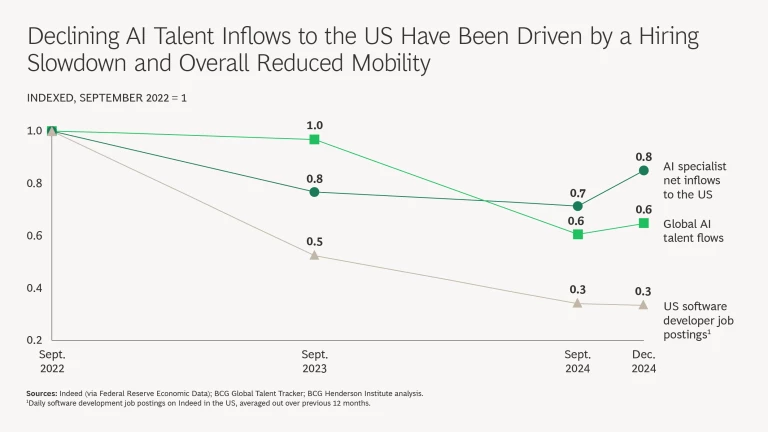
The number of AI researchers and developers moving to the US has dropped 89% since 2017, according to Stanford's 2026 AI Index, released April 13. In the last year alone, the decline was 80%. The country that built its AI advantage on attracting the world's best minds is now recording the sharpest talent inflow decline in over a decade, at exactly the moment when China is closing the performance gap to within 2.7 percentage points.
The policy changes driving that decline are not subtle. They are structural, deliberate, and already showing measurable effects on how the technology industry hires.
The $100,000 Visa and What It Did to the Market
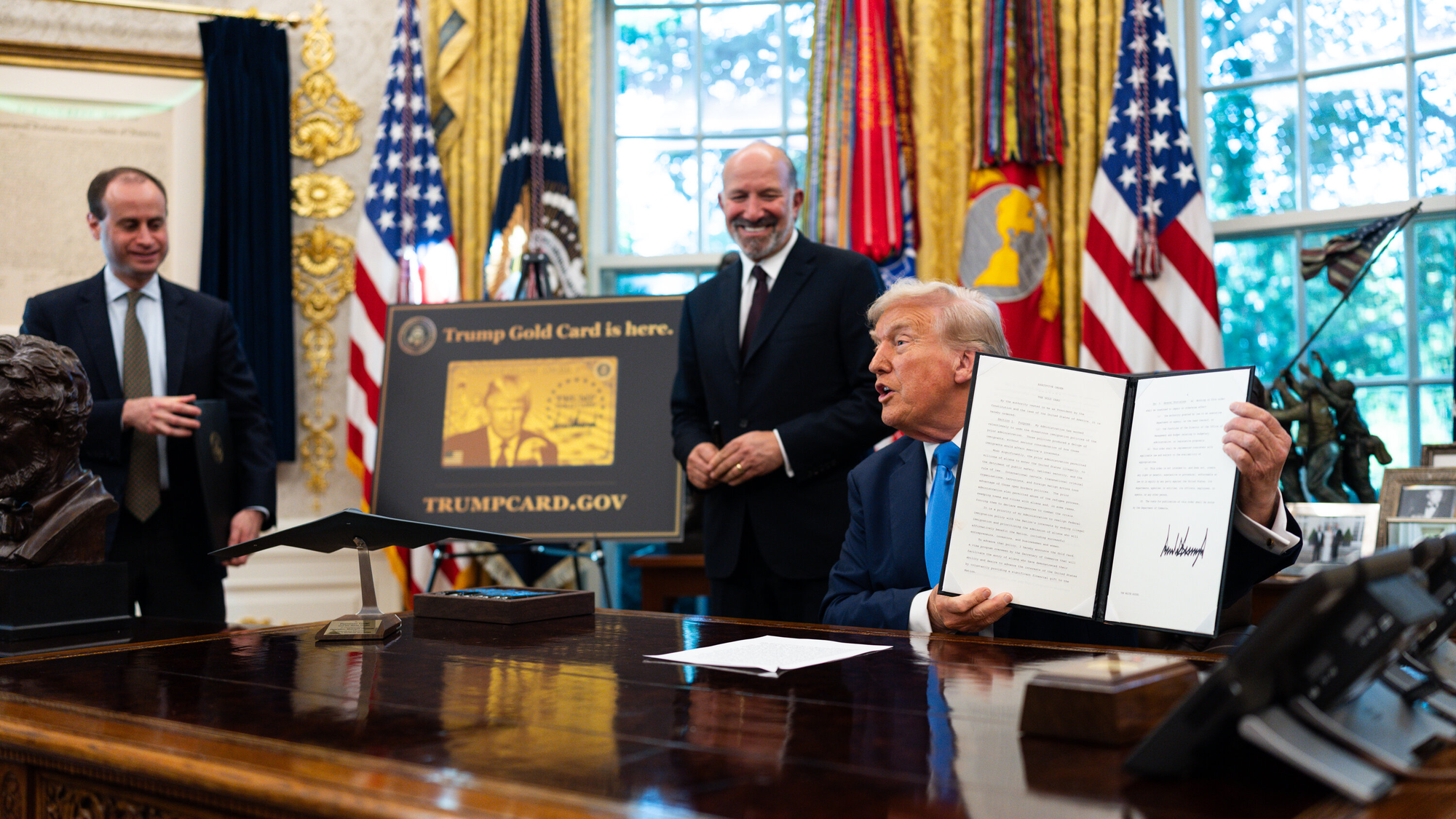
On September 19, 2025, President Trump signed a presidential proclamation restructuring the H-1B visa program. The central change was a $100,000 "visa integrity fee" that employers must pay per new petition for workers filing from abroad. The fee took effect on September 21, 2025. It expires after 12 months unless extended.
The H-1B program has been the primary pathway through which US employers have hired high-skilled foreign professionals in technology, engineering, and research for decades. Before the proclamation, the cost per petition ranged from approximately $2,000 to $5,000 depending on employer size. The new fee represents a cost increase of roughly 20 to 50 times, depending on the employer.
The National Immigration Forum described it as "the most restrictive measures on the H-1B program in decades." The American Immigration Council called it effectively unaffordable for many employers, warning of a "brain drain" of qualified workers to other countries and slower economic growth.
The administration's stated rationale was protecting American workers and closing loopholes in a system it said had been used to replace domestic workers with cheaper imported labor. Commerce Secretary Howard Lutnick framed the intent bluntly: "Do we need to have a person valuable $100,000 a year to the government, or should they return home and hire an American?"
How Big Tech Responded
Department of Labor data on certified H-1B applications in Q1 of fiscal year 2026 (October through December 2025) showed declines across much of the industry's largest employers.
Amazon posted the largest volume and the steepest drop, falling from 4,647 certified applications in Q1 2025 to 3,057 in Q1 2026. Meta and Google each recorded nearly 50% year-over-year declines. Apple, Microsoft, IBM, Salesforce, and Tesla all reported fewer filings. Walmart cut its filings by more than half, submitting 312 certified applications in the quarter. Nvidia moved in the other direction, with filings rising from 369 to 434.
The pattern reflects a structural sorting that immigration attorneys predicted. The $100,000 fee is absorbable for Nvidia, which is hiring for extremely high-value roles where a six-figure visa cost represents a small fraction of total compensation. It is prohibitive for startups, smaller research institutions, and employers filling entry-level or mid-level AI roles. "When companies stop sponsoring," said immigration attorney Richard T. Herman, "it's rarely because they don't value their global talent. It's because they're terrified of punishment for unintentional mistakes."
The proclamation also launched the Department of Labor's "Project Firewall," a new enforcement initiative that resulted in a 48% jump in Labor Department probes targeting H-1B employers. That enforcement pressure added compliance risk on top of the financial cost, reinforcing the caution that drove filing declines.
A federal judge in December 2025 upheld the administration's authority to impose the fee, ruling that the president has legal authority to impose financial requirements on foreign workers entering the country. A coalition of 20 state attorneys general and a separate suit by the Chamber of Commerce and various universities are still working through the courts. The fee is currently set to expire September 21, 2026, absent an extension.
The Talent Decline Predates the Fee
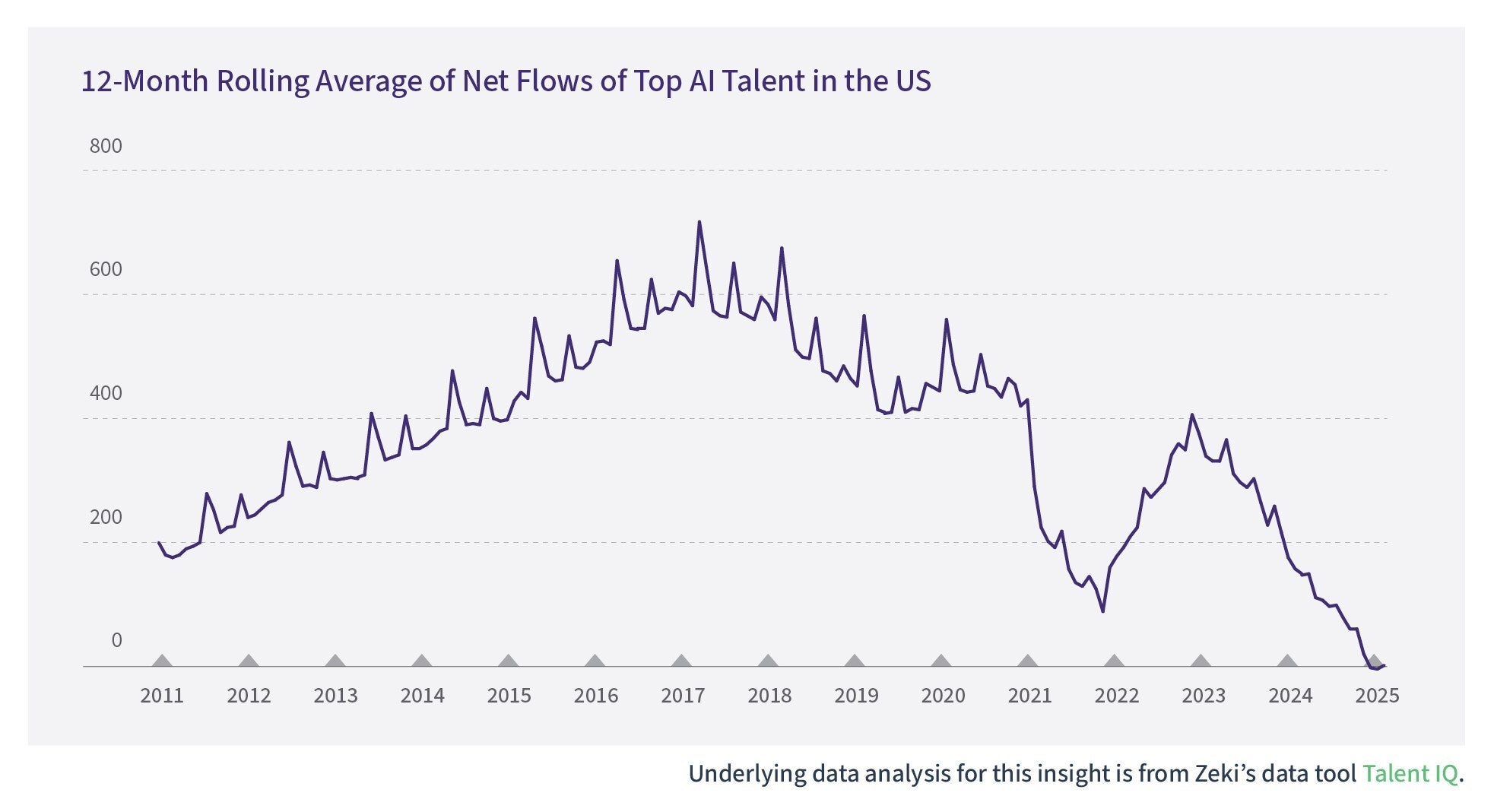
The Stanford AI Index's 89% figure covers the period since 2017, and the data shows the decline started before the H-1B proclamation. According to Zeki Data's 2025 State of AI Talent Report, which tracks approximately 800,000 individuals working in AI across 115 countries, the decline in talent headed to the US first became measurable in late 2022 and has accelerated since. The country has now reached a point where the amount of AI talent leaving roughly matches the amount arriving.
Several factors contributed before the 2025 policy changes. The February 2025 budget cuts to the National Science Foundation and National Institutes of Health eliminated major sources of public funding for AI research, making academic AI careers less viable and reducing an important pipeline for international researchers who arrive through academic programs. Student visa scrutiny has increased across STEM disciplines.
The deeper structural issue, identified by Stanford HAI's own policy brief on DeepSeek's talent base, is that the US can no longer assume the world's best AI researchers will choose to come here. "Policymakers need to reinvest in competing to attract and retain the world's best AI talent," the brief stated directly, after analyzing that nearly all of DeepSeek's researchers were educated and trained in China, and that the quarter who had US experience largely returned to China to work on AI. The default of global AI talent flowing toward the US is not permanent. It is a product of policy choices, institutional investment, and the perception that this is where the frontier is.
Where the Talent Is Going Instead
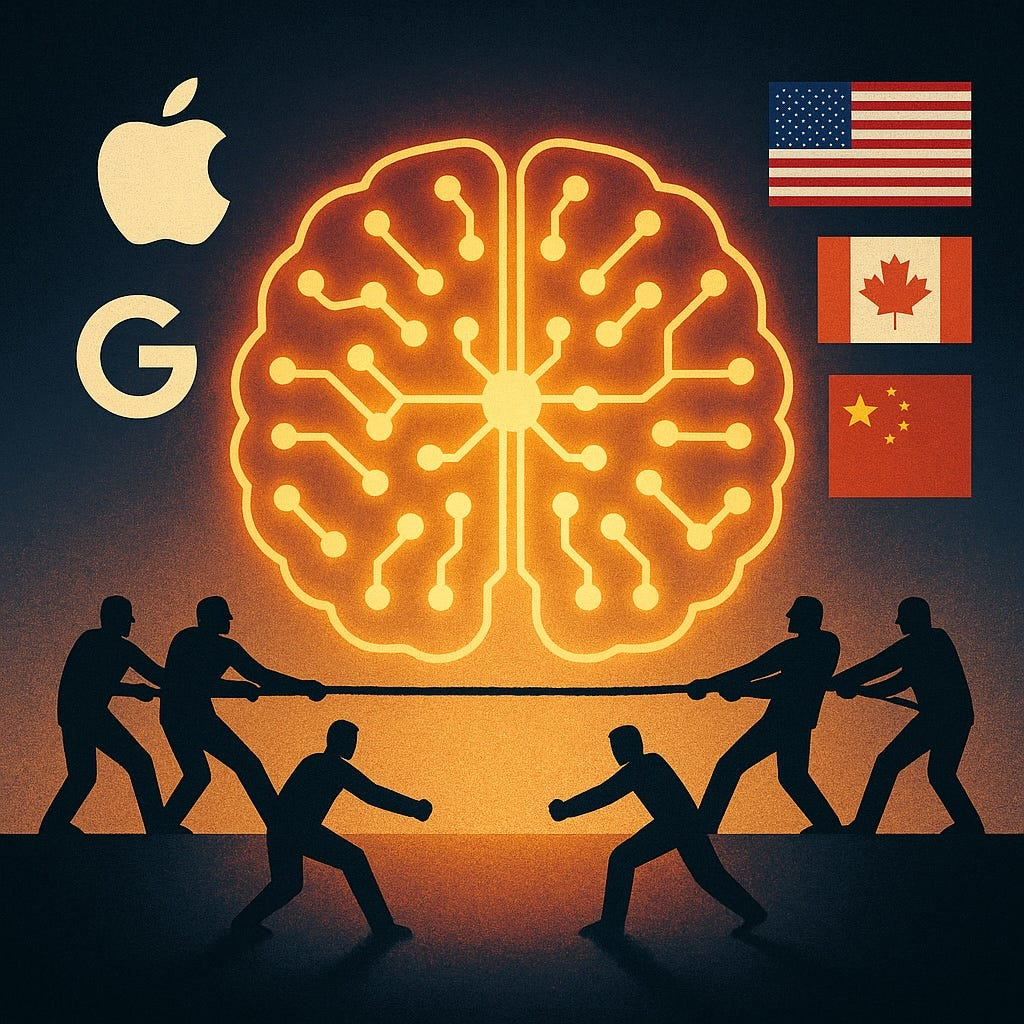
The US talent slowdown is not occurring in a vacuum. Competitor countries are actively repositioning to absorb the researchers and engineers who might otherwise have moved to California.
Canada has emerged as the most direct beneficiary. Toronto, Montreal, and Vancouver are established AI hubs anchored by the Vector Institute, MILA, and the University of Toronto. Canada's Global Talent Stream visa program allows companies to bring in skilled workers within two weeks, a processing timeline that stands in sharp contrast to the US system's delays and uncertainties. The Canadian government's Pan-Canadian Artificial Intelligence Strategy has been running since 2017.
The United Kingdom is actively marketing itself as an alternative. London is attracting US AI professionals alongside European talent, according to executives at firms building there. Since 2020, Britain has founded more AI companies per capita than any other European country. Chancellor Rachel Reeves committed £2.5 billion to UK AI and quantum computing leadership. The UK government's stated ambition is the fastest AI adoption rate in the G7.
The UAE and Saudi Arabia are investing at a scale that was not credible even two years ago. AI engineering skill development is growing fastest in the UAE, according to LinkedIn data cited in the Stanford report. The US-UAE AI Acceleration Partnership commits $1.4 trillion over ten years, including a 5-gigawatt AI compute cluster and GPU allotments that could anchor a serious research ecosystem.
Singapore and Switzerland lead the world in AI researchers and developers per capita, according to the Stanford Index, and are absorbing regional talent that might otherwise have moved to the US.
The structural advantage the US has had is not that it produces the most AI talent domestically. It is that it has been the destination most researchers around the world chose. Stanford's data on the top-tier global AI talent pool shows the US hosts 60% of the world's top-tier AI researchers despite not producing most of them domestically. That ratio is a function of attractiveness, not birth rate. It can be changed.
The Strategic Cost of Getting This Wrong
The connection between talent inflows and frontier AI capability is not abstract. It is the mechanism by which the US lead was built.
Stanford HAI's analysis of DeepSeek's researcher base found that the small fraction of the team who had US experience, primarily through academic programs, represented a notable transfer of knowledge and methodology. The researchers who trained at American universities and then returned to China carried with them training approaches, research frameworks, and technical intuitions developed in US labs. Restricting that inflow does not just reduce the US talent pool. It potentially accelerates the knowledge transfer to competitors, as researchers train at US institutions, find the path to staying blocked, and return home with what they learned.
The Zeki Data report predicts India will shift from a net exporter of AI talent to a net importer in the coming years, as investment in Indian AI infrastructure accelerates. Major European and Gulf State hubs are also expected to benefit, absorbing researchers who might previously have moved to the US. The global competition for AI talent is intensifying at precisely the moment the US is raising the cost and complexity of participation.
The Stanford 2026 AI Index frames the arithmetic directly: the US is attracting new AI talent at the lowest rate in over a decade, while spending more on AI than any country in history. Those two trends cannot coexist indefinitely without narrowing the capability advantage the investment is supposed to protect.
PwC's 2026 AI Performance Study, also released April 13, found that 74% of AI's economic value is captured by just 20% of organizations, with the leading companies distinguished in part by their ability to attract and retain the talent to build foundations that scale. The same concentration dynamic applies at the national level. Countries that successfully attract the researchers who build frontier systems will compound their advantage. Countries that do not will find the gap closing faster than their investment numbers suggest it should.
Conclusion
The US AI talent advantage was never simply a function of domestic supply. It was built on a decades-long pattern of being the place the world's best researchers chose to go, trained, and stayed. That pattern is unwinding.
The 89% decline in AI researcher inflows since 2017, accelerating to an 80% drop in a single year, is not primarily a story about individual visa cases. It is a story about the structural conditions that made the US the default destination for global AI talent and the policy decisions that are eroding those conditions at a time when the performance gap with China has narrowed to single digits.
The tools to rebuild that attractiveness exist. The visa pathways, the university infrastructure, the lab ecosystem, and the compensation levels that make US AI careers competitive remain largely intact. What is changing is the signal the policy environment sends to the researcher in Beijing, Bangalore, or Berlin deciding where to build the next decade of their career.
If that signal continues to say the border is harder to cross, the capability advantage the US has spent hundreds of billions to construct will face a structural challenge that no amount of compute spending can fully compensate for.
Frequently Asked Questions
How much has AI talent inflow to the US declined?
According to Stanford's 2026 AI Index, the number of AI researchers and developers moving to the US has dropped 89% since 2017. In the most recent year covered by the report, the decline was 80%. The US is attracting new AI talent at its lowest rate in over a decade.
What is the $100,000 H-1B visa fee and when did it take effect?
On September 19, 2025, President Trump signed a presidential proclamation imposing a $100,000 "visa integrity fee" on new H-1B visa petitions for workers filing from abroad. The fee took effect September 21, 2025, and is set to expire September 21, 2026, absent an extension. It replaced the previous cost of approximately $2,000 to $5,000 per petition. A federal judge upheld the administration's authority to impose it in December 2025, and legal challenges from states and business groups continue.
Which tech companies reduced H-1B filings after the new fee?
Department of Labor data shows that Amazon's certified applications fell from 4,647 to 3,057 in Q1 2026. Meta and Google each recorded nearly 50% year-over-year declines. Walmart cut its filings by more than half. Apple, Microsoft, IBM, Salesforce, and Tesla also reported fewer filings. Nvidia was a notable exception, increasing its filings.
Where is AI talent going if not to the US?
Canada, the UK, Singapore, Switzerland, the UAE, and Saudi Arabia are all actively competing for AI researchers who might previously have chosen the US. Canada's Global Talent Stream processes skilled worker visas within two weeks. The UK has committed £2.5 billion to AI leadership. The UAE is accelerating AI skill development faster than any country tracked by LinkedIn data in the Stanford report.
How does the talent decline connect to the US-China AI performance gap?
Stanford's 2026 AI Index shows the US leads China by just 2.7% on top model performance as of March 2026, down from double-digit leads in 2023. The US lead was partly built on attracting globally trained AI researchers, including those originally from China who chose to stay in the US. A Stanford HAI analysis of DeepSeek's researcher base found that researchers who had US training experience were a notable part of its knowledge base, suggesting that restricting inflows while training continues could accelerate knowledge transfer to competitors.
What is the argument that the talent decline will reverse itself?
The administration argues the H-1B fee reforms protect American workers, prioritize genuinely high-skill hires over lower-cost labor substitution, and will improve standards within the visa program. The fee is structured to favor higher-wage, higher-skill workers, which in theory should concentrate talent inflow on the most qualified candidates. Nvidia's increased filings suggest the most high-value AI hiring continues. The fee is also temporary without an extension, set to expire September 21, 2026.
Related Articles
 Dani
Dani Dani
Dani Dani
Dani