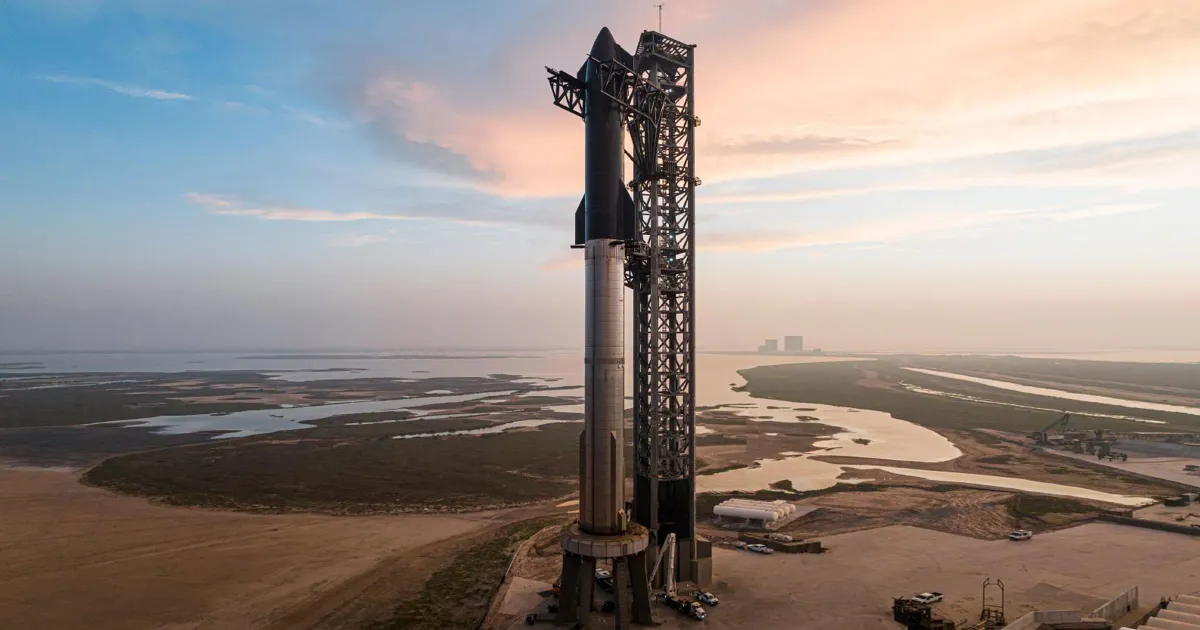
At 6:35 p.m. EDT on April 1, 2026, NASA's Space Launch System rocket lifted off from Kennedy Space Center's Launch Complex 39B in Florida, carrying four astronauts on the first crewed mission beyond low Earth orbit since Apollo 17 in December 1972.
The Artemis II crew, Commander Reid Wiseman, Pilot Victor Glover, Mission Specialist Christina Koch, and Canadian Space Agency Mission Specialist Jeremy Hansen, are on a ten-day journey that will take them around the far side of the Moon and back to Earth. On April 6, at 1:56 p.m. EDT, Artemis II broke Apollo 13's record for the farthest distance any human has traveled from Earth, reaching 252,760 miles at its maximum distance.
The launch itself went remarkably smoothly. Pilot Victor Glover, speaking from space during a live event the following day, captured the crew's genuine surprise: "It was surprising. We like to say that we're prepared without having an expectation, but in the back of your mind, you kind of hope you launch."
What Artemis II Is Doing
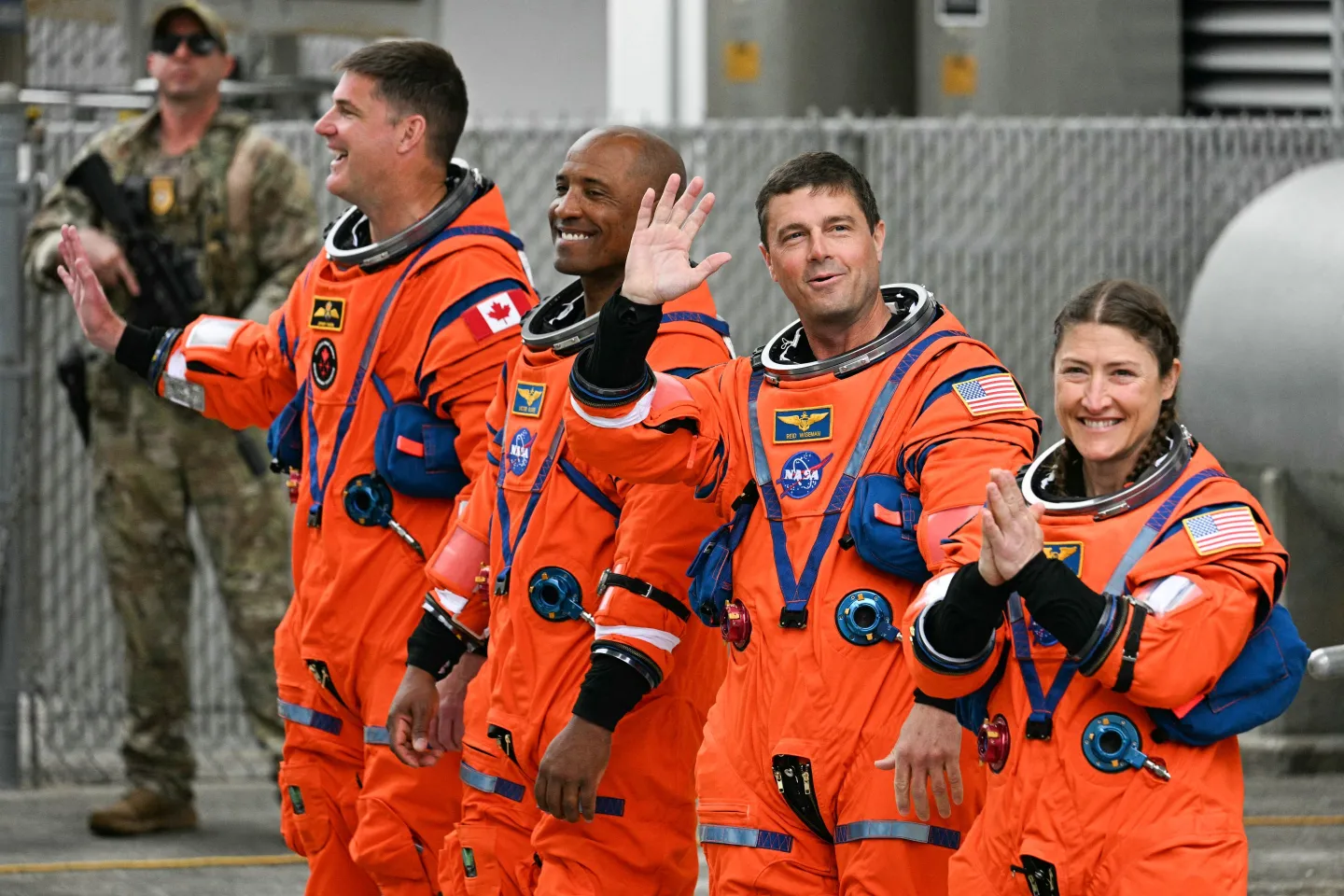
Artemis II is a test flight, not a landing. The mission's primary purpose is to verify that the Orion spacecraft's life support systems work with humans aboard, testing propulsion, power, thermal control, navigation, and proximity operations in deep space for the first time with a crew.
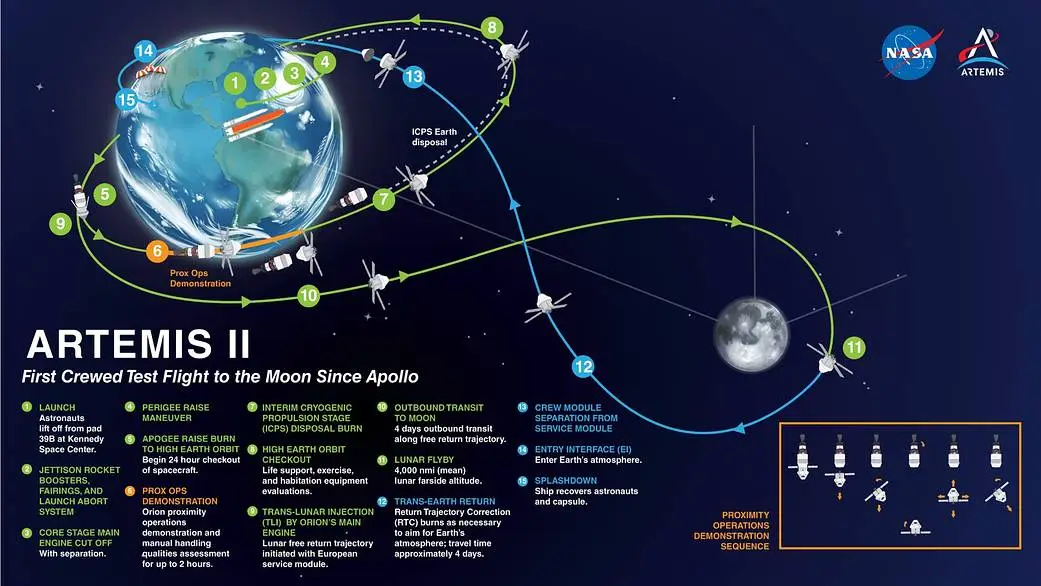
The astronauts spend the mission manually flying Orion at intervals to test its handling, while overseeing the automated systems that manage the vast majority of trajectory and monitoring functions. On April 6, the spacecraft completed a lunar flyby at a closest approach of 4,070 miles above the Moon's surface, entering a communications blackout of approximately 40 minutes as Orion passed behind the Moon.
The mission concludes with a reentry into Earth's atmosphere at roughly 25,000 miles per hour, and splashdown in the Pacific Ocean.
The Artemis II Crew
| Astronaut | Role | Notable |
|---|---|---|
| Reid Wiseman | Commander | NASA veteran, former ISS commander |
| Victor Glover | Pilot | First Black astronaut assigned to a lunar mission |
| Christina Koch | Mission Specialist | Record holder for longest single spaceflight by a woman (328 days) |
| Jeremy Hansen | Mission Specialist | First Canadian astronaut on a lunar mission |
The AI Layer Running Beneath the Mission
The launch itself illustrated one of the less-discussed aspects of modern crewed spaceflight: the degree to which automated systems now handle critical mission phases without human intervention.
NASA's own launch day updates noted that as the SLS rocket rose from the pad, umbilicals providing power, fuel, and data disconnected and retracted automatically. The terminal countdown, which controls ignition sequencing and the final minutes before launch, is managed by an automated launch sequencer that "minimizes human intervention, reducing risk and ensuring synchronization across complex subsystems," according to NASA's mission documentation.
The vast majority of Orion's trajectory monitoring and life-support system management is handled by advanced algorithms rather than manual ground control. AI Magazine's pre-launch analysis noted that while the astronauts manually fly Orion at intervals to test its handling, the trajectory and life-support monitoring is predominantly handled by automated systems. This is a fundamental shift from the Apollo era, when mission critical decisions required continuous human intervention and real-time ground control for most functions.
The implications extend beyond this single mission. As spacecraft travel farther from Earth and communication delays become more significant, the ability of onboard systems to make decisions autonomously becomes not just convenient but essential.
AI in NASA Operations: What Has Already Changed
Artemis II is happening in a context where AI integration across NASA's missions has accelerated significantly in the past 18 months.
Perseverance Completes First AI-Planned Drive on Mars
The most concrete recent milestone came from JPL in January 2026. NASA's Perseverance Mars rover completed the first drives on another world planned entirely by generative AI, executed on December 8 and 10, 2025.
Rover route planning has been performed manually by human "drivers" for 28 years across multiple missions. For these two drives, a vision-capable generative AI created waypoints for Perseverance across the Jezero Crater rim without human route planners involved in the decision-making.
"This demonstration shows how far our capabilities have advanced and broadens how we will explore other worlds," said NASA Administrator Jared Isaacman. "Autonomous technologies like this can help missions to operate more efficiently, respond to challenging terrain, and increase science return as distance from Earth grows."
Vandi Verma, a space roboticist at JPL and member of the Perseverance engineering team, described what the demonstration points toward: "We are moving towards a day where generative AI and other smart tools will help our surface rovers handle kilometer-scale drives while minimizing operator workload, and flag interesting surface features for our science team by scouring huge volumes of rover images."
The fundamental constraint driving this work is physics, not preference. Mars is on average about 140 million miles from Earth. That distance creates a communication lag that makes real-time remote operation impossible. AI-managed navigation is not an enhancement in this context; it is a requirement.
Stanford Demonstrates AI Robot Control on the ISS
Stanford researchers reported in late 2025 that they had demonstrated machine learning-based control of the Astrobee robot aboard the International Space Station, the first time AI has been used to help control a robot in microgravity on orbit. The system allowed Astrobee to plan autonomous movements 50 to 60% faster than previous approaches while maintaining safety constraints.
Banerjee, a Stanford researcher on the project, described what it represents for deeper missions: "As robots travel farther from Earth and as missions become more frequent and lower cost, we won't always be able to teleoperate them from the ground. Autonomy with built-in guarantees isn't just helpful; it's essential for the future of space robotics."
ESA's Hera Mission Navigates Autonomously
ESA launched the Hera autonomous interplanetary station in October 2024, tasked with studying the asteroid Dimorphos through the end of 2026. Hera navigates itself directly to the asteroid using the same sensor-fusion principles underlying self-driving cars, building a model of its environment from multiple sensor inputs and making navigation decisions independently without waiting for Earth-based commands.
Why Communication Lag Changes Everything
The reason AI autonomy matters more in space than in almost any other domain comes down to a simple physical fact: the speed of light imposes hard limits on remote control.
For missions at the Moon, the communication delay is roughly 1.3 seconds each way. For Mars, it ranges from 3 to 22 minutes depending on orbital position. For the outer planets, round-trip communication delays are measured in hours. Any system that requires a human on Earth to approve each decision cannot function reliably at those distances.
This constraint is the reason Perseverance already operates autonomously for 88% of its driving, using onboard cameras and computer vision to identify hazards and navigate around them in real time. It is the reason the Artemis program is designed with increasingly autonomous onboard systems rather than relying on continuous ground support. And it is the reason AI capability development for space applications has been treated by NASA as a mission-critical infrastructure investment rather than an experimental add-on.
The AI in space operation market was valued at $2.36 billion in 2025 and is projected to grow to $15.05 billion by 2034, according to Fortune Business Insights, reflecting sustained investment across agency and commercial space programs.
What Comes Next in the Artemis Program
Artemis II is the second mission in a multi-year program designed to return humans to the lunar surface and establish a long-term presence there.
| Mission | Planned Date | Key Objective |
|---|---|---|
| Artemis II | April 2026 (current) | First crewed test flight around Moon; life support verification |
| Artemis III | 2027 | Low Earth orbit operations; test integrated crew and commercial lander systems |
| Artemis IV | Early 2028 | First crewed lunar landing since Apollo 17; south pole surface mission |
| Artemis V+ | 2029 and beyond | Lunar Gateway assembly; sustained surface presence |
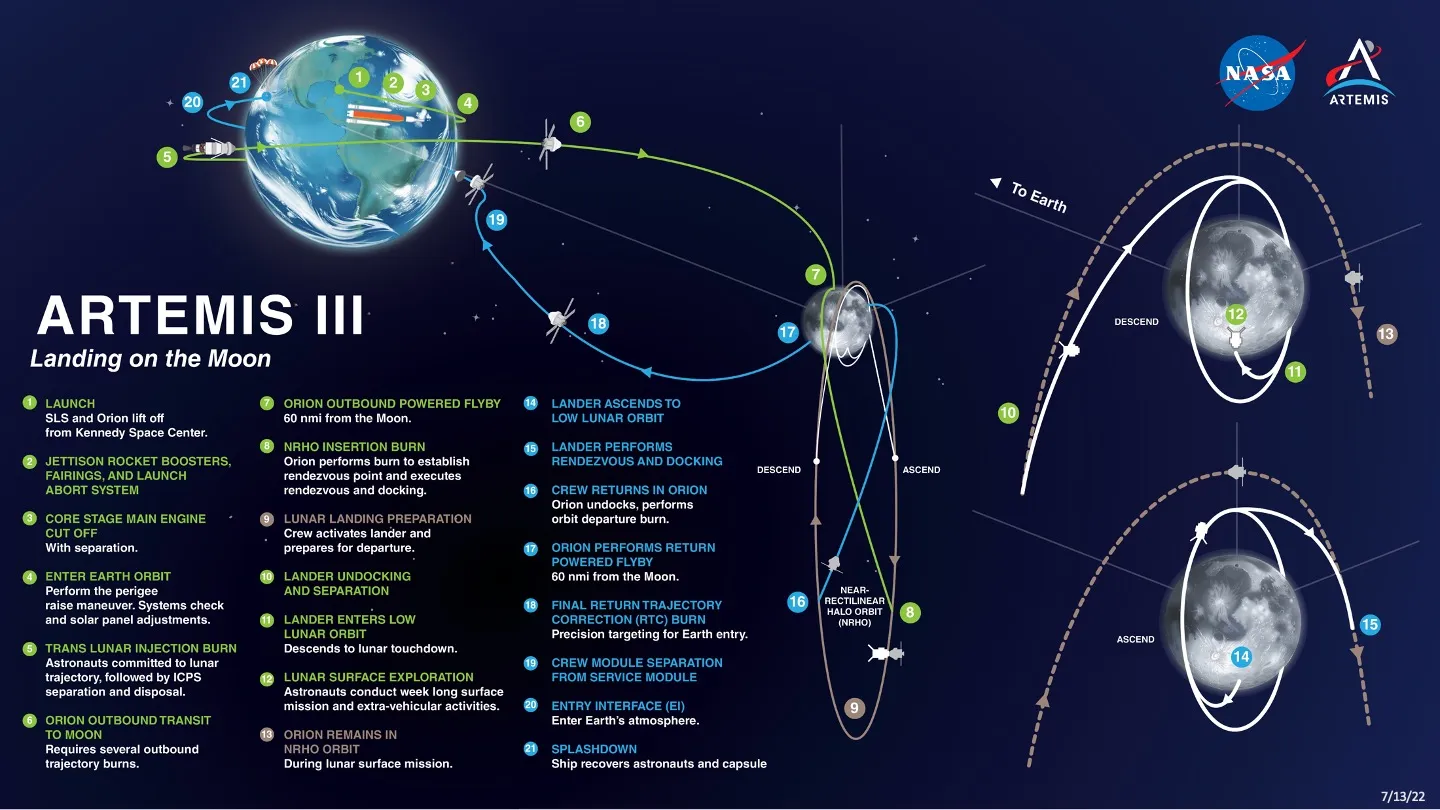
The Lunar Gateway program, which was originally a planned space station in lunar orbit to support surface missions, was canceled in March 2026. NASA overhauled the Artemis III mission profile as a result, shifting its objective to testing integrated operations between Orion and commercial landers in low Earth orbit rather than a direct landing attempt.
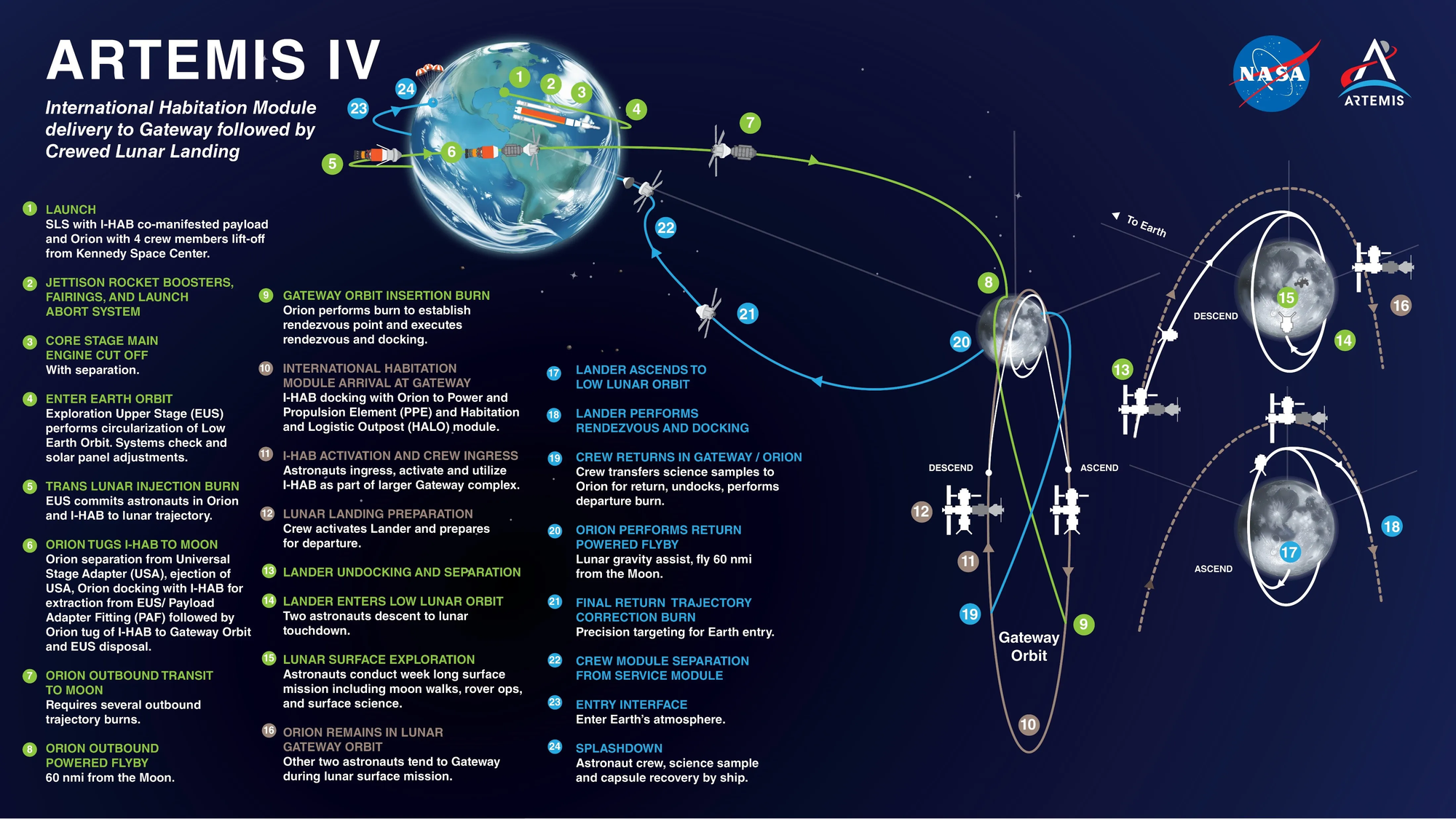
Artemis IV, now targeting early 2028, is planned to be the first crewed lunar landing since December 1972, targeting the south pole region where water ice deposits have been detected.
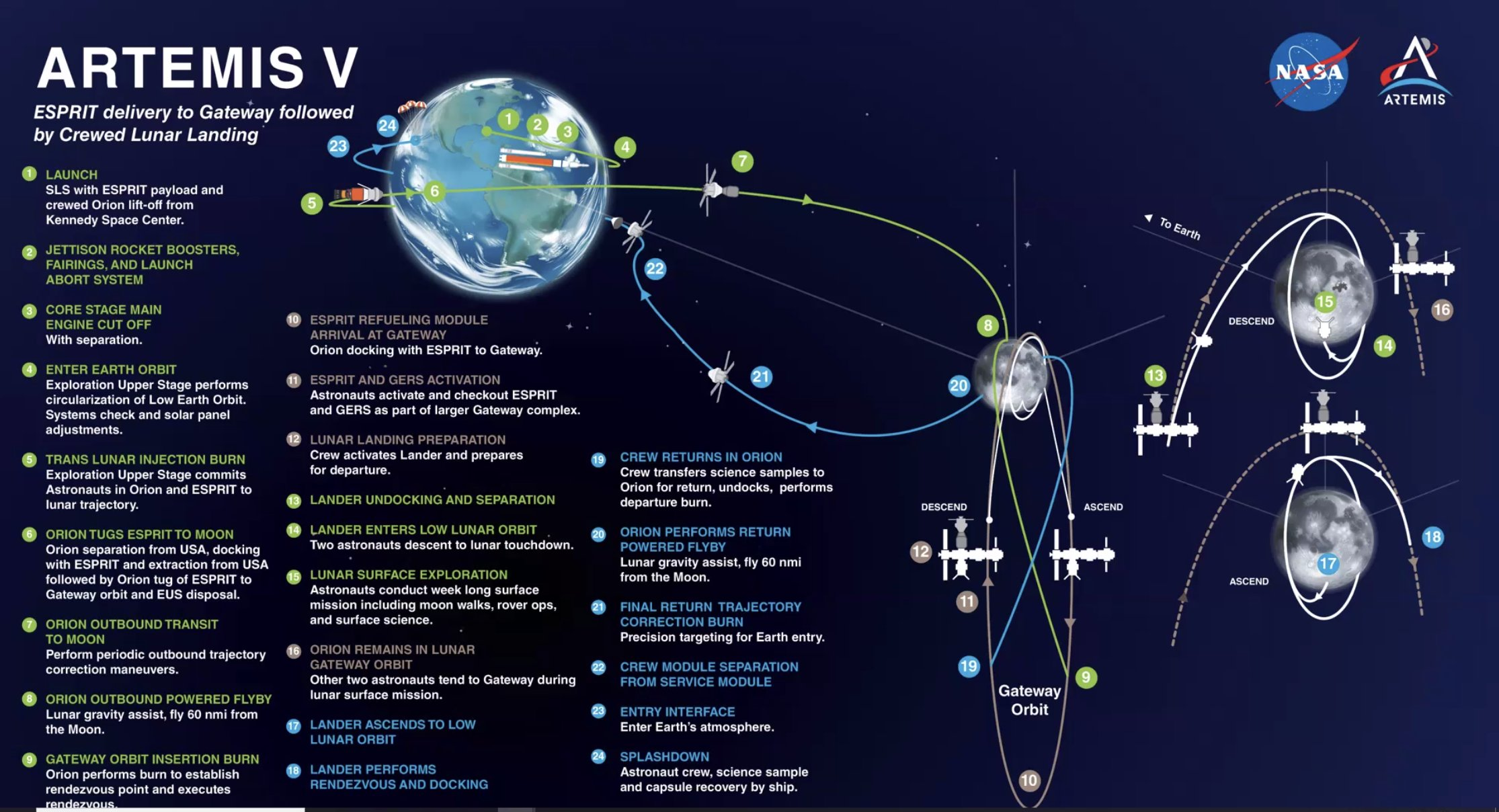
For each of these missions, the role of autonomous AI systems is expected to grow. NASA's Artemis program documentation describes deploying autonomous construction robots for lunar surface operations starting in 2028, using AI to manage terrain assessment, material selection, and infrastructure tasks without waiting for commands from Earth.
The Broader Shift: AI as Mission-Critical Infrastructure
What Artemis II and the surrounding context make visible is a transition that has been building for years but is now operational rather than theoretical.
AI in space is no longer about research demonstrations or incremental improvements to ground-based data processing. It is about systems making real decisions, in real time, in environments where a human being cannot effectively intervene. The Perseverance drives in December 2025 were the first instance of generative AI planning a route for a vehicle on another world. Artemis II's automated terminal countdown and life-support monitoring systems are managing a crewed mission around the Moon.
NASA's use of AI spans multiple domains simultaneously: AEGIS selects science targets autonomously for planetary rovers, ASPEN manages mission scheduling, CLASP handles resource allocation and mission planning, and ML-based navigation tools help robots and spacecraft handle terrain and trajectory without human approval of every step.
The deeper challenge is building systems that are reliable enough to trust in environments where failures are not recoverable. That is why NASA's commitment to what it calls Responsible AI, which requires accountability, traceability, and alignment with human oversight, is embedded in how these systems are developed. The goal is not to remove humans from the loop but to define, precisely, which parts of the loop humans need to be in when communication delays, distance, and time constraints make full human control physically impossible.
Wrap up
Artemis II is the most visible human spaceflight event in more than five decades, and it is generating the attention that milestone deserves. Four astronauts are circling the Moon for the first time since 1972, and the images coming back from Orion's cameras are extraordinary.
The less-visible story is what is running beneath the mission. The automated systems managing Orion's trajectory, the AI-planned rover drives on Mars, the autonomous navigation of ESA's Hera probe, and the ISS robot tests together describe an inflection point in how space agencies operate. AI is not a future capability in this context. It is operational infrastructure that crewed and uncrewed missions are already depending on.
When Artemis IV attempts the first lunar landing in over 50 years in 2028, the autonomous systems managing the descent will be more capable than anything flying today. Artemis II is, among other things, a test of what those systems need to do.
Frequently Asked Questions
When did Artemis II launch and what is its mission?
Artemis II launched on April 1, 2026, at 6:35 p.m. EDT from Kennedy Space Center's Launch Complex 39B. It is a ten-day crewed test flight sending four astronauts on a flyby around the Moon. The primary mission objectives are to verify Orion's life support systems with humans aboard and test propulsion, navigation, thermal control, and proximity operations in deep space for the first time with a crew.
Who is the Artemis II crew?
The Artemis II crew consists of Commander Reid Wiseman, Pilot Victor Glover, Mission Specialist Christina Koch, all from NASA, and Mission Specialist Jeremy Hansen from the Canadian Space Agency. Victor Glover is the first Black astronaut assigned to a lunar mission. Christina Koch holds the record for the longest single spaceflight by a woman. Jeremy Hansen is the first Canadian astronaut on a lunar mission.
What records did Artemis II break?
On April 6, 2026, Artemis II broke Apollo 13's record for the farthest distance humans have ever traveled from Earth, reaching a maximum distance of 252,760 miles. This surpassed the Apollo 13 record by more than 4,100 miles. The mission also marks the first crewed mission beyond low Earth orbit since Apollo 17 in December 1972.
What role does AI play in the Artemis II mission?
The vast majority of Orion's trajectory monitoring and life-support system management is handled by automated algorithms. The terminal countdown sequence is managed by an automated launch sequencer designed to minimize human intervention during the most time-critical phase. The astronauts manually fly Orion at specific intervals to test its handling, but most routine system management is autonomous.
What is the most significant recent milestone in AI-managed space operations?
In January 2026, JPL announced that NASA's Perseverance Mars rover had completed the first drives on another world planned entirely by generative AI, executed in December 2025. For 28 years, rover route planning had been performed manually by human drivers. The AI-planned drives marked the first time autonomous navigation planning was used for surface operations on another planet.
What comes after Artemis II?
Artemis III, planned for 2027, will test integrated operations between the Orion spacecraft and commercial landers in low Earth orbit following the cancellation of the Lunar Gateway program. Artemis IV, targeting early 2028, is planned to be the first crewed lunar landing since Apollo 17 in 1972, with a destination at the lunar south pole where water ice deposits have been detected.
Related Articles
 Mark
Mark
 Dani
Dani