The world's AI infrastructure buildout has a power problem, and everyone knows it.
Global data center electricity consumption stood at 415 terawatt-hours in 2024. The International Energy Agency projects that figure will more than double to 945 TWh by 2030 — and could reach 1,300 TWh by 2035. To put those numbers in context: the entire nation of Japan consumed roughly 900 TWh of electricity in 2024. Within this decade, the world's data centers alone will consume as much electricity as one of the most industrialized countries on earth.
That demand has to come from somewhere. In the United States, grid interconnection queues have swelled to over 2,600 gigawatts of pending requests — more than twice the total installed capacity of the entire national grid. Wholesale electricity costs near data center clusters have surged as much as 267 percent over the past five years. In parts of Ohio, commercial AI load growth pushed coal generation up 23 percent in 2025 because it was the only dispatchable fuel available fast enough. In Virginia, Texas, and the Midwest, hyperscalers are competing directly with households for grid capacity — and the surge hasn't even peaked yet.
China is building its way out of the problem at a scale that has no Western equivalent, with over 30 gigawatts of nuclear capacity currently under construction and projections pointing toward 200 GW by 2030 and potentially 400 to 500 GW by 2050.
France, meanwhile, is making a different kind of bet.
Not faster. Not cheaper. But arguably cleaner, more structurally coherent, and more strategically deliberate than anything else happening in Europe. France already generates 60 to 75 percent of its electricity from nuclear power, operates the second-largest nuclear fleet in the world, and in 2024 exported approximately 90 terawatt-hours of decarbonized electricity — a record surplus not seen in over two decades. It also has a €72.8 billion program underway to build six next-generation reactors, with a potential option for eight more.
The question is not whether France has the energy assets to anchor European AI infrastructure. It clearly does. The question is whether its industrial and political systems can execute on that advantage fast enough for it to matter in a race where the timelines are measured in years, not decades.
The Asset France Already Has
A Grid Built for Exactly This Moment
France's relationship with nuclear power is unusual among Western nations, and deliberately so. Following the 1973 oil crisis, successive French governments made a strategic decision to build energy sovereignty through domestically controlled nuclear generation. The program that followed was one of the most rapid industrial buildouts of any energy technology in modern history — 57 reactors across 17 sites, brought online largely throughout the 1980s, providing a 61-gigawatt nuclear baseload that has defined the French grid ever since.
The result is a power system that is structurally well-suited to AI workloads in ways that few others are. Nuclear generation is dispatchable and continuous, unaffected by weather, time of day, or seasonal intermittency. It produces large volumes of electricity at stable, predictable prices. And in France's case, it produces that electricity with a carbon intensity that is among the lowest in the world for any grid at comparable scale.
In March 2026, President Macron stated plainly at the World Nuclear Energy Summit in Paris: "In France, last year, we exported 90 terawatt-hours of decarbonized electricity. Thanks to our nuclear plants, we have the ability to open data centers, to build computing capacity, to be at the heart of the artificial intelligence challenge."
That surplus matters. France is not being asked to choose between powering its citizens and powering AI infrastructure. The 90 TWh it exported in 2024 represents available generation capacity that is currently leaving the country rather than supporting domestic industrial development. Redirecting a portion of that surplus into co-located data center infrastructure is, in energy terms, relatively low-risk. It is one of the few scenarios in the global AI energy discussion where the near-term supply actually exists.
EDF's Land Play
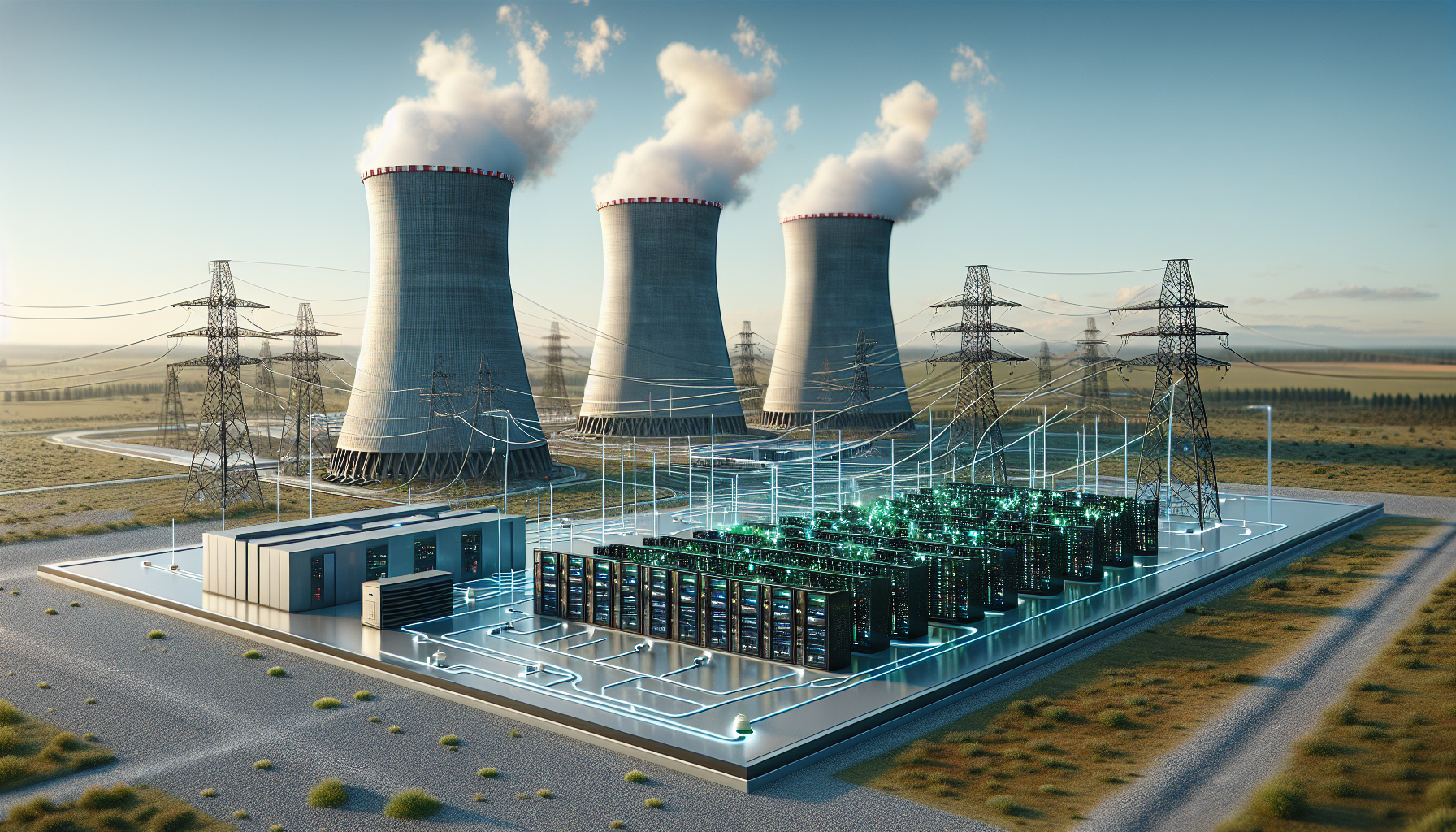
France's state-owned utility, EDF, has moved quickly to position its existing nuclear sites as physical infrastructure for data center development. At the Paris AI Action Summit in February 2025, EDF announced it was offering four plots of land it owns for possible data center developments, with plans to have two additional sites out to tender by 2026 — the initial four sites totaling 3 gigawatts of available power capacity.
The strategic logic is straightforward. Co-locating data centers near existing power stations means base load consumption with reduced transmission losses, and nuclear plants are already situated near large water sources well-suited for cooling high-density computing infrastructure.
EDF also announced it was supplying 40 megawatts of nuclear power to Data4 for its data centers, establishing the commercial model it intends to scale. For operators accustomed to spending years fighting grid interconnection queues, the offer of 3 gigawatts of ready power at pre-identified sites is not a trivial advantage.
The Investment Wave That Followed
€109 Billion and What It Actually Represents

The numbers announced at the Paris AI Action Summit in February 2025 were striking enough to generate significant international attention. President Macron announced that private investors had pledged nearly €110 billion in France's AI sector, including between €30 and €50 billion from the United Arab Emirates for a data center campus expected to be the largest in Europe, and another €20 billion from Brookfield Corporation.
Macron described the investment as France's equivalent of the Stargate initiative in the United States, referencing the Trump administration's $500 billion private AI infrastructure project. The comparison is directionally apt, though the U.S. commitment is nearly five times larger in dollar terms.
The investor roster that signed on was notable: commitments came from MGX, BlackRock, Brookfield, Amazon, Microsoft, Fluidstack, Data4, Equinix, Digital Realty, Prologis, Evroc, Sesterce, Opcore, Mistral AI, BPI France, Infravia, and Scaleway.
The Fluidstack deal was the most structurally interesting. UK-based AI cloud provider Fluidstack signed a memorandum of understanding with the French government to construct one of the world's largest decarbonized AI supercomputers in France, with Phase 1 backed by an initial investment of €10 billion and set to be operational in 2026. The facility's first phase is designed to host approximately 500,000 next-generation AI chips, providing up to 1 gigawatt of dedicated AI compute power.
Brookfield separately announced a €20 billion investment in French data centers, including a 1-gigawatt facility in Cambrai, in northern France, on the site of a former military airbase. The Cambrai development is structurally important because it is being built outside Paris, closer to power generation infrastructure, where AI workloads that do not require low latency can operate more cost-effectively.
The New Reactor Program — and Its Honest Timeline
Six EPR2s, One Final Investment Decision, and a 2038 Target
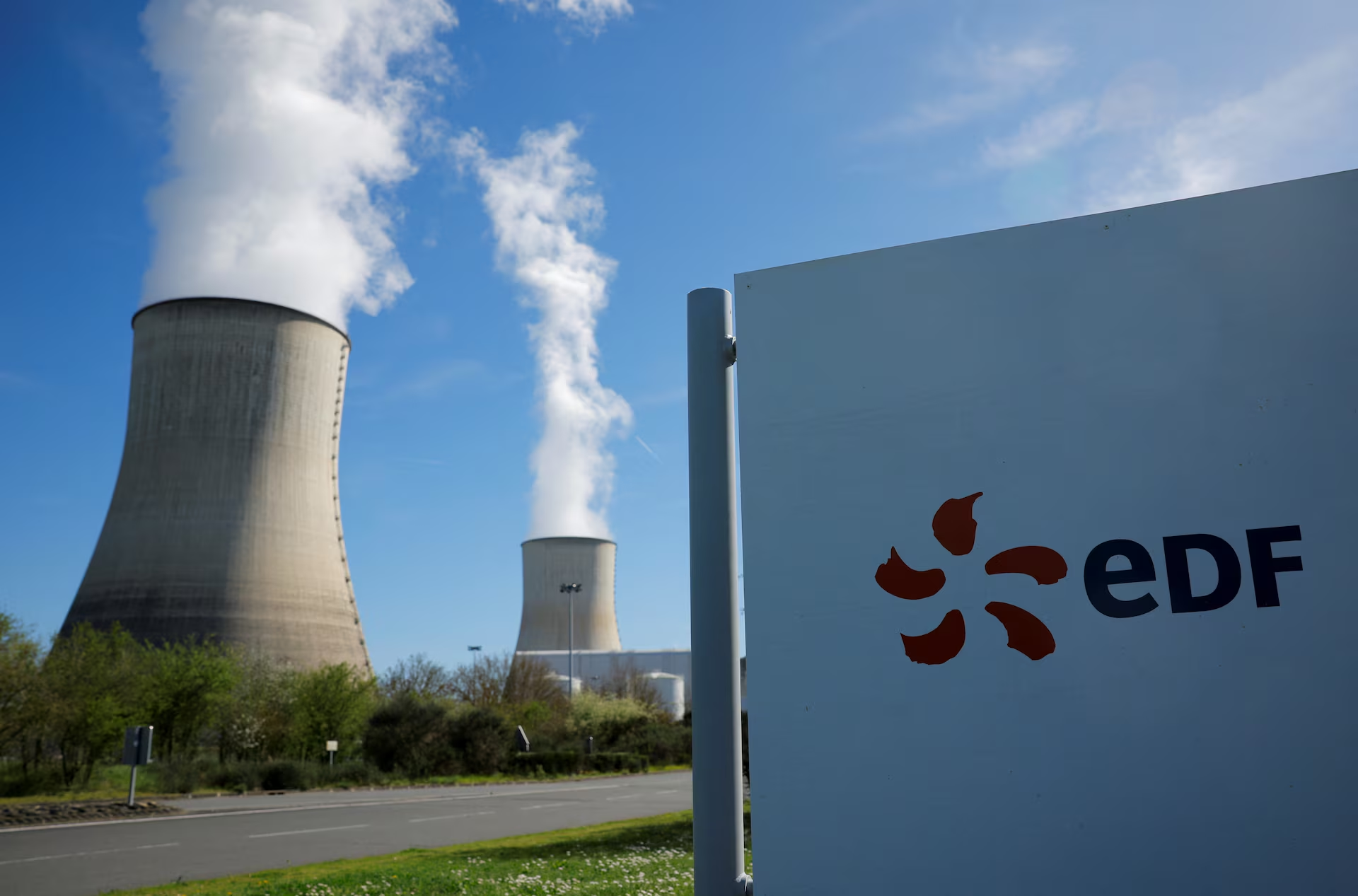
The part of France's nuclear-AI strategy that generates the most enthusiasm — and the most misunderstanding — is the new reactor construction program. The picture is more complicated than the headlines suggest, and professionals evaluating France's AI infrastructure position need to understand it precisely.
In February 2022, President Macron announced a nuclear renaissance program: six new EPR2 reactors to be built at three existing sites, with an option for eight additional units. France's third Multiannual Energy Programme, covering 2026 to 2035, formalizes these ambitions, calling for the construction of six EPR2 reactors, establishing the objective of deciding as early as 2026 whether to launch construction of eight additional EPR2 reactors, and beginning construction of a first small modular reactor around the start of the 2030s.
Nuclear production is targeted at 380 to 420 TWh per year between 2030 and 2035, up from the previous target range of 360 to 400 TWh, consistent with EDF's own target of 400 TWh.
The cost estimate, released by EDF in December 2025, was €72.8 billion at 2020 prices — roughly €89 billion in current terms. That figure has already escalated significantly from the original projection. EDF is expected to make a final investment decision in 2026, with construction beginning at Penly around 2027 to 2028, and the first reactor targeted for commissioning in 2038.
The 2038 commissioning date deserves to be stated plainly: the new reactors France is currently planning will not generate a single electron until at least twelve years from now. For a global AI infrastructure competition being fought on a five-year timeframe, that timeline is effectively irrelevant to near-term positioning.
EDF has acknowledged that Flamanville 3, the most recent French EPR completed after years of delays and cost overruns, had financing costs that drove a decision to take EDF fully into state ownership. The Cour des Comptes estimates Flamanville 3's total cost at €23.7 billion and predicts profitability below 2 percent — insufficient to cover EDF's cost of capital.
The EPR2 design is explicitly intended to address Flamanville's problems. It requires far fewer components, uses more prefabricated elements, and is designed for faster, more standardized construction. Whether that design advantage translates into on-time, on-budget delivery remains the central unanswered question for the entire program.
The French Court of Auditors has recommended that the final investment decision for the EPR2 program be withheld until financing is secured and detailed design studies reach the "first nuclear concrete" milestone, explicitly to avoid the cost deviations experienced with the EPR reactors at Olkiluoto, Hinkley Point, and Flamanville.
The financing model involves at minimum a subsidized government loan covering half the construction cost, a Contract for Difference providing a guaranteed minimum electricity price of no more than €100 per MWh, and European Commission approval for the state aid package — a negotiation that was still ongoing at the start of 2026.
What France Is Competing Against
The Global Nuclear-AI Landscape
France is not alone in recognizing the structural alignment between nuclear power and AI infrastructure demand. The three major AI powers — the United States, China, and now Europe via France — are each pursuing nuclear energy to power their compute buildouts, but with fundamentally different starting positions, timelines, and risk profiles.
| Dimension | France | United States | China |
|---|---|---|---|
| Current nuclear share of electricity | ~67-70% | ~19% | ~5% |
| Current nuclear capacity (GW) | 61 | 97 | 58 (operational) |
| New nuclear capacity under construction | 6 EPR2 reactors (planned) | Limited (Vogtle 4 completed 2024) | 30+ GW |
| Target nuclear capacity by 2030 | Maintain ~400 TWh output | Restart + life extensions | 200 GW |
| First new reactor online | 2038 (EPR2 at Penly) | Palisades restart (2026) | Linglong SMR (2026) |
| AI data center electricity demand growth to 2030 | +70% (Europe overall) | +130% | +170% |
| 2024 data center electricity consumption | Included in Europe 15% share | ~186 TWh (45% of global) | ~103 TWh (25% of global) |
The American comparison illuminates a structural difference. The U.S. is not building new large reactors at any meaningful scale – Vogtle Unit 4 in Georgia, which finally reached commercial operation in late 2024, was the first new American reactor to come online since 1996 and cost approximately $35 billion. What the U.S. is doing is extending the operational life of existing plants and, in the case of Palisades, restarting a plant that had already entered decommissioning. Microsoft's deal with Constellation to procure power from the reactivated Three Mile Island reactor represents the same logic: existing capacity, reactivated for a new customer.
Amazon, through AWS, has announced over $20 billion in investment to convert the Three Mile Island site into an AI-ready data center campus powered entirely by nuclear energy. Google is advancing plans to bring a 500 MW small modular reactor online by 2030 in partnership with Kairos Power.
China's trajectory is the most aggressive by any measure. As of 2025, China has more than 30 GW of nuclear capacity under construction, representing over half of the world's current nuclear buildout. By comparison, U.S. nuclear growth is limited to incremental projects, with little in the way of large-scale expansion. China's stated target is 500 GW of nuclear capacity by 2050, versus the United States' ambitious but unfunded target of 400 GW.
The IEA's projections capture the scale of what China is preparing for. China's electricity demand for data centers is expected to more than double over the next five years, reaching around 277 TWh by 2030. Yet this growth in energy demand for AI is unlikely to be a constraint for China, given the country's historically rapid pace of overall energy expansion.
That last sentence is significant. China has a structural advantage in AI energy that goes beyond nuclear: it has been building electrical generation infrastructure at scale for decades, has surplus manufacturing capacity for solar panels and batteries, and does not face the interconnection queue backlogs, supply chain delays, and regulatory timelines that constrain every Western grid expansion.
France's Near-Term Advantage vs. Its Long-Term Bet
Two Different Strategic Stories
Understanding France's position requires separating two distinct claims that often get conflated in the same conversation.
The first claim is that France's existing nuclear surplus makes it the most credible location in Europe for AI data center development right now. This claim is well-supported. The 90 TWh export surplus, the EDF site offerings, the €109 billion investment wave, and the Fluidstack agreement all point toward a genuine near-term advantage. Data centers that need baseload, low-carbon electricity at scale – and that can locate themselves away from major urban centers – have concrete reasons to prefer France over Germany, the UK, or the Netherlands, where grid constraints and regulatory limits on new data center connections are genuine operational barriers.
France's energy surplus and nuclear capacity allow the country to host new data center clusters while keeping energy costs predictable, making it an attractive destination for AI infrastructure investment from both European and international companies.
The second claim is that the new EPR2 reactor program is part of a coherent AI infrastructure strategy. This claim requires more careful qualification. The reactors being planned will not come online until 2038 at the earliest, and the cost trajectory has already escalated 40 percent from original estimates. They represent an important long-range bet on energy sovereignty and industrial decarbonization, but they are not the mechanism by which France captures a position in the near-term AI infrastructure market.
What connects these two stories is the extended operational life program for France's existing fleet. France is pursuing life extensions to 50 or even 60 years for reactors built in the 1980s, subject to safety approvals. Those life extensions – rather than the new build program – are what will sustain the baseload capacity that makes France's near-term AI infrastructure pitch viable. The new reactors are the replacement generation for when the 1980s fleet eventually retires. The extended operational life program is what keeps the lights on – and the data centers running – between now and then.
Europe's Asymmetric Risk
Falling Behind While Playing It Safe
The broader European context matters for understanding what France is trying to accomplish at the continental level.
The risk for Europe is asymmetric. By constraining data center supply while the US and China race to build, Europe may preserve grid stability at the cost of AI sovereignty. Ireland imposed a moratorium on new data center grid connections after the sector threatened to consume 30 percent of national electricity. Amsterdam enacted similar restrictions. The European Commission is launching new measures to limit data center energy consumption across the EU in 2026.
France, by contrast, has positioned itself as the European country willing to accept and build for the energy demands of AI infrastructure, rather than restrict them. That positioning is a deliberate political choice, made more sustainable by the nuclear surplus that gives France room to accommodate demand growth that would destabilize less well-endowed grids.
At the Paris AI Action Summit, EU Commission President von der Leyen cited the European AI Champions initiative, with €150 billion in private sector investment pledges, and the InvestAI initiative, which mobilized an additional €50 billion for AI gigafactories – framing the total European commitment at roughly €200 billion.
France's €109 billion national commitment, sitting within that broader European mobilization, positions it as the host nation for much of that investment. Whether European AI sovereignty can be built on French nuclear infrastructure – and whether that infrastructure can be delivered on the timelines the AI industry requires – is the question that the next three to five years will begin to answer.
The Constraints That Remain Real
Why Enthusiasm Needs to Be Tempered with Precision
Several structural constraints deserve honest acknowledgment rather than footnoting.
The EPR2 cost trajectory is one. What started as a €51.7 billion estimate at 2020 prices is now €72.8 billion – an increase of more than 40 percent over five years without a shovel having been put in the ground. The Court of Auditors has flagged this pattern explicitly, drawing direct comparisons to Flamanville, Hinkley Point C, and Olkiluoto – three EPR projects that collectively overran their original budgets by factors of two to four. EDF's case that EPR2 is a fundamentally simpler, more constructible design is credible in engineering terms, but the financial history of large nuclear projects counsels caution.
The SMR program is at an even earlier stage. In late 2024, EDF abandoned the complex NUWARD design in favor of a simplified 400 MW reactor utilizing proven technologies. NUWARD now expects to finalize conceptual designs by mid-2026, with a demonstration unit targeting market deployment in the 2030s. France will not have a commercial small modular reactor before 2030, and the first demonstration unit is unlikely before the mid-2030s.
The regulatory and financing clock for the EPR2 program is also genuinely tight. EDF is targeting a final investment decision by end of 2026, contingent on European Commission approval of the state aid package – a process that involves negotiating the terms of a Contract for Difference, a subsidized loan structure, and risk-sharing arrangements between EDF and the French state. Any slippage in that approval process pushes the construction start date and, consequently, the 2038 commissioning target.
Finally, there is the question of whether the timelines align with what the AI industry needs. The companies signing data center deals in France today – Fluidstack, Brookfield, Equinix, Amazon, Microsoft – are making decisions based on the nuclear capacity that exists right now, not the capacity that will come online in 2038. The EPR2 program is a hedge against energy scarcity in the 2040s and beyond. It is not, in any meaningful sense, a near-term AI infrastructure play.
What France Gets Right That Others Don't
The Structural Argument for Long-View Energy Sovereignty
Despite all the caveats, the core logic of France's position is sound in ways that deserve recognition.
Every country building AI infrastructure is making bets about energy over long timeframes. The U.S. is betting on gas plus renewables plus some nuclear life extensions, accepting higher emissions in the near term and hoping that SMRs arrive in the late 2020s. China is betting on a combination of solar, coal, and aggressive nuclear expansion, backed by state capacity to build at speeds no democratic country can match. Europe – minus France – is betting on renewables with grid constraints that are already delaying data center development.
France's bet is different: maintain and extend an existing nuclear fleet, invest in a successor generation of reactors that will arrive in the early 2040s, and use the surplus capacity of the existing fleet to attract AI infrastructure investment in the interim. The economics of that bet depend on keeping the 1980s fleet operating safely for another decade or more, which requires successful life extension approvals from France's nuclear safety authority.
The IEA projects that after 2030, SMRs will enter the data center energy mix across multiple markets, providing baseload low-emissions electricity that complements the renewables buildout. Coupled with the ongoing growth of renewable electricity generation, the resulting increase in nuclear electricity generation is expected to lead to an absolute decline in coal-fired generation for data center operations by 2035.
France is positioned to benefit from that transition more directly than any other European country. It already has the baseload nuclear infrastructure. It has the surplus capacity. It has attracted the investment commitments. And it has a new build program that, if it executes on schedule, will deliver replacement capacity as the 1980s fleet approaches the end of even extended operating lives.
The gap between that structural story and the ambient enthusiasm of political speeches about France "winning the AI race" is where investors, infrastructure operators, and policymakers need to think carefully. France is not building nuclear reactors for AI in the sense that the headline implies – it is not constructing new capacity that will power AI workloads within any timeframe relevant to current infrastructure decisions. What it is doing is leveraging decades of existing nuclear investment to position itself as Europe's most credible host for AI data center infrastructure, while simultaneously making the long-range bets that will determine whether that position is sustainable well into mid-century.
That is a defensible, coherent strategy. It is also a slower, more complicated, and more expensive one than the political framing tends to suggest.
Frequently Asked Questions
Why is France positioning nuclear energy as central to its AI infrastructure strategy?
France generates between 60 and 75 percent of its electricity from nuclear power, operates the second-largest nuclear fleet in the world, and exported approximately 90 terawatt-hours of decarbonized electricity surplus in 2024 – a record level. That surplus means France can accommodate large new data center electricity demands without straining domestic supply or increasing carbon emissions. Nuclear power's continuous, dispatchable, weather-independent generation profile is particularly well-suited to AI data centers, which require constant, high-density power around the clock. President Macron has framed this existing advantage as France's strategic leverage in the global AI infrastructure competition.
What investments were announced at the Paris AI Action Summit, and which are real commitments?
At the February 2025 AI Action Summit, France announced approximately €109 billion in private sector AI investment commitments from investors including the UAE, Brookfield, Amazon, Microsoft, Fluidstack, Data4, Equinix, and others. The Fluidstack deal – a €10 billion memorandum of understanding for a 1 GW AI supercomputer facility to host 500,000 AI chips – is the most operationally specific, with Phase 1 targeting a 2026 operational date. Brookfield's €20 billion commitment includes a 1-gigawatt facility in Cambrai. Many of the other announcements are investment pledges over multi-year timelines rather than firm construction contracts, and the distinction between committed capital and announced intentions matters significantly for assessing when capacity will actually materialize.
When will France's new EPR2 nuclear reactors come online, and will they power AI data centers?
The first EPR2 reactor at Penly, Normandy, is currently targeted for commissioning in 2038, with subsequent reactors following at 12 to 18-month intervals. Construction is expected to begin in 2027 or 2028, contingent on a final investment decision expected in late 2026. The total program cost is estimated at €72.8 billion at 2020 prices, already representing a 40 percent increase from the original €51.7 billion estimate. These reactors will not generate electricity until at least twelve years from now, making them irrelevant to near-term AI infrastructure decisions. France's current AI data center positioning depends entirely on the surplus capacity of its existing 1980s fleet, not on the new build program.
How does France's nuclear-AI strategy compare to the United States and China?
The United States has 97 GW of operational nuclear capacity but is not building new large reactors at scale. Its near-term nuclear strategy relies on life extensions and restarts of existing plants, supplemented by private sector deals for power from reactivated facilities like Three Mile Island. Small modular reactor deployments are targeted for the late 2020s to early 2030s but face significant cost and timeline uncertainty. China has 58 GW of operational nuclear capacity and more than 30 GW under construction – over half the world's current nuclear buildout – targeting 200 GW by 2030. China's ability to build at state-directed speed with limited public opposition gives it an execution advantage no Western country can match. France sits between these two models: it has a proportionally larger existing nuclear fleet than either, but its new build program is slower and more expensive to finance than China's and depends on regulatory and state aid approvals not yet finalized.
What is the IEA's projection for how AI will affect global electricity demand?
The International Energy Agency's Energy and AI report projects global data center electricity consumption will grow from 415 TWh in 2024 to approximately 945 TWh by 2030 and 1,300 TWh by 2035. The United States accounts for roughly 45 percent of current global data center electricity consumption, China 25 percent, and Europe 15 percent. In the United States, data center demand is expected to increase by up to 240 TWh by 2030 – a 130 percent increase. In China, the increase is projected at 175 TWh, or 170 percent. Europe is expected to grow by approximately 45 TWh, or 70 percent. Renewables are projected to meet roughly half of global growth in data center demand through 2030, with natural gas and nuclear providing the balance. The IEA projects that small modular reactors will begin entering the data center energy mix after 2030.
What are the risks to France's nuclear-AI strategy?
The primary risks fall into three categories. First, the EPR2 cost and timeline trajectory has already deteriorated, with the cost estimate rising 40 percent and the first reactor pushed back three years to 2038 before construction has even started. Comparison with Flamanville, Hinkley Point C, and Olkiluoto – three recent EPR-class projects – suggests that further cost and schedule revision is a realistic possibility. Second, the financing model requires European Commission approval of state aid measures, a process still unresolved as of early 2026, and delay in that approval pushes the construction start and commissioning dates accordingly. Third, the life extension program for existing 1980s reactors – which is the actual foundation of France's near-term AI infrastructure position – requires ongoing safety approvals from France's nuclear regulator, and any curtailment of that program would reduce the capacity surplus France is counting on to attract data center investment.
What does France's strategy mean for European AI sovereignty?
France is explicitly positioning its nuclear infrastructure as a resource for European AI sovereignty, arguing that European AI development needs to run on European-controlled energy infrastructure rather than depending on energy grids dominated by fossil fuels, geopolitically sensitive supply chains, or foreign-controlled generation assets. The broader European investment context – roughly €200 billion in combined private sector commitments and public funding for AI infrastructure – gives France a realistic claim to becoming the primary host nation for European AI compute capacity. However, whether European AI sovereignty can be built on French nuclear infrastructure requires both that the investment commitments materialize into operational data centers on promised timelines, and that France's nuclear fleet continues to perform reliably over the next decade. Both conditions are plausible; neither is guaranteed.
Related Articles
 Dani
Dani
 Dani
Dani