


ElevenLabs is best known for voice cloning. On April 1, 2026, it launched a standalone iOS app designed to make it known for music generation too.
The app, ElevenMusic, lets users describe what they want and receive a complete song within minutes. Free accounts can generate up to seven tracks per day. A Pro subscription at $9.99 per month or $95.90 per year unlocks 500 tracks monthly, additional music styles, and expanded storage. Users can also discover and remix songs created by others on the platform, access curated mood-based stations, and interact with the app like a streaming service that happens to let you make everything you hear.
The launch places ElevenLabs directly in competition with Suno and Udio, the two dominant AI music platforms. What separates ElevenMusic from both is not primarily the audio quality or the feature set. It is the legal foundation the model was built on, and the timing of when that foundation was established.
What ElevenMusic Can Do
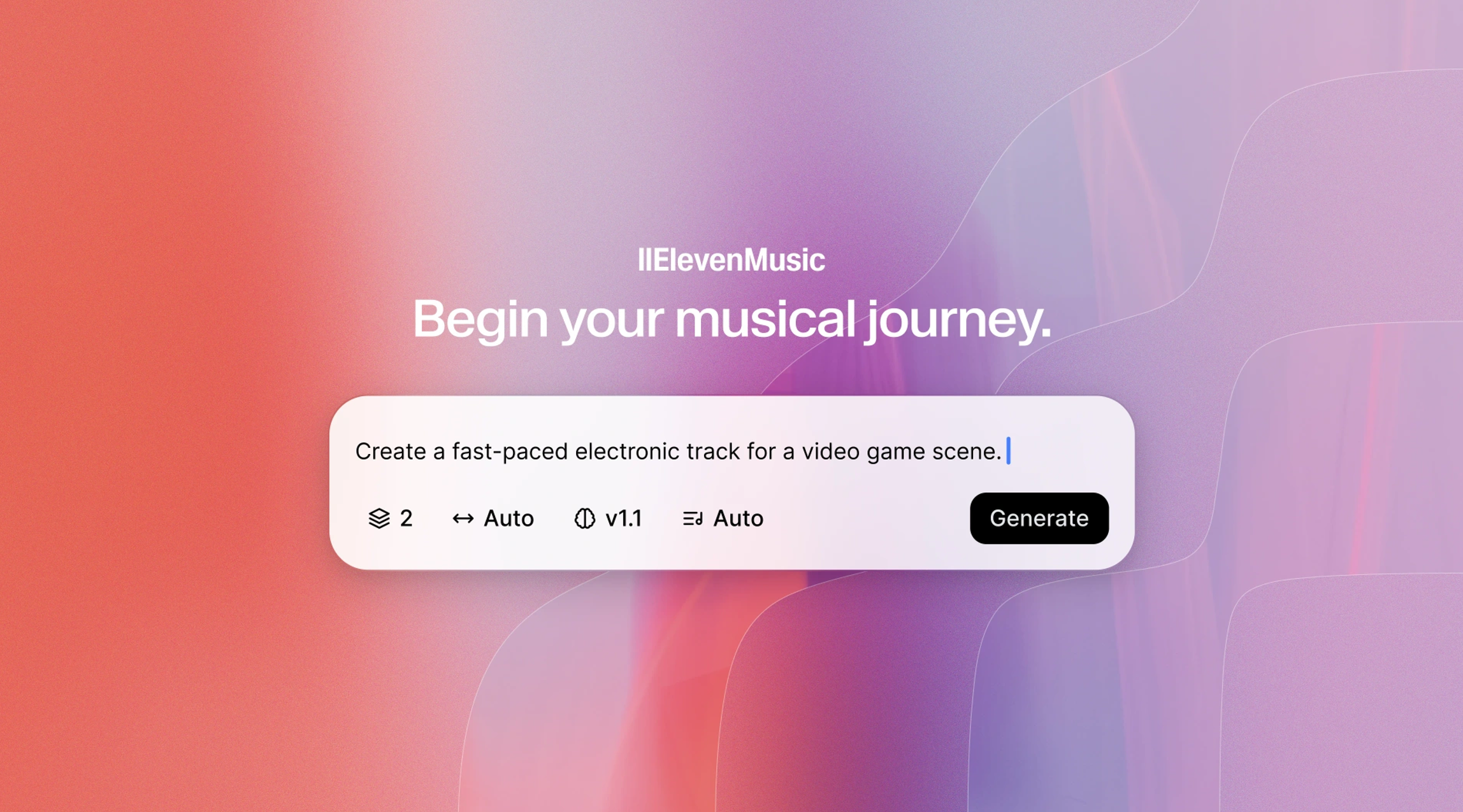
Eleven Music is ElevenLabs' text-to-music model, available through the iOS app and via API for paid subscribers. The company describes it as built to understand both natural language and musical terminology, allowing prompts that range from abstract emotional descriptions to precise technical specifications.
- Vocal and instrumental generation. Users can generate complete songs with AI vocals and lyrics, or purely instrumental tracks across any genre. The model handles English, Spanish, German, French, Japanese, and several additional languages.
- Style and structure control. Prompts can include genre, mood, tempo, instrumentation, production style, and structural elements. Section-by-section generation allows users to define the Intro, Verse, Chorus, Breakdown, and Outro separately, giving compositional control that goes beyond a single broad description.
- Style fine-tuning. The model can be fine-tuned on a user's own original, non-copyrighted audio to generate new tracks that consistently reflect a specific sonic identity. Enterprise customers can fine-tune on proprietary intellectual property they fully own. ElevenLabs also offers a library of curated Finetunes across global genres available immediately to eligible subscribers.
- Platform integration. Because ElevenLabs already offers voice cloning, text-to-speech, sound effects, and video tools under ElevenCreative, music generation plugs into an existing workflow. Podcast producers, video creators, and app developers can generate background music and voiceover in the same platform without switching tools.
- Community discovery. The app includes a discovery layer where users can browse and remix songs generated by others, similar in structure to how streaming platforms surface charts and mood playlists. Community members have generated over 14 million songs through ElevenLabs' music tools since the model first launched in August 2025.
Audio outputs at 44.1kHz MP3, positioned as studio-grade quality for professional downstream use.
The Copyright Story That Explains the Strategy
ElevenLabs launched its first music model in August 2025. By the time the consumer app arrived in April 2026, the competitive landscape had been reshaped by a legal conflict that started before ElevenLabs entered the space.
What Happened to Suno and Udio
In June 2024, the Recording Industry Association of America filed copyright infringement suits against both Suno and Udio on behalf of Universal Music Group, Warner Music Group, and Sony Music Entertainment. The complaints alleged that both companies copied copyrighted recordings without permission to train their models, generating output that reproduced the style and in some cases the specific characteristics of protected songs.
Suno argued its technology was transformative and protected under fair use. Udio made similar arguments. Both cases proceeded through 2024 and into 2025, creating ongoing legal uncertainty for commercial users of either platform.
By late 2025, both companies had reached settlement agreements with the major labels. Universal Music Group agreed to license its catalog to Udio. Warner Music Group reached a similar settlement with both Suno and Udio. Suno announced it would launch an entirely new model in 2026 built on "more advanced and licensed" training, with current models phased out. Sony's case against Udio was not part of the settlements and remained ongoing.
The settlements resolved the immediate legal threat but left commercial users with residual uncertainty about terms, indemnification, and whether outputs generated on prior models carry any liability. For brands, advertisers, and professional content creators, the risk calculus changed but did not disappear.
How ElevenLabs Positioned Itself
ElevenLabs entered the music space in August 2025 with a deliberately different approach. Rather than training on copyrighted recordings and negotiating with labels afterward, the company built its music model on licensed training data from the outset, securing deals with Merlin Network, the independent music organization, and Kobalt Music Group before launch.
The result is a model that is cleared for commercial use across film, television, podcasts, social media, advertising, and gaming from day one, without the copyright uncertainty that surrounded Suno and Udio during their litigation. ElevenLabs' own documentation states the model was "created in collaboration with labels, publishers, and artists."
The trade-off is audio quality. ElevenLabs' music generation is generally considered to lag behind Suno and Udio at their respective peaks, particularly on complex arrangements, nuanced rock, and orchestral work requiring dynamic range. It performs well on electronic, ambient, lo-fi, and background content. For professional audio producers or artists seeking high musical complexity, the qualitative gap is real. For commercial content creators, advertisers, and developers who need legally clean output at volume, the licensing clarity may outweigh it.
Where ElevenMusic Fits in the Market
The AI music generation space in 2026 has three meaningful players at scale, each with a distinct positioning.
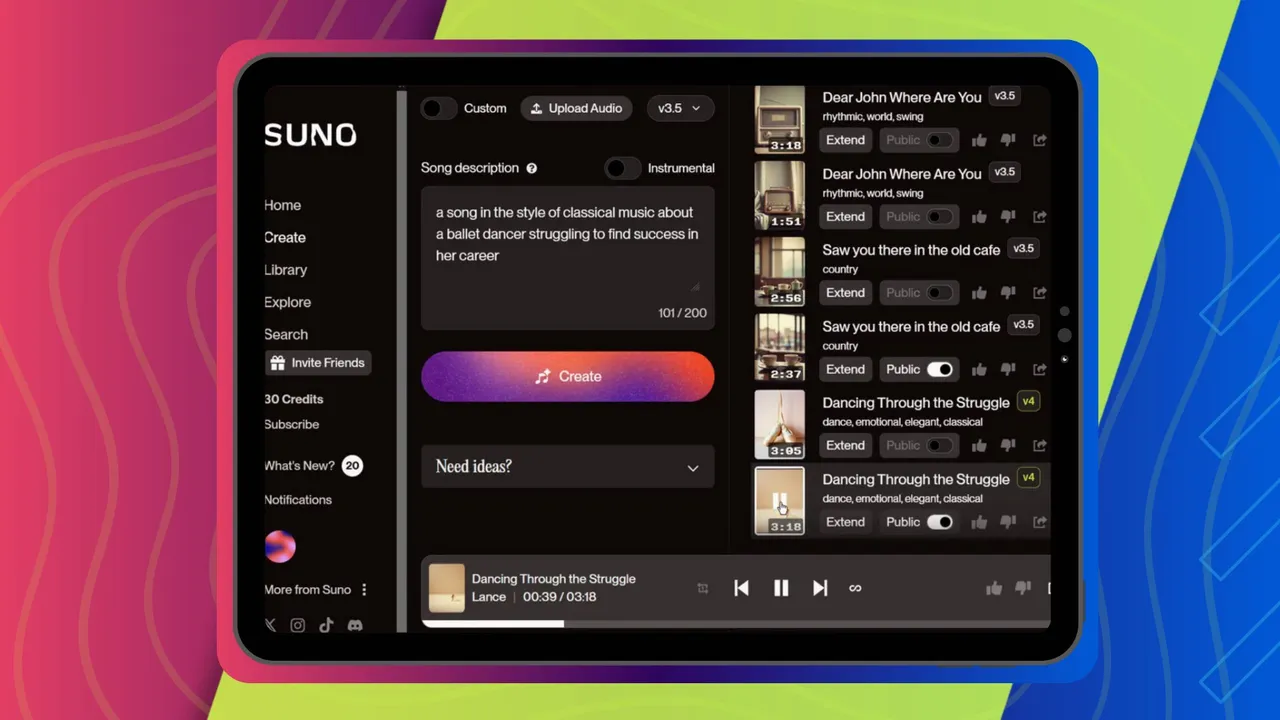
Suno has the largest user base and the most polished consumer product. Its V5 model, the most capable release to date, includes Suno Studio, a digital audio workstation layered on top of the generation engine. Suno settled with Warner Music Group and is in the process of transitioning to a fully licensed training dataset. The settlements address the prior model liability, but Suno's commercial terms still carry caveats that vary by use case.
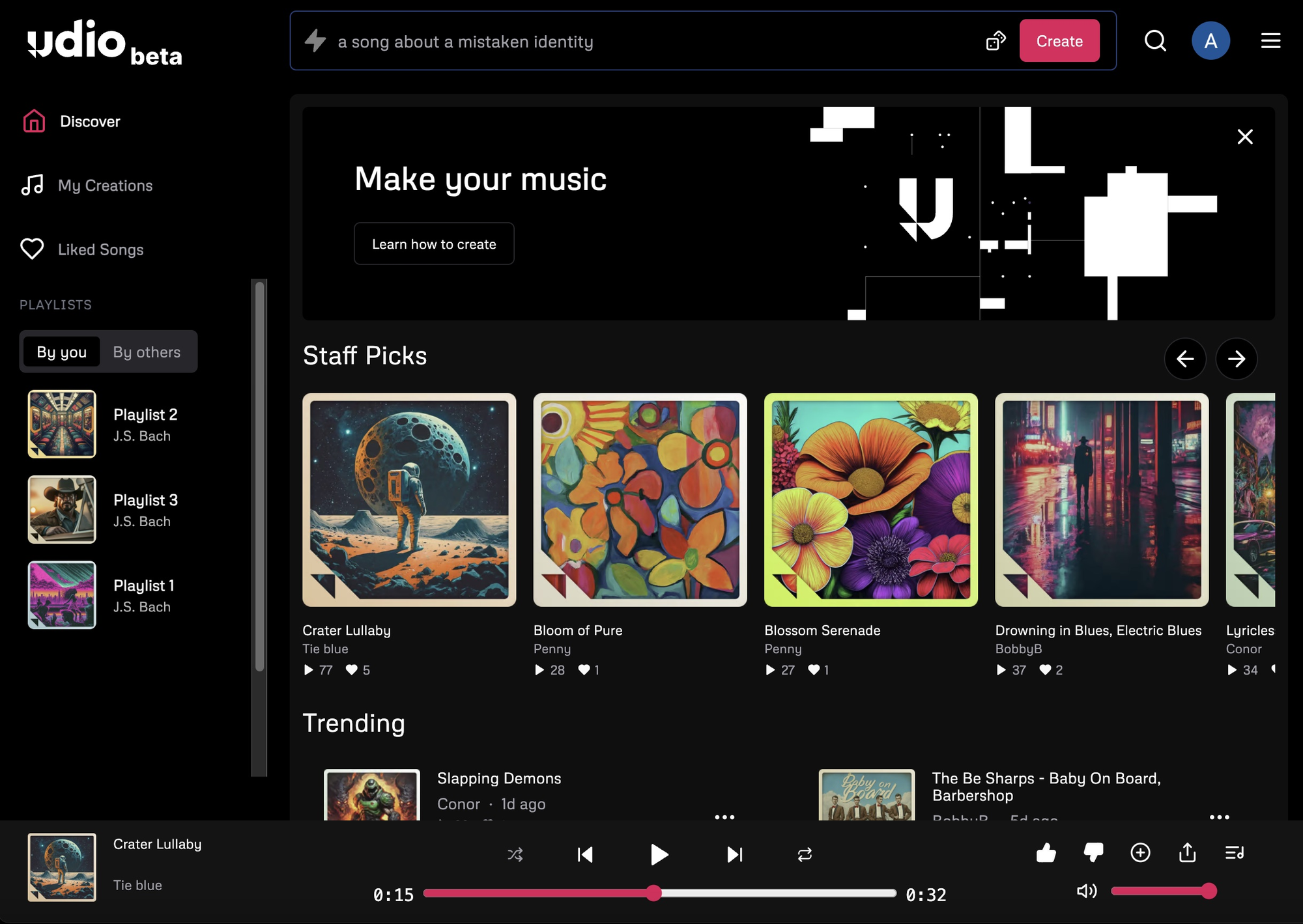
Udio is positioned as the audio quality choice. Its output is consistently rated highest for realism and sonic complexity, particularly on orchestral and jazz. It settled with Universal Music Group and launched a visual editing workstation alongside an artist style library. Sony's case remains open.
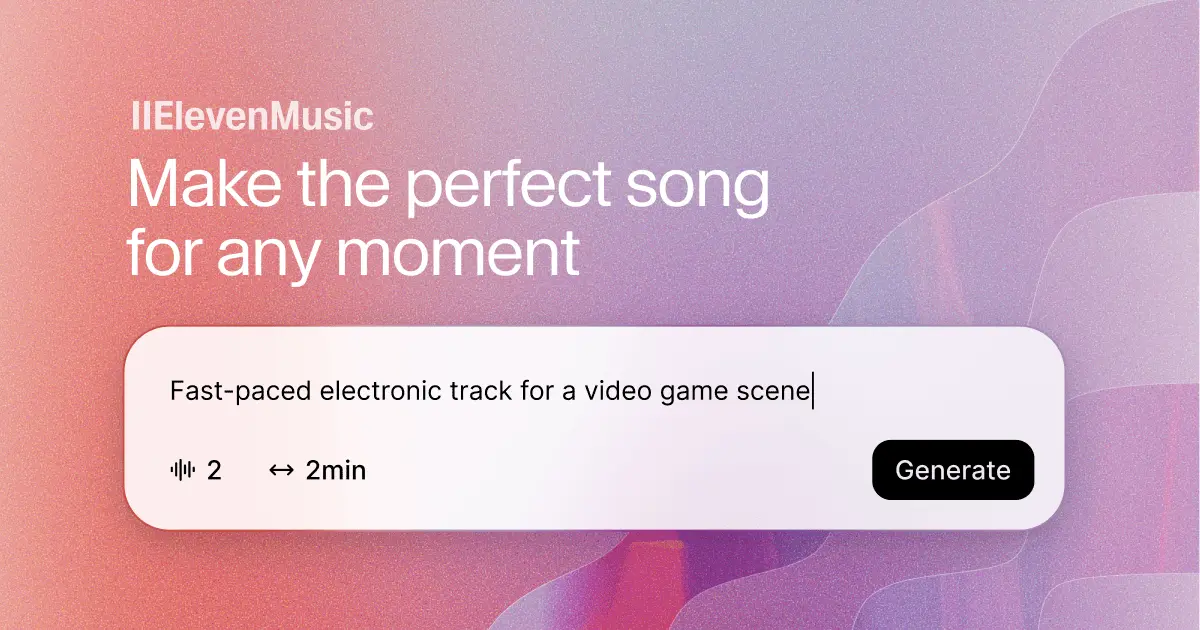
ElevenMusic is positioned as the commercially safe, workflow-integrated option. It is not trying to win on raw audio quality. It is trying to win on legal clarity, platform integration, and the specific advantage of voice AI capabilities that neither Suno nor Udio can match. A creator using ElevenLabs for a podcast voiceover, sound effects, and background music never needs to leave the platform.
The company raised $500 million in a Series C round in February 2026 at an $11 billion valuation, which substantially expands what it can invest in model development. The gap in audio quality between ElevenMusic and its competitors is a current state, not necessarily a permanent one.
What This Means for Creators and Businesses
The arrival of a third well-capitalized player with distinct positioning is genuinely good for the market. Competition across three platforms with different strengths accelerates improvement across all of them.
For individual creators and hobbyists, the free tier of ElevenMusic (seven songs per day, no credit card required) removes the barrier to experimentation. The remix and discovery features make it closer to a social platform than a pure creation tool, which gives casual users something to explore even without generating original content themselves.
For commercial content creators, video producers, and brand teams, the licensing story is the most important feature. Suno and Udio's settlements reduced but did not eliminate the uncertainty around commercial use of their output. ElevenMusic's commercially clean training data from the outset provides a cleaner indemnification position for brands that need it.
For developers and businesses building products on top of AI audio, ElevenLabs' API access and the upcoming integration into its Agents Platform extend the utility beyond the consumer app. A development team that already uses ElevenLabs for voice synthesis adds music generation without evaluating a separate vendor.
The practical limitation to note: the seven-song daily free tier and the 500-track Pro cap may constrain high-volume commercial users who need large batches. ElevenLabs has not disclosed enterprise pricing beyond the Pro tier publicly.
Conclusion
ElevenMusic is not the most capable text-to-music product available today. But it enters a market where capability is not the only variable that matters, and where ElevenLabs has deliberately positioned itself around the one dimension where it is unambiguously ahead: commercial legal safety.
The combination of licensed training data, voice AI integration, a discovery community that already has 14 million generated songs, and $500 million in fresh capital creates a competitive position that Suno and Udio will need to account for, regardless of where the audio quality comparison stands today.
For creators who have been reluctant to use AI music generation because of copyright uncertainty, ElevenMusic's architecture removes the main objection. Whether that unlocks adoption at scale or whether audio quality ultimately proves to be the deciding factor is what the next twelve months will begin to show.
Frequently Asked Questions
What is ElevenMusic and how does it work?
ElevenMusic is an iOS app and web platform from ElevenLabs that generates complete songs from text prompts. Users describe the genre, mood, style, tempo, and instrumentation they want, and the model produces a full track. Free accounts can generate up to seven songs per day. A Pro subscription at $9.99 per month or $95.90 per year unlocks 500 monthly tracks, additional styles, and expanded storage. The app also includes song discovery, mood-based playlists, and community remix features.
How does ElevenMusic compare to Suno and Udio?
Suno has the largest user base and the most polished consumer product, with its V5 model and Suno Studio DAW. Udio is generally considered the highest audio quality option, especially for complex arrangements. ElevenMusic lags behind both on raw audio quality but leads on commercial licensing clarity: its model was trained on licensed data from the start, while Suno and Udio settled major record label lawsuits by late 2025 and are still transitioning to fully licensed datasets.
Is ElevenMusic safe for commercial use?
ElevenLabs built its music model on licensed training data through deals with Merlin Network and Kobalt Music Group before launch, and the model is cleared for commercial use across film, television, podcasts, advertising, social media, and gaming. This is the key legal distinction from Suno and Udio, which trained on copyrighted recordings and reached settlements with major labels only after litigation.
Can ElevenMusic generate vocals?
Yes. ElevenMusic generates complete tracks with AI vocals and lyrics, or purely instrumental compositions. It supports English, Spanish, German, French, Japanese, and several other languages. The voice AI capabilities are a specific advantage given ElevenLabs' background in voice cloning technology.
What is the Music Finetune feature?
Music Finetune lets users upload their own original, non-copyrighted audio to fine-tune the ElevenLabs model toward a specific sonic identity. Any tracks generated using a custom Finetune reflect the tonal and stylistic characteristics of the uploaded material while remaining original compositions. Enterprise customers can fine-tune on proprietary intellectual property they fully own without third-party copyright screening.
What happened with the Suno and Udio copyright lawsuits?
In June 2024, the RIAA filed copyright infringement suits against Suno and Udio on behalf of Universal Music Group, Warner Music Group, and Sony Music Entertainment, alleging the companies trained their models on copyrighted recordings without permission. By late 2025, both Suno and Udio reached settlement agreements with UMG and WMG. Suno announced plans to transition to a fully licensed model. Sony's case against Udio remained ongoing as of April 2026.
Related Articles
 Dani
Dani Dani
Dani


