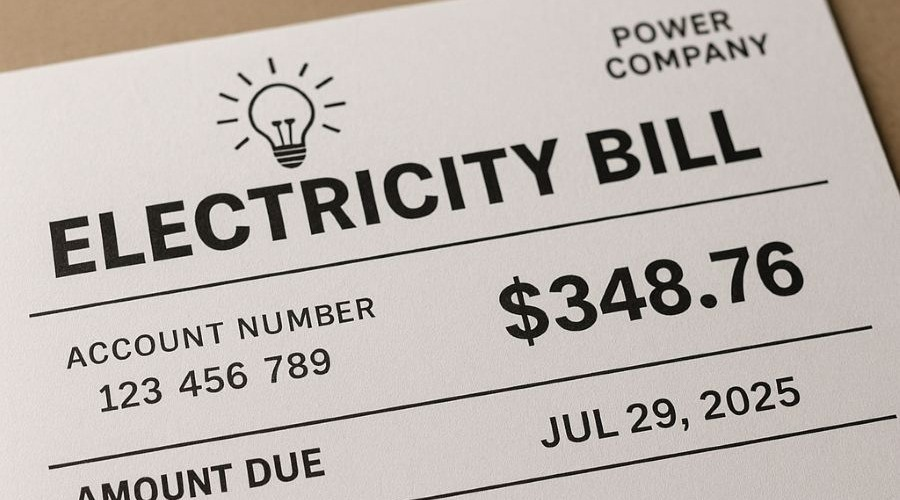
Something changed on your electricity bill after 2020, and it is not entirely inflation.
Electricity prices in the United States jumped 6.9% in 2025 year-over-year, more than double the headline inflation rate of 2.9%, according to a Goldman Sachs research note published in February 2026. Goldman analysts said prices will continue rising through the end of the decade, with data centers accounting for 40% of electricity demand growth over that period.
In areas near heavy concentrations of data centers, the numbers are more dramatic. Bloomberg's analysis found that wholesale electricity costs rose as much as 267% over the past five years in those regions. In Baltimore, residents saw average monthly bills jump by more than $17 after a power auction by PJM, the grid operator covering 13 states across the mid-Atlantic and Midwest, set a new record. Another auction is expected to push average bills up by an additional $4 starting in mid-2026.
The headline figure of a 36% rise in residential electricity prices since 2020 reflects the national average across all regions, not a worst-case scenario. Depending on where you live, especially in Virginia, Ohio, Illinois, and other data center-heavy states, the impact has been larger.
How Data Centers Became the Electricity Story
The US electricity grid spent roughly 20 years with no meaningful growth in overall demand. Utility companies planned around that stability. Then AI changed the calculus entirely.
A January 2026 report by Bloom Energy projected that total US data center energy demand will nearly double between 2025 and 2028, jumping from 80 to 150 gigawatts. For context, 70 gigawatts of added demand is roughly equivalent to adding a country the size of Spain to the US grid in three years.
The International Energy Agency projects that worldwide electricity demand from AI data centers will more than quadruple by 2030. By 2028, data centers could use 12% of all electricity consumed in the US, according to Lawrence Berkeley National Laboratory. The US economy is on track to consume more electricity in 2030 for processing data than for manufacturing all energy-intensive goods combined, including aluminum, steel, cement, and chemicals.
A single hyperscale data center might use 100 megawatts of electricity, according to the IEA, enough to power 100,000 households. Meta's Hyperion project in Louisiana is expected to require at least 5 gigawatts, three times the electricity consumption of the entire city of New Orleans.
How the Demand Increase Hits Your Bill
When grid operators need more electricity capacity, they hold auctions to secure future power supply. The results of those auctions are passed directly to consumers as higher monthly rates. This is the mechanism behind the Baltimore price jumps: PJM's Base Residual Auction records drove up costs that utilities then recovered from ratepayers.
The connection between data center concentration and residential price increases is geographically measurable. Bloomberg's analysis found that more than 70% of the nodes that recorded the largest wholesale price increases since 2020 are located within 50 miles of significant data center activity.
Virginia illustrates the concentration problem most visibly. Data centers in Northern Virginia's "Data Center Alley" accounted for almost 40% of the state's total electricity consumption in 2024, according to Bloomberg. Nearly three-quarters of Virginia voters blame the facilities for rising electricity costs, per a January 2026 survey by Global Strategy Group and the Chesapeake Climate Action Network Action Fund.
The Political Flashpoint
The electricity bill problem became an election issue in 2025.
Democrats Mikie Sherrill and Abigail Spanberger won elections for governor of New Jersey and Virginia, respectively, in part by campaigning on bringing utility bills under control. Sherrill and Spanberger ran in two of the states most directly affected by PJM's data center-driven capacity costs.
Senator Elizabeth Warren opened a Senate investigation in December 2025 into whether AI data centers are driving up Americans' electricity bills, sending letters to Google, Microsoft, Amazon, Meta, CoreWeave, Digital Realty, and Equinix. "Tech companies have paid lip service in support of covering their data centers' energy costs, but their actions have shown the opposite," the senators wrote. "On top of failing to pay their fair share of their electricity rates, tech companies regularly hide as much information as possible from the communities in which their data centers will be built."
Community opposition materialized in dollar terms as well. Research firm Data Center Watch found that between March and June 2025, local opposition led to $98 billion in data center projects being blocked or delayed. A Heatmap Pro review of public records from January 2026 found that at least 25 projects were canceled last year in direct response to local objections.
President Trump acknowledged the political problem in plain terms. "They need some PR help," he said of the data center industry, "because people think that if a data center goes in there, electricity prices are going to go up."
The Ratepayer Protection Pledge
On March 4, 2026, seven major technology companies gathered at the White House with President Trump to sign the Ratepayer Protection Pledge. Amazon, Google, Meta, Microsoft, OpenAI, Oracle, and xAI all signed on.
The pledge commits signatories to five things:
- Build, bring, or buy all new power generation needed for their data centers, covering the full cost of those resources regardless of whether they ultimately use all the electricity they contracted for.
- Negotiate separate rate structures with utilities and state governments wherever they build data centers, paying industrial rates rather than drawing from the residential rate pool.
- Cover infrastructure costs for grid upgrades required by their data center deployments, ensuring those upgrade costs are not passed to residential ratepayers.
- Invest in local communities, including local hiring and workforce development programs in areas where data centers are built.
- Contribute to grid resilience, making backup power generation available to local grids during emergencies.
Trump said the pledge would lower electricity prices "very substantially" and insisted it would prevent future price increases: "It's going to have a tremendous impact on electricity costs; we're bringing down all of the costs."
What the Pledge Covers and What It Doesn't
| Commitment | What It Means in Practice | Enforcement |
|---|---|---|
| Build, bring, or buy power | Companies must source their own generation, not draw from residential grid allocation | Voluntary; depends on utility contracts |
| Separate rate structures | Data centers pay industrial rates, not residential equivalent | Requires state utility regulator approval |
| Pay for grid upgrades | Infrastructure costs tied to data center demand don't land on households | Contractual with utilities; no federal mandate |
| Local hiring and investment | Jobs and tax revenue in host communities | Self-reported; no external audit mechanism |
| Emergency backup power | Data center generation shared with local grid in crises | Contractual and situational |
Why Experts Are Skeptical
The pledge is voluntary, not legally enforceable at the federal level. Trump's own administration acknowledged this at the signing event.
"The White House has the bully pulpit but no legal authority to impose new rate structures that ensure data centers pay their full costs of service," said Ari Peskoe, director of the Harvard Law School's electricity law initiative. "The burden should be on utilities and utility regulators to address these issues."
Administration officials at the signing confirmed that enforcement would have to come from states and state utility regulators, the bodies that actually approve electric rate increases. Several states are moving to require data centers to pay more of their infrastructure costs upfront, but there is no federal regulation requiring them to do so.
Joseph Bowring, the independent market monitor for PJM, added that even if the pledge were fully executed by all signatories, its effect on electricity prices in the short term would be limited, because the grid infrastructure buildout already in progress is already priced into future utility rates.
Goldman Sachs analysts, whose February 2026 note preceded the pledge by less than a month, projected that electricity prices would continue rising through the end of the decade regardless of tech company commitments, as data centers make up an increasing share of demand growth that supply-side investments will take years to balance.
The Counterargument: Not All of This Is Data Centers
Not everyone accepts the premise that data centers are primarily responsible for rising electricity prices.
A 2025 analysis by SemiAnalysis argued that market design and policy decisions, particularly the structure of PJM's capacity auctions, play a larger role in electricity price increases than data center demand growth alone. The report noted that the Base Residual Auction mechanism was responsible for much of what it called "runaway" prices in the PJM region, independent of how fast data center demand was growing.
Maeghan Rouch of Bain & Company told CNBC that in many markets, unrelated investments in grid hardening and modernization, combined with overall inflation, also push consumer rates higher. "Even in the absence of data center investment, we'd still expect some degree of upward pressure on price growth," she said.
Some research suggests data centers could lower bills in some regions. A California PG&E projection estimated that incremental data center growth in that state could reduce average household bills by up to 2% by spreading fixed grid costs over more kilowatt-hours. Data centers draw power continuously and predictably, unlike air conditioning loads that spike on hot days. Utilities can plan around stable industrial demand in ways they cannot plan around residential usage spikes.
The honest answer is that the electricity price increase is real, the data center contribution is real, and the size of that contribution varies considerably by region and by how grid costs are allocated. In PJM, the concentration of data center demand in a capacity-constrained market has been a significant driver. In other regions, the effect has been smaller or potentially positive.
What's Actually Coming for Bills
Goldman Sachs projects that electricity prices will continue rising through the end of the decade. The EIA's March 2025 forecast, issued before the current Iran War, predicted retail electricity prices would outpace inflation through 2026.
Bloom Energy's 2026 projection shows US data center demand growing from 80 to 150 gigawatts between 2025 and 2028. Lawrence Berkeley National Laboratory estimated that by 2028, data centers could consume 12% of all US electricity, and that percentage will continue growing. In the most heavily burdened regions, household electricity bills could increase by up to 25% by 2030 as grid infrastructure costs are passed through, according to TTMS research drawing on multiple energy analyses.
The Ratepayer Protection Pledge is the most visible policy response so far. Whether it translates into actual ratepayer protection depends on how states and utility regulators implement separate rate structures for data centers, whether the Federal Energy Regulatory Commission establishes binding rules through its current review process, and whether companies honor commitments made voluntarily without federal enforcement mechanisms.
Wrap up
AI is driving measurable increases in US electricity prices. The connection between data center density and residential rate increases is geographically documented. The political backlash is real enough that it affected governor's races in two states and prompted a White House signing ceremony with seven of the world's largest technology companies.
The Ratepayer Protection Pledge is a public commitment. Whether it functions as a substantive protection or a political gesture depends on what utilities and state regulators do with it. The electricity bill impact is already in the system. The question now is how much of the next decade's data center buildout lands on households, and how much the companies building that infrastructure will be made to pay for it themselves.
Frequently Asked Questions
Has AI actually raised electricity bills?
Yes, measurably, though the size of the impact depends on where you live. Goldman Sachs found that electricity prices rose 6.9% in 2025, more than double the headline inflation rate. Bloomberg's analysis found wholesale electricity costs rose up to 267% since 2020 in areas near major data center concentrations. In PJM-region states like Virginia, Ohio, and Maryland, residential bills have seen above-average increases. In regions without high data center density, the impact has been smaller.
What is the Ratepayer Protection Pledge?
It is a voluntary agreement signed at the White House on March 4, 2026, by Amazon, Google, Meta, Microsoft, OpenAI, Oracle, and xAI. Under the pledge, these companies commit to building, buying, or bringing their own electricity supply for data centers rather than drawing from the residential grid allocation, covering the cost of grid upgrades required by their demand, and negotiating separate industrial rate structures with utilities. The pledge is not legally enforceable at the federal level, and enforcement depends on state utility regulators.
Why isn't the pledge legally binding?
The US electricity system is regulated at the state level, not federally. The White House can call on companies to make commitments, but it cannot impose new rate structures on utilities or require specific contracts. Actual enforcement would require state utility commissions to approve separate data center rate structures and the Federal Energy Regulatory Commission to establish binding rules, which is currently under review.
Which states have been hit hardest by data center electricity costs?
Virginia, Ohio, Illinois, and Maryland have seen the largest residential electricity price increases, partly driven by data center demand in the PJM grid region. Virginia alone had nearly 600 data center facilities as of early 2026, with more than 100 additional facilities proposed or under construction. Data centers accounted for almost 40% of Virginia's total electricity consumption in 2024.
Will electricity prices go down after the pledge?
Goldman Sachs projected in February 2026 that electricity prices will continue rising through the end of the decade regardless, as data center demand growth continues outpacing new power supply additions. The pledge may slow the rate of increase over time if companies follow through on building their own generation capacity, but the grid infrastructure already being built to meet projected demand is already priced into future utility rates.
How much electricity do AI data centers actually use?
The IEA says a typical hyperscale data center uses around 100 megawatts, equivalent to the electricity needs of 100,000 homes. By 2028, all US data centers combined are projected to use 150 gigawatts, roughly 12% of total US electricity consumption. Meta's Hyperion project in Louisiana alone is expected to require 5 gigawatts, three times the electricity used by the entire city of New Orleans.
Related Articles
 Dani
Dani
 Mark
Mark
 Mark
Mark